
India’s manufacturing sector, contributing ~17% of GDP and employing over 27.3 million workers, stands central to India’s ambition of becoming a $5 trillion economy and global supply chain hub. Anchored by the Make in India initiative and Production-Linked Incentive (PLI) schemes, India targets raising manufacturing’s GDP share to 25% by 2025. With ₹1.76 lakh crore investments materialized and 12+ lakh jobs created, the transformation spans electronics, automotive, textiles, and defense production.
Key Highlights
- PLI scheme success: ₹1.97 lakh crore outlay across 14 sectors attracted ₹1.76 lakh crore investments, generated ₹16.5 lakh crore production, and created 12+ lakh jobs by March 2025
- Electronics boom: India became world’s 2nd largest mobile producer with 99.2% local manufacturing (up from 26% in 2014-15), 300+ factories, and 77-fold export surge to ₹1.29 lakh crore
- Automotive evolution: As 3rd largest auto market, FAME-II scheme supported 16+ lakh EVs with ₹11,500 crore outlay, while PM E-DRIVE continues with ₹10,900 crore for green mobility acceleration
- Supply chain integration: Logistics ranking improved to 38th globally; China+1 strategy leverages FTAs with UAE, Australia and G20 leadership for global manufacturing shift
- Technology adoption: Industry 4.0, AI, IoT adoption rises but R&D spending remains low at 0.7% GDP; startups drive innovation in supply chain analytics and smart warehousing
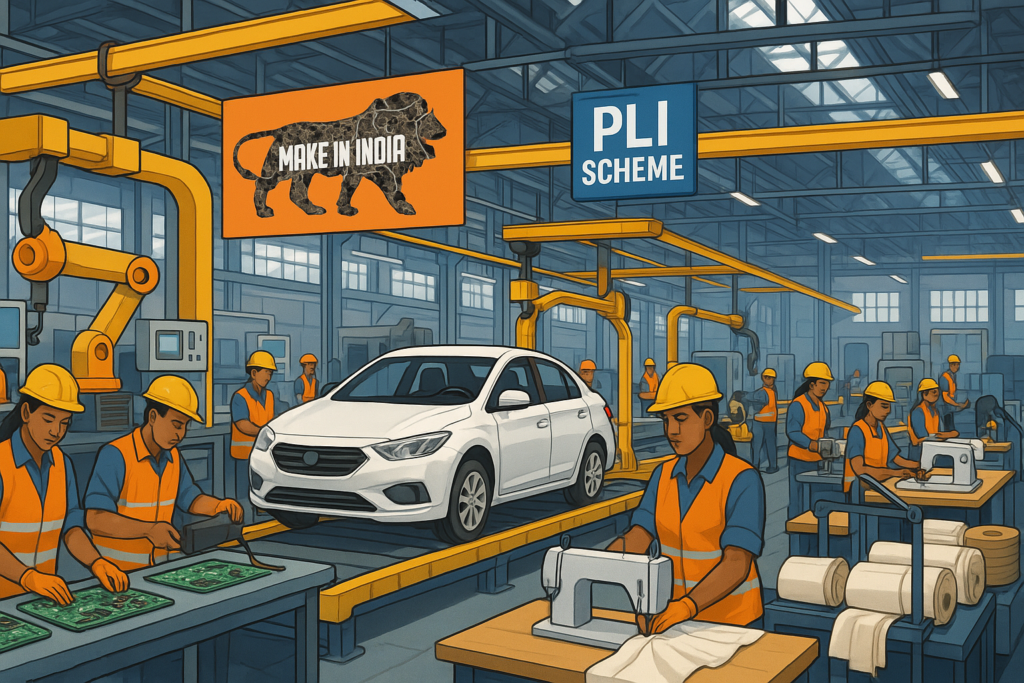
Manufacturing Sector Overview: Foundation of Economic Transformation
Current Scale and Employment Impact
India’s manufacturing sector represents a crucial pillar of economic growth, directly employing 27.3 million workers while creating extensive backward and forward linkages across the economy. The sector’s 17% GDP contribution underscores both its current significance and growth potential toward the target 25% share by 2025. emrald
Employment distribution spans:
- Direct manufacturing jobs: 27.3 million workers
- MSME employment: Significant portion in textiles, chemicals, food processing
- Women workforce participation: Enhanced through textile and garment manufacturing
- Urban-rural linkages: Manufacturing creates demand for agricultural inputs and absorbs surplus farm labor
GDP Contribution and Economic Significance
Despite consistent efforts, manufacturing’s GDP share has remained relatively stable at 16-17%, highlighting the challenge of structural transformation from a services-dominated economy. The PLI scheme’s mixed results—achieving only 37% of expected production targets—demonstrate both progress and challenges in scaling manufacturing.
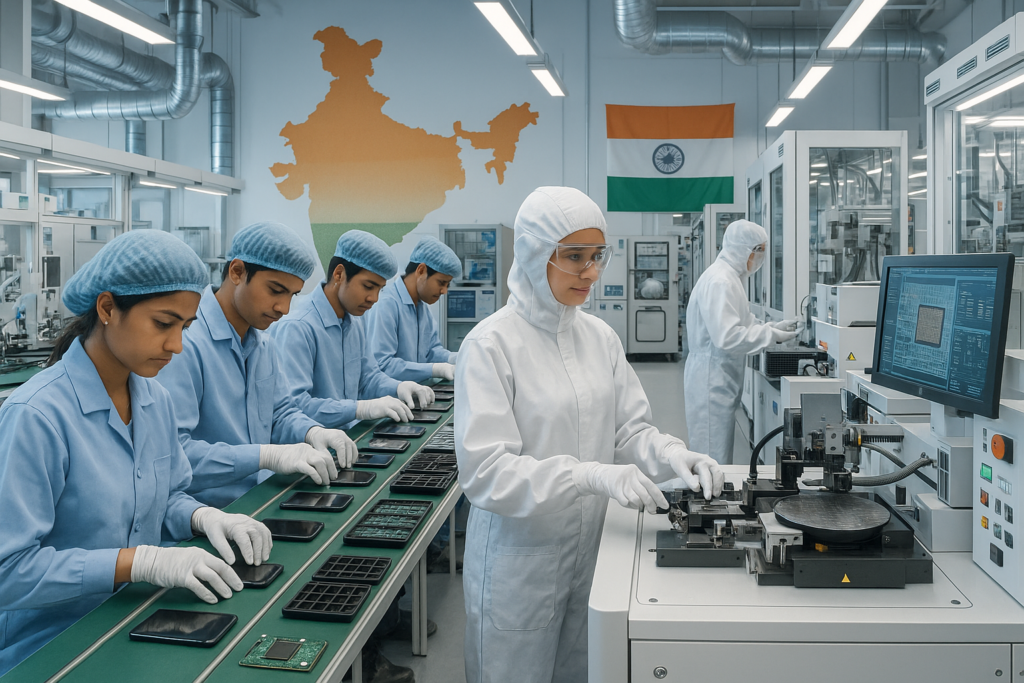
Sectoral Highlights: Leading the Transformation
Electronics and Semiconductors: Digital Manufacturing Hub
India’s electronics manufacturing has achieved remarkable transformation, emerging as the world’s 2nd largest mobile phone producer. Key achievements include: ddnews
Mobile Manufacturing Revolution:
- Manufacturing units: Grew from 2 in 2014 to 300+ in 2024
- Local production: Rose from 26% in 2014-15 to 99.2% in December 2024
- Manufacturing value: Surged from ₹18,900 crore (FY14) to ₹4.22 lakh crore (FY24)
- Export growth: 77-fold increase from ₹1,566 crore (FY15) to ₹1.29 lakh crore (FY24) pib
Semiconductor Ecosystem Development:
- ₹1.52 lakh crore investment in five semiconductor projects
- India Semiconductor Mission establishing fabrication capabilities
- HCL-Foxconn joint venture for display driver chips near Jewar Airport
- Renesas OSAT facility in Gujarat for chip assembly and testing
Automotive and Electric Vehicles: Green Mobility Acceleration
India’s position as the 3rd largest automobile market provides a strong foundation for EV transformation.
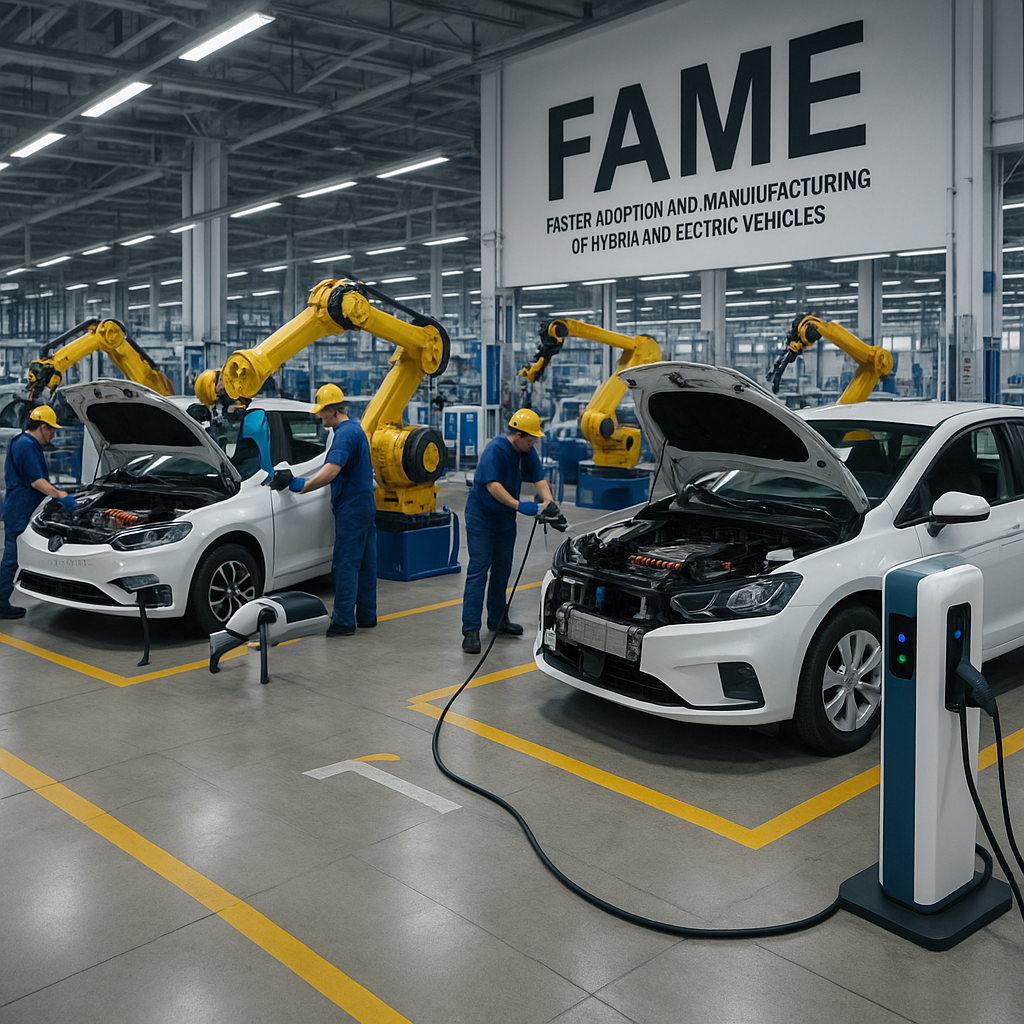
The FAME scheme has been instrumental in accelerating green mobility adoption.
FAME-II Achievements (2019-2024):
- Total budget: ₹11,500 crore over five years
- EVs supported: 16.14 lakh vehicles across all segments
- Segment breakdown: 14.28 lakh 2-wheelers, 1.64 lakh 3-wheelers, 22,548 4-wheelers
- Charging infrastructure: Support for EV public charging stations
PM E-DRIVE Scheme (2024 onwards):
- Budget allocation: ₹10,900 crore for continued EV promotion
- Focus areas: Demand incentives, charging infrastructure, manufacturing support
- Technology emphasis: Advanced battery technologies and green mobility solutions
Textiles and Traditional Strengths: High-Value Export Potential
Textiles sector remains a cornerstone of Indian manufacturing, providing significant employment and export earnings. PLI scheme support of ₹106.83 crore for MMF segment and technical textiles aims to enhance competitiveness and move up the value chain.
Sector characteristics:
- Labor-intensive manufacturing providing rural employment
- Women workforce participation: High representation in garment manufacturing
- Export potential: Traditional strength with opportunities for high-value products
- Technology upgrade: Focus on technical textiles and sustainable production
Global Supply Chain Integration: China+1 Strategy
Leveraging Geopolitical Realignment
India strategically positions itself as a key beneficiary of the China+1 strategy, where global companies seek to diversify manufacturing beyond Chinese dependencies. This realignment creates unprecedented opportunities for Indian manufacturing.
Strategic advantages:
- Demographic dividend: World’s youngest workforce with median age 28 years
- Cost competitiveness: Lower labor costs compared to developed economies
- English proficiency: Communication advantage for global operations
- Democratic stability: Predictable policy environment for long-term investments
FTA Partnerships and Trade Integration
Free Trade Agreements with UAE and Australia provide preferential market access, while ongoing negotiations with UK and EU promise expanded opportunities. G20 leadership enhances India’s global profile as a reliable manufacturing partner.
Logistics Infrastructure Development:
- World Bank ranking: Improved to 38th position in logistics performance
- National Logistics Policy: Integrated multimodal infrastructure development
- Dedicated freight corridors: Enhanced connectivity for manufacturing clusters
- Port modernization: Improved efficiency for export-import operations
Technology and Innovation: Industry 4.0 Adoption
Digital Manufacturing Transformation
Industry 4.0 technologies including AI, IoT, robotics, and digital twins are gradually penetrating Indian manufacturing, though adoption remains uneven across sectors and company sizes.
Technology adoption challenges:
- Capital constraints: High upfront costs for SMEs
- Skill gaps: Limited technical workforce for advanced technologies
- Infrastructure limitations: Inconsistent connectivity in industrial areas
- Awareness deficits: Limited understanding of digital transformation benefits
Innovation Ecosystem and Startups
Startups play crucial roles in manufacturing innovation, particularly in supply chain analytics, drone technologies, and smart warehousing solutions. However, R&D spending remains low at 0.7% of GDP, constraining long-term innovation capacity.
Innovation priorities:
- Process optimization: Lean manufacturing and Six Sigma implementations
- Sustainability integration: Green manufacturing practices
- Quality enhancement: Digital quality control systems
- Supply chain visibility: Real-time tracking and analytics
Sustainability and Green Manufacturing
ESG Compliance and Net-Zero Goals
Environmental, Social, and Governance (ESG) compliance becomes increasingly critical for global competitiveness, with net-zero 2070 goals driving renewable-powered factories and circular economy adoption.
Green manufacturing initiatives:
- Renewable energy adoption: Solar and wind power for manufacturing operations
- Energy efficiency systems: Advanced motor controls and waste heat recovery
- Circular economy practices: Material recycling and waste minimization
- Water conservation: Closed-loop systems and wastewater treatment
Sustainability Performance Improvements
Research findings demonstrate significant improvements through integrated sustainability approaches. A foundry case study showed 68.03% economic index improvement, 61.62% social index improvement, and 13.24% environmental index improvement after implementing integrated lean, green, and Six Sigma strategies.
Policy Landscape: Comprehensive Support Framework
PLI Scheme Implementation and Results
The PLI scheme’s ₹1.97 lakh crore outlay across 14 sectors represents India’s most ambitious manufacturing initiative. Performance metrics demonstrate substantial progress despite challenges:
Investment and Production Results:
- Committed investments: ₹1.76 lakh crore (March 2025)
- Production value: ₹16.5 lakh crore achieved
- Applications approved: 806 across all sectors
- Employment generation: 12+ lakh direct and indirect jobs
Sectoral Performance Variation:
- Mobile manufacturing: Strong performance with major global players participating
- Pharmaceuticals: Steady progress in API and drug intermediate production
- Automotive components: Growing participation from domestic and international firms
- Advanced chemistry cells: Slower uptake due to technology complexities
National Manufacturing Policy Integration
Multiple policy initiatives create a comprehensive ecosystem for manufacturing growth:
Digital India: ICT infrastructure and digital adoption support
Skill India: Workforce development for manufacturing skills
Startup India: Innovation ecosystem development
Make in India: Overall manufacturing promotion and ease of doing business
Challenges and Constraints
Structural and Operational Challenges
Despite significant progress, fundamental challenges continue to constrain manufacturing growth:
High Logistics Costs: 13-14% of GDP compared to 8-10% in developed economies
Complex Regulations: Land and labor laws creating compliance burdens
Skill Mismatches: Gap between industry requirements and available workforce
Slow IP Creation: Limited intellectual property development constraining innovation
Import Dependencies and Vulnerabilities
Critical technology imports remain a significant vulnerability:
- Semiconductors: Heavy dependence on Asian suppliers
- Rare earth materials: Limited domestic sources
- Advanced machinery: Import-dependent for high-precision equipment
- Raw materials: Reliance on global supply chains for critical inputs
Social and Employment Impact
Urban-Rural Linkage Creation
Manufacturing growth creates vital connections between urban industrial centers and rural agricultural areas, facilitating economic diversification and income growth. MSME clusters particularly benefit rural areas through local employment generation.
Women Workforce Participation Enhancement
Textiles and garment manufacturing provide significant opportunities for women’s economic participation, contributing to gender equality and household income improvement. PLI scheme expansion to labor-intensive sectors could further enhance these opportunities.
Future Outlook and Strategic Priorities
Achieving the 25% GDP Target
Reaching the 25% manufacturing GDP share by 2025 requires accelerated implementation of existing schemes and addressing structural constraints. Current trajectory suggests the target remains challenging but achievable with sustained policy focus.
Strategic priorities include:
- Expanding PLI coverage to labor-intensive sectors
- Improving logistics infrastructure and reducing costs
- Enhancing skill development programs
- Strengthening innovation ecosystems
- Promoting sustainability adoption
Global Competitiveness Enhancement
India’s manufacturing competitiveness depends on continuous improvements in productivity, quality, and innovation. Integration with global value chains while building domestic capabilities remains a delicate balance requiring strategic policy coordination.
Conclusion
India’s manufacturing sector stands at a transformational juncture, with PLI schemes and Make in India creating unprecedented momentum for industrial growth. The achievement of becoming the world’s 2nd largest mobile producer and significant progress in electronics manufacturing demonstrate policy effectiveness and industry capability.
However, challenges including high logistics costs, skill gaps, and import dependencies require sustained attention and innovative solutions. The mixed results of PLI implementation—strong performance in some sectors while missing targets in others—highlight the complexity of industrial transformation.
Success in achieving the $5 trillion economy goal and 25% manufacturing GDP share depends on continued policy support, infrastructure development, skill enhancement, and technology adoption. The foundation has been established; execution excellence will determine ultimate success.
India’s manufacturing renaissance represents not just economic transformation but social upliftment through employment generation, rural-urban integration, and women’s empowerment. Global supply chain integration through the China+1 strategy provides historic opportunities that India is well-positioned to capitalize upon.
The journey toward manufacturing excellence requires balancing growth with sustainability, global integration with domestic resilience, and technology adoption with human development. India’s manufacturing future appears bright, provided strategic focus and implementation discipline are maintained.



+ There are no comments
Add yours