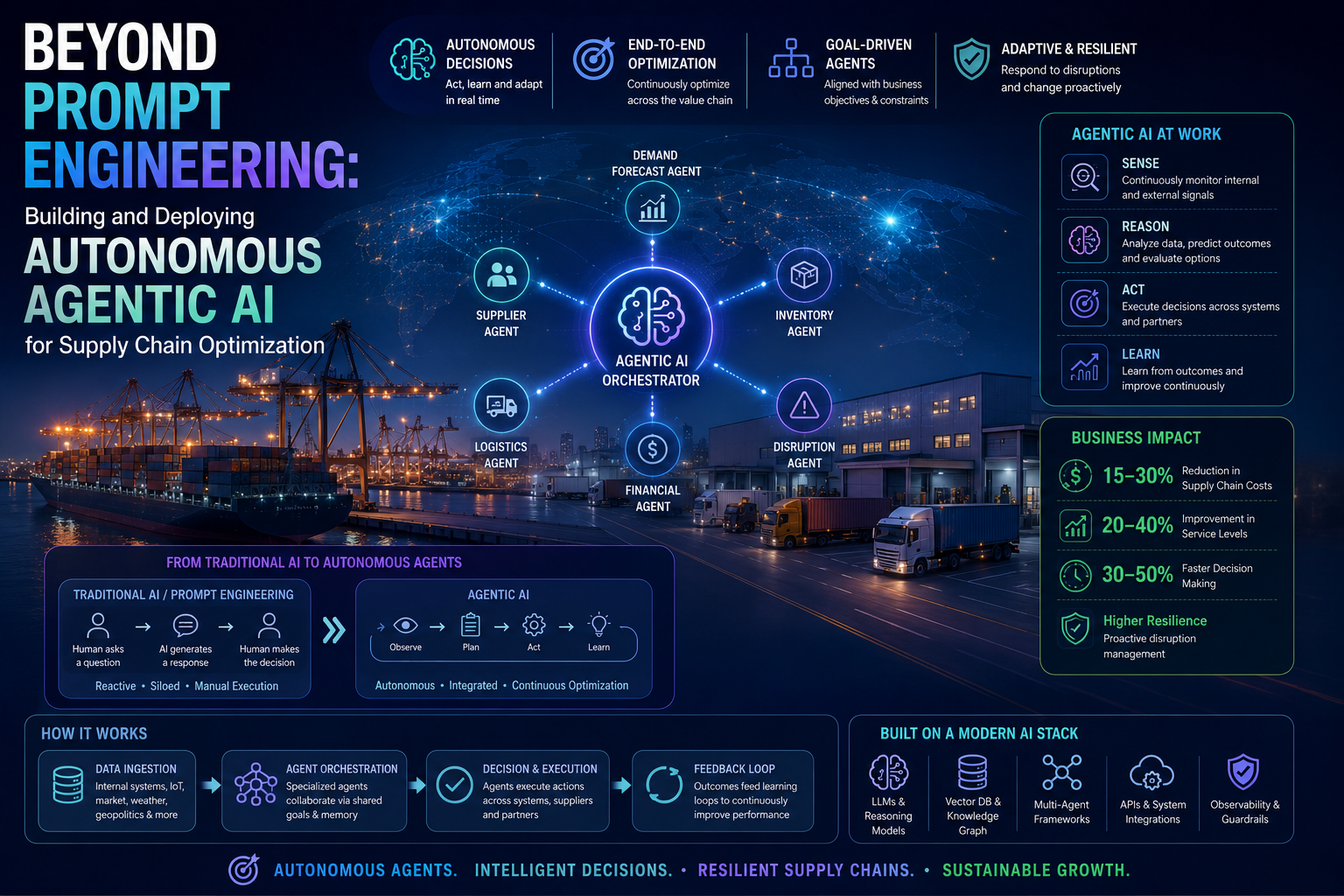
For the past several years, enterprise AI implementation has been dominated by static, large language model (LLM) interfaces. Teams used prompt engineering to generate insights, draft emails, or analyze spreadsheets. While valuable, these implementations shared a fundamental limitation: they were entirely passive. They generated recommendations but required a human planner to manually log into an ERP, TMS, or warehouse management system to execute the actual work.
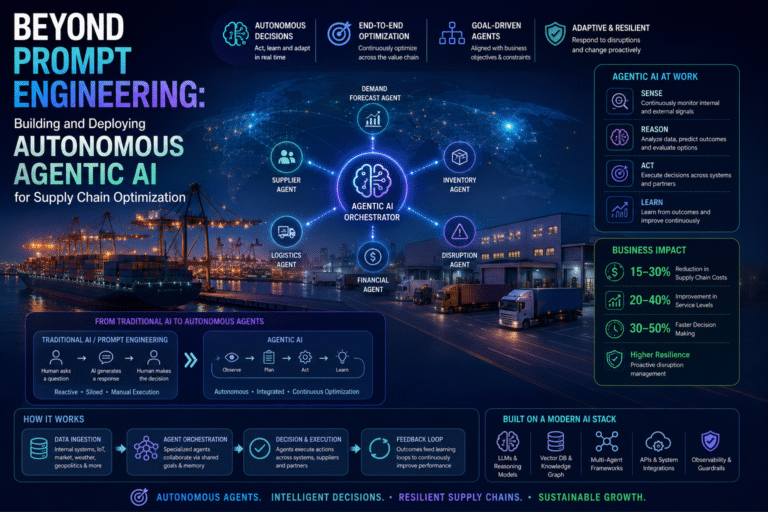
The enterprise ecosystem has officially shifted from passive visibility to Agentic AI and Collaborative Multiagent Systems (MAS). Instead of merely highlighting anomalies, modern AI architectures rely on autonomous software entities that perceive real-time data, reason through operational trade-offs, and execute continuous multi-step workflows across systems without needing human approval at every junction.
This technical deep dive outlines the architecture required to build a multi-agent orchestration framework for autonomous supply chain management.
1. Architectural Foundation: The Multi-Agent Blueprint
A single monolithic AI agent struggles under the massive data complexity of an end-to-end supply chain. The optimal approach relies on Domain Specialization—deploying a coordinated network of specialized, task-specific agents that operate like an agile digital workforce.
                          [ CENTRAL ORCHESTRATOR AGENT ]
                                 │              │
         ┌───────────────────────┘              └───────────────────────┐
         ▼                                                              ▼
[ SENSING AGENT ]                                              [ EXECUTION AGENT ]
Monitors: IoT, Port Delays, ERP                                Connects to: TMS, WMS, APIs
         │                                                              ▲
         └─────────────► [ PROCUREMENT/LOGISTICS AGENT ] ───────────────┘
                         Reasons trade-offs & re-routes
- The Orchestrator Layer: Actively manages task distribution, context sharing, and conflict resolution across the network. It ensures that the actions of individual agents match high-level corporate objectives (e.g., keeping unit freight costs within budget).
- The Sensing Layer: Continuously scans real-time streams—such as live carrier feeds, customs delays, warehouse dwell times, and IoT environmental sensors—to detect structural exceptions immediately.
- The Execution Layer: Interacts directly with core business software through secure API integrations, dynamically modifying database entries across the ERP, warehouse, and shipping layers.
2. Engineering an Autonomous Disruption Resolution Loop
To see this architectural shift in action, let’s evaluate how a multi-agent framework resolves a classic supply chain failure: a critical overseas component shipment falling three days behind schedule due to port congestion.
Step 1: Exception Detection (Sensing Agent)
The specialized Logistics Sensing Agent detects an anomaly: a container ship’s updated ETA conflicts with a production milestone logged in the ERP. Instead of generating a generic email alert, it extracts the exact SKU list, computes the production shortfall window, and sends a structured data frame to the Central Orchestrator.
Step 2: Alternative Evaluation (Procurement & Inventory Agents)
The Orchestrator activates the Procurement Agent and the Inventory Agent to work in parallel:
- The Inventory Agent checks across regional safety stocks to see if the deficit can be temporarily covered by a domestic facility.
- Simultaneously, the Procurement Agent pings pre-qualified secondary suppliers via automated API queries to pull real-time pricing and lead times for an emergency replacement order.
Step 3: Multi-Step Execution (Execution Agent)
Once the optimal resolution path is selected (e.g., ordering 500 units from a secondary domestic supplier), the Execution Agent issues a coordinated sequence of operations:
- Generates and signs a digital Purchase Order (PO) within the ERP.
- Updates the master manufacturing schedule to adjust for the new delivery date.
- Modifies the warehouse inbound logs to clear dock space for the expedited freight.
- Pushes a context update to the customer service layer detailing the resolved timeline.
3. Core Implementation Framework: Building a Basic Orchestration Worker
This simplified Python framework maps the logic of a localized Orchestration loop using a specialized multi-agent pattern to process an inventory stockout:
Python
import time

class SupplyChainAgent:
    def __init__(self, name, role):
        self.name = name
        self.role = role

    def execute(self, task_data):
        raise NotImplementedError

class SourcingAgent(SupplyChainAgent):
    def execute(self, task_data):
        print(f"[{self.name}] Scanning secondary suppliers for SKU: {task_data['sku']}...")
        # Simulate API check to secondary vendors
        time.sleep(1)
        return {"supplier_id": "VEND-902", "unit_cost": 42.50, "lead_time_days": 2}

class FulfillmentAgent(SupplyChainAgent):
    def execute(self, allocation_data):
        print(f"[{self.name}] Injecting PO into ERP for Vendor {allocation_data['supplier_id']}...")
        time.sleep(1)
        return {"status": "PO_CREATED", "po_number": 88041}

class AgenticOrchestrator:
    def __init__(self):
        self.sourcer = SourcingAgent("Sourcing-01", "Procurement Optimization")
        self.filler = FulfillmentAgent("Fulfillment-01", "Automated Execution")

    def resolve_stockout(self, sku, target_threshold):
        print(f"[Orchestrator] Disruption Detected: SKU {sku} below safety limit ({target_threshold}).")

        # Step 1: Gather options from the specialized sourcing agent
        sourcing_option = self.sourcer.execute({"sku": sku})

        # Step 2: Validate against predefined business constraints
        if sourcing_option["lead_time_days"] <= 3 and sourcing_option["unit_cost"] < 50.00:
            # Step 3: Trigger autonomous execution block
            action_result = self.filler.execute(sourcing_option)
            print(f"[Orchestrator] Resolution Complete. Triggered PO #{action_result['po_number']}.\n")
        else:
            print("[Orchestrator] Escalating to Human Planner: Options exceed budget thresholds.\n")

if __name__ == "__main__":
    orchestration_engine = AgenticOrchestrator()
    orchestration_engine.resolve_stockout(sku="LITH-BATT-48V", target_threshold=15)
4. Guardrails: Trust, Governance, and Human-in-the-Loop (HITL)
As systems shift toward complete autonomy, establishing explicit operational boundaries is critical to preventing rogue agent workflows.
- Bounded Autonomy: Agents are granted complete execution authority only within strict financial and operational boundaries (e.g., self-approving expenditures under $10,000).
- The Escalation Protocol: If an issue requires a complex strategic pivot—such as altering a long-term contract with a Tier-1 vendor—the framework acts as a Decision Support tool, presenting fully costed scenarios to a human planner for final sign-off.
- Audit-Trail Logging: Every state change, API query, and inter-agent communication must be stored as an unalterable, structured log file. This ensures complete explainability, allowing teams to audit exactly why an agent chose a specific vendor or shipment route.
By integrating intelligence directly into execution layers, agentic architectures remove structural delays, allowing modern enterprises to operate as connected, self-correcting networks capable of adapting to disruptions in real time.
Reference Links
- Gartner Supply Chain Technology Trends: https://www.gartner.com/en/supply-chain
- Association for Supply Chain Management (ASCM): https://www.ascm.org/
- AI Multi-Agent Design Principles: https://www.sap.com/

+ There are no comments
Add yours