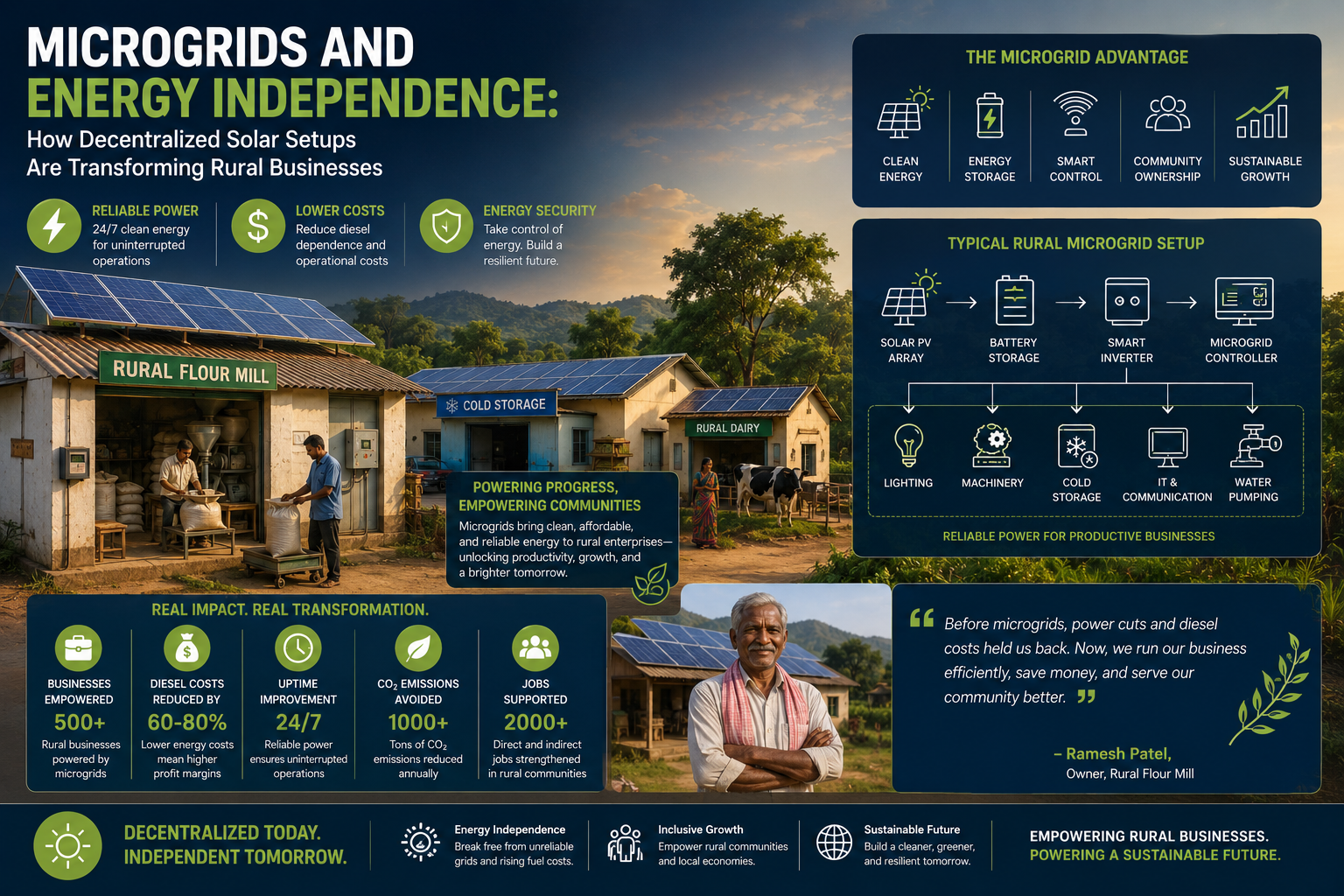
For decades, the standard path toward economic development in developing rural markets relied on a monolithic assumption: businesses needed to wait for the centralized national utility grid to reach their town before they could expand. However, expansion across vast geographical distances frequently encounters heavy transmission losses, high infrastructural costs, and high commercial tariffs. Even when the grid physical wires arrive, rural enterprises are often plagued by persistent load shedding, voltage fluctuations, and lengthy power outages.
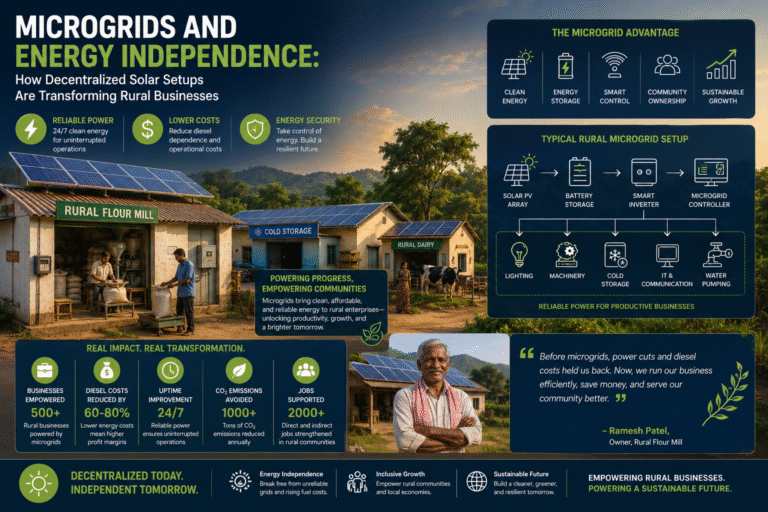
The rise of Decentralized Solar Microgrids has flipped this paradigm upside down. By combining localized solar generation arrays with advanced storage and smart distribution networks, rural businesses are bypassing fragile state infrastructure entirely. This guide breaks down the core architecture of community-level microgrids, evaluates the financial viability of localized energy hubs, and details how decentralized power transforms rural commercial growth.
1. Technical Blueprint: The Architecture of a Hybrid Microgrid
Unlike a completely isolated, standalone home system, a commercial microgrid acts as a localized utility framework that networks multiple businesses, production facilities, and cold storages into a single smart energy loop.
   [ SOLAR PV ARRAY ]              [ LOCAL DIESEL/GRID BACKUP ]
 (Primary Generation)                 (Auxiliary Input Layer)
          │                                      │
          ▼                                      ▼
┌────────────────────────────────────────────────────────┐
│             CENTRAL MICROGRID CONTROL HUB              │
│  (Bidirectional Hybrid Inverters + Smart EMS Core)     │
└────────────────────────────────────────────────────────┘
          │                                      │
          ▼                                      ▼
   [ BATTERY BANK ]                       [ COMMERCIAL LOADS ]
(Storage & Load Smoothing)            (Shops, Processing, Cold Storage)
- The Generation Core: A high-wattage array of bifacial solar panels that harvest raw sunlight from both the top and reflective bottom surfaces, maximizing output in dusty or sandy environments.
- The Hybrid Inverter Infrastructure: Industrial-grade, bidirectional inverters manage multiple power inputs seamlessly. They actively balance solar input, battery charge cycles, and emergency backup connections without interrupting business operations.
- The Intelligent Energy Management System (EMS): The true brain of the grid. The EMS monitors cumulative power demand in real time. Using predictive algorithms, it automatically routes excess solar power during midday peaks to heavy industrial machinery (like agricultural mills or ice makers) and saves stored battery power for essential night lighting.
2. Overcoming the High Upfront Cost: Innovative Financial Frameworks
Building a reliable microgrid requires substantial initial capital for batteries, panels, and heavy-duty switchgear. To bridge this funding gap, developers use innovative commercial payment structures:
A. The Pay-As-You-Go (PAYG) Smart-Meter Network
Instead of forcing small shopkeepers to purchase individual solar setups, a microgrid developer installs a central station and strings power lines directly to local businesses. Each shop is equipped with a digital smart meter linked to a mobile money wallet. Business owners pay only for the exact kilowatt-hours ($\text{kWh}$) they consume on a daily basis. This matches their energy expenditure perfectly to their daily cash flows.
B. The Anchor-Load Optimization Framework
A microgrid’s long-term financial survival depends on its Anchor Load—a major local business (such as a telecom tower, a commercial dairy chiller, or a clean water filtration plant) that contracts to purchase a guaranteed percentage of the grid’s base power every single day. The steady revenue generated by this anchor tenant subsidizes the distribution costs for smaller, variable retail shops around them, stabilizing the entire project’s financial risk profile.
3. Economic Multipliers: Transforming the Local Commercial Landscape
By shifting from erratic power connections to clean, continuous, and predictable electricity, rural business clusters experience immediate, compounding growth across three main sectors:
A. Agricultural Processing and Cold Chains
In purely agricultural areas, a massive percentage of fresh produce, milk, and fish spoils before it ever reaches urban wholesale markets due to high heat and a lack of refrigeration. Solar-powered community cold storages allow local farmers to preserve their yields for days. This refrigeration capability lets them wait out temporary market drops and negotiate significantly higher wholesale prices.
B. The Growth of Regional Service Hubs
Unreliable grid voltage instantly destroys sensitive modern computing equipment. A stable, microgrid-backed power loop allows rural retail hubs to confidently run internet cafes, digital print shops, digital financial centers, and technical repair workshops. This brings high-value services directly to the town, keeping local currency circulating inside the community instead of leaking away to distant urban centers.
C. Extended Operational Windows
Without power, commercial activity in rural villages stops completely the moment the sun goes down. Safe, affordable LED lighting supplied by the local microgrid extends the operational window of local markets by three to four hours every evening. This extra trading time dramatically scales up retail revenue and creates new jobs for evening shift workers.
4. Conclusion: The Blueprint for Distributed Energy Independence
Decentralized solar microgrids are doing far more than replacing old, polluting diesel generators; they are democratizing access to industrial capability. By turning regional market clusters into self-sustaining energy hubs, this architecture removes the barriers of state grid dependence, limits corporate carbon output, and builds a robust foundation for localized wealth creation that can thrive independently for decades to come.
Reference Links
- International Renewable Energy Agency (IRENA): https://www.irena.org/
- The World Bank – Energy Sector Management Assistance Program: https://www.esmap.org/
- Rocky Mountain Institute (RMI) Global Energy Transition: https://rmi.org/

+ There are no comments
Add yours