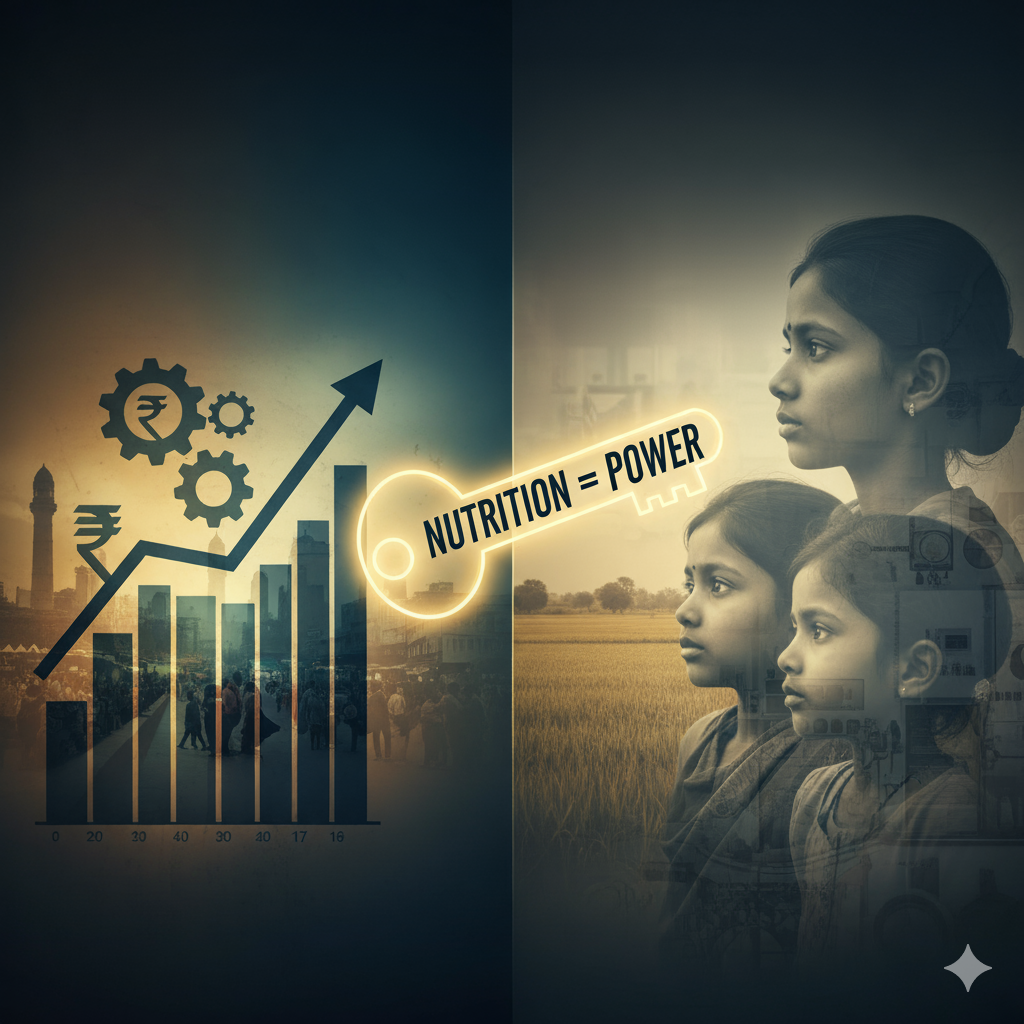
Key Highlights
- Every dollar invested in nutrition interventions generates up to $28 in economic returns globally
- India loses 4% of GDP annually due to child malnutrition, equivalent to massive productivity losses
- POSHAN Abhiyaan reduced stunting from 38.4% to 35.5% and wasting from 21.0% to 19.3%
- India ranks 105th out of 127 countries in Global Hunger Index 2024 despite economic growth
- The triple burden of malnutrition affects 194 million undernourished Indians while obesity rises
In a country that produces enough food to feed its entire population, why do 35.5% of children under five remain stunted? This paradox reveals India’s most overlooked economic opportunity – one where strategic nutrition investments could catalyze the nation’s transformation into a global superpower. globalhungerindex
The Economic Case: Why Nutrition Matters More Than GDP Growth
India’s economic growth story masks a critical vulnerability. Despite achieving consistent GDP growth averaging 4.5% annually between 1990-2015, child malnutrition rates have remained stubbornly high. This disconnect, known as the “Indian enigma,” demonstrates that economic prosperity alone cannot solve nutritional challenges.
The numbers paint a stark picture. India loses approximately 4% of its GDP annually due to child malnutrition – a staggering economic cost that dwarfs many government spending programs. When translated to individual impact, every 1% loss in adult height due to childhood stunting results in 2.4% productivity loss. pmc.ncbi.nlm.nih
However, the inverse presents unprecedented opportunity. International evidence shows that nutrition interventions yield $18-28 for every dollar invested, making them among the highest-return development investments available. A comprehensive benefit-cost analysis across 17 high-burden countries found ratios ranging from 3.6 to 48, with a median of 18. worldbank
India’s Nutrition Landscape: The Triple Burden Challenge
Current Malnutrition Statistics
India faces what experts term the “double burden of malnutrition” – the simultaneous presence of undernutrition and rising obesity. According to the latest National Family Health Survey (NFHS-5): globalnutritionreport
Undernutrition Indicators:
- 35.5% of children under-5 are stunted
- 19.3% suffer from wasting
- 32.1% are underweight
- 57% of women aged 15-49 are anaemic
Overnutrition Rising:
- 24% of women and 22.9% of men are overweight/obese
- 6.2% of adult women and 10.2% of adult men have diabetes
The Hidden Costs of Malnutrition
The economic implications extend far beyond healthcare costs. Stunted children demonstrate reduced cognitive function, lower educational attainment, and decreased lifetime earning capacity. This creates an intergenerational cycle where malnourished mothers give birth to low-birth-weight babies, perpetuating nutritional deficiencies across generations.
Research indicates that children who avoid stunting experience lifetime productivity benefits equivalent to 5 times GDP per capita in present value terms. For India’s demographic dividend to realize its full potential, addressing malnutrition becomes not just a moral imperative but an economic necessity.
POSHAN Abhiyaan: India’s Flagship Response
Program Overview and Achievements
Launched in March 2018, POSHAN Abhiyaan (National Nutrition Mission) represents India’s most comprehensive approach to tackling malnutrition. With a budget of Rs. 9,046 crore, the program targets children 0-6 years, pregnant women, lactating mothers, and adolescent girls. niti.gov
- Stunting reduction: From 38.4% to 35.5%
- Wasting decrease: From 21.0% to 19.3%
- Underweight prevalence: Reduced from 35.8% to 32.1%
- Training impact: Over 10 lakh field functionaries trained
- Millet promotion: More than 1 crore millet-centric activities in 2023
Integrated Approach and Convergence
POSHAN Abhiyaan’s strength lies in its multisectoral convergence approach, mapping interventions across 18 ministries and departments. The program integrates with existing schemes including:
- Integrated Child Development Services (ICDS)
- Mid-Day Meal Scheme (now PM POSHAN)
- National Health Mission
- Targeted Public Distribution System
This convergence model ensures that nutrition interventions reach beneficiaries through multiple touchpoints, maximizing impact and reducing implementation gaps.
Food System Integration and Fortification Initiatives
Rice Fortification: Scaling Nutrition Impact
India’s rice fortification program demonstrates innovative policy implementation at scale. By March 2024, the country achieved 100% coverage of fortified rice distribution through all government schemes, reaching millions of beneficiaries. pib.gov
- 406 lakh metric tonnes of fortified rice distributed between 2019-24
- 35% reduction in iron deficiency risk potential
- Rs. 49,800 crore healthcare savings in GDP terms anticipated
- 16.6 million Disability-Adjusted Life Years (DALYs) could be averted annually
Beyond Rice: Comprehensive Fortification
The fortification strategy extends beyond rice to include fortified salt (92% of participating states), oil (46%), and grains/cereals (23%). States like Haryana have pioneered fortified atta (wheat flour) distribution, reaching 3.3 million PDS beneficiaries and 2.8 million school children and ICDS beneficiaries. gcnf
The Double Burden: Addressing Undernutrition and NCDs Simultaneously
Understanding the Paradox
India’s nutrition challenge has evolved beyond simple undernutrition to encompass what researchers call the “thin-fat phenotype” – individuals appearing thin but harboring excess visceral fat and elevated diabetes risk. This phenomenon affects 43.3% of India’s population, with higher prevalence in rural areas (46%) than urban (39.6%).
The double burden manifests differently across states. Kerala demonstrates low malnutrition (19.7% underweight) but high diabetes prevalence (25.5%), while Jharkhand exhibits severe malnutrition but lower NCD rates. This variation suggests different stages of epidemiological transition requiring tailored interventions.
Policy Implications for Double-Duty Actions
Addressing the double burden requires “double-duty actions” – interventions that simultaneously tackle undernutrition and prevent overnutrition. These include:
- Promoting dietary diversity while preventing excessive caloric intake
- Nutrition education programs targeting both deficiency and excess
- Food system interventions that increase access to nutrient-dense foods while reducing ultra-processed options
Challenges and Structural Barriers
Implementation Gaps
Despite policy frameworks, implementation challenges persist. India’s Global Hunger Index ranking of 105 out of 127 countries in 2024 indicates significant room for improvement. Key barriers include:
Systemic Challenges:
- Fragmented policy implementation across sectors
- Low awareness about nutrition among target populations
- Inadequate convergence between agriculture and nutrition programs
- Quality concerns in service delivery
Socioeconomic Factors:
- Persistent poverty limiting food access
- Gender inequalities affecting maternal nutrition
- Social discrimination impacting vulnerable populations
- Geographic disparities between urban and rural areas
The Rural-Urban Divide
Rural areas face distinct challenges with 46% higher prevalence of the thin-fat phenotype compared to urban areas. Limited healthcare access, traditional dietary patterns, and agricultural dependency create complex intervention requirements that standard programs may not adequately address.
Sustainable Development Goals: India’s Progress and Gaps
Current SDG Status
India’s SDG India Index score improved significantly from 63 in 2018 to 89 in 2023-24. However, nutrition-related targets remain challenging: pib
- Maternal mortality reduction on track
- Malaria incidence reduction target achieved
- Overall SDG momentum showing positive trajectory
Areas Requiring Acceleration:
- Child stunting: Expected 35% in 2030 vs. 15% target
- Under-five mortality: Progress insufficient for 2030 deadline
- Neonatal mortality: Current 22 deaths per 1,000 live births needs significant reduction
Nutrition-Sensitive Agriculture: The Missing Link
Nutrition-sensitive agriculture (NSA) represents a critical pathway for achieving SDGs. This approach integrates nutrition goals into agricultural practices, promoting: manage.gov
- Climate-resilient, biofortified crops like iron-rich rice and vitamin A-enhanced sweet potatoes
- Dietary diversification beyond staple cereals to include pulses, millets, and vegetables
- Post-harvest loss reduction to maintain nutritional quality
- Smallholder farmer empowerment with nutrition-focused extension services
Research indicates that targeted NSA training programs can transform agricultural landscapes and uplift nutritional standards at the grassroots level.
Policy Recommendations: The Path Forward
Invest “Best Things First”
Prioritizing high-impact, cost-effective interventions should guide resource allocation. Evidence suggests focusing on:
Critical 1000-Day Interventions:
- Maternal nutrition during pregnancy and lactation
- Exclusive breastfeeding promotion for first six months
- Complementary feeding education and support
- Micronutrient supplementation for pregnant women and children
Multisectoral Integration
Breaking policy silos requires systematic convergence mechanisms that harmonize:
- Agriculture policies with nutrition objectives
- Health programs with social protection schemes
- Education initiatives with feeding programs
- Water and sanitation improvements with nutrition interventions
Technology and Innovation Leverage
Digital platforms and technology solutions can enhance program reach and effectiveness:
- POSHAN Tracker for real-time monitoring praised by international reports
- Mobile-based nutrition counseling for remote areas
- Data analytics for targeting interventions to most vulnerable populations
- Blockchain solutions for supply chain transparency in fortification programs
Private Sector Partnership
Incentivizing private sector participation through:
- Tax incentives for nutrition-focused food companies
- Public-private partnerships in fortification initiatives
- Corporate social responsibility alignment with nutrition goals
- Market-based solutions for affordable, nutritious food access
Economic Returns: The Investment Case
National Economic Benefits
Scaling nutrition interventions to 90% coverage could generate substantial returns. International models suggest that comprehensive nutrition packages can:
- Prevent 55,000 cases of child stunting annually
- Avoid 1,830 under-five deaths yearly
- Generate benefit-cost ratios of 5.2 to 19.4 depending on intervention mix
- Create productivity gains equivalent to 11-82% income increases for individuals avoiding stunting
State-Level Success Models
Tamil Nadu, Karnataka, and Andhra Pradesh demonstrate effective implementation models that other states can replicate. These success stories show that coordinated state-level leadership, community engagement, and systematic monitoring can achieve significant improvements in nutrition outcomes.








+ There are no comments
Add yours