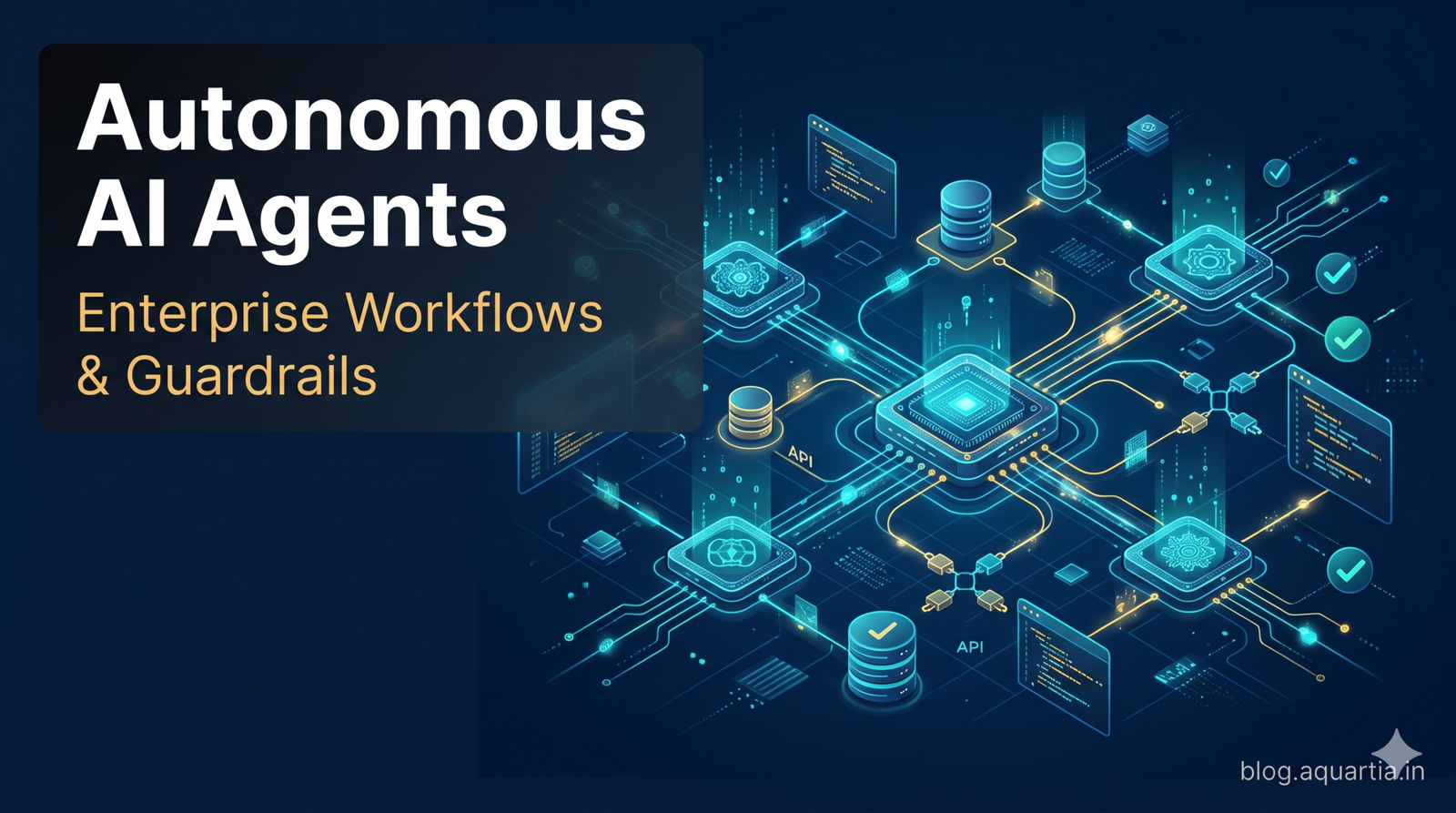
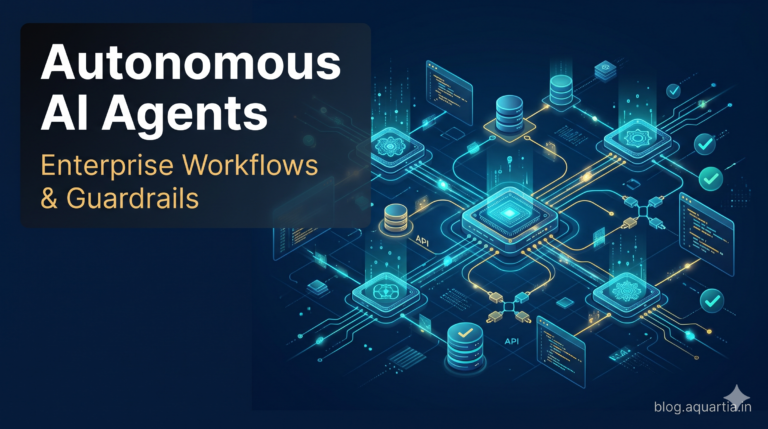
Modern software automation is shifting from single-turn chatbots to autonomous AI agents in enterprise workflows—systems capable of planning multi-step tasks, querying live databases, invoking APIs, and verifying outcomes with minimal human intervention. Unlike static text generators, enterprise agents interact directly with production infrastructure, making sound architecture and runtime guardrails essential.
What Separates an AI Agent from a Standard Chatbot?
A traditional large language model (LLM) responds to a prompt using patterns learned during training or static retrieval-augmented generation (RAG). By contrast, an agentic system operates in a continuous loop: it perceives context, breaks a goal into sub-tasks, selects external tools, inspects tool outputs, and iterates until completion. As Anthropic’s agent engineering research highlights, reliable production agents combine structured workflows with bounded autonomy rather than unconstrained open-ended loops.
Core Architecture: Connecting Agents via Model Context Protocol (MCP)
Historically, connecting M models to N enterprise tools created a fragile N×M custom integration bottleneck. Introduced by Anthropic in November 2024 and later donated to the Linux Foundation’s Agentic AI Foundation, the Model Context Protocol (MCP) standardizes how AI clients discover and call external tools, resources, and prompts.
As Databricks explains, MCP acts like a universal interface layer—reducing N×M custom connectors to N+M standardized client-server integrations while supporting typed JSON schemas and scoped permissions. For large tool catalogs, code execution with MCP further reduces token overhead by letting agents filter and transform intermediate results before loading them into context.
Enterprise Patterns: Workflows vs. Autonomous Loops
| Pattern | Control Flow | Best Enterprise Use Cases | Primary Risk Profile |
|---|---|---|---|
| Prompt Chaining & Routing | Deterministic code steps | Document triage, ticket classification, ETL enrichment | Low — predictable execution paths |
| RAG + Tool-Use Agent | Model-selected read/query tools | Customer support lookup, internal knowledge + live SQL | Moderate — stale data or over-fetching |
| Multi-Agent Orchestrator | Supervisor + specialized sub-agents | Code refactoring, supply-chain reconciliation, incident response | High — cascading errors and permission sprawl |
Guardrails and Governance: Applying NIST AI RMF to Agents
When an agent can write database records, send emails, or trigger deployments, prompt-only safety rules are insufficient. The NIST AI Risk Management Framework (AI RMF 1.0) organizes risk across four core functions—Govern, Map, Measure, and Manage—supplemented by NIST-AI-600-1 for generative AI. Extending these controls to agentic systems requires four practical guardrails:
- Least-Privilege Tool Scoping: Enforce read-only credentials by default and separate read tools from state-mutating write tools.
- Human-in-the-Loop Approvals: Require explicit confirmation gates before irreversible financial, security, or external communication actions.
- Prompt-Injection Defenses: Treat all retrieved web pages, emails, and tool outputs as untrusted data rather than executable instructions, following Cloud Security Alliance MCP security guidelines.
- Immutable Audit Trails: Log every model decision, tool call, input payload, and latency metric for compliance and post-incident review.
Frequently Asked Questions
How does MCP complement RAG in enterprise AI?
RAG indexes static documents into vector databases for semantic search, whereas MCP connects agents to live APIs, databases, and transactional tools. Combining both gives agents historical knowledge and real-time operational state.
What is the biggest security risk for autonomous AI agents?
Indirect prompt injection via untrusted tool outputs—combined with overly broad API permissions—can trick an agent into exfiltrating data or executing unintended state changes.
When should teams choose deterministic workflows over autonomous agents?
Choose deterministic workflows when tasks follow repeatable rules and predictable branching; reserve autonomous agents for ambiguous, multi-step problems where dynamic tool selection adds clear value.
Explore more architecture guides in our Agentic AI and Artificial Intelligence archives on Aquartia Blog.


+ There are no comments
Add yours