
Key Highlights
- Green Credit Programme launched in October 2023 under Environment Protection Act 1986, with over 17,000 hectares degraded land identified across 13 states for tree plantation
- ICFRE serves as Administrator while State Forest Departments execute plantations, with one green credit awarded per surviving tree after two-year verification period
- Broader scope than carbon credits covering tree plantation, water management, waste reduction, sustainable agriculture, and mangrove conservation beyond emissions
- Supports India’s NDCs targeting 2.5-3 billion tonnes CO2 additional carbon sink by 2030 and integrates with Mission LiFE for lifestyle transformation
- Market-based mechanism enables CSR compliance, ESG reporting, and compensatory afforestation through tradable green credits on domestic platforms
India’s environmental landscape stands at a critical juncture where immediate action is essential to combat climate change while fostering sustainable development. The Green Credit Programme (GCP), launched by the Ministry of Environment, Forest and Climate Change (MoEFCC) in October 2023 under the Environment Protection Act, 1986, represents a revolutionary market-based mechanism that transforms environmental conservation into a tradable commodity. With over 17,000 hectares of degraded land already identified across 13 states for tree plantation activities, this pioneering initiative aims to create additional carbon sinks of 2.5-3 billion tonnes CO2 equivalent by 2030, directly supporting India’s ambitious Nationally Determined Contributions (NDCs) under the Paris Agreement. ceew mohua pib
Constitutional and Policy Framework
Environment Protection Act, 1986: Legal Foundation
The Green Credit Rules, 2023 derive their authority from the Environment Protection Act, 1986, providing a robust legal framework for implementing market-based environmental incentives. This legislation enables the government to create innovative mechanisms that encourage voluntary environmental actions while ensuring regulatory compliance and transparent governance.
Legal Architecture:
- Statutory backing under Environment Protection Act, 1986
- Rule-making powers for dynamic policy adjustments
- Compliance integration with existing forest conservation laws
- Market mechanism authorization for credit trading and exchange
Mission LiFE Integration
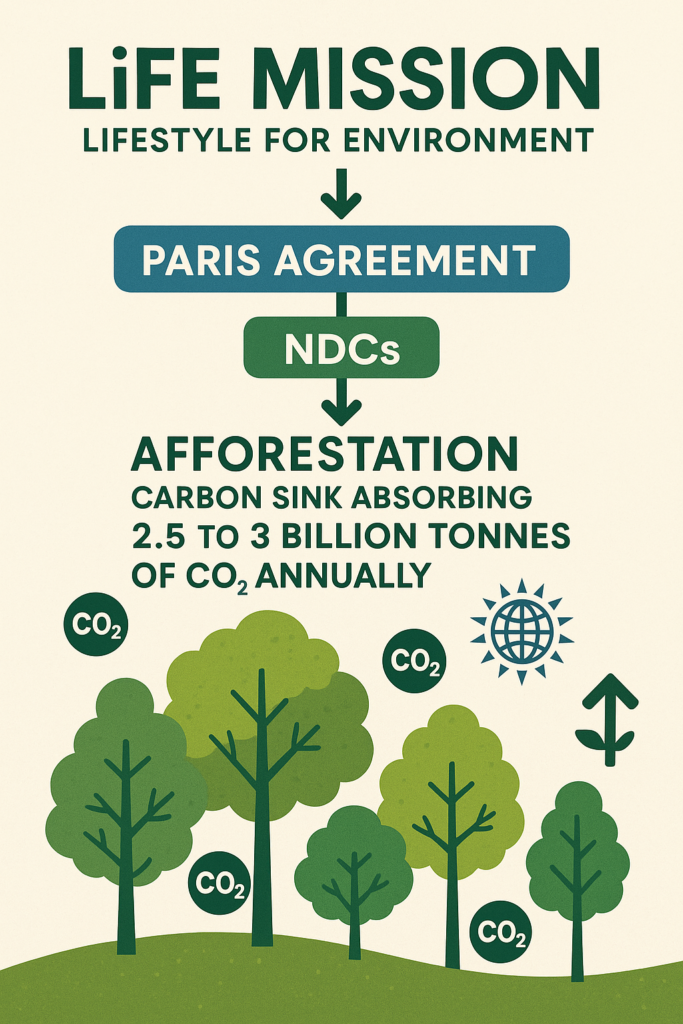
The GCP directly supports Mission LiFE (Lifestyle for Environment), launched at COP26 to promote behavioral change and community-based environmental action. This integration ensures that individual actions contribute to national climate goals while creating economic incentives for environmental stewardship.
Mission LiFE Objectives:
- Behavioral transformation toward sustainable living practices
- Community engagement in environmental conservation
- Global climate action through local initiatives
- Sustainable lifestyle promotion based on conservation values
Institutional Mechanism and Governance Structure
ICFRE: The Administrator
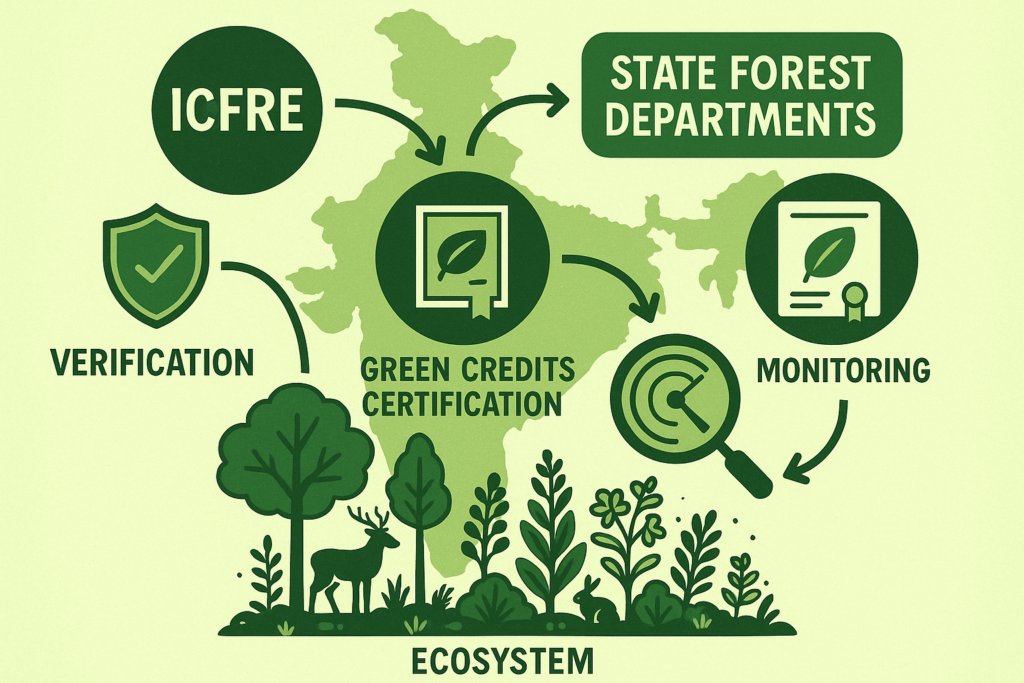
The Indian Council of Forestry Research and Education (ICFRE), an autonomous body under MoEFCC, serves as the Administrator for the Green Credit Programme, ensuring scientific rigor and transparent implementation.
ICFRE Responsibilities:
- Registration of individuals and entities seeking green credits
- Methodology development for credit calculation and verification
- Quality assurance through scientific evaluation protocols
- Credit issuance based on verified plantation success rates
- Registry maintenance for transparent credit tracking tropentag
State Forest Departments: Implementation Partners
Operational Framework:
- Land identification of degraded forest areas suitable for plantation
- Plantation execution using scientific afforestation techniques
- Maintenance and monitoring ensuring tree survival and growth
- Cost communication to applicants for transparent financial planning
- Progress reporting to ICFRE for credit verification
Credit Calculation and Verification
Technical Standards:
- One green credit per surviving tree after two-year evaluation period
- Approximately 1,100 trees per hectare for dense plantation targets
- Survival rate assessment using scientific monitoring protocols
- Growth parameter evaluation including height, girth, and health indicators
- Ecosystem impact measurement for biodiversity and soil health benefits
Scope and Multi-Sectoral Coverage
Phase-wise Implementation
The GCP follows a structured rollout approach, beginning with tree plantation and water management before expanding to comprehensive environmental activities.
Initial Phase Activities:
- Tree Plantation: Primary focus on afforestation and reforestation
- Water Management: Conservation, harvesting, and efficient utilization
- Land restoration: Rehabilitation of degraded ecosystems
- Carbon sequestration: Measurable climate mitigation benefits
Subsequent Phase Expansion:
- Sustainable Agriculture: Soil health improvement and organic practices
- Waste Management: Recycling, reduction, and circular economy promotion
- Air Pollution Reduction: Emission control and clean technology adoption
- Mangrove Conservation: Coastal ecosystem protection and restoration
- Ecomark Labelling: Sustainable product certification and promotion
- Sustainable Building: Green infrastructure and construction practices
Economic and Social Benefits
Market-Based Incentive Structure
The GCP creates economic value for environmental actions, transforming conservation from a cost center into a revenue generator for participating entities.
Financial Mechanisms:
- Tradable credits on designated domestic platforms
- CSR compliance opportunities for corporate entities
- ESG reporting enhancement for investment attraction
- Compensatory afforestation alternative for development projects
- Revenue generation for environmental service providers
Employment Generation and Rural Development
Job Creation Opportunities:
- Nursery establishment and seedling production
- Plantation labor for large-scale afforestation projects
- Monitoring and maintenance roles for local communities
- Technical services including surveying and verification
- Administrative support for program implementation
Community Engagement and Social Impact
Participatory Approach:
- Individual participation through personal environmental actions
- Community involvement via Gram Panchayat partnerships
- NGO engagement in implementation and monitoring
- Corporate participation through CSR and sustainability programs
- Educational institutions involvement in awareness and action
Comparison with Carbon Credits
Scope and Coverage Differences
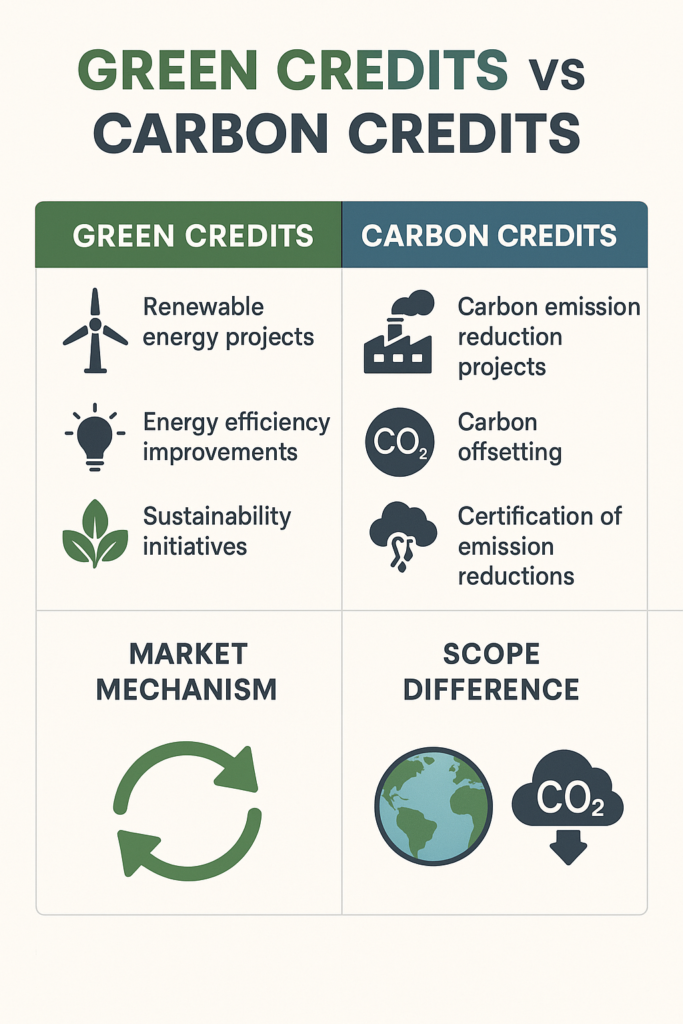
While carbon credits focus exclusively on greenhouse gas emission reductions, green credits encompass a broader spectrum of environmental benefits. burgeon
Carbon Credits Characteristics:
- Narrow focus on emission reductions and removals
- International tradability on global carbon markets
- Regulatory compliance under cap-and-trade systems
- Technical measurement using standardized methodologies
- Ministry of Power oversight through Bureau of Energy Efficiency
Green Credits Distinctions:
- Comprehensive coverage including biodiversity, water, and soil benefits
- Domestic platform for trading and exchange
- Voluntary participation with incentive-based adoption
- Ecosystem services valuation beyond carbon alone
- MoEFCC administration through ICFRE framework
Complementary Relationship
Synergistic Potential:
- Combined utilization for comprehensive environmental impact
- Portfolio approach to sustainability reporting
- Risk diversification across different environmental benefits
- Market stability through diverse credit categories
- Policy integration supporting multiple climate goals
Global Climate Commitments and NDCs
India’s NDCs and Carbon Sink Targets
India’s updated NDCs commit to creating an additional carbon sink of 2.5-3 billion tonnes CO2 equivalent by 2030 through afforestation and reforestation.
Specific NDC Commitments:
- 45% reduction in GDP emission intensity by 2030 (from 2005 levels)
- 50% non-fossil fuel electric power capacity by 2030
- 2.5-3 billion tonnes CO2 additional carbon sink creation
- Enhanced climate resilience in vulnerable sectors
- Sustainable lifestyle promotion through Mission LiFE
Paris Agreement Article 6 Alignment
The establishment of National Designated Authority (NDA) for carbon markets under Article 6 of the Paris Agreement creates synergistic opportunities for green credits and international climate finance.
Challenges and Implementation Barriers
Monitoring and Verification Concerns
Technical Challenges:
- Plantation survival rates often compromised by inadequate maintenance
- Long-term monitoring requirements for credit validation
- Quality assurance in vast geographic implementation areas
- Data integrity ensuring accurate credit calculation
- Technology integration for remote sensing and verification
Greenwashing and Credibility Risks
Market Integrity Issues:
- Corporate image-building without substantial environmental impact
- Credit accumulation without genuine conservation commitment
- Verification gaps enabling fraudulent or exaggerated claims
- Transparency deficits in credit utilization and trading
- Accountability mechanisms for ensuring real environmental benefits
Community Rights and Social Concerns
Potential Conflicts:
- Forest Rights Act (2006) compliance ensuring tribal and community rights
- Land tenure issues affecting plantation site selection
- Benefit-sharing mechanisms with local communities
- Traditional knowledge integration in restoration practices
- Equitable participation across socioeconomic strata
Technological Innovation and Digital Integration
Advanced Monitoring Systems
Technology Applications:
- Satellite imagery for large-scale monitoring and verification
- Drone surveillance for detailed plantation assessment
- GIS mapping for precise location tracking and analysis
- Blockchain technology for transparent credit registry maintenance
- Mobile applications for community participation and reporting
Digital Platform Development
Infrastructure Requirements:
- Green Credit Registry for comprehensive database management
- Trading platform for credit exchange and market operations
- Verification portal for transparent assessment processes
- Stakeholder dashboard for real-time progress monitoring
- Integration systems connecting various implementing agencies
Way Forward: Building Robust Implementation Framework
Enhanced Monitoring and Verification
Technology-Enabled Solutions:
- Blockchain integration for tamper-proof credit tracking and trading
- AI-powered analysis of satellite data for automated monitoring
- IoT sensors for real-time environmental parameter measurement
- Mobile verification apps enabling community-based monitoring
- Digital twin technology for comprehensive ecosystem modeling
Community-Centric Approach
Inclusive Implementation Strategy:
- Forest dweller partnerships ensuring traditional knowledge integration
- Self-Help Group engagement for local capacity building
- Women’s participation in nursery management and plantation activities
- Youth involvement through educational institution partnerships
- Tribal community rights protection under Forest Rights Act compliance
Policy Integration and Synergy
Coordinated Framework Development:
- CAMPA funds alignment with green credit investments
- Green India Mission integration for comprehensive forest restoration
- SDG synchronization particularly Goals 13, 15, and 17
- International climate finance leveraging for program scaling
- Carbon market integration for comprehensive environmental benefits
Market Development and Scaling
Economic Ecosystem Building:
- Price discovery mechanisms for green credit valuation
- Market maker institutions ensuring liquidity and stability
- Quality standards preventing greenwashing and ensuring credibility
- International recognition for potential global market integration
- Financial instrument development including green bonds and loans
Building India’s Green Economy Through Environmental Markets
The Green Credit Programme represents more than an environmental initiative – it embodies India’s vision of transforming conservation into economic opportunity while achieving ambitious climate goals. With 17,000 hectares already identified for restoration and multiple sectors poised for integration, the program creates unprecedented opportunities for sustainable development that balances economic growth with environmental stewardship.
Success depends on coordinated effort across multiple dimensions:
- Robust institutional frameworks ensuring transparent and accountable implementation
- Technology integration providing accurate monitoring and verification
- Community participation ensuring equitable benefits and traditional knowledge inclusion
- Private sector engagement creating sustainable financing and market development
- Policy coherence aligning with existing programs and international commitments
The pioneering nature of India’s approach to environmental markets positions the nation as a global leader in innovative climate action. By creating economic incentives for voluntary environmental behavior, the GCP demonstrates how market mechanisms can accelerate conservation while supporting livelihoods and community development.
As the program scales and evolves, its success will be measured not only by trees planted and credits generated, but by its contribution to biodiversity conservation, ecosystem restoration, rural development, and climate resilience. The integration with Mission LiFE ensures that individual actions contribute to collective impact, creating a movement that transforms environmental stewardship from obligation to opportunity.
The path forward requires sustained commitment to quality over quantity, transparency over convenience, and long-term sustainability over short-term gains. Only through such principled implementation can the Green Credit Programme achieve its transformative potential and establish India as a model for market-based environmental conservation globally.
Mains Practice Qs
GS Paper II (Governance / Environment Policy)
- Critically examine the potential of the Green Credit Programme in balancing ecological sustainability with economic growth.
GS Paper III (Environment & Economy)
- “Green Credits can become India’s next big instrument for environmental governance, but only if backed by robust monitoring.” Discuss.
Essay Topics
- “Market mechanisms for environmental protection: opportunities and pitfalls.”
- “Sustainable development in India needs both community action and market incentives.”









+ There are no comments
Add yours