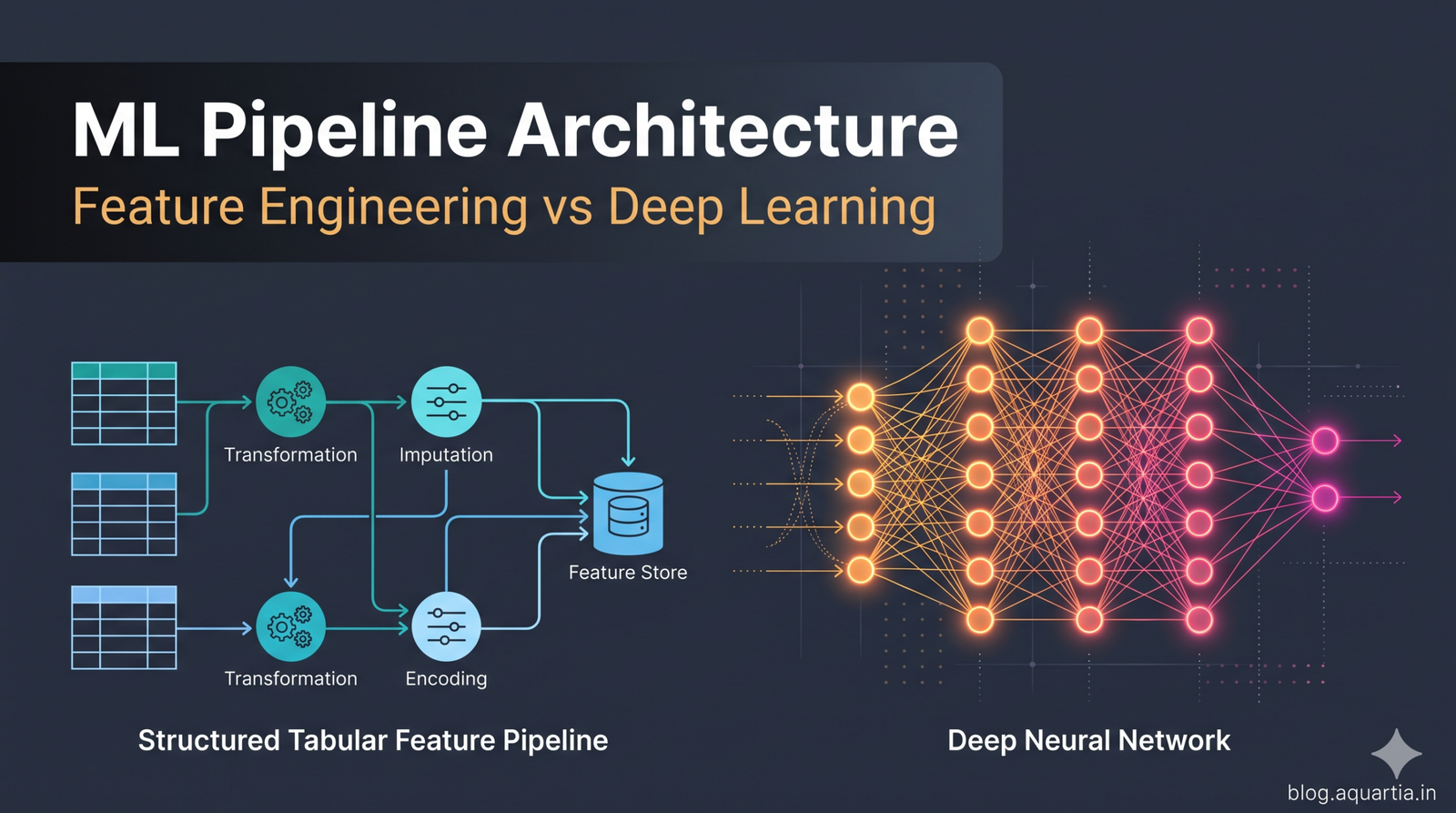
Choosing between structured feature engineering vs. deep learning remains one of the most consequential architectural decisions in applied machine learning. While deep neural networks dominate images, audio, and natural language, tabular enterprise datasets—from credit scoring to churn prediction—still behave very differently in production.
What Benchmarks Show on Structured Tabular Data
Empirical evaluations consistently demonstrate that gradient-boosted decision trees (GBDTs) such as XGBoost, LightGBM, and CatBoost remain formidable baselines on structured tables. In a landmark NeurIPS benchmark across 45 datasets, Grinsztajn, Oyallon, and Varoquaux showed why tree-based models outperform standard deep networks on medium-sized tabular data: trees naturally handle uninformative features, non-smooth decision boundaries, and mixed numerical/categorical columns.
More recent 2026 tabular benchmarks comparing TabPFN v2 against tuned XGBoost confirm that while tabular foundation models can match trees on small datasets (under 10,000 rows), XGBoost still leads on larger tables and delivers orders-of-magnitude faster CPU inference.
Where Deep Learning Wins Unquestionably
Manual feature engineering hits a ceiling when raw inputs are high-dimensional and unstructured:
- Computer Vision & Medical Imaging: Convolutional and Vision Transformer backbones learn hierarchical spatial filters directly from pixels.
- Text, Audio & Multimodal Streams: Transformer embeddings capture long-range semantic context that bag-of-words or TF-IDF features miss.
- Hybrid Pipelines: Many production teams extract dense embeddings from a neural network (or multimodal model) and feed them alongside structured business columns into a GBDT classifier.
Comparison: Feature-Engineered GBDTs vs. Deep Learning
| Criterion | Feature Engineering + GBDT (XGBoost/LightGBM) | End-to-End Deep Learning |
|---|---|---|
| Best Data Type | Structured tabular CSVs, SQL tables, time-series aggregates | Images, audio, video, raw text, multimodal inputs |
| Training Hardware | Fast on standard multi-core CPUs | Typically requires GPUs or distributed accelerators |
| Inference Latency | Sub-millisecond to single-digit milliseconds | Higher compute footprint and serving complexity |
| Explainability | High (native feature importance and exact TreeSHAP) | Lower (requires gradient-based or perturbation methods) |
Preventing Data Leakage in Production Pipelines
Regardless of model family, improper preprocessing ruins real-world accuracy. As outlined in Scikit-learn’s common pitfalls guide, teams should follow three strict rules:
- Split Before Preprocessing: Always split datasets into training and test subsets before fitting any scaler, imputer, or encoder.
- Wrap Steps in a Pipeline: Use Scikit-learn’s Pipeline and ColumnTransformer so cross-validation fits transformers strictly inside each training fold.
- Separate Offline & Online Feature Logic: Version transformation logic alongside model weights so inference receives identical feature distributions.
Frequently Asked Questions
Should I always start with XGBoost on a new tabular dataset?
Yes. A clean Scikit-learn preprocessing pipeline paired with tuned XGBoost or LightGBM provides a fast, interpretable baseline before testing heavier neural architectures.
When does a hybrid deep learning + GBDT pipeline make sense?
Hybrid pipelines excel when your dataset mixes rich unstructured fields (like product descriptions or images) with structured transaction columns.
How does data leakage happen during feature engineering?
Fitting scalers, target encoders, or missing-value imputers on the full dataset before train/test splitting leaks test statistics into training, inflating validation metrics.
Explore more engineering deep dives on Aquartia Blog.










+ There are no comments
Add yours