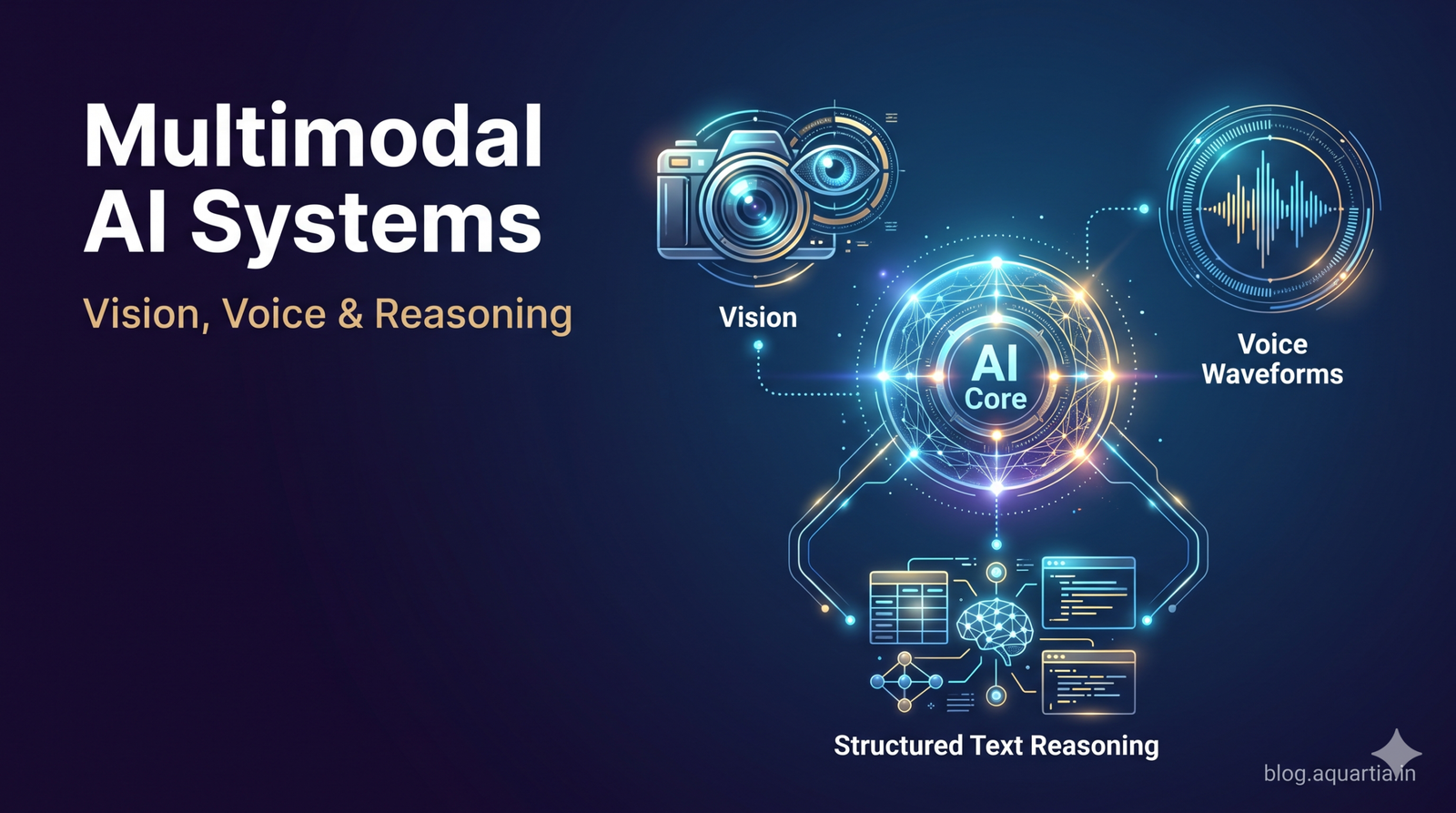
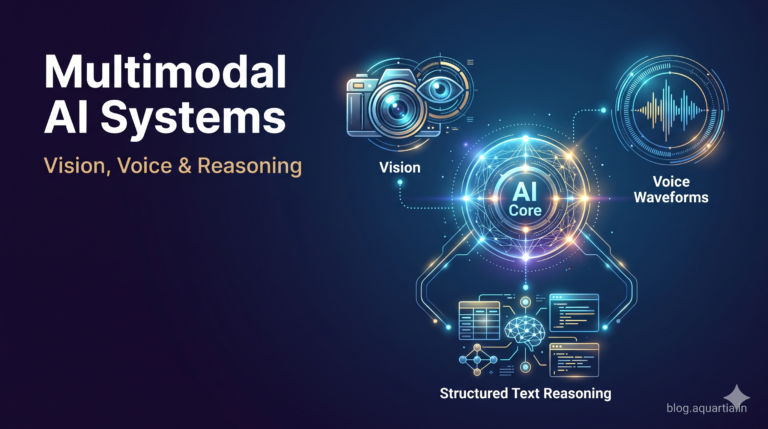
For years, artificial intelligence operated in isolated silos: one model parsed text, another classified images, and a third transcribed speech. Multimodal AI systems break down those barriers by processing text, images, audio, video, and structured documents inside a single unified reasoning architecture—delivering faster responses and richer contextual awareness.
From Brittle Pipelines to Native Multimodal Architectures
Early “multimodal” assistants were actually stitched-together pipelines. For voice interactions, an automatic speech recognition (ASR) model converted audio into text, passed that transcript to a large language model (LLM), and then sent the text reply to a separate text-to-speech (TTS) engine. As ExplainX’s multimodal architecture guide notes, each handoff added 800 ms to 1,500 ms of latency and stripped away vocal tone, pacing, and emotional prosody.
Modern native multimodal models—such as Google DeepMind’s Gemini and Gemini Embedding 2—are trained end-to-end on interleaved modalities within a shared semantic space. Because audio, image patches, video frames, and text tokens interact directly through cross-modal attention, the model preserves acoustic nuance and visual spatial relationships without lossy intermediate transcription.
How Different Modalities Become Tokens
- Text: Split into subword tokens via byte-pair encoding (BPE) or SentencePiece vocabularies.
- Images & Video: Divided into fixed-size pixel patches, projected through vision encoders (such as ViT) or native patch embeddings into visual tokens.
- Audio: Converted into time-frequency representations such as mel spectrograms (a technique popularized by Whisper) or discrete neural audio codec tokens so the transformer perceives tone alongside spoken words.
Comparison: Stitched Pipeline vs. Native Multimodal Model
| Dimension | Stitched Pipeline (ASR + LLM + TTS) | Native Multimodal Model |
|---|---|---|
| Voice Latency | High (typically 800–1,500 ms+ across handoffs) | Low (tens to low hundreds of milliseconds) |
| Prosody & Tone | Lost during speech-to-text transcription | Preserved directly in audio token representations |
| Visual-Text Reasoning | Relies on static image captions | Direct cross-attention over image patches and text |
| Maintenance | Three or more separate models to tune and version | Single unified model and deployment endpoint |
High-Impact Enterprise Use Cases
Unified perception unlocks workflows that text-only models cannot handle reliably:
- Multimodal RAG & Document Intelligence: Indexing charts, scanned engineering blueprints, invoices, and video clips in a single vector space using models like Gemini Embedding 2.
- Real-Time Field Diagnostics: Technicians streaming live camera feeds and voice questions to troubleshoot machinery hands-free.
- UI & Software QA Agents: Vision-language models inspecting live browser screenshots, layout regressions, and DOM state simultaneously.
Frequently Asked Questions
What makes a model “natively” multimodal?
A natively multimodal model is trained from the ground up on interleaved text, image, audio, and video tokens in a shared representation space, rather than bolting separate vision or speech adapters onto a text-only LLM afterward.
Why are visual tokens more expensive than text tokens?
A single high-resolution image or multi-second video clip decomposes into hundreds or thousands of patch tokens, consuming more context window and attention compute than a short sentence of text.
Can open-weight models match proprietary multimodal systems?
Yes, for many document, OCR, and vision-language tasks, modern open-weight VLMs offer strong accuracy and can be deployed privately on dedicated enterprise GPUs.
Dive deeper into AI architecture and hardware on our Artificial Intelligence and Reasoning Model pages at Aquartia Blog.





+ There are no comments
Add yours