
Labour welfare in India encompasses social security, workplace safety, fair wages, and dignity of work, while skill development initiatives aim to enhance employability and productivity. With over 500 million workers and 90% in the informal sector, the Code on Social Security 2020 and Skill India Mission targeting 400 million youth represent transformative policy priorities. The e-Shram portal has registered 30.95 crore unorganised workers, while PMKVY has trained 1.48 crore beneficiaries, marking unprecedented progress in social protection and human capital development.
Key Highlights
- Universal social security coverage: Code on Social Security 2020 consolidates 9 labour laws, extends coverage to gig workers, platform workers, and unorganised sector, with e-Shram portal registering 30.95 crore workers by July 2025
- Massive skill development scale: Skill India Mission targets 400 million youth with PMKVY training 1.48 crore beneficiaries, NAPS supporting 29.91 lakh apprentices, and JSS covering 26.38 lakh learners since inception
- Digital welfare integration: e-Shram “One-Stop-Solution” launched October 2024 integrates 14+ social security schemes including PMSBY, PMJJBY, MGNREGS, PMAY for seamless benefit delivery to informal workers
- Pension security expansion: PM-SYM scheme provides ₹3,000 monthly pension to unorganised workers with flexible contribution structure from ₹55-200 based on entry age 18-40 years
- Comprehensive safety framework: Occupational Safety, Health and Working Conditions Code 2020 simplifies 13 labour laws while ESI, EPFO, Maternity Benefits ensure health, pensions, and gender equity
India’s Labour Landscape: Scale and Challenges
Workforce Demographics and Informal Sector Dominance
India’s workforce exceeds 500 million with a striking 90% employed in the informal sector, creating massive challenges for welfare delivery and skill development. This informal dominance reflects structural economic patterns where traditional employment relationships remain limited while self-employment, casual labor, and unorganised enterprises predominate.
Sectoral distribution reveals:
- Agricultural workers: Largest segment facing seasonal employment and income volatility
- Manufacturing and construction: Significant informal participation with limited social protection
- Services sector: Growing gig economy and platform workers requiring new protection frameworks
- Home-based workers: Particularly women in textiles, handicrafts, food processing
Geographic and Social Disparities
Interstate migration complicates welfare delivery, with circular migrants from rural areas working in urban centers without permanent settlement rights. Research in Gujarat demonstrates how footloose labour remains vulnerable due to absence of legal protection and social security coverage. link.springer
Gender disparities persist with women workers facing additional challenges in accessing welfare benefits and skill development opportunities. Traditional social hierarchies and purity-pollution considerations further marginalize certain worker categories, particularly during crisis periods like the COVID-19 pandemic.
Code on Social Security 2020: Universal Coverage Framework
Legislative Consolidation and Expansion
The Code on Social Security 2020 represents ambitious legislative reform, consolidating 9 central labour enactments into a unified framework aimed at extending social security to all employees and workers across organised, unorganised, and emerging sectors.
Consolidated legislation includes:
- Employees’ Compensation Act, 1923
- Employees’ State Insurance Act, 1948
- Employees’ Provident Fund Act, 1952
- Employment Exchanges Act, 1959
- Maternity Benefit Act, 1961
- Payment of Gratuity Act, 1972
- Cine Workers Welfare Fund Act, 1981
- Building Workers’ Welfare Cess Act, 1996
- Unorganised Workers’ Social Security Act, 2008
Expanded Worker Definitions and Coverage
Revolutionary expansion includes previously excluded categories:
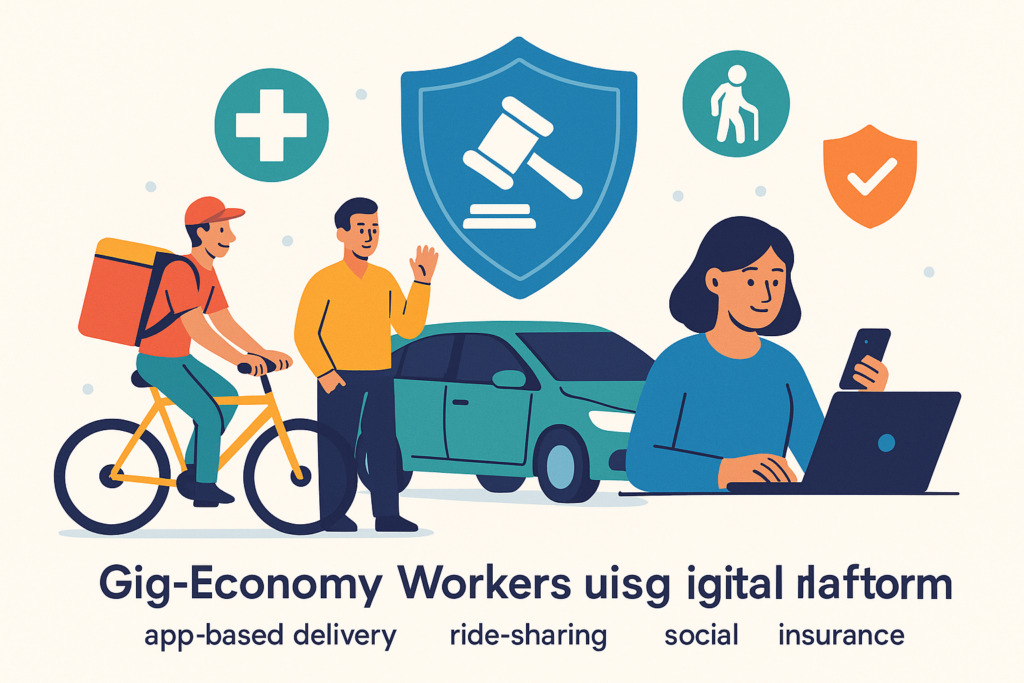
Gig Workers: Individuals outside traditional employer-employee relationships engaged in non-standard employment
Platform Workers: Those accessing work opportunities through online platforms for service delivery and payment
Unorganised Workers: Employees in unorganised sectors not covered by Industrial Disputes Act or existing social security provisions
Inter-state Migrant Workers: Mobile workforce requiring portable benefits across state boundaries
Social Security Fund and Financing
Innovative funding mechanism creates a social security fund supported by:
- Central and state government contributions
- Corporate Social Responsibility (CSR) funding
- Aggregator contributions: Digital platforms contributing 1-2% of annual turnover (up to 5% of worker payments
Digital Infrastructure: e-Shram Portal Revolution
National Database of Unorganised Workers
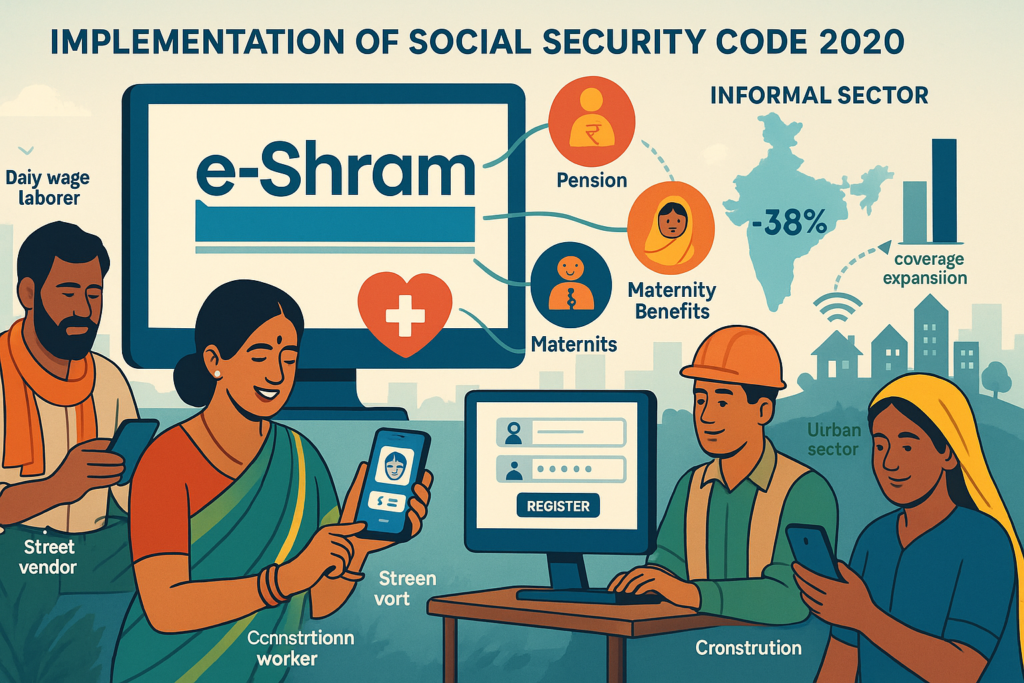
Launched August 26, 2021, the e-Shram portal creates the world’s largest database of unorganised workers with Aadhaar-based verification and Universal Account Number (UAN) issuance. Registration exceeding 30.95 crore workers by July 2025 demonstrates unprecedented scale of informal sector documentation.
Portal capabilities include:
- Self-declaration based registration minimizing bureaucratic barriers
- Aadhaar integration ensuring identity verification
- Universal Account Number providing unique worker identification
- Multi-language support for diverse linguistic populations
One-Stop-Solution Integration
Budget 2024-25 vision materialized through e-Shram “One-Stop-Solution” launched October 21, 2024, integrating 14 major welfare schemes:
Financial Security Schemes:
- PMSBY (Pradhan Mantri Suraksha Bima Yojana)
- PMJJBY (Pradhan Mantri Jeevan Jyoti Bima Yojana)
- PMSVANidhi (PM Street Vendor’s AtmaNirbhar Nidhi)
Employment and Rural Development:
- MGNREGS (Mahatma Gandhi National Rural Employment Guarantee Scheme)
- PM-KMY (Pradhan Mantri Karam Yogi Maandhan)
Housing and Healthcare:
- PMAY Gramin and Urban (Pradhan Mantri Awaas Yojana)
- AB-PMJAY (Ayushman Bharat – Pradhan Mantri Jan Arogya Yojana)
- PMMVY (Pradhan Mantri Matru Vandana Yojana)
Pension Security: PM-SYM Scheme
Contributory Pension Framework
PM-SYM (Pradhan Mantri Shram Yogi Maandhan) provides ₹3,000 monthly pension to unorganised workers with monthly income ≤₹15,000 and entry age 18-40 years. The voluntary and contributory structure ensures financial sustainability while maintaining accessibility.
Age-based contribution structure:
| Entry Age | Monthly Contribution |
|---|---|
| 18 years | ₹55 |
| 25 years | ₹100 |
| 30 years | ₹110 |
| 35 years | ₹150 |
| 40 years | ₹200 |
Flexible exit provisions accommodate erratic employment patterns common in unorganised sectors, allowing contribution regularization with penalty payments for default periods.
Enrollment and Implementation
Enrollment facilitation through Common Service Centres (CSCs), Labour offices, LIC branches, and ESIC/EPFO offices ensures widespread accessibility. 24/7 customer care (1800 2676 888) and online portal (maandhan.in) provide comprehensive support. pib
Skill Development Revolution: Skill India Mission
Mission Scale and Objectives
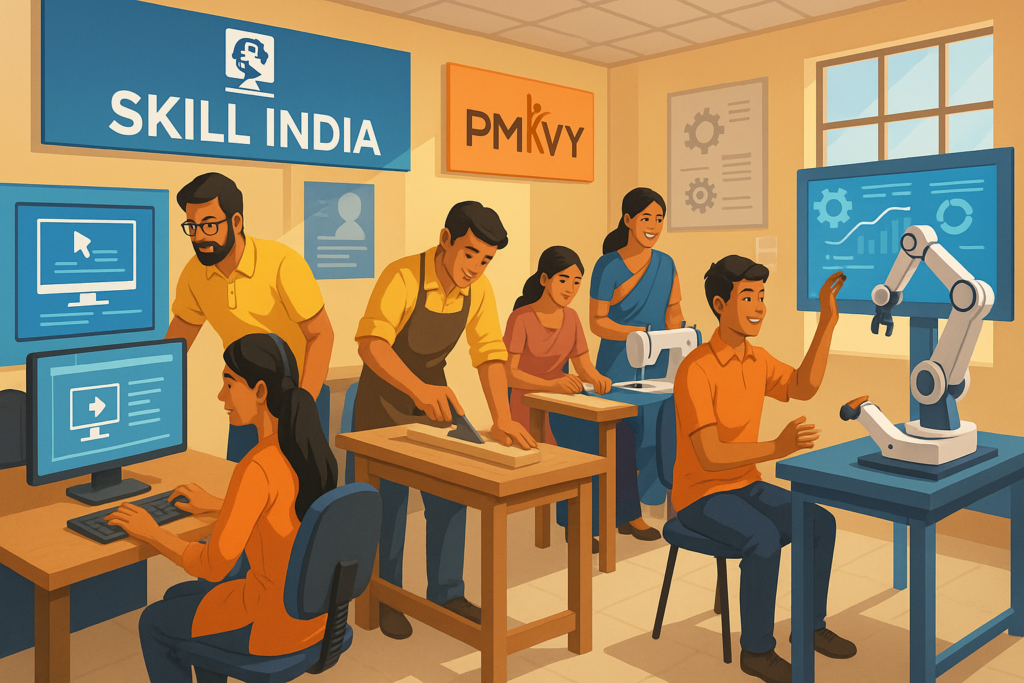
Launched July 15, 2015, Skill India Mission targets skilling 400 million youth by 2022, addressing India’s demographic dividend and industry skill requirements. Prime Minister Modi’s vision positions India as world’s human resource capital, leveraging 65% population below 35 years.
Comprehensive objectives include:
- Closing skill gaps between industry requirements and worker capabilities
- Enhancing employability through market-relevant training
- Promoting entrepreneurship and job creation
- Building global competitiveness for Indian workforce
- Supporting industry diversification across multiple sectors
Implementation Framework and Achievements
Multi-pronged implementation through specialized agencies and flagship programs:
Training Programs Performance (as of June 2024):
| Scheme | Full Form | Beneficiaries Trained |
|---|---|---|
| PMKVY | Pradhan Mantri Kaushal Vikas Yojana | 1,48,11,506 |
| JSS | Jan Shikshan Sansthan | 26,38,028 |
| NAPS | National Apprenticeship Promotion Scheme | 29,91,072 |
| CTS | Craftsman Training Scheme | 79,51,834 |
Total training exceeding 2.8 crore beneficiaries across multiple schemes demonstrates substantial progress toward 400 million target.
Sector Skill Councils and Standards
37 operational Sector Skill Councils governed by 600+ corporate representatives develop occupational standards, qualification frameworks, and competency assessments. National Skills Qualifications Framework (NSQF) ensures standardized skill recognition and career progression pathways.
Recognition of Prior Learning (RPL) validates existing skills acquired through informal learning and on-the-job experience, providing certification for traditional craftspeople and experienced workers.
Industry 4.0 and Digital Skilling
Emerging Technology Focus
Digital India integration addresses emerging skill gaps in AI, robotics, IoT, and automation technologies. Industry 4.0 initiatives focus on renewable energy, electric vehicles, and advanced manufacturing requiring specialized technical skills.
Technology adoption challenges include:
- Limited digital literacy in rural areas
- Infrastructure constraints affecting online training delivery
- Cost barriers for advanced technology training
- Rapid technology evolution requiring continuous curriculum updates
Public-Private Partnership Models
Industry collaboration through apprenticeship programs, skill development partnerships, and corporate training initiatives ensures market-relevant skill development. Apprentices Act reforms encourage industry participation with financial support through NAPS.
Challenges and Implementation Barriers
Skill Mismatch and Quality Concerns
Despite extensive training programs, skill mismatch between training outcomes and industry demand remains significant. Only 5% of workforce possesses formal skills certification, indicating substantial gaps in quality and relevance.
Quality challenges include:
- Inadequate training infrastructure in rural areas
- Limited instructor quality and technical expertise
- Outdated curriculum not reflecting current industry needs
- Poor placement rates after training completion
Awareness and Access Barriers
Research findings reveal poor awareness of social security schemes among eligible beneficiaries. Community-level workers lack adequate knowledge about available programs, application procedures, and benefit entitlements.
Access barriers include:
- Complex application processes requiring multiple documentations
- Delays in benefit processing and payment delivery
- Language barriers for non-Hindi speaking populations
- Digital divide limiting online service access
Fragmented Implementation
Multiple implementing agencies create coordination challenges and service delivery inconsistencies. Different eligibility criteria, application procedures, and benefit structures across schemes confuse potential beneficiaries.
Gender and Social Inclusion
Women’s Workforce Participation
Labour welfare and skill development programs increasingly focus on enhancing women’s participation. Textile sector provides significant employment opportunities for women workers, while maternity benefits and childcare support address gender-specific challenges.
Skill development for women emphasizes:
- Traditional crafts and handicrafts with market linkages
- Digital skills for online work opportunities
- Entrepreneurship training for self-employment
- Soft skills and communication for service sector jobs
Social Security for Marginalized Groups
Code expansion includes previously excluded categories like domestic workers, street vendors, agricultural laborers, and construction workers. Special provisions address interstate migrants, seasonal workers, and home-based workers.
Way Forward: Integration and Innovation
NEP 2020 Integration
National Education Policy 2020 integration with skill development creates comprehensive human capital framework. Vocational education mainstreaming and apprenticeship promotion align formal education with industry requirements.
Technology-Enabled Solutions
AI-driven job matching, digital skill platforms, and cluster-based training for MSMEs enhance efficiency and effectiveness. Portable benefits and digital identity systems support workforce mobility.
Blockchain technology for credential verification, mobile-first platforms for rural access, and data analytics for program optimization represent future directions.
Conclusion
India’s labour welfare and skill development transformation represents unprecedented policy ambition addressing 500 million workers through comprehensive social security and 400 million youth through skill development. The Code on Social Security 2020 creates universal coverage framework while Skill India Mission builds human capital for economic growth.
Digital infrastructure through e-Shram portal and integrated benefit delivery demonstrates innovative approaches to service delivery at massive scale. PM-SYM pension scheme and PMKVY training programs provide concrete benefits to millions of workers and youth.
However, challenges including skill mismatch, implementation fragmentation, awareness gaps, and quality concerns require sustained attention. Success depends on effective coordination, quality enhancement, technology adoption, and continuous program refinement.
The transformation extends beyond economic objectives to social inclusion, dignity of work, and human development. Gender equity, social security, and skill empowerment create foundation for sustainable and inclusive growth.
Future progress requires strengthening implementation, enhancing quality, leveraging technology, and maintaining policy continuity. India’s workforce transformation can drive economic growth while ensuring social protection and human dignity for all workers.
📝 Possible Mains Questions
- Discuss the role of labour welfare and social security reforms in ensuring inclusive growth in India. (150 words)
- “India’s demographic dividend can only be realized through large-scale skill development.” Critically examine. (250 words)





+ There are no comments
Add yours