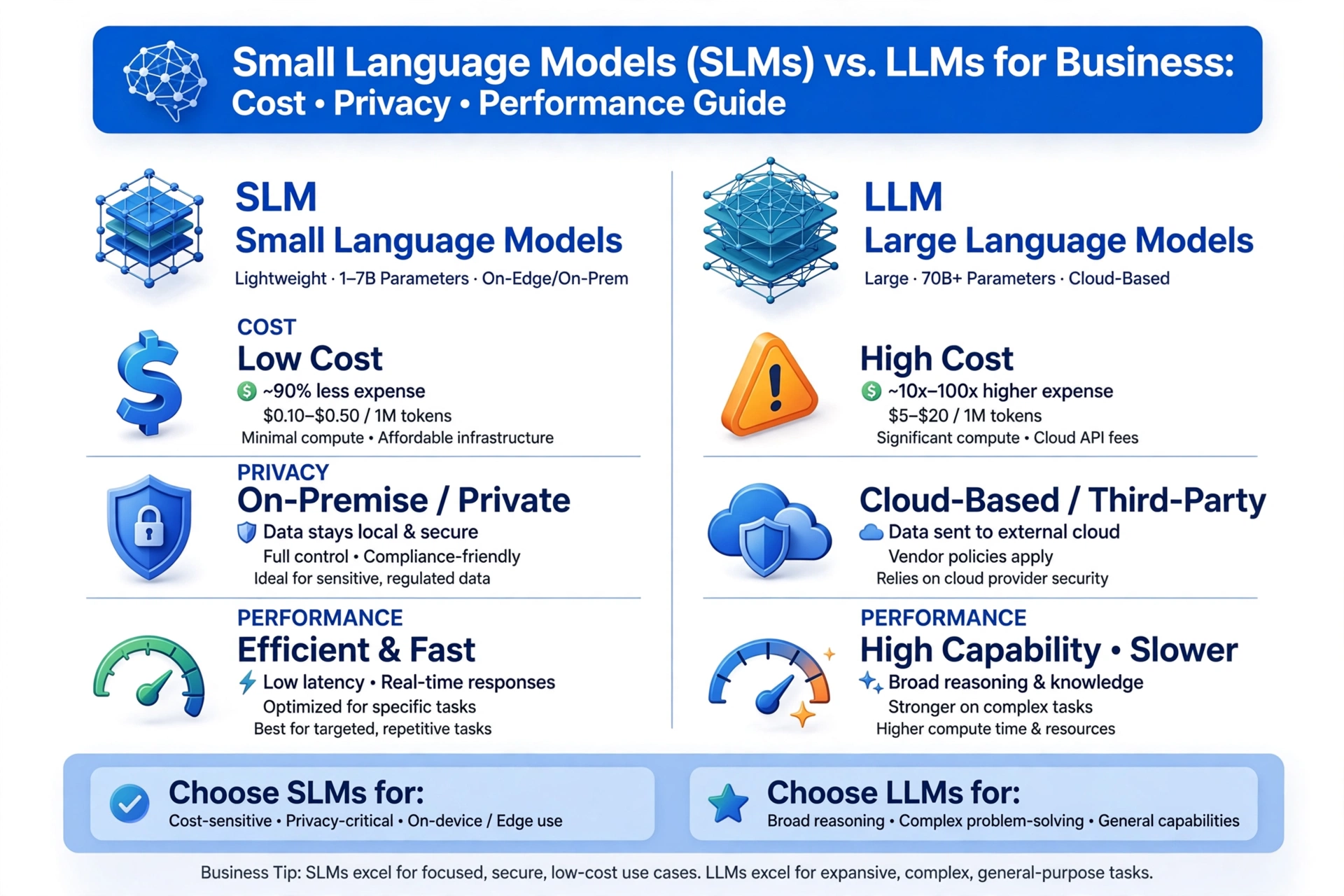
The rapid expansion of artificial intelligence across corporate software ecosystems has reached an engineering and financial crossroad. Over the past several years, the initial enterprise strategy for integrating AI was straightforward: connect internal application pipelines to cloud-hosted, multi-billion-parameter Large Language Models (LLMs) via external API endpoints. While this approach allowed organizations to quickly deploy conversational interfaces and document processing tools, running production-grade enterprise workflows entirely on third-party cloud LLMs has revealed major structural bottlenecks.
Multi-tenant frontier models present significant operational challenges for core enterprise tasks. High API token costs, unpredictable network latency, variable response times, complex data privacy compliance hurdles, and sudden model deprecations create risks for long-term scalability.
In response, enterprise engineering teams are shifting toward Small Language Models (SLMs)—compact, highly specialized models ranging from 1 billion to 15 billion parameters designed to run on private cloud nodes, edge servers, or localized hardware.
Choosing between SLMs and LLMs is not a matter of picking a single winner. Instead, it requires finding the right balance across three critical engineering dimensions: Inference Cost, Data Privacy/Sovereignty, and Domain-Specific Performance.
This comprehensive architectural guide evaluates the trade-offs between SLMs and LLMs, analyzes fine-tuning strategies, and provides a production-grade Python framework to deploy a hybrid, cost-optimized model router.
Architectural Overview: SLMs vs. LLMs
To understand why smaller models are gaining traction in production environments, we must examine how parameter efficiency, memory bandwidth, and compute requirements impact real-world infrastructure.
┌────────────────────────────────────────────────────────────────────────┐
│                      HYBRID ENTERPRISE AI ROUTER                       │
│  • Inbound Prompt & Task Complexity Classifier                          │
│  • Token Budget Allocator & SLA Policy Evaluator                       │
└───────────────────────────────────┬────────────────────────────────────┘
                                    │
                  ┌─────────────────┴─────────────────┐
                  │                                   │
                  ▼                                   ▼
┌───────────────────────────────────┐   ┌───────────────────────────────────┐
│     LOCALIZED SLM INFERENCE       │   │     FRONTIER LLM API INGRESS      │
│  • Fine-Tuned Open Source Models  │   │  • High-Parameter Reasoning       │
│  • On-Prem / Private Cloud (NPU)  │   │  • Multi-Tenant Cloud API          │
│  • Low-Latency, Zero Data Leak    │   │  • Complex Multi-Step Planning    │
└───────────────────────────────────┘   └───────────────────────────────────┘
1. Large Language Models (LLMs): High-Capacity Generalization
Frontier LLMs (typically 70B+ parameters) excel at high-ambiguity tasks, broad zero-shot reasoning, complex multi-lingual translation, and open-ended creative synthesis. Because these models store vast amounts of world knowledge across their parameter weights, they can process diverse prompts without task-specific retraining.
However, this high capacity comes with clear trade-offs: high memory consumption, high latency per generated token, and reliance on centralized, third-party cloud infrastructure.
2. Small Language Models (SLMs): Specialized Domain Efficiency
Small Language Models (typically 1B to 15B parameters) focus on targeted task execution. By training or fine-tuning compact architectures on structured, domain-specific datasets (such as corporate internal documentation, financial ledgers, or specific codebases), SLMs can match or exceed the accuracy of general-purpose LLMs on targeted tasks at a fraction of the compute cost.
SLMs can be quantized (e.g., compressed to 4-bit or 8-bit precision) and hosted directly on localized edge nodes, private cloud virtual machines, or local workstation hardware. This architecture provides sub-second response times and complete data sovereignty.
Metric Trade-Off Matrix
Choosing the right model architecture requires evaluating key operational metrics across compute, privacy, and maintenance requirements:
| Architectural Metric | Cloud-Hosted Frontier LLMs | On-Premise / Private Cloud SLMs |
| Parameter Scale | 70 Billion to 1 Trillion+ Parameters | 1 Billion to 15 Billion Parameters |
| Deployment Footprint | Multi-Tenant Hyperscale Cloud Data Centers | Private Cloud VMs, Local Edge NPUs, On-Prem Servers |
| Inference Latency | High / Variable (500ms – 3000ms Time-To-First-Token) | Ultra-Low (20ms – 150ms Time-To-First-Token) |
| Operating Cost Structure | Variable API Token Pricing (Pay per input/output token) | Fixed Infrastructure Hardware / Host Compute Costs |
| Data Privacy & Sovereignty | Data transmitted across external multi-tenant APIs | Absolute Data Ownership (Zero external network egress) |
| Domain Specialization | Broad General Knowledge (Prone to broad hallucinations) | High Precision on Fine-Tuned Domain Tasks |
| Maintenance Overhead | Zero model maintenance (Managed by vendor API) | Requires internal MLOps, quantization, and evaluation |
Deep Dive: Cost, Privacy, and Performance
1. Cost Architecture: API Token Debt vs. Fixed Hardware Margins
Relying entirely on cloud LLM APIs introduces financial risk as transaction volumes scale. As an application’s daily active user base grows, API token expenses scale linearly with traffic. High-volume enterprise workflows—such as analyzing millions of customer service logs, parsing real-time sensor streams, or generating automated code completions—can quickly create unsustainable monthly API bills.
Total Monthly LLM Cost = (Inbound Tokens + Outbound Tokens) × API Rate × Monthly Request Volume
Conversely, deploying fine-tuned SLMs transforms variable operational expenditure (OpEx) into predictable, capped infrastructure costs. A quantized 7B-parameter SLM can comfortably run on a single cost-effective GPU instance or edge hardware, handling millions of monthly requests for a fixed compute hosting cost.
Total Monthly SLM Cost = Fixed Private Cloud VM Instance Cost + Local MLOps Storage
   Monthly Operational Expense ($)
   ▲
   │                                  /  Cloud LLM API Cost (Linear Scaling)
   │                                 /
   │                                /   ◄── High Token Volume Crossover Point
   │                               /
   │  ----------------------------/------------------- Private SLM Hosting (Fixed Cost)
   │                            /
   │                           /
   └──────────────────────────┴────────────────────────► Monthly Request Volume
2. Data Privacy & Sovereign Compliance
For enterprises operating in regulated industries—such as healthcare (HIPAA), financial services (FINRA/PCI-DSS), legal compliance, or government defense—sending confidential customer records or proprietary codebases across external cloud API networks creates major compliance barriers. Even with contractual zero-data-retention agreements, enterprise security teams must evaluate third-party network egress risks.
SLMs solve this privacy challenge through Local Air-Gapped Deployment. Because compact models can be hosted inside an organization’s private Virtual Private Cloud (VPC) or directly on on-premise hardware, sensitive data never leaves the corporate security boundary. This approach ensures total compliance with data sovereignty regulations while protecting proprietary intellectual property.
3. Task Performance & Fine-Tuning Precision
While broad LLMs perform well across general trivia and conversational tasks, they frequently struggle with domain-specific nuances, proprietary terminologies, and rigid structural outputs (such as generating validated JSON matching an internal database schema).
Through techniques like Low-Rank Adaptation (LoRA) and Direct Preference Optimization (DPO), engineering teams can fine-tune a 7B or 8B parameter open-source SLM on high-quality internal datasets. The resulting specialized SLM routinely outperforms massive generalist models on target benchmarks—such as extraction accuracy, structural compliance, and domain terminology—while generating responses at a fraction of the latency.
Deploying a Hybrid AI Architecture: The Model Router
Rather than forcing a rigid binary choice between SLMs and LLMs, leading enterprise software architectures use a Hybrid AI Routing Strategy.
In a hybrid framework, a lightweight classifier acts as an intelligent traffic controller at the application ingress layer. Simple queries, structured extraction tasks, and data-sensitive requests are directed to low-cost local SLMs. High-complexity planning, multi-step creative reasoning, and ambiguous open-ended prompts are routed to frontier LLM APIs.
[ Inbound User Request ] ──► [ Query Complexity Classifier ]
                                         │
                   ┌─────────────────────┴─────────────────────┐
                   │                                           │
                   ▼ (Simple / Sensitive / Structured)          ▼ (Complex / Unstructured)
┌──────────────────────────────────────┐     ┌──────────────────────────────────────┐
│       LOCALIZED PRIVATE SLM          │     │        FRONTIER LLM API             │
│  • 20ms - 100ms Low Latency          │     │  • High-Parameter Reasoning          │
│  • Zero-Egress Data Security         │     │  • Multi-Step Task Synthesis         │
│  • Fixed Infrastructure Overhead     │     │  • Variable Token Cost Rate          │
└──────────────────────────────────────┘     └──────────────────────────────────────┘
Production Code Blueprint: Asynchronous Hybrid AI Router in Python
The production-grade Python implementation below demonstrates an Asynchronous Intelligent Hybrid AI Router. It evaluates inbound prompt complexity, checks for sensitive data markers, enforces SLA latency targets, and dynamically routes tasks between a local SLM inference endpoint and a cloud LLM API provider.
Python
#!/usr/bin/env python3
"""
Production-Grade Enterprise Hybrid AI Router Engine.
Dynamically routes inference workloads between local SLMs and cloud LLMs based on task complexity.
"""

import asyncio
import json
import logging
import re
import time
from dataclasses import dataclass
from enum import Enum
from typing import Dict, Any, Optional

# Configure Clean Enterprise Operations Logging Layout
logging.basicConfig(
    level=logging.INFO,
    format='%(asctime)s [%(levelname)s] (AIRouterEngine) %(message)s'
)
logger = logging.getLogger("EnterpriseAIRouter")

class ExecutionTarget(Enum):
    LOCAL_SLM = "LOCAL_SLM"
    CLOUD_LLM = "CLOUD_LLM"

@dataclass
class InferenceRequest:
    request_id: str
    prompt: str
    is_sensitive: bool = False
    max_acceptable_latency_ms: float = 500.0
    required_json_output: bool = False

@dataclass
class InferenceResponse:
    request_id: str
    execution_target: ExecutionTarget
    response_text: str
    latency_ms: float
    estimated_cost_usd: float

class LocalSLMService:
    """Simulates an on-premise, localized SLM endpoint running quantized open-source weights."""
    def __init__(self, endpoint_url: str = "http://localhost:8080/v1/completions"):
        self.endpoint_url = endpoint_url

    async def generate(self, prompt: str) -> str:
        # Simulate low-latency local NPU/GPU inference
        await asyncio.sleep(0.04)  # ~40ms processing time
        return json.dumps({
            "status": "SUCCESS",
            "source": "Local-SLM-7B",
            "extracted_data": "Parsed structured payload successfully."
        })

class CloudLLMService:
    """Simulates a multi-tenant frontier cloud LLM API endpoint."""
    def __init__(self, api_key: str = "sk-enterprise-mock-key"):
        self.api_key = api_key

    async def generate(self, prompt: str) -> str:
        # Simulate network latency and processing time of a high-parameter cloud model
        await asyncio.sleep(0.45)  # ~450ms processing time
        return "Frontier Cloud LLM: Comprehensive multi-step reasoning completed successfully."

class HybridAIRouter:
    """Intelligent router evaluating prompt requirements to balance cost, privacy, and speed."""
    def __init__(self, slm_service: LocalSLMService, llm_service: CloudLLMService):
        self.slm = slm_service
        self.llm = llm_service
        # Define complex reasoning indicator keywords
        self.complex_reasoning_keywords = [
            "compare and contrast", "synthesize", "strategic roadmap",
            "theoretical framework", "multi-step plan"
        ]

    def _assess_prompt_complexity(self, prompt: str) -> float:
        """Calculates a normalized complexity score (0.0 = Simple, 1.0 = Highly Complex)."""
        prompt_lower = prompt.lower()
        score = 0.2  # Base score

        # Increase complexity score based on length and specific keywords
        if len(prompt.split()) > 100:
            score += 0.3

        for keyword in self.complex_reasoning_keywords:
            if keyword in prompt_lower:
                score += 0.4
                break

        return min(score, 1.0)

    def determine_optimal_target(self, request: InferenceRequest) -> ExecutionTarget:
        """Determines whether to execute via local SLM or cloud LLM based on policy rules."""
        # Rule 1: Absolute Data Sovereignty Enforcement
        if request.is_sensitive:
            logger.info(f"[{request.request_id}] Route -> LOCAL_SLM (Reason: Data Privacy / Sensitive Payload)")
            return ExecutionTarget.LOCAL_SLM

        # Rule 2: Strict Low-Latency SLA Constraints
        if request.max_acceptable_latency_ms < 100.0:
            logger.info(f"[{request.request_id}] Route -> LOCAL_SLM (Reason: Strict Latency Constraint < 100ms)")
            return ExecutionTarget.LOCAL_SLM

        # Rule 3: Structured JSON Formatting (SLMs fine-tuned for structural output)
        if request.required_json_output:
            logger.info(f"[{request.request_id}] Route -> LOCAL_SLM (Reason: Structured Schema Extraction)")
            return ExecutionTarget.LOCAL_SLM

        # Rule 4: Dynamic Complexity Thresholding
        complexity = self._assess_prompt_complexity(request.prompt)
        if complexity >= 0.7:
            logger.info(f"[{request.request_id}] Route -> CLOUD_LLM (Reason: High Prompt Complexity Score = {complexity:.2f})")
            return ExecutionTarget.CLOUD_LLM

        logger.info(f"[{request.request_id}] Route -> LOCAL_SLM (Reason: Cost Optimization Default Score = {complexity:.2f})")
        return ExecutionTarget.LOCAL_SLM

    async def execute_inference(self, request: InferenceRequest) -> InferenceResponse:
        start_time = time.time()
        target = self.determine_optimal_target(request)

        if target == ExecutionTarget.LOCAL_SLM:
            response_text = await self.slm.generate(request.prompt)
            latency = (time.time() - start_time) * 1000
            # Fixed local compute cost calculation (~$0.00001 per request amortization)
            cost = 0.00001
        else:
            response_text = await self.llm.generate(request.prompt)
            latency = (time.time() - start_time) * 1000
            # Cloud API token pricing calculation (~$0.003 per request estimation)
            cost = 0.003

        logger.info(f"[{request.request_id}] Executed on {target.value} in {latency:.2f}ms | Est Cost: ${cost:.5f}")
        return InferenceResponse(
            request_id=request.request_id,
            execution_target=target,
            response_text=response_text,
            latency_ms=latency,
            estimated_cost_usd=cost
        )

async def main():
    slm_node = LocalSLMService()
    llm_node = CloudLLMService()
    router = HybridAIRouter(slm_service=slm_node, llm_service=llm_node)

    # Define various test workloads to demonstrate dynamic routing
    workload_samples = [
        InferenceRequest(
            request_id="req-001",
            prompt="Extract user phone numbers and return a clean JSON list.",
            is_sensitive=True,
            required_json_output=True
        ),
        InferenceRequest(
            request_id="req-002",
            prompt="Synthesize a comprehensive, multi-step strategic roadmap for international expansion.",
            is_sensitive=False,
            max_acceptable_latency_ms=2000.0
        ),
        InferenceRequest(
            request_id="req-003",
            prompt="Parse this incoming customer support log and extract sentiment.",
            is_sensitive=False,
            max_acceptable_latency_ms=50.0
        )
    ]

    logger.info("Starting Enterprise Hybrid AI Router Workload Execution...")
    for req in workload_samples:
        res = await router.execute_inference(req)
        print(f"-> ID: {res.request_id} | Target: {res.execution_target.value} | Speed: {res.latency_ms:.1f}ms | Cost: ${res.estimated_cost_usd:.5f}\n")

if __name__ == "__main__":
    asyncio.run(main())
Related Technical Resources
- To see how autonomous agents use standardized tool interfaces to connect with internal databases, explore our detailed guide on Building Enterprise Agentic AI Workflows: Architecture, Orchestration, and Scaling.
- To see how clean software architectures run autonomous processes efficiently, check out our guide on Autonomous Agentic AI for Supply Chain Optimization.
- To learn how to build lightweight, code-first customer registries that track system metrics securely, read our implementation manual for a Lightweight CRM Built from Scratch with Python and SQLite.
Frequently Asked Questions (FAQ)
Q1: Can a Small Language Model (SLM) really match the performance of a Large Language Model (LLM)?
Yes, on targeted, domain-specific tasks. While a general-purpose LLM outperforms an SLM on broad trivia, creative writing, or complex multi-step reasoning, an SLM (such as an 8B model) fine-tuned on specialized corporate data routinely matches or exceeds the accuracy of massive frontier models for specific tasks like schema extraction, classification, or domain-specific SQL generation.
Q2: What hardware is required to run a 7B or 8B parameter SLM locally?
When compressed using modern 4-bit or 8-bit quantization techniques (such as AWQ or GGUF formats), an 8B parameter model requires less than 8GB to 12GB of VRAM. This allows it to run efficiently on accessible consumer-grade GPUs, specialized workstation NPUs, or cost-effective cloud virtual machines without needing expensive multi-GPU clusters.
Q3: How does quantization affect the accuracy of Small Language Models?
Quantization reduces the precision of model weights (for example, compressing 16-bit floating-point numbers down to 4-bit integers). While extreme compression can lead to minor quality drops, modern quantization algorithms preserve nearly 95% to 98% of the model’s baseline accuracy while cutting memory footprints by up to 75% and speeding up token generation significantly.
Reference Links & Strategic Tags
- Gartner Executive Report on Small Language Models in Enterprise Infrastructure: https://www.gartner.com/en/information-technology
- Hugging Face Open LLM & SLM Performance Benchmarks: https://huggingface.co/spaces/open-llm-leaderboard/open_llm_leaderboard
- NIST AI Infrastructure Security & Private Deployment Guidelines: https://www.nist.gov/itl/ai-risk-management-framework
Internal related links
Smaller AI models trained on domain-specific datasets
How Indian businesses are adopting LLMs for productivity
Cost comparison of local vs cloud-hosted AI models




+ There are no comments
Add yours