Key Highlights
- India’s first space-based cosmic dawn mission: PRATUSH will be positioned in lunar orbit by 2030, making India among the few nations pursuing deep-space radio astronomy
- Revolutionary 21-cm signal detection: The mission targets faint hydrogen signals from 200 million years after Big Bang, when first stars and galaxies formed in the early Universe
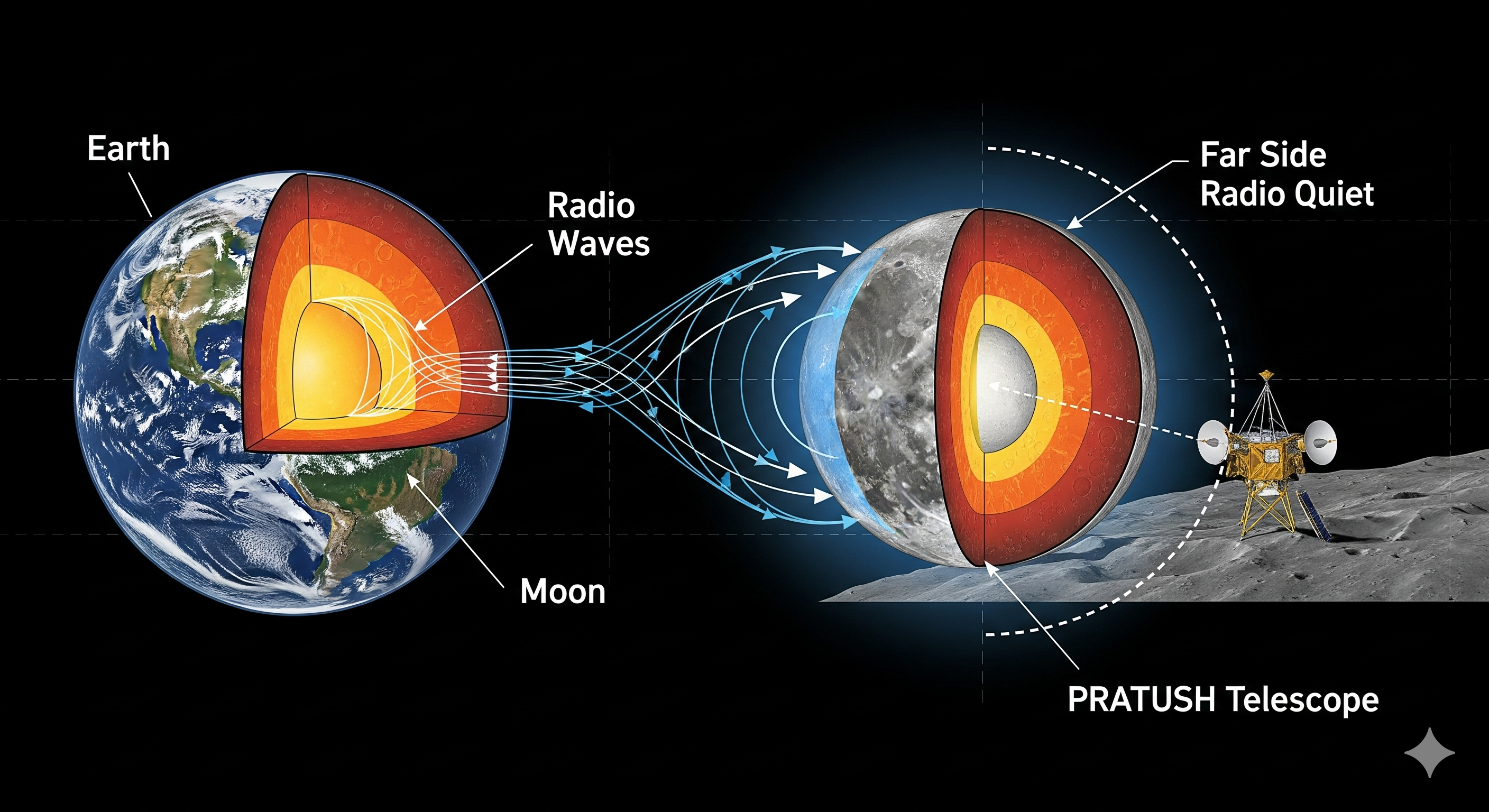
- Natural radio-quiet zone advantage: Moon’s far side provides 90 dB radio interference shielding, creating optimal conditions for detecting whisper-quiet cosmic signals buried under terrestrial noise
- ISRO-RRI collaboration breakthrough: Raman Research Institute Bengaluru with ISRO developed credit card-sized digital receivers and CubeSat-scale instruments reducing mission costs
- Advanced signal processing technology: AI-driven detection algorithms will isolate signals millions of times fainter than galactic foreground radiation using precision radiometer technology

The Dawn of Cosmic Exploration
PRATUSH (Probing ReionizATion of the Universe using Signal from Hydrogen) represents India’s most ambitious foray into cosmic archaeology, aiming to unveil the mysteries of the Cosmic Dawn—the epoch when the first stars flickered to life approximately 200 million years after the Big Bang. This pioneering mission positions India alongside global leaders in deep-space exploration and radio astronomy. pib
The mission’s significance extends beyond scientific discovery, embodying India’s technological prowess and strategic vision outlined in the Space Policy 2023. By targeting one of astronomy’s most challenging frontiers, PRATUSH demonstrates India’s commitment to cutting-edge space science and international collaboration. rri
Cosmic Dawn remains one of the least understood epochs in cosmic history, representing the transition from a dark, cold universe filled with neutral hydrogen to a luminous cosmos populated by stars, galaxies, and complex structures. Understanding this transformation holds keys to fundamental questions about galaxy formation, dark matter distribution, and cosmic evolution.

Understanding the 21-cm Hydrogen Signal
The 21-cm hydrogen line represents the universe’s most ancient whisper, carrying information from cosmic epochs invisible to conventional telescopes. This signal originates from neutral hydrogen atoms in the intergalactic medium, providing a three-dimensional map of the early universe across redshift ranges z~6-1000.
Signal characteristics include:
- Original frequency: 1420 MHz from neutral hydrogen
- Redshifted frequency: 50-200 MHz due to cosmic expansion
- Signal strength: Extremely faint, buried under foreground radiation millions of times stronger
- Information content: Temperature, density, and ionization state of primordial gas
The detection challenge resembles “hearing a whisper in a stadium full of noise”, requiring unprecedented sensitivity and interference mitigation. Ground-based attempts face insurmountable obstacles from terrestrial radio interference, ionospheric distortion, and man-made electromagnetic pollution.
Moon’s Far Side: The Ultimate Radio Sanctuary
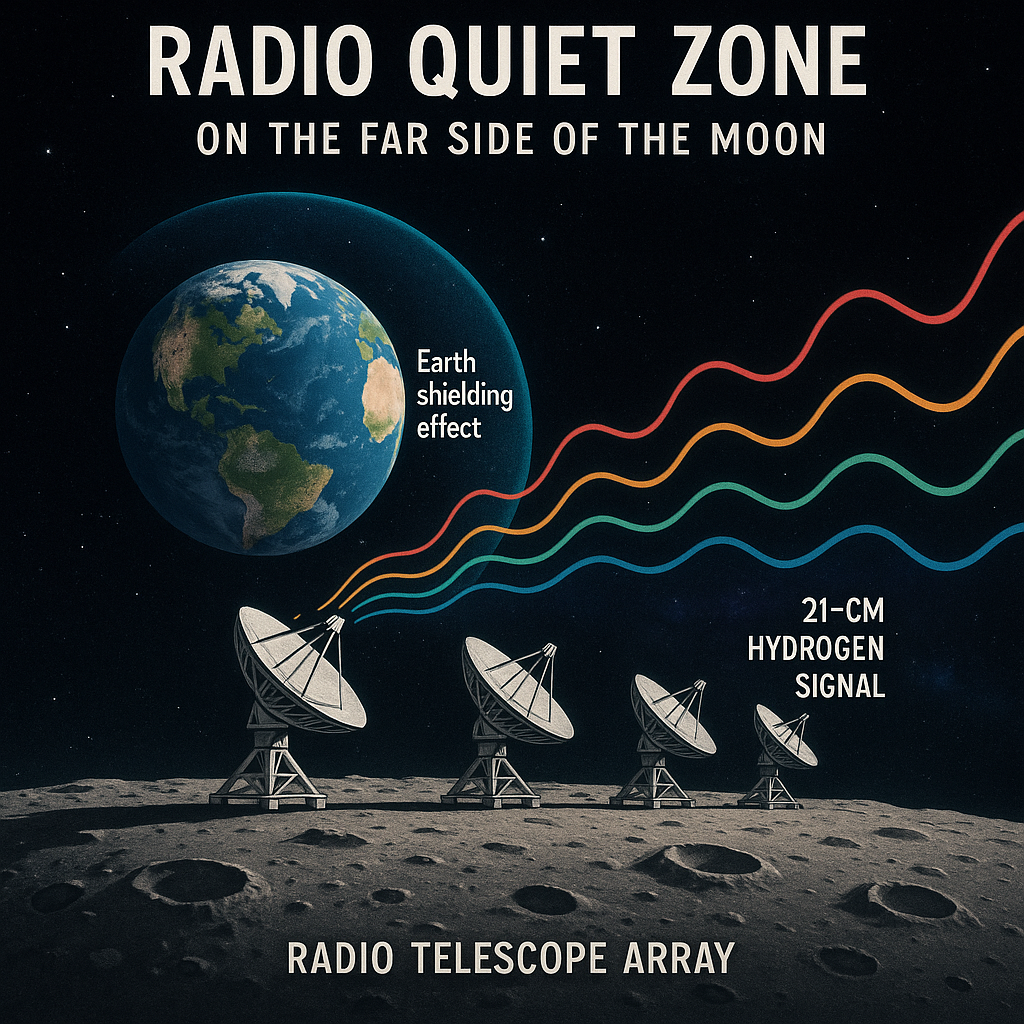
The Moon’s far side offers an unparalleled radio-quiet environment, naturally shielded from Earth’s electromagnetic cacophony by 3,400 kilometers of lunar mass. This Radio Quiet Zone (RQZ) provides 90 dB attenuation of terrestrial signals, creating conditions impossible to achieve on Earth.
Technical advantages include:
- Natural shielding: Moon acts as a massive radio frequency barrier
- Stable environment: No ionosphere, minimal atmospheric disturbance
- Low noise floor: Eliminates terrestrial interference, satellite signals, lightning strikes
- Geometric protection: ±108° longitude coverage ensures consistent quiet zone
The Protected Antipode Circle (PAC) concept, proposed by international astronomers, seeks to establish a 1,130-mile wide protected zone on the lunar far side, preserving this unique cosmic treasure for future generations. This initiative recognizes the irreplaceable value of the Moon’s natural radio sanctuary.
PRATUSH Mission Architecture and Technology
Miniaturization Revolution
PRATUSH leverages breakthrough miniaturization, utilizing a compact single-board computer about the size of a credit card to manage precision radio measurements. This CubeSat-scale approach dramatically reduces mission costs while maintaining scientific capability.
Core components include:
- Wideband frequency-independent antenna: Optimized for 30-250 MHz reception
- Self-calibrating analog receiver: Minimizes systematic errors
- Digital correlator: Processes high-resolution spectral data
- AI-driven signal processing: Isolates faint cosmological signals
The mission design targets millikelvin sensitivity without systematic limitations, representing the pinnacle of radio astronomy precision.
Orbital Strategy and Operations
PRATUSH will operate in circumlunar orbit, conducting scientific observations during far-side passages and transmitting data to Earth during near-side phases. This operational cycle ensures optimal observation conditions while maintaining communication links.
Mission parameters:
- Launch timeline: By 2030 via ISRO launch vehicle
- Mission duration: Two years of primary operations
- Orbit type: Lunar orbit optimized for radio-quiet observations
- Frequency coverage: 40-200 MHz with 100 kHz resolution
- Sky coverage: Large area continuous observations
Scientific Objectives and Expected Discoveries
Cosmic Dawn Revelations
PRATUSH aims to answer fundamental questions about cosmic history:
- When did the first stars form?
- What were the properties of Population III stars?
- How did early galaxies shape cosmic evolution?
- What role did dark matter play in structure formation?
The mission will provide unprecedented insights into reionization processes, galaxy formation mechanisms, and early universe physics.
Global Signal Detection
The global 21-cm signal represents the sky-averaged signature of cosmic evolution, revealing timing of cosmic milestones including:
PRATUSH’s sensitivity enables detection of predicted cosmic dawn signals with varying degrees of confidence, potentially confirming or challenging current cosmological models.
International Context and Collaboration
Global Radio Astronomy Initiatives
PRATUSH joins an elite group of missions targeting cosmic dawn detection:
NASA’s DARE (Dark Ages Radio Explorer): Proposed space-based mission for dark ages exploration
EDGES Experiment: Ground-based efforts claiming controversial cosmic dawn detection
China’s Chang’e-4: Relay satellite on Moon’s far side with radio astronomy capabilities
European initiatives include the Square Kilometre Array (SKA) and REACH experiment, demonstrating global interest in 21-cm cosmology.
India’s Strategic Position
PRATUSH strengthens India’s position in international space science, demonstrating indigenous capabilities in cutting-edge technology and deep-space exploration. The mission aligns with India’s broader space ambitions, including human spaceflight, lunar exploration, and interplanetary missions.
Collaboration benefits include:
- Technology transfer and knowledge sharing
- International prestige and scientific leadership
- Commercial opportunities in space technology
- Educational impact on future scientists
Technological Innovation and Development
Raman Research Institute Excellence
RRI Bengaluru brings decades of expertise in radio astronomy and precision instrumentation. The institute’s SARAS telescope program provides crucial experience in 21-cm signal detection and foreground mitigation.
Key achievements include:
- Indigenous radio telescope development
- Novel deployment strategies (including floating telescopes)
- Precision calibration techniques
- Advanced signal processing algorithms
PRATUSH builds upon this heritage of innovation, incorporating lessons learned from ground-based experiments into space-ready technology.
AI and Signal Processing Breakthroughs
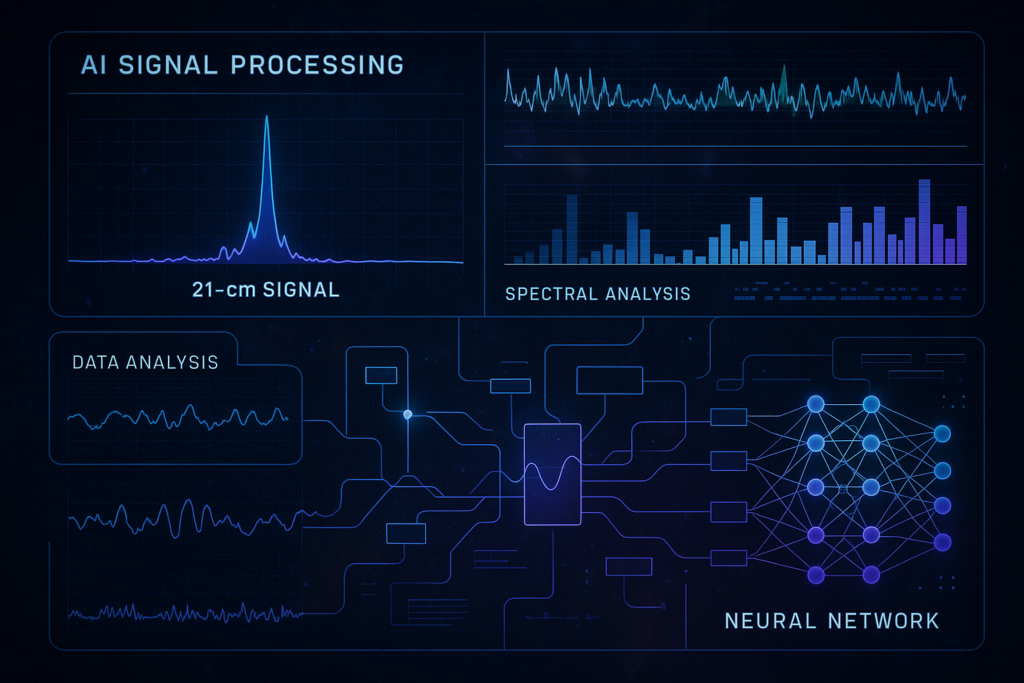
Artificial intelligence plays a crucial role in PRATUSH’s success, enabling detection of signals buried under overwhelming foreground noise. Machine learning algorithms will:
- Identify faint cosmological signatures
- Distinguish signal from interference
- Optimize observation strategies
- Process massive datasets efficiently
These AI-driven approaches represent the future of radio astronomy, enabling discoveries impossible with traditional methods.
Challenges and Solutions
Technical Hurdles
PRATUSH faces significant technical challenges:
- Foreground contamination: Galactic emissions are 10,000 times stronger than cosmic signals
- Systematic errors: Instrument calibration requires unprecedented precision
- Data processing: Massive datasets demand advanced algorithms
- Space environment: Thermal stability and radiation resistance are critical
Innovative solutions include:
- Self-calibrating receivers minimizing systematic errors
- AI-powered foreground removal algorithms
- Robust space-qualified electronics
- Comprehensive ground testing and validation
International Coordination
Lunar far-side protection requires international cooperation to prevent radio frequency interference from future space activities. The International Academy of Astronautics is developing frameworks for protecting this unique environment.
Mission Timeline and Future Prospects
Development Roadmap
PRATUSH currently undergoes pre-project studies with concept model development leading to engineering model and flight model construction. The 2030 launch target aligns with India’s ambitious space program timeline.
Key milestones:
- 2025-2026: Engineering model development and testing
- 2027-2029: Flight model construction and integration
- 2030: Launch and commissioning
- 2030-2032: Primary mission operations
Legacy and Impact
PRATUSH’s success will establish India as a leader in cosmic dawn research, potentially making groundbreaking discoveries about the universe’s earliest epochs. The mission’s technological innovations will benefit future space missions and commercial applications.
Long-term benefits include:
- Scientific breakthroughs in cosmology and astrophysics
- Technological advancement in radio astronomy
- International collaboration opportunities
- Educational inspiration for future generations
Sustainability and Ethics in Space Exploration
PRATUSH raises important questions about responsible space exploration and environmental preservation beyond Earth. The mission’s location on the Moon’s far side highlights the need to protect unique cosmic environments for future scientific research.
Ethical considerations include:
- Preserving radio-quiet zones for scientific research
- Balancing exploration with environmental protection
- International cooperation in space governance
- Sustainable development of lunar resources
Global Implications and Future Directions
PRATUSH represents more than a single mission—it embodies humanity’s quest to understand cosmic origins and India’s role in that endeavor. Success will inspire future missions targeting even earlier cosmic epochs and more sophisticated measurements.
Future possibilities include:
- Multi-spacecraft constellations for enhanced sensitivity
- Lunar surface arrays for high-resolution mapping
- Interplanetary radio telescopes for ultra-long baseline interferometry
- Next-generation missions targeting primordial gravitational waves
Conclusion
PRATUSH stands poised to revolutionize our understanding of the universe’s earliest epochs, carrying India’s scientific ambitions to the Moon’s far side in pursuit of cosmic truth. This pioneering mission combines cutting-edge technology, international collaboration, and visionary leadership to tackle one of astronomy’s greatest challenges.
The mission’s 2030 launch will mark a historic milestone for Indian space science, potentially delivering discoveries that reshape our understanding of cosmic evolution and galaxy formation. PRATUSH’s success will establish India as a global leader in deep-space exploration and radio astronomy.
Beyond scientific achievement, PRATUSH embodies the spirit of human exploration and our insatiable curiosity about the cosmos. As the mission prepares to listen for whispers from the universe’s dawn, it carries the hopes and dreams of a nation and the scientific community worldwide.
The Moon’s far side awaits, radio-quiet and pristine, ready to reveal secrets locked in cosmic hydrogen for over 13 billion years. PRATUSH will be our ear to the cosmos, finally hearing the universe’s first words and understanding how darkness became light in the cosmic dawn.
📝 Mains Questions
- Science & Tech:
“Discuss the significance of PRATUSH in advancing India’s space science and its role in unlocking insights about the Cosmic Dawn epoch.” - Policy & Ethics:
“Space beyond Earth orbit is considered a global commons. Critically examine how missions like PRATUSH can be balanced with ethical exploration and sustainable use of the Moon’s far side.” - Case-Based Question:
ISRO is considering international collaboration for PRATUSH’s lunar deployment. As a space policy analyst, outline measures to ensure data-sharing, ethical exploration, and protection of radio-quiet zones.







+ There are no comments
Add yours