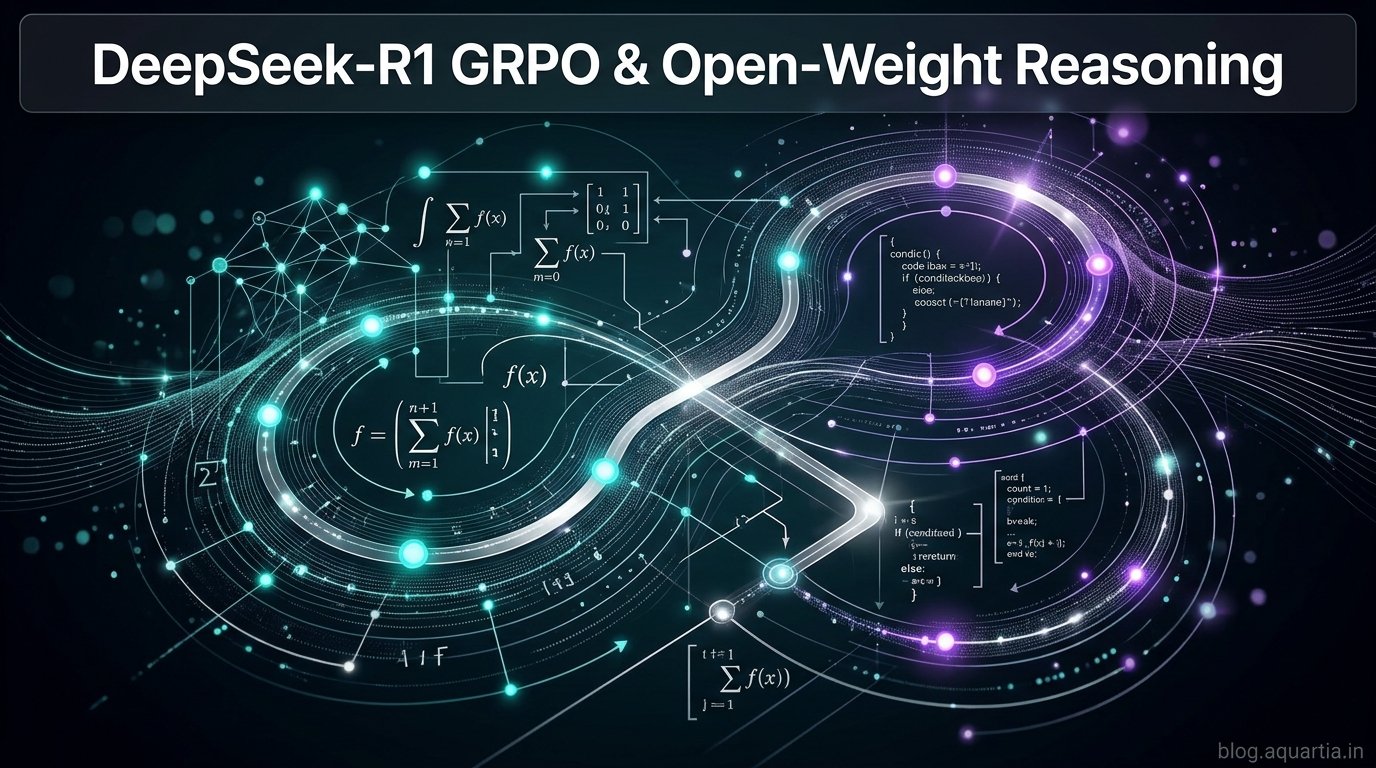
Reasoning capabilities are no longer locked inside proprietary frontier APIs. The rise of open-weight reasoning models—sparked by breakthroughs like DeepSeek-R1 using Group Relative Policy Optimization (GRPO)—proved that pure reinforcement learning over verifiable tasks can unlock strong multi-step reasoning without massive critic-model overhead (Taskade, Zylos).
How GRPO Works Without a Critic Model
Traditional reinforcement learning (such as PPO) requires training a separate value/critic model of similar size to the policy model, doubling memory overhead. GRPO drops the critic model and instead samples a group of candidate answers for each prompt, scoring them against verifiable outcomes (e.g., math solutions or unit tests) and using the group’s average reward as the baseline (Taskade). Using pure RL, DeepSeek-R1-Zero improved AIME 2024 pass@1 accuracy from 15.6% to 71.0% (Taskade).
Why Open-Weight Reasoning Matters for Enterprises in 2026
1. Data Sovereignty: Regulated industries can host reasoning models inside private VPCs or on-premise clusters.
2. Predictable Cost at Scale: Fixed GPU cluster pricing eliminates per-thinking-token billing spikes on high-volume internal workloads.
3. Custom RL Environments: Engineering teams can fine-tune open-weight models directly on domain-specific verifiers (SQL execution, compiler checks, or internal policy engines).
Internal & Further Reading
Explore open-source high-parameter deployment in our NVIDIA Nemotron 3 Ultra 550B A55B Guide.
Frequently Asked Questions
What is GRPO in AI training?
Group Relative Policy Optimization (GRPO) is a reinforcement learning algorithm that removes the separate critic network and computes baselines from a group of sampled outputs, cutting training memory and cost (Taskade).







+ There are no comments
Add yours