
Key Highlights
- Railway investment increased five-fold since 2014 with cumulative ₹62,477 crore allocation and ongoing projects worth ₹77,000 crore transforming regional connectivity
- PM-DevINE scheme provides ₹6,600 crore (2022-26) with 100% central funding for infrastructure convergence, social development and livelihood enhancement
- Act East Policy positions Northeast as gateway with 5,182 km international borders (98% of total) connecting to Southeast Asia through major projects
- NESIDS sanctioned 90 projects worth ₹3,417.68 crore during 2021-24 covering healthcare, education, water supply and industrial development infrastructure
- Airport connectivity doubled from 9 to 17 with 194 UDAN routes and 113% passenger traffic growth demonstrating transformation in regional accessibility
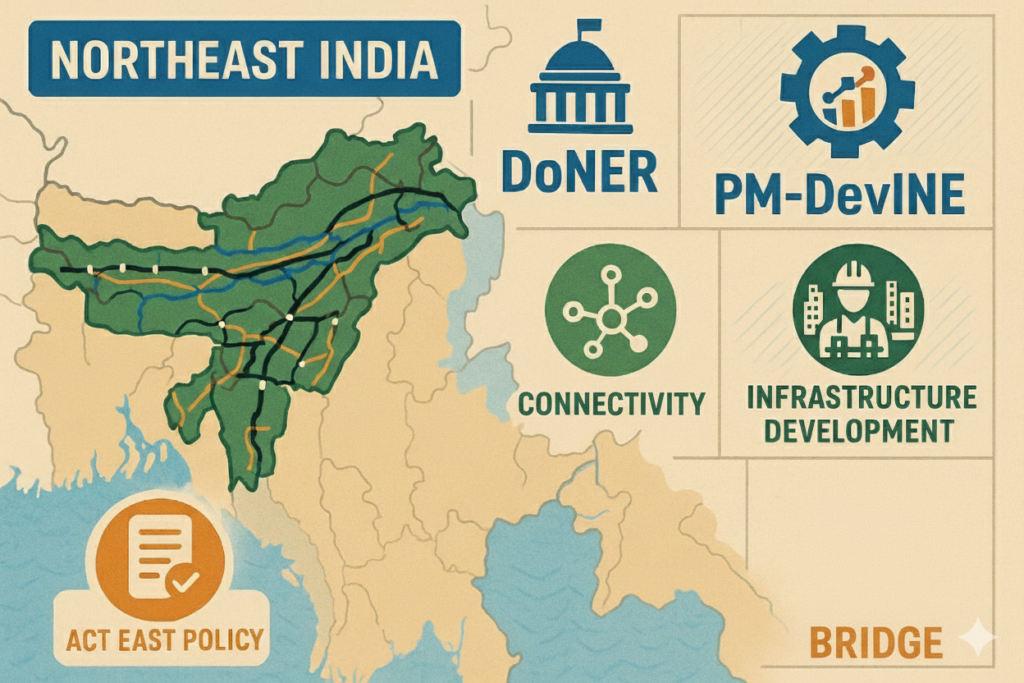
The Northeast Region (NER), comprising eight states with their distinct identities and immense potential, has long been perceived as India’s “remote corner” despite being the gateway to 98% of the country’s international borders. This perception is rapidly changing as the region undergoes a historic transformation through unprecedented infrastructure investment and policy focus. With the railway budget allocation increasing five-fold since 2014 to a cumulative ₹62,477 crore and ongoing projects worth ₹77,000 crore, the Northeast is witnessing the highest level of investment in its history. The Prime Minister’s Development Initiative for North Eastern Region (PM-DevINE) with an outlay of ₹6,600 crore (2022-26) represents the government’s commitment to bridging development gaps and connecting this culturally rich, strategically vital region to India’s mainstream development narrative. pib
Historical Context: From Neglect to National Priority
Colonial Legacy and Post-Independence Challenges
The Northeast’s journey from colonial-era “frontier zone” treatment to its current status as a strategic development priority reflects India’s evolving understanding of national integration. During British rule, the region was treated as a buffer zone with minimal administrative integration, creating long-lasting connectivity and developmental challenges. nedfi
Post-Independence Development Patterns:
- 1950s-1980s: Security-focused approach with limited socioeconomic investment
- 1962 India-China War: Exposed critical infrastructure gaps and strategic vulnerabilities
- 1990s: Beginning of systematic development efforts with Look East Policy
- 2014-present: Comprehensive transformation through Act East Policy and enhanced budgetary allocations ddnews.gov
Strategic Awakening: The 1962 Watershed
The 1962 India-China conflict served as a strategic awakening, highlighting the region’s critical importance for national security while exposing severe infrastructure deficits. This realization gradually shifted policy focus from mere border management to comprehensive regional development.
Institutional Architecture for Development
Ministry of Development of North Eastern Region (DoNER)
Established in 2001, the Ministry of DoNER represents the institutional commitment to the Northeast’s development, serving as the nodal ministry for coordinating developmental efforts across eight states. pib
DoNER’s Comprehensive Mandate:
- Policy formulation: Regional development strategies and schemes
- Inter-ministerial coordination: Ensuring coherent development approach
- Resource mobilization: Central funding allocation and monitoring
- Capacity building: Institutional strengthening in NE states
North Eastern Council (NEC): Advisory and Planning Body
The North Eastern Council, established as a statutory advisory body, plays a crucial role in regional planning and coordination, ensuring that development initiatives reflect local needs and priorities.
NEC Functions:
- Regional development planning: Comprehensive area development approach
- Inter-state coordination: Facilitating collaborative projects
- Scheme implementation: Executing central sector schemes
- Policy advisory: Providing regional perspectives to central government
Flagship Schemes: Transforming Infrastructure and Livelihoods
PM-DevINE: Holistic Development Initiative
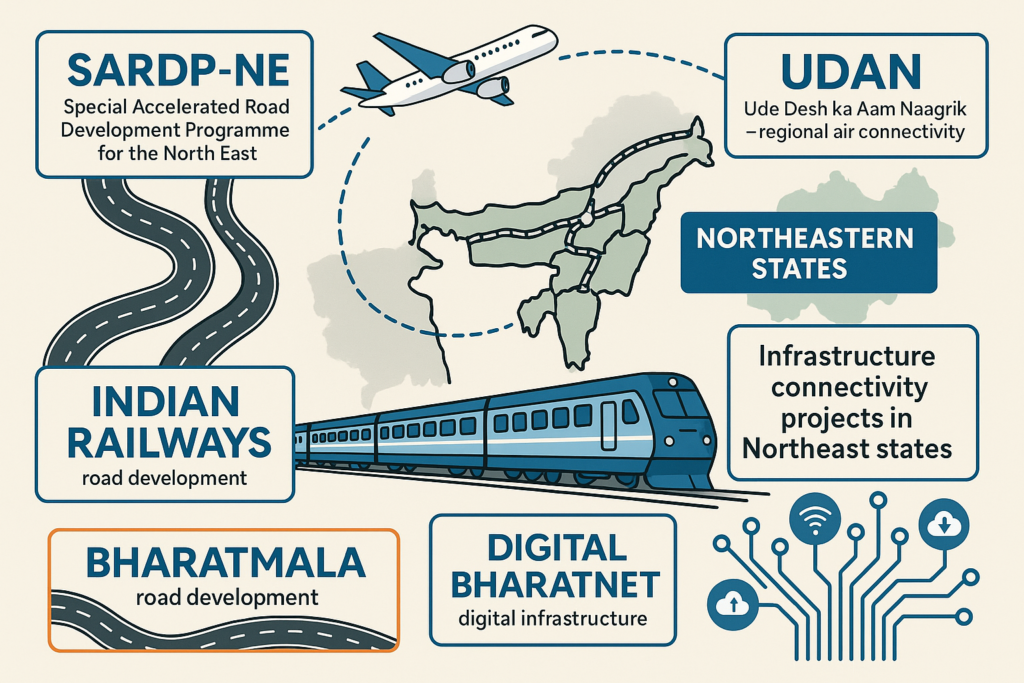
The Prime Minister’s Development Initiative for North Eastern Region (PM-DevINE), announced in Union Budget 2022-23, represents a paradigmatic shift toward comprehensive development with 100% central funding and an outlay of ₹6,600 crore (2022-2026).
PM-DevINE Core Objectives:
- Infrastructure convergence: Implementation in the spirit of PM Gati Shakti
- Social development: Projects based on felt needs of NER
- Livelihood enhancement: Special focus on youth and women empowerment
- Gap-filling: Addressing Basic Minimum Services (BMS) shortfalls
Implementation Highlights:
- Engineering-Procurement-Construction (EPC) basis: Minimizing time and cost overruns
- End-to-end solutions: Comprehensive development rather than isolated projects
- Front-loading approach: Priority sanctioning in 2022-23 and 2023-24
- Sustainability focus: Adequate operation and maintenance provisions
NESIDS: Infrastructure Development Catalyst
The North East Special Infrastructure Development Scheme (NESIDS), approved in 2017-18 and restructured in 2022, operates through two specialized components addressing different infrastructure needs. megpwd
NESIDS-Roads Component:
- Administered by: North Eastern Council (NEC)
- Focus areas: Roads, bridges, and auxiliary infrastructure
- Gap-filling mandate: Projects not covered by other central agencies
- Strategic importance: Access to remote locations and border areas
NESIDS-OTRI (Other Than Roads Infrastructure):
- Project range: ₹5 crore to ₹50 crore investment ceiling
- Sectoral coverage: Healthcare, education, water supply, waste management, industrial development, civil aviation, sports, telecommunications
- Achievement record: 90 projects worth ₹3,417.68 crore sanctioned during 2021-24, with overall expenditure of ₹462.21 crore
SARDP-NE: Accelerated Road Development
The Special Accelerated Road Development Programme for North Eastern Region (SARDP-NE), initiated in 2005 and continuing implementation, represents a comprehensive highway development initiative with three-fold objectives.
SARDP-NE Strategic Goals:
- Interstate connectivity: Linking all northeastern states through quality highways
- International border access: Enhancing connectivity to neighboring countries
- District headquarters connection: Minimum 2-lane highway standards to all district capitals
Implementation Scale:
- Total identified length: 892.822 km across multiple phases
- Phase-A projects: 715.822 km with 2 NHAI projects (₹762 crore) and 2 State PWD projects (₹2,366 crore)
- NHIDCL implementation: 4 projects covering 263.364 km (₹1,994.90 crore)
Act East Policy: Northeast as Gateway to Southeast Asia
Strategic Reorientation and Regional Positioning
The Act East Policy, launched in 2014, represents a fundamental shift from the earlier Look East Policy, positioning Northeast India as the primary gateway to Southeast and East Asia rather than a peripheral region.
Geographic Advantage:
- 5,182 kilometers of international borders: Representing 98% of India’s northeastern border
- Four-nation connectivity: Direct borders with Bhutan, China, Myanmar, and Bangladesh
- Strategic proximity: Natural launchpad for India-Myanmar-Thailand Trilateral Highway and Kaladan Multimodal Transit Transport Project
Major Cross-Border Connectivity Projects
India-Myanmar-Thailand Trilateral Highway:
- Enhancing regional integration: Direct land connectivity to Southeast Asia
- Economic corridor development: Facilitating trade and investment flows
- Strategic partnership strengthening: Deepening ties with ASEAN nations
Kaladan Multimodal Transit Transport Project (KMTTP):
- Investment scale: ₹550 crore under Inland Water Transport component
- Operational significance: Efficient cargo transportation between India and Myanmar
- Strategic impact: Alternative route reducing dependency on land corridors
Bangladesh-Bhutan-India-Nepal (BBIN) Initiative:
- Regional integration: Enhanced connectivity across South Asian nations
- Trade facilitation: Improved cross-border commerce and investment
- Infrastructure development: Coordinated transport and logistics enhancement
Infrastructure Revolution: Quantitative Transformation
Railway Network Expansion
The Northeast railway transformation represents one of India’s most ambitious regional connectivity projects, with record investment levels and engineering marvels like the Bairabi-Sairang line in Mizoram.
Railway Investment Scale (2014-2025):
- Budget increase: Five-fold growth in railway allocation
- Cumulative investment: ₹62,477 crore with ₹10,440 crore for 2024-25
- Ongoing projects: ₹77,000 crore worth initiatives under implementation
- Future planning: 17 new railway surveys covering 1,790 km approved under PM Gati Shakti
Engineering Achievements:
- Bairabi-Sairang line: 51 km with 143 bridges and 45 tunnels at ₹8,000 crore cost
- Mizoram connectivity: First railway connection since independence
- New train services: Rajdhani Express to Delhi, Mizoram Express to Kolkata, Aizwal Intercity to Guwahati
Road Infrastructure Development
National Highway Expansion:
- Total construction: 16,207 km of National Highways in Northeast Region
- 2024 progress: 78 km constructed during January-May 2024
- Investment flow: ₹2,859 crore expenditure on NH development in NE states (April-June 2024)
Aviation Connectivity Enhancement
Airport Infrastructure Growth:
- Capacity expansion: From 9 airports in 2013 to 17 by 2023
- Traffic surge: 113% increase in passenger movement over 10 years
- UDAN implementation: 194 valid fixed-wing and helicopter routes awarded in northeastern states
Strategic Aviation Developments:
- Pakyong Airport (Sikkim): Operational since 2018
- Hollongi Airport (Arunachal Pradesh): Commissioned in 2022
- Tourism boost: Enhanced accessibility attracting visitors and investors
Waterways and Inland Transport
Waterway Network Expansion:
- Total operational waterways: 20 in NER with 19 added in the last decade
- Sagarmala projects: Over ₹1,000 crore investment in Northeast development
- Ferry terminals: 6 terminals worth ₹310 crore at Kurua, Bahari, Dhubri, Guijan, Ghagor & Matmora
Indo-Bangladesh Protocol Enhancement:
- Route expansion: From 8 to 10 waterway routes
- Port infrastructure: 11 Ports of Call and 2 extended ports in each country
- Cargo movement: 4.7 million tonnes transported via IBP route in FY 2023-24
Socio-Cultural Integration: Beyond Infrastructure
Ek Bharat Shreshtha Bharat Initiative
The Ek Bharat Shreshtha Bharat program represents a comprehensive approach to cultural integration, promoting mutual understanding and appreciation between Northeast and other Indian regions.
Cultural Integration Components:
- Youth exchange programs: Facilitating inter-regional understanding
- Festival promotion: Showcasing Northeast culture in national events
- Educational partnerships: Academic collaboration between regions
- Language preservation: Supporting indigenous languages while promoting Hindi and English
Addressing Social Challenges
Anti-Discrimination Measures:
- Awareness campaigns: Combating racial stereotyping against NE students
- Legal framework: Strengthening protection mechanisms
- Cultural sensitization: Promoting understanding of Northeast diversity
- Support systems: Counseling and assistance for NE students in metros
Economic Transformation and Investment Attraction
Advantage Assam 2.0: Investment Gateway
The Advantage Assam 2.0 summit held in February 2025 exemplifies the Northeast’s emergence as a global investment destination, positioning Assam and the broader region as a major economic hub.
Investment Summit Outcomes:
- Global investor participation: Leading international companies engaging with Northeast
- Sectoral diversification: Energy, agriculture, tourism, and manufacturing focus
- Sustainable development: Environmental responsibility in economic growth
- Regional integration: Collaborative development across NE states
Economic Potential Sectors
Renewable Energy Hub:
- Hydropower potential: Abundant water resources for clean energy generation
- Solar and wind: Growing renewable energy installations
- Regional grid: Interstate power sharing and surplus energy export
Organic Agriculture:
- Sikkim model: 100% organic state serving as template
- High-value crops: Spices, medicinal plants, and specialty products
- Export potential: Organic produce for national and international markets
Tourism Development:
- Eco-tourism: Biodiversity hotspot attractions
- Adventure tourism: Trekking, rafting, and mountaineering
- Cultural tourism: Rich tribal heritage and festivals
- Spiritual tourism: Buddhist monasteries and pilgrimage sites
Environmental and Sustainability Challenges
Climate Resilience and Disaster Management
The Northeast’s location in the Indo-Burma biodiversity hotspot and high seismic zone necessitates climate-resilient infrastructure and disaster preparedness measures.
Environmental Concerns:
- Frequent flooding: Particularly affecting Assam’s Brahmaputra valley
- Landslides: Monsoon-triggered geological instability
- Earthquake vulnerability: High seismic zone requiring earthquake-resistant construction
- Deforestation pressure: Balancing development with forest conservation
Sustainable Development Approach:
- Eco-sensitive planning: Environmental impact assessments for major projects
- Community-based conservation: Indigenous knowledge integration in environmental protection
- Green infrastructure: Sustainable construction practices and materials
- Disaster-resilient design: Building codes adapted to regional challenges
Security and Border Management
Peace Building and Insurgency Resolution
The Northeast’s transformation includes significant progress in peace building and conflict resolution, creating conditions conducive to development and investment.
Peace Initiatives:
- Bodo Accord 2020: Comprehensive settlement bringing lasting peace to Assam
- Naga peace talks: Ongoing negotiations for final settlement
- Surrender and rehabilitation: Insurgent groups joining mainstream development
- Community reconciliation: Healing ethnic divisions through development programs
Border Security and Management
Strategic Border Infrastructure:
- Integrated Check Posts (ICPs): Modern facilities for cross-border trade
- Border road construction: All-weather connectivity to border areas
- Technology integration: Modern surveillance and communication systems
- Cross-border cooperation: Joint mechanisms with neighboring countries
Way Forward: Building an Integrated Northeast
Technology and Digital Integration
Digital Northeast Vision:
- BharatNet expansion: High-speed internet connectivity to all villages
- 4G/5G saturation: Universal mobile coverage across the region
- Digital governance: E-governance platforms for efficient service delivery
- Digital literacy: Skills development for technology adoption
Human Resource Development
Education and Skill Enhancement:
- Northeast universities: Strengthening higher education infrastructure
- Technical education: Industry-relevant skill development programs
- Research and innovation: Science and technology institutions
- Youth entrepreneurship: Startup ecosystem development
Regional Integration and ASEAN Connectivity
Economic Corridor Development:
- Multi-modal connectivity: Road, rail, air, and waterway integration
- Value chain integration: Connecting with ASEAN manufacturing networks
- Trade facilitation: Streamlined customs and border procedures
- Investment promotion: Joint investment initiatives with Southeast Asian partners
Building the Bridge to Prosperity
The transformation of Northeast India from a “disconnected region” to a “gateway to prosperity” represents one of modern India’s most remarkable development stories. The unprecedented investment in infrastructure, policy attention, and institutional support has created momentum for sustained growth and regional integration.
Success factors include:
- Political commitment: Sustained high-level attention and resource allocation
- Institutional coordination: Effective collaboration between central and state governments
- Community participation: Local ownership of development initiatives
- Strategic vision: Long-term planning aligned with national and regional goals
- International cooperation: Leveraging regional partnerships for mutual benefit
The Northeast’s journey from isolation to integration demonstrates how focused policy attention, adequate resource allocation, and strategic vision can transform geographical challenges into strategic advantages. As the region continues its remarkable transformation, it serves as a bridge not just between India and Southeast Asia, but between India’s developmental aspirations and its regional leadership ambitions.
The next decade will be crucial in consolidating these gains and building upon the foundation laid through comprehensive infrastructure development, economic integration, and cultural bridge-building. The Northeast’s success in achieving mainstream integration while preserving its unique identity will serve as a model for inclusive development and regional transformation globally.
Mains Practice Qs
GS Paper I (Society & Culture)
- Discuss the role of socio-cultural integration in bridging the gap between the North Eastern Region and the Indian mainstream.
GS Paper II (Governance & Federalism)
- Evaluate the role of institutions like DoNER and NEC in ensuring inclusive governance in the North East.
GS Paper III (Infrastructure, Security, Economy)
- “Connectivity in the North East is not only a developmental priority but a strategic imperative.” Discuss.
Essay Topics
- “Peripheries are the soul of integration: Lessons from North East India.”
- “Bridging geography, culture, and economy for national unity.”





+ There are no comments
Add yours