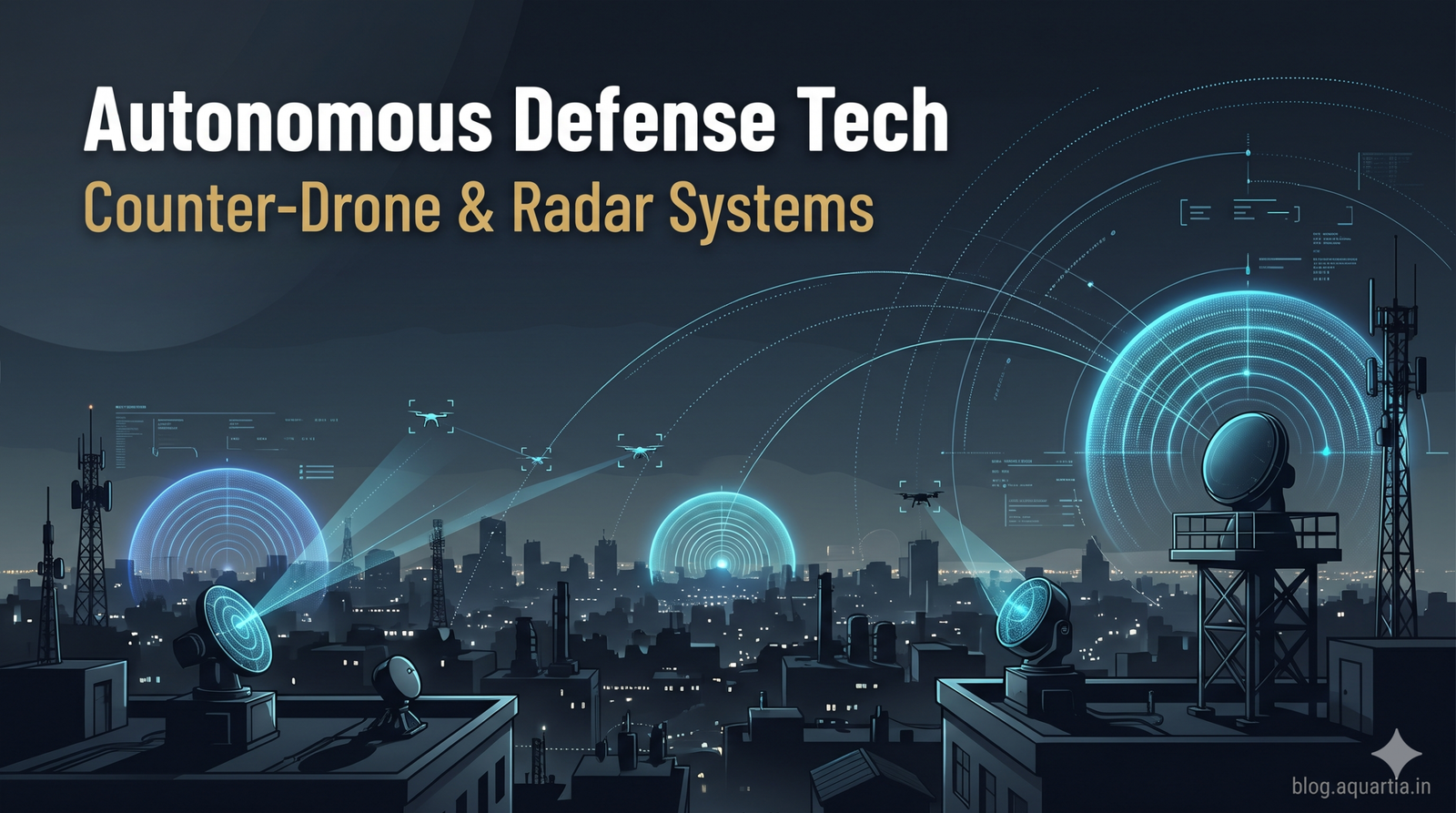
Low-cost unmanned aerial systems have reshaped modern air defense economics. When inexpensive commercial or one-way attack drones can threaten bases, airfields, and energy grids, shooting them down with million-dollar surface-to-air missiles is unsustainable. Modern counter-drone and radar systems solve this asymmetry through integrated, multi-layered detection and defeat architectures.
Why No Single Sensor Can Defend Against Modern Drones
Small unmanned aircraft systems (sUAS) present a difficult radar target: they fly at low altitudes, carry minimal radar cross-sections, and often blend into urban clutter or terrain. Worse, newer autonomous and fiber-optic-guided drones can navigate without emitting radio-frequency (RF) control links or relying on GPS, rendering standalone RF detectors or GPS jammers ineffective.
To close those blind spots, defense planners treat counter-UAS (C-UAS) as a networked decision pipeline rather than a single device—fusing multiple sensor modalities into a unified command-and-control (C2) picture.
The Four Layers of Modern Counter-UAS Architecture
- Detection & Early Warning: Active 3D phased-array radars track low, slow, and small aerial targets, paired with passive RF spectrum analyzers and acoustic sensors that identify drone telemetry signatures.
- Classification & Optical Tracking: Electro-optical and infrared (EO/IR) camera gimbals cue onto radar tracks using computer vision to distinguish birds from hostile payloads.
- Command & Control (C2) Fusion: AI-assisted C2 software deconflicts friendly aircraft, prioritizes swarm threats, and recommends the lowest-collateral effector.
- Layered Defeat Effectors: Depending on rules of engagement, defenders choose between non-kinetic electronic warfare (EW), cyber takeover, high-energy lasers, or kinetic/net interceptors.
Allied Initiatives: DoD Replicator 2 and NATO LCI-X
Two major defense programs highlight the push toward rapid, interoperable counter-drone deployment:
- U.S. DoD Replicator 2 (Domestic Shield): Launched to field counter-small UAS capabilities protecting military installations and critical infrastructure, the program’s Joint Interagency Task Force 401 announced its first Replicator 2 purchase in January 2026—acquiring AI- and radar-guided DroneHunter net-capture interceptors designed for low-collateral defense in populated environments, as also detailed by the U.S. Army.
- NATO Layered Counter-UAS Initiative (LCI-X): Managed by NATO Allied Command Transformation, LCI-X runs multi-national Crucible experimentation events across Europe to test interoperability across allied radars, acoustic/RF sensors, electronic warfare tools, and C2 networks.
Comparison: Non-Kinetic vs. Kinetic Counter-Drone Effectors
| Defeat Method | How It Works | Best Operational Environment | Key Limitation |
|---|---|---|---|
| RF Jamming & EW | Disrupts command, video, or GNSS links | Open terrain or tactical perimeter defense | Ineffective against autonomous or fiber-optic drones |
| Net-Capture Interceptors | Radar/AI-guided drone deploys a tethered net | Urban sites, bases, and airports (low collateral) | Limited magazine depth against large swarms |
| Directed Energy (Lasers) | High-energy beam disables airframe/optics | Fixed base defense with high power supply | Attenuated by heavy fog, rain, or dust |
| 30mm Airburst / Micro-Missiles | Kinetic fragmentation or proximity interception | Contested frontline air defense | Higher cost per shot and falling-debris risk |
Frequently Asked Questions
Why is radar essential if RF sensors can already detect drones?
RF sensors only detect drones that actively transmit radio signals; radar is required to track autonomous waypoint drones or fiber-optic FPVs that operate in complete radio silence.
What is a low-collateral counter-UAS interceptor?
Systems like net-capture interceptor drones physically snare small rogue drones without explosive warheads or stray gunfire, reducing risk near airports, refineries, or populated bases.
How does NATO LCI-X improve allied drone defense?
LCI-X tests open data standards in short experimentation cycles so sensors, radars, and effectors from different NATO nations can plug into a shared command-and-control network.
Explore more aerospace and security analysis in our Defense and National Security sections on Aquartia Blog.










+ There are no comments
Add yours