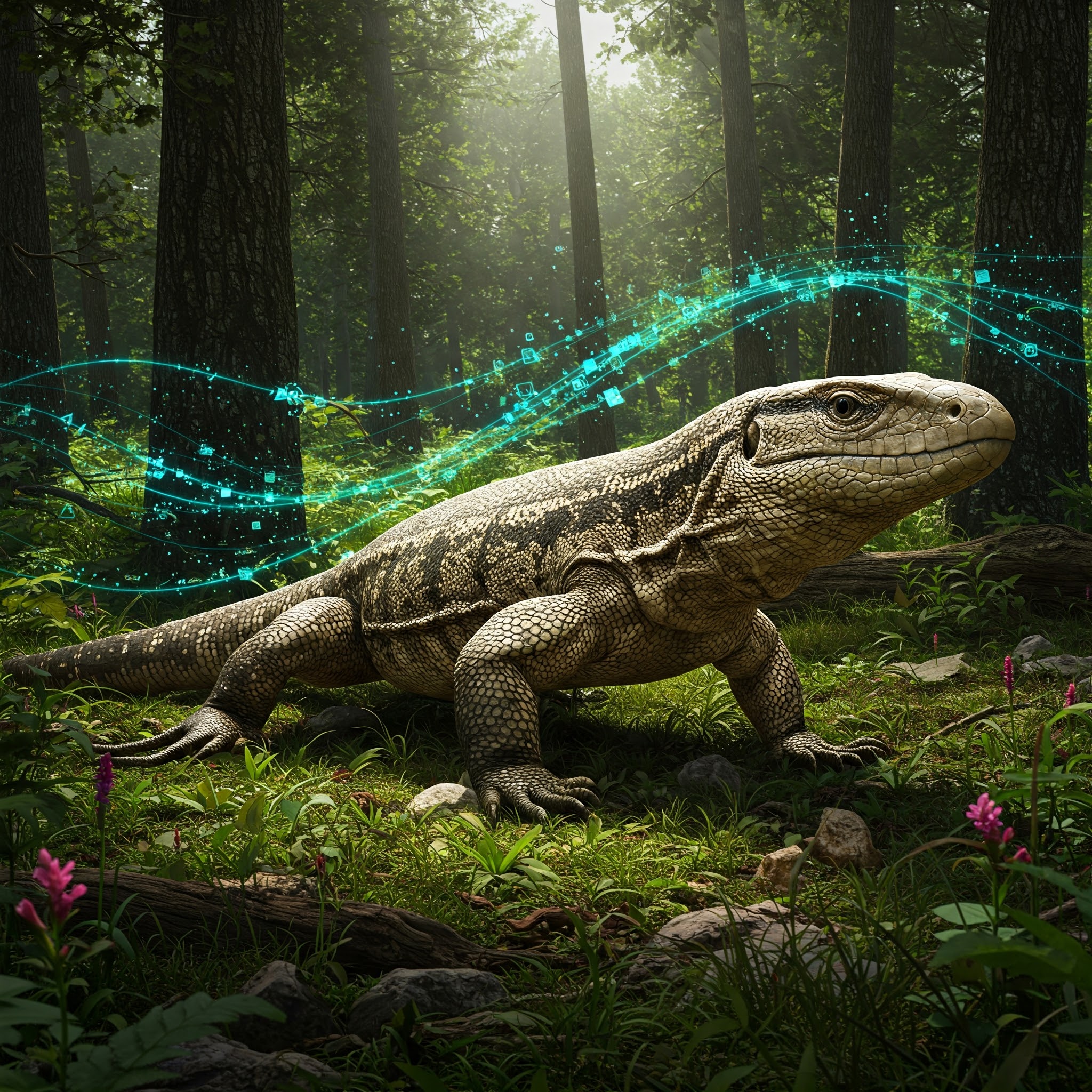
In an era where artificial intelligence can compose music, diagnose diseases, and predict financial markets, it’s now doing something even more unexpected—rewriting natural history. In a thrilling blend of science and technology, AI has cracked a two-decade-old mystery involving a tiny fossil that had confounded paleontologists for years. This small vertebra, unearthed from the lush fossil-rich lands along the Florida-Georgia border, has now been identified as belonging to a never-before-seen species of tegu lizard.
Meet Wautaugategu formidus—a giant, formidable reptile that once roamed ancient North America. Thanks to advanced AI algorithms and digital fossil modeling, researchers are now reconstructing a forgotten chapter of our continent’s prehistoric story.
The Bottleneck: Human Eyes Couldn’t See What Machines Could
Discovered in the early 2000s, the fossil in question—a single vertebra no bigger than a human thumbnail—lay largely unnoticed and unclassified in the Florida Museum of Natural History. Despite multiple expert examinations, the identity of the fossil remained unresolved. Traditional methods of comparative anatomy failed to yield conclusive results.
Why? Because human-led fossil analysis, especially when dealing with fragmentary remains, depends heavily on experience, reference materials, and time. Even the sharpest eyes can miss microscopic details or fail to account for millions of evolutionary permutations.
The field of paleontology, though rich in discovery, has its limitations. Fossil identification is often a manual, subjective, and slow process. The fragmentary nature of the fossil record only compounds the problem. In this case, despite years of scrutiny, the fossil’s origins remained a mystery—until AI stepped in.
AI Steps In: Digitizing Bones and Decoding Prehistory
That breakthrough came from an innovative project led by Dr. Arthur Porto, a paleobiologist at the Florida Museum of Natural History. Dr. Porto and his team turned to artificial intelligence—not just for support, but as a lead analyst.
The Technology

- High-Resolution CT Scans:
The tiny fossil was digitally scanned using high-resolution computed tomography (CT). This non-destructive method produced a detailed 3D model, allowing researchers to analyze the internal and external morphology without damaging the original specimen. - AI Landmark Mapping Algorithm:
Dr. Porto’s team developed a machine learning algorithm that could identify and compare “landmarks”—precise points on the fossil that define shape, curvature, and anatomical structure. - Deep Morphological Comparison:
The AI compared these digital landmarks against a vast database of known vertebrate fossils, learning to distinguish even subtle differences that human researchers may miss.
This was more than pattern recognition. The algorithm effectively “learned” paleontological taxonomy, comparing shape metrics across thousands of vertebrae to pinpoint probable identities.
Efficiency & Precision
What would have taken months or years of manual cross-checking was completed in days. The algorithm didn’t just propose possible matches—it offered statistical probabilities, ranking them by confidence levels. And then it hit gold.
The “Aha!” Moment: The Giant Revealed
After crunching through massive datasets and digital fossil scans, the AI finally delivered the breakthrough: the vertebra belonged to a previously unidentified species of tegu lizard. The new species was named Wautaugategu formidus—a nod to the fossil’s discovery location near the Wautauga region and the Latin formidus, meaning “fearsome.”
It was a striking revelation. The fossil, barely the size of a coin, turned out to be from a creature that may have grown up to 4 feet long—massive by lizard standards. This paradox—small fossil, big reptile—underscored the sheer scale of insight AI can bring to fragmentary evidence.
What made it even more astounding was that this discovery didn’t involve finding a brand-new skeleton, but rediscovering a fossil that had been lying in wait for 20 years, misclassified and overlooked.
AI Rewrites the Paleontological Narrative
Prior to this finding, scientists believed that tegu lizards—mostly associated with South America today—had no native presence in prehistoric North America. This fossil changes that. It proves that during the Miocene epoch, giant tegu lizards did in fact roam what is now the southeastern United States.
📚 Breaking Assumptions
- Old Belief: Tegu lizards migrated northward in recent times, possibly due to human activity.
- New Understanding: Tegus had already colonized North America during the Miocene—over 15 million years ago—long before human interference.
This AI-driven revelation forces paleontologists to revise the evolutionary and migratory history of tegus and other reptilian fauna in the Americas. It also highlights AI’s growing ability not just to confirm existing theories but to challenge and overturn them.
The Ancient World Through New Eyes: The Middle Miocene
The Miocene epoch, particularly a warm period known as the Middle Miocene Climatic Optimum (approximately 17–14 million years ago), serves as the temporal backdrop for Wautaugategu formidus.
What Was the World Like?
- Climate: Warmer and more humid than today.
- Geography: Subtropical forests stretched across much of North America.
- Fauna: Giant turtles, early horses, saber-toothed cats—and now, giant tegus.
The AI-identified lizard likely thrived in this environment, feeding on smaller reptiles, birds, or insects. Its existence in the fossil record—unlocked by AI—helps scientists better understand animal dispersion patterns during global climate shifts.
The Future is Intelligent: AI’s Expanding Role in Paleontology
This case is more than an isolated victory for technology. It marks the beginning of a paradigm shift in paleontology. AI’s capacity to analyze complex structures, predict evolutionary relationships, and reassemble ancient worlds is unmatched by human capabilities alone.
🔮 Emerging Applications of AI in Paleontology
- Automated Fossil Identification:
AI can sort through thousands of fossil fragments from excavation sites, tagging and classifying them in real time. - Predictive Modeling of Fossil Locations:
Using geological, climatic, and biological data, AI can predict where significant fossil beds may exist, optimizing fieldwork. - Evolutionary Reconstruction:
AI algorithms can simulate evolutionary trees, offering insights into how extinct species are related to modern organisms. - Virtual Paleoecology:
Combined with VR and AR, AI could help reconstruct entire ecosystems—showing not just what lived, but how it lived, interacted, and evolved.
This is not about replacing paleontologists—it’s about supercharging them with tools that increase speed, accuracy, and depth of discovery.
Conclusion: The Dawn of AI-Powered Discovery
The identification of Wautaugategu formidus is a triumph not just for paleontology but for human curiosity assisted by artificial intelligence. A forgotten vertebra lying idle in a museum drawer is now rewriting evolutionary history—because a machine could see what we could not.
This is the power of interdisciplinary innovation. AI isn’t just reshaping our future—it’s rediscovering our past. And as the technology grows smarter and datasets more expansive, who knows what other ancient secrets await decoding?
From the Jurassic to the Miocene, from dust-covered drawers to data-driven revelations, the fossil record has a new ally. The age of AI-powered discovery is here—and it’s just beginning.








+ There are no comments
Add yours