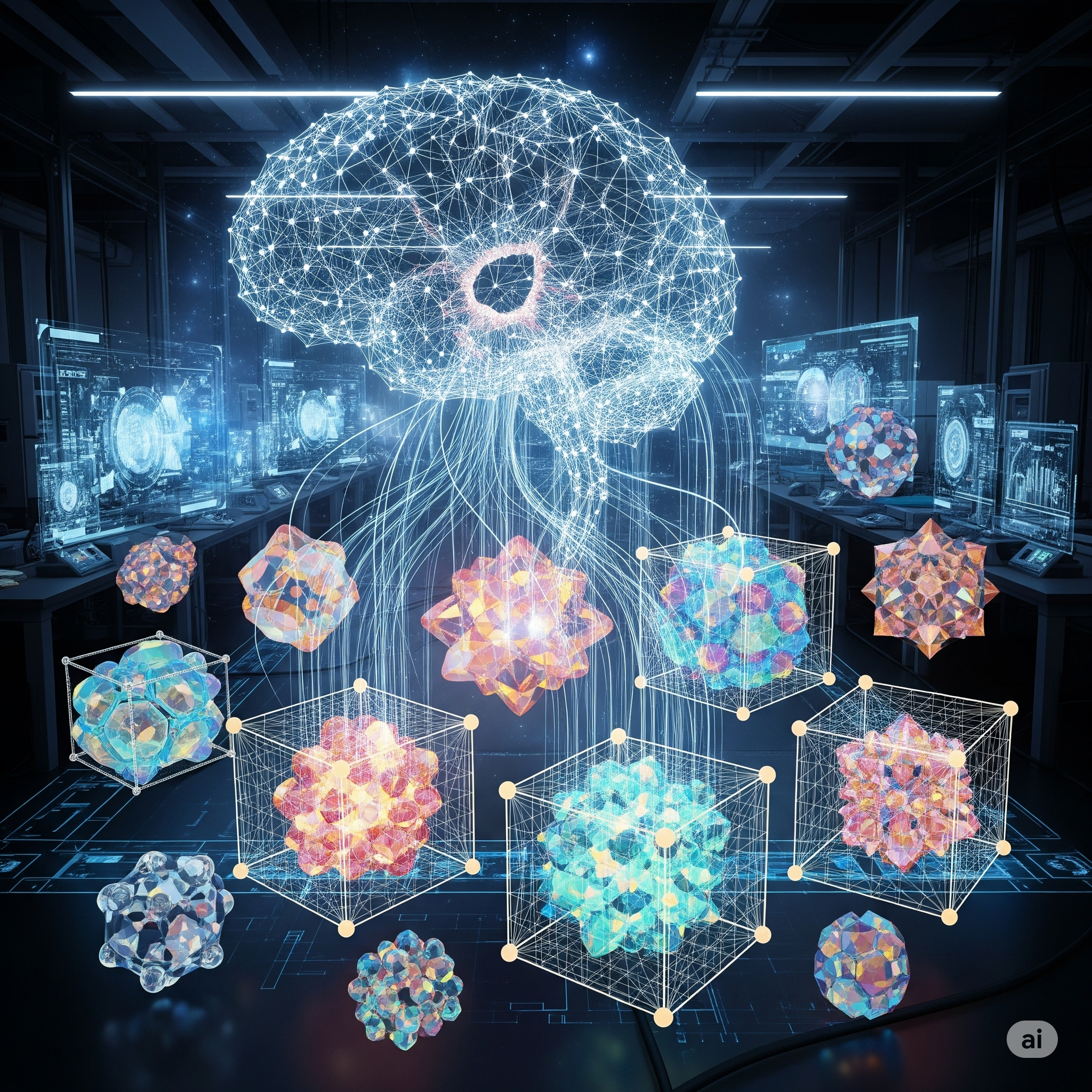
From powering our smartphones to fueling electric vehicles, batteries shape our modern world. Yet, one critical bottleneck remains: current lithium-ion technology is nearing its limits in energy density, safety, and sustainability. Now, a pioneering team at the New Jersey Institute of Technology (NJIT) has taken a monumental leap using generative artificial intelligence. Their discovery? Five entirely new, porous transition-metal oxide crystal structures—tailor-made for multivalent-ion batteries—that could redefine how we store and use energy.
Let’s unpack this breakthrough, the science behind these materials, and what it means for the future of sustainable, powerful energy storage.
The Bottleneck: Why We Need Batteries Beyond Lithium
Lithium-ion batteries transformed devices and transportation, but they come with constraints:
- Resource Scarcity: Lithium and cobalt are geologically limited and unevenly distributed, leading to high cost and supply chain instability.
- Energy Density Limits: Lithium’s chemistry is approaching a theoretical ceiling for how much energy it can store per unit mass.
- Safety Concerns: Thermal runaway risks have led to fires in both consumer electronics and EVs.
- Sustainability Issues: Mining and processing lithium and cobalt both have significant environmental impacts.
For a planet needing more solar, wind, and grid-scale storage, safer and greener solutions are urgently sought.
Enter Multivalent-Ion Batteries: Why They Matter
Think of multivalent ions—like magnesium (Mg²⁺), zinc (Zn²⁺), or aluminum (Al³⁺)—as “power multipliers.” Unlike lithium’s single charge (Li⁺), these ions carry two or even three positive charges, potentially offering:
- Much higher energy density (more charge per atom)
- Abundant, non-toxic materials (magnesium, zinc, and aluminum are far easier to source sustainably)
- Lower cost and improved safety
So why aren’t multivalent batteries already everywhere? The challenge has always been in finding materials that can conduct and hold these “bulkier” and more highly charged ions as easily as current lithium-based ones. That’s where AI comes in.
Generative AI Accelerates Materials Discovery
Traditional materials discovery involves painstaking trial-and-error: synthesize, test, analyze, repeat. It can take years to identify just one promising compound. The NJIT team, however, used generative AI models to flip the process on its head:
1. The Crystal Diffusion Variational Autoencoder (CDVAE):
- Think of the CDVAE as an “imagination machine” for crystal structures.
- It “learns” from vast datasets of existing oxide crystals how atoms can fit together, then generates thousands of theoretical, never-seen-before structures—all optimized for stability and desired properties.
2. Tuned Large Language Models:
- Beyond imagining crystals, the research team fine-tuned a large language model (like a specialized version of GPT) to help guide the search, prioritizing materials that:
- Are open-tunnel (porous enough for fast ion transport)
- Can accommodate multivalent ions
- Show thermodynamic stability (won’t break apart under normal conditions)
3. Quantum Simulations for Validation:
- AI isn’t crystal ball gazing—the best candidate structures were validated using quantum-level computer simulations to predict stability, energy profile, and how easily ions could diffuse through them.
The Breakthrough: Five New Transition-Metal Oxide Materials
At the end of this AI-powered journey, the NJIT researchers identified five previously unknown, highly stable open-tunnel oxides, each predicted to support the reversible insertion and extraction of multivalent ions like Mg²⁺, Al³⁺, and Zn²⁺.
Key Benefits:
- Greater Energy Density: Each multivalent ion can carry 2–3 times the charge of lithium—translating directly to more energy in the same or smaller battery.
- Improved Safety: The materials are non-flammable and can operate safely even under demanding conditions.
- Sustainability: Transition metals and multivalent carriers (like aluminum and magnesium) are vastly more abundant and environmentally friendly than lithium or cobalt.
- Faster Innovation Pipeline: This AI-driven strategy slashes discovery times from years to months or even weeks.
Quote from the NJIT Team:
“Our generative AI tools let us search chemical space at unprecedented speed and scale. We’re not just tweaking existing chemistry—we’re inventing new materials from scratch to meet the demands of future energy systems.”
Why Porous, Open-Tunnel Oxides?
- Ion Mobility: For a battery to work, ions must move quickly through the host structure. Open-tunnel architectures offer minimal resistance, even for bulky multivalent ions.
- Structural Robustness: These designs allow for repeated insertion/extraction cycles—critical for long-term battery life—without the lattice collapsing.
- Versatility: Different tunnel shapes and sizes can be tuned for specific ions (Mg²⁺ vs. Al³⁺), maximizing versatility.
The Path from Quantum Simulations to Real-World Batteries
While these newly-discovered materials haven’t yet hit the factory floor, their quantum-confirmed thermodynamic stability and predicted performance offer a fast track for experimental validation:
- Prototype Synthesis: Labs can now prioritize synthesis and testing of the most promising AI-predicted candidates.
- Commercialization Roadmap: By combining rapid virtual screening with targeted physical trials, commercial multivalent-ion batteries could arrive faster than anyone expected.
- Scalable Impact: Once validated, similar AI approaches can discover materials for sodium-ion, potassium-ion, or even exotic chemistries.
What Could This Mean for Energy Storage and Everyday Life?
Consumers
- Longer-lasting, safer electronics (less fire risk, more compact designs).
- Electric cars with greater range and lower cost.
- Even more powerful, affordable energy storage for homes and businesses.
Industry and the Grid
- Grid-scale batteries that are more robust, cheaper, and eco-friendly—critical for renewable integration.
- Reduced dependence on geopolitically sensitive mineral supplies.
For Sustainability Goals
- Lower carbon footprint in battery production.
- Fewer supply chain bottlenecks and reductions in toxic mining operations.
The Golden Age of Materials Discovery Begins
The NJIT team’s use of generative AI marks a watershed moment—not just for batteries, but for how we engineer the future. With machine learning’s power to explore “chemical space” far beyond what humans alone can imagine, solutions to our thorniest energy challenges are moving from promise to proof. As these new multivalent-ion materials head from simulation to shelves, the dream of safer, cheaper, and vastly more sustainable batteries may soon be within everyone’s reach.






+ There are no comments
Add yours