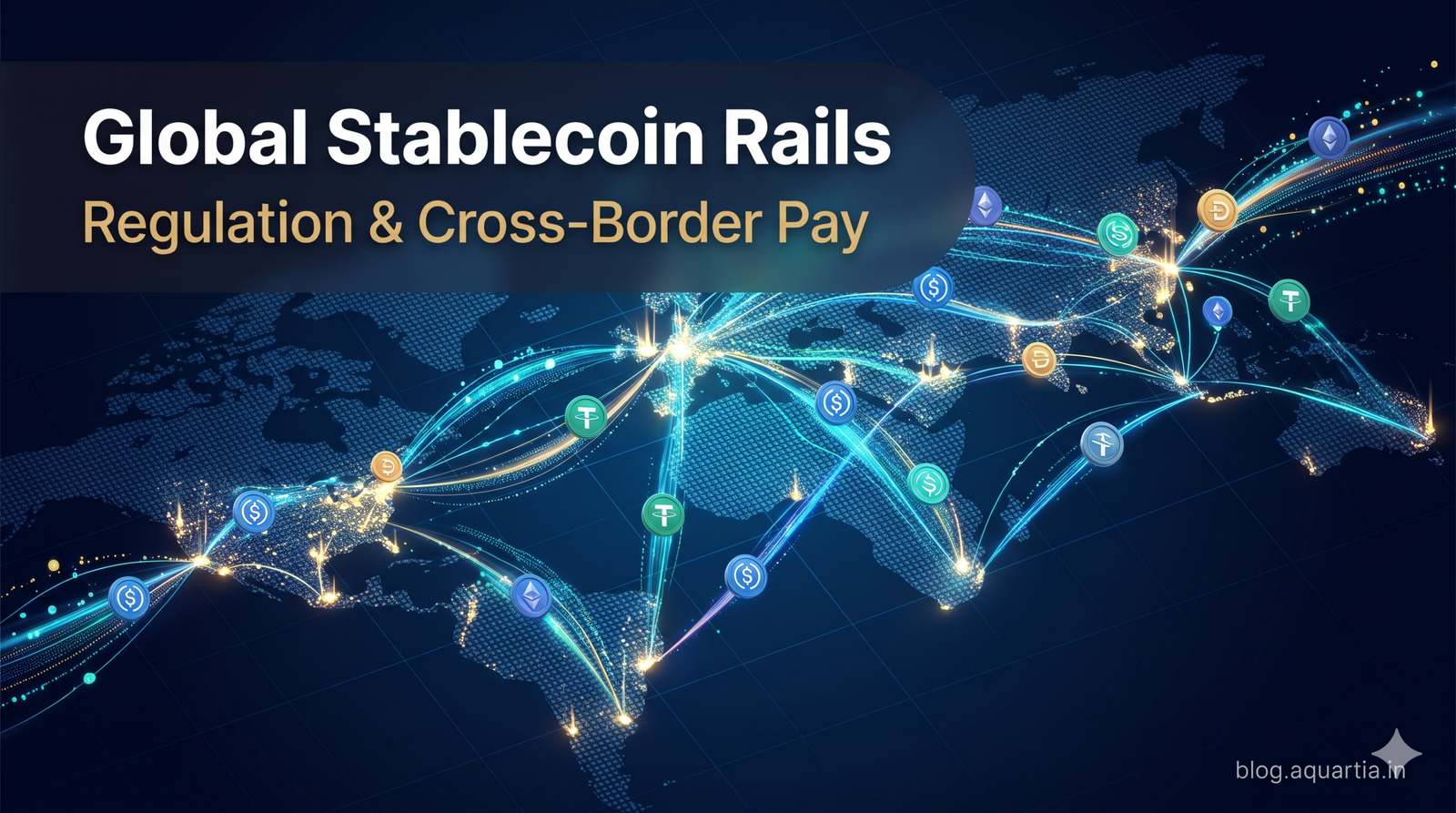
Stablecoins have evolved from crypto-exchange trading pairs into a multi-hundred-billion-dollar settlement layer. Yet institutional adoption in global commerce depends on a single factor: clear regulatory guardrails. Understanding global stablecoin rails requires looking at how payment networks, central banks, and frameworks like Europe’s MiCA are balancing 24/7 settlement speed against monetary stability.
Why Cross-Border Payments Use Stablecoin Rails
Traditional correspondent banking chains often route international transfers through multiple intermediary banks across business-hour cutoffs, adding FX spreads, trapped nostro liquidity, and multi-day settlement delays. As Visa’s cross-border payment analysis outlines, fiat-pegged stablecoins on public or permissioned ledgers can settle in seconds to minutes around the clock while providing an auditable transaction trail.
However, on-chain transfer speed is only half the payment stack. Real-world treasury workflows still depend on compliant fiat on- and off-ramps, KYC/AML screening, and automated accounting reconciliation.
How EU MiCA Regulates Stablecoins (EMTs vs. ARTs)
The European Union’s Markets in Crypto-Assets Regulation (MiCA) established one of the world’s first comprehensive stablecoin rulebooks, with issuer provisions taking effect in June 2024. Under guidelines supervised by the European Banking Authority (EBA), MiCA divides stablecoins into two distinct categories:
- E-Money Tokens (EMTs): Pegged 1:1 to a single official fiat currency (such as EUR or USD). Issuers must be authorized credit or electronic money institutions, maintain safeguarded reserves, guarantee par redemption at any time, and publish regulated white papers.
- Asset-Referenced Tokens (ARTs): Pegged to a basket of currencies, commodities, or other assets, subject to strict reserve, governance, and transaction-cap oversight.
Importantly, MiCA prohibits issuers of both EMTs and ARTs from paying interest directly to token holders, separating regulated payment instruments from yield-bearing investment funds.
Central Bank Perspective: BIS Findings on Risks and Limits
While payment processors highlight efficiency gains, the Bank for International Settlements (BIS) cautions that unregulated stablecoins pose challenges around financial crime, reserve fire-sale tail risks, and “stealth dollarization” in emerging economies. In its CPMI cross-border stablecoin report, the BIS emphasizes the principle of “same business, same risks, same regulatory outcome.”
Comparison: Correspondent Banking vs. Regulated Stablecoin Rails
| Feature | Traditional Correspondent Banking | Regulated Stablecoin Settlement |
|---|---|---|
| Settlement Speed | 1–5 business days (cutoffs & holidays) | Seconds to minutes, 24/7/365 |
| Working Capital | Requires pre-funded nostro/vostro accounts | On-demand liquidity with atomic settlement |
| Regulatory Focus | Bank licensing & SWIFT messaging compliance | 1:1 reserve audits, EMI licensing, travel-rule KYC |
| Main Bottleneck | Intermediary fees & fragmented clearing | Local fiat on/off-ramps and FX conversion |
Frequently Asked Questions
What is the difference between an e-money token (EMT) and an asset-referenced token (ART) under MiCA?
An EMT maintains a stable value by referencing a single official currency (like the euro or U.S. dollar), whereas an ART references a basket of currencies, commodities, or other assets.
Why can’t MiCA-compliant stablecoins pay yield to holders?
EU lawmakers barred interest payments on EMTs and ARTs so regulated stablecoins function strictly as payment and settlement instruments rather than unregulated bank deposits or money market funds.
Do stablecoins replace SWIFT and commercial banks?
In practice, banks and payment networks increasingly integrate regulated stablecoin rails alongside existing messaging and treasury systems rather than replacing bank accounts entirely.
Read more digital finance and blockchain coverage in our Cryptocurrency and Blockchain sections on Aquartia Blog.








+ There are no comments
Add yours