
Key Highlights
- Historic Indigenous Achievement: Vikram-32 (VIKRAM3201) is India’s first fully indigenous 32-bit microprocessor qualified for space applications, designed by VSSC and fabricated at ISRO’s SCL Mohali using 180nm CMOS technology
- Space-Flight Validated: Successfully flight-tested during PSLV-C60 mission in the POEM-4 orbital experimental module, proving its reliability for future space missions and harsh environmental conditions
- Advanced Technical Capabilities: Features custom instruction set architecture, floating-point computation, Ada programming support with in-house compiler, assembler, linker, and simulator tools developed by ISRO
- Strategic Applications Beyond Space: Rugged design makes it suitable for defense systems, aerospace technologies, automotive solutions, and high-reliability energy systems requiring extreme condition performance
- Semiconductor Mission Milestone: Represents major progress under India Semiconductor Mission launched in 2021, with ₹1.60 lakh crore investments approved across six states and 23 design startups supported under DLI scheme
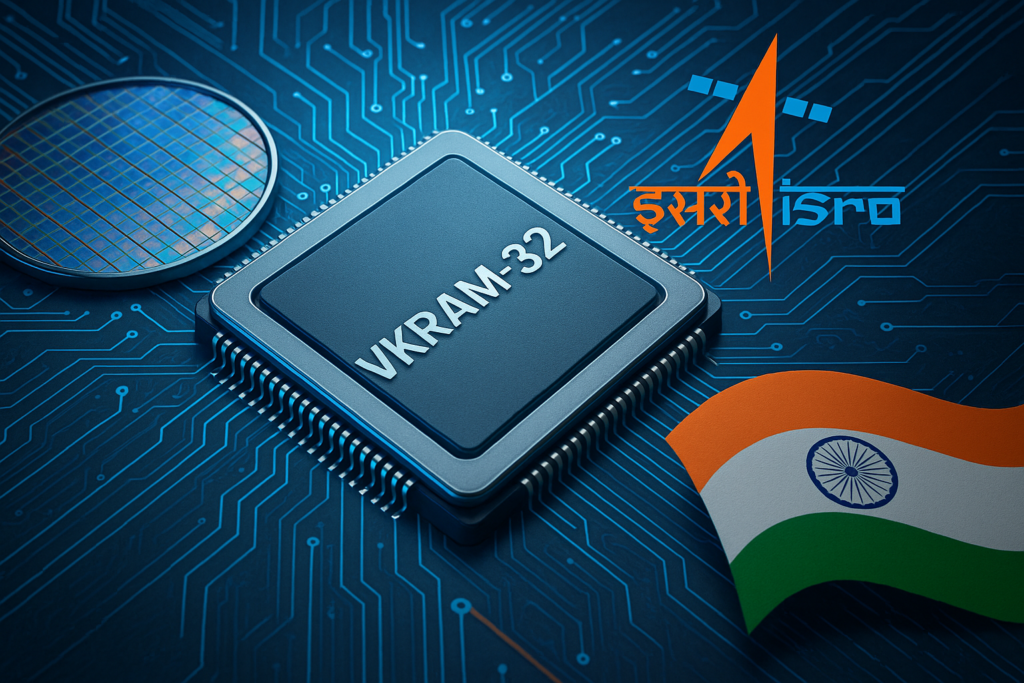
Revolutionary Unveiling at Semicon India 2025
The presentation of Vikram-32 (VIKRAM3201) to Prime Minister Narendra Modi by IT Minister Ashwini Vaishnaw at Semicon India 2025 marked a watershed moment in India’s semiconductor journey. PM Modi’s characterization of semiconductors as “digital diamonds” of the modern era underscored the strategic importance of this achievement for Atmanirbhar Bharat. ddnews.gov
The three-day Semicon India conference brought together global industry leaders, ecosystem partners, and technology innovators to witness India’s emergence as a trusted semiconductor manufacturing destination. Minister Vaishnaw highlighted that “construction of five semiconductor units is underway” with pilot lines completed and two more units set to begin production in coming months.
The presentation ceremony represented more than a technological demonstration—it symbolized India’s transformation from chip consumer to chip producer in just 3.5 years since the India Semiconductor Mission launch. The moment captured the culmination of decades of indigenous research and strategic planning by ISRO’s semiconductor teams.
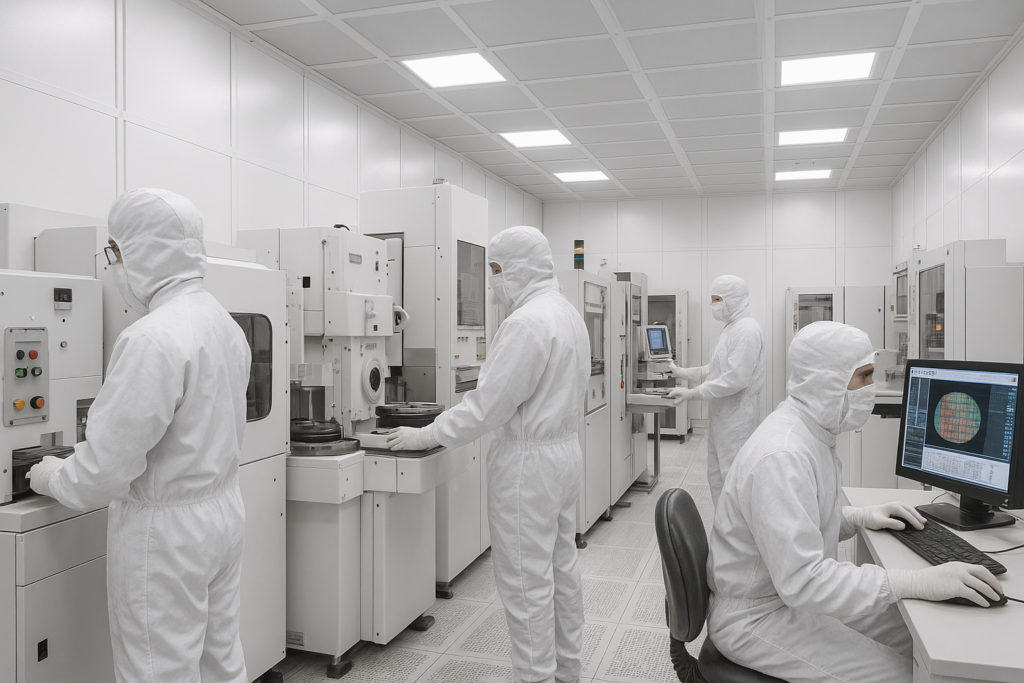
Technical Specifications: Engineering Excellence
Vikram-32 represents a significant technological leap from its predecessor, the 16-bit VIKRAM1601 processor that has powered ISRO’s launch vehicles since 2009. The 32-bit architecture enables enhanced computational capabilities essential for modern space missions and complex satellite operations. isro
Core Technical Features
Architecture and Processing: The processor employs a custom instruction set architecture (ISA) specifically tailored for space applications, providing optimized performance for navigation, guidance, and control systems. The 32-bit data bus allows processing of larger data chunks simultaneously, significantly improving computational efficiency.
Floating-Point Computation: Unlike its 16-bit predecessor, Vikram-32 includes dedicated floating-point units capable of handling complex mathematical calculations required for orbital mechanics, attitude control, and precision landing algorithms.
Programming Language Support: The processor supports Ada programming language with a complete software ecosystem including compiler, assembler, linker, simulator, and Integrated Development Environment (IDE) all developed in-house by ISRO. C language support is currently under development to expand usability across diverse applications.
Fabrication Technology: Manufactured at SCL’s 180nm CMOS semiconductor facility in Mohali, Punjab, the processor demonstrates India’s indigenous fabrication capabilities while maintaining space-grade quality standards.
Performance and Reliability
Environmental Resilience: Designed to withstand extreme space conditions including radiation exposure, temperature fluctuations (-40°C to +85°C), vacuum environments, and mechanical stress during rocket launches.
Memory Management: The 32-bit architecture enables addressing up to 4GB of memory space, providing substantial capacity for complex space missions and multi-tasking operations.
Power Efficiency: Optimized for low-power consumption essential for battery-operated spacecraft and long-duration missions where power conservation is critical.
Space Validation: PSLV-C60 Success Story
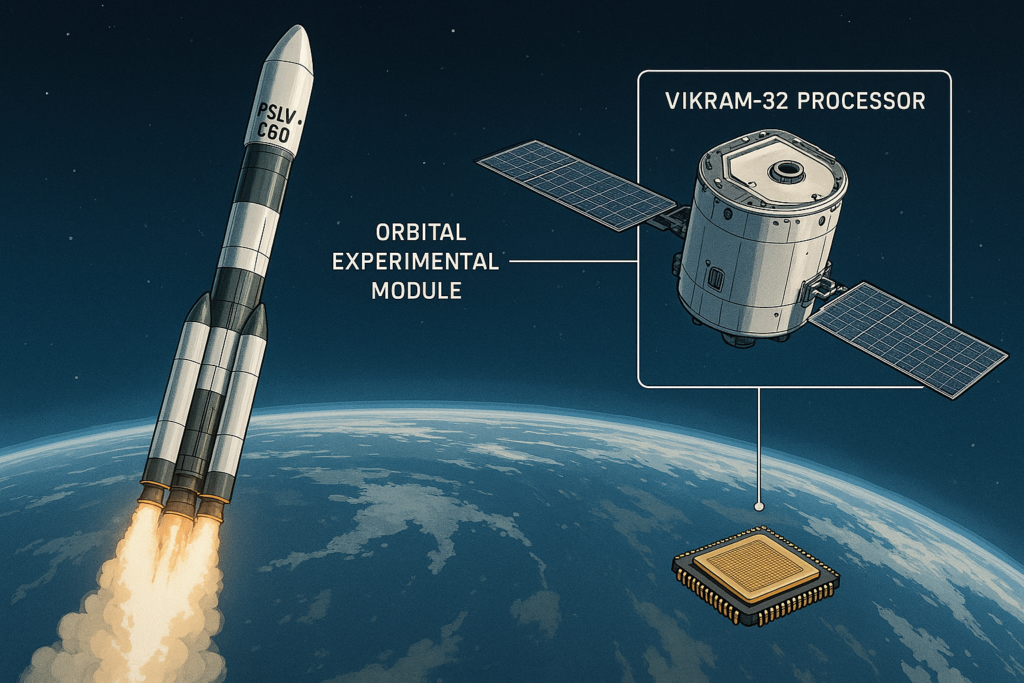
The flight validation of Vikram-32 during the PSLV-C60 mission provided definitive proof of its space-worthiness and operational reliability. The processor was integrated into the Mission Management Computer of the PSLV Orbital Experimental Module (POEM-4), where it successfully operated throughout the mission duration.
Mission Profile and Testing
Launch Environment: The processor survived the intense vibrations, acoustic noise, and acceleration forces during PSLV launch, demonstrating robust mechanical design and packaging integrity. Peak acceleration during launch can reach several Gs, creating extreme stress on electronic components.
Orbital Operations: During orbital phase, Vikram-32 managed critical spacecraft functions including attitude control, thermal management, and communication protocols while exposed to space radiation and temperature cycling.
Performance Validation: All computational functions, floating-point operations, and system interfaces performed within specifications throughout the mission, validating the processor’s design and manufacturing quality.
Data Collection: Telemetry data collected during the mission confirmed stable operation, accurate processing, and reliable communication with ground stations, providing confidence for future missions.
Advanced Companion: Kalpana-3201 Processor
Alongside Vikram-32, ISRO developed Kalpana-3201, a complementary 32-bit processor based on SPARC V8 RISC architecture and IEEE 1754 instruction set. This processor demonstrates ISRO’s comprehensive approach to indigenous semiconductor development across different architectural paradigms.
Kalpana-3201 Specifications
Architecture Foundation: Built on industry-standard SPARC V8 RISC design, providing compatibility with existing software ecosystems and open-source development tools.
Software Compatibility: Designed for seamless integration with open-source toolsets while maintaining ISRO’s in-house development capabilities through custom simulator and IDE implementations.
Flight Software Integration: Successfully tested with actual flight software, proving its operational readiness for diverse space applications and mission-critical functions.
Performance Optimization: Focuses on high-speed processing and computational efficiency with simplified instruction sets designed for rapid execution and minimal power consumption.
Strategic Applications Beyond Space
While initially developed for space missions, Vikram-32’s robust design makes it highly suitable for terrestrial applications requiring high reliability and extreme condition operation. The processor’s space-grade qualifications translate into exceptional performance for critical civilian and defense applications.
Defense and Military Applications
Missile Guidance Systems: The processor’s precision floating-point capabilities and radiation hardening make it ideal for ballistic missile navigation, cruise missile guidance, and air defense systems requiring split-second accuracy.
Military Communications: Secure communication systems benefit from the processor’s custom instruction set and indigenous design, providing protection against foreign backdoors and ensuring national security.
Battlefield Electronics: Rugged construction enables operation in harsh combat environments with extreme temperatures, shock, vibration, and electromagnetic interference.
Automotive and Transportation
Autonomous Vehicle Systems: Advanced computational capabilities support real-time processing for sensor fusion, path planning, and decision-making in autonomous driving applications.
Railway Safety Systems: High-reliability requirements for train control systems, signaling networks, and collision avoidance align with the processor’s space-grade reliability standards.
Aviation Electronics: Aircraft avionics, flight management systems, and engine control units benefit from proven space heritage and extreme condition performance.
Energy and Industrial Applications
Nuclear Power Systems: Radiation-hardened design makes the processor suitable for reactor control systems, safety monitoring, and automated shutdown mechanisms in nuclear facilities.
Renewable Energy: Solar panel tracking systems, wind turbine controllers, and energy storage management leverage the processor’s precision control capabilities and environmental resilience.
Industrial Automation: Manufacturing control systems, robotics applications, and process monitoring benefit from reliable operation in harsh industrial environments.
India Semiconductor Mission: Strategic Context
The Vikram-32 achievement exemplifies the success of India’s comprehensive semiconductor strategy launched in 2021 with ambitious targets for domestic chip manufacturing and design capabilities.
Mission Progress and Investments
Infrastructure Development: Five semiconductor manufacturing units are currently under construction across multiple states, with combined investments exceeding ₹1.60 lakh crore. The first pilot line has been completed, with two additional units scheduled to begin production in the coming months.
Design Ecosystem: 23 design startups are receiving support under the Design Linked Incentive (DLI) scheme, fostering innovation in semiconductor design and intellectual property development.
Talent Development: 278 universities now offer semiconductor manufacturing courses, creating the world’s largest talent development program with 60,000 students already trained toward the 85,000 target by 2030.
Global Partnerships: International ecosystem partners including equipment manufacturers, materials suppliers, and technology providers are establishing operations in India, creating a comprehensive supply chain.
Policy Framework and Execution
Transparent Governance: Minister Vaishnaw emphasized the professional and transparent management of the semiconductor mission, with decisions backed by rigorous analysis from industry professionals across all major sectors.
Stable Policy Environment: In an uncertain global landscape, India has emerged as a “lighthouse of stability and growth” with consistent policies and strong execution capabilities attracting international investment.
Sector Coverage: The mission encompasses power electronics, consumer electronics, automobiles, defense, and strategic industries, ensuring comprehensive domestic capabilities.
Global Semiconductor Landscape Position
Vikram-32’s development positions India as a serious player in the global semiconductor industry, moving beyond traditional assembly and testing roles to design and fabrication capabilities.
International Competitiveness
Technology Sovereignty: Indigenous design and fabrication reduce dependence on foreign suppliers while ensuring complete control over critical technology components.
Cost Advantage: Domestic manufacturing eliminates import duties, reduces logistics costs, and provides competitive pricing for Indian and international customers.
Supply Chain Security: Local production ensures uninterrupted supply during global shortages or geopolitical tensions, providing strategic advantage for Indian industries.
Market Opportunities
Domestic Demand: Electronics production has grown six times in the last decade, with exports increasing eight times, creating substantial domestic market for indigenous processors.
Export Potential: Space-grade specifications and competitive pricing position Vikram-32 for international markets, particularly emerging economies seeking reliable, cost-effective solutions.
Technology Transfer: Indigenous capabilities enable technology licensing and knowledge sharing with partner nations, creating additional revenue streams.
Future Development Roadmap
Enhanced Capabilities
C Language Support: Ongoing development of C compiler will broaden accessibility for software developers across diverse industries beyond the aerospace sector.
Advanced Architectures: Future versions may incorporate multi-core designs, enhanced processing speeds, and advanced instruction sets for next-generation applications.
Miniaturization: Process technology migration to smaller geometries (90nm, 65nm) will improve performance per watt and reduce physical footprint.
Application Expansion
AI and Machine Learning: Future variants could include dedicated AI acceleration units for edge computing and autonomous systems applications.
Communications: 5G and satellite communication processors leveraging space heritage and radiation hardening capabilities.
Internet of Things: Low-power variants optimized for IoT applications requiring long battery life and reliable operation.
Economic and Strategic Impact
Technology Independence
Reduced Import Dependence: Domestic processor production reduces foreign exchange outflow while building strategic technology reserves.
Skill Development: Indigenous development creates high-value engineering jobs and advanced technology expertise within the country.
Innovation Ecosystem: Successful processor development encourages private sector investment in semiconductor research and advanced manufacturing.
National Security Benefits
Supply Chain Control: Complete indigenous control from design to fabrication eliminates foreign dependency for critical applications.
Technology Protection: Domestic development prevents technology transfer to foreign entities while protecting intellectual property.
Strategic Autonomy: Independent semiconductor capabilities provide negotiating power in international technology partnerships.
Conclusion
The Vikram-32 microprocessor represents a transformational achievement in India’s journey toward technological self-reliance and strategic autonomy. From its successful space validation aboard PSLV-C60 to its presentation to PM Modi at Semicon India 2025, this indigenous 32-bit processor embodies the spirit of Atmanirbhar Bharat in the most critical technology sector.
ISRO’s collaboration with SCL Mohali demonstrates the power of institutional partnerships in creating world-class technology solutions. The 180nm CMOS fabrication process, custom instruction set architecture, and comprehensive software ecosystem showcase India’s end-to-end capabilities in processor development.
The successful flight validation proves that Indian engineering can deliver space-grade reliability matching international standards. Vikram-32’s performance in the harsh space environment provides confidence for deployment in critical terrestrial applications across defense, aerospace, automotive, and energy sectors.
Minister Vaishnaw’s presentation highlighted India’s rapid progress from chip consumer to chip producer in just 3.5 years. The ₹1.60 lakh crore investments, five manufacturing units under construction, and 278 universities training semiconductor talent demonstrate the scale and ambition of India’s semiconductor mission.
Beyond technical achievement, Vikram-32 represents strategic depth in critical technology capabilities. The processor’s space-grade qualifications ensure applications in high-reliability sectors while indigenous design provides protection against foreign backdoors and supply chain vulnerabilities.
The global semiconductor industry is taking notice of India’s emerging capabilities. International partners are establishing operations in India, recognizing the stable policy environment, skilled workforce, and growing domestic market as compelling investment factors.
Future developments including C language support, enhanced architectures, and advanced applications will expand Vikram-32’s market reach while building India’s reputation as a reliable technology partner. The processor’s success paves the way for more ambitious projects and deeper technology sovereignty.
As India progresses toward becoming a developed nation by 2047, indigenous semiconductor capabilities like Vikram-32 provide the foundation for technological independence and economic growth. The processor stands as proof that Indian innovation can compete globally while serving national strategic objectives.
Mains Question:
“Critically examine the strategic and technological significance of India’s Vikram-32 microprocessor. How does it reflect the country’s broader push towards semiconductor self-reliance?”




+ There are no comments
Add yours