Key Highlights
- 30% of software projects miss time/cost targets; of those, approximately 50% also fail to deliver expected business value.
- Cost overruns average 27–75% beyond original budgets, with 52.7% of projects costing over 189% of initial estimates; 31.1% are canceled outright.
- Root causes: unclear requirements (40%), scope creep (35%), poor stakeholder communication (25%), and unrealistic timelines (20%)—not agile vs. waterfall methodology.
- Strategic partnerships between technology and business leaders increase project success rates by 154%; when developers are incentivized by business outcomes, success improves by 25%.
- Requirements Engineering failures account for the majority of project waste—validating user needs and market fit before coding saves 40–60% of rework costs.
The $1 Trillion Problem Nobody Talks About
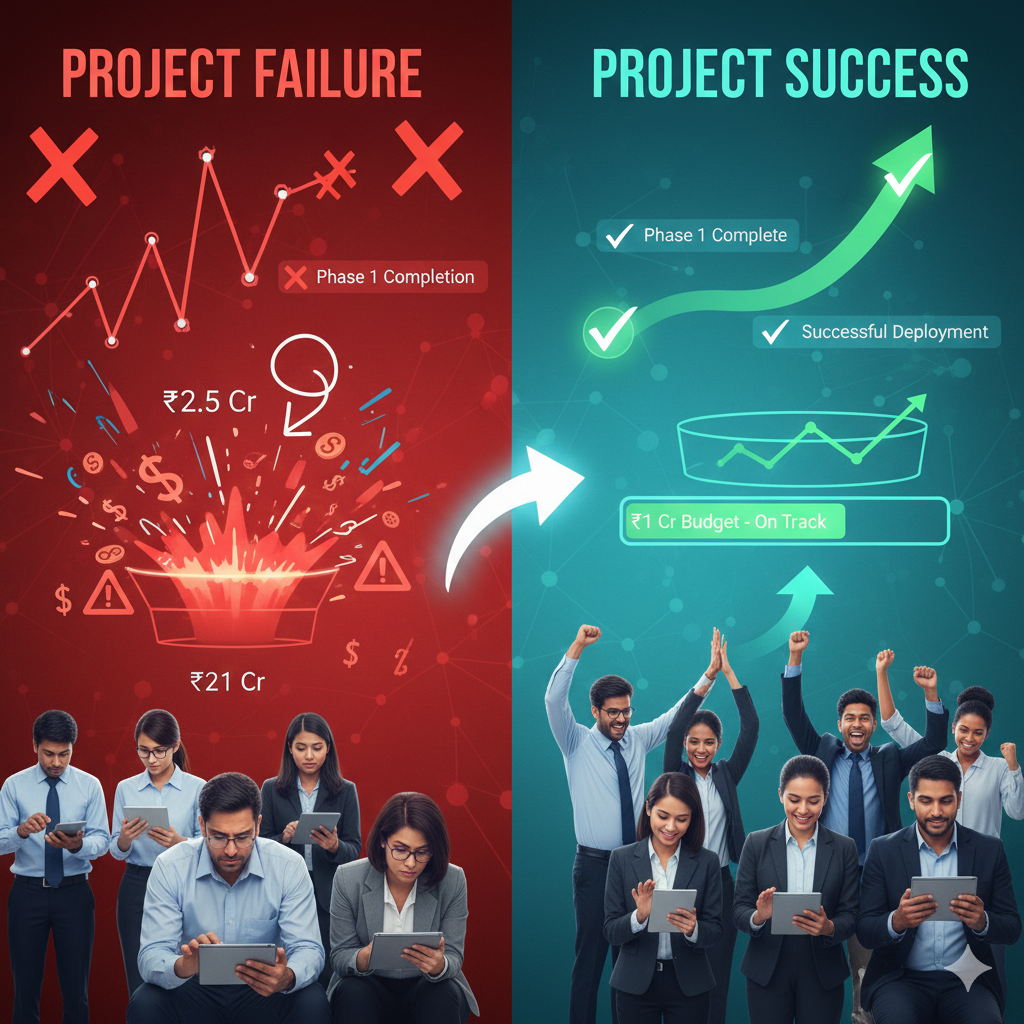
Imagine spending ₹10 crore to build a software system, only to discover midway that what was built doesn’t match what was needed—then adding another ₹15 crore and 18 months to “fix” it. When the dust settles, the system is delivered 2 years late, 75% over budget, and 40% of users don’t want it. agileengine
This isn’t an outlier. This is the norm.
Global research reveals a staggering truth: software projects routinely cost 27–75% more than estimated, miss deadlines by an average of 50%, and deliver 40% less business value than promised.
For India’s booming IT industry and enterprises modernizing their digital infrastructure, this waste translates to ₹50,000+ crore annually in lost productivity, abandoned projects, and unrealized benefits. Yet the fix is straightforward—not technical, but organizational.
Root Causes of Failure and Waste
Linear Thinking in a Complex World
The fundamental problem: treating software as a predictable manufacturing process when it’s actually a knowledge-creation exercise under uncertainty. bcg
Most failed projects start with a classic assumption:
“Define requirements upfront, estimate costs, allocate budget, build for 12–18 months, ship.”
This assumes:
- User needs are fully understood at the start (they’re not)
- Technology will work as designed (dependencies are unpredictable)
- Business priorities won’t change (they always do)
Reality: By the time software is delivered, market conditions, user preferences, and regulatory requirements have shifted—making the end product irrelevant.
The Off-the-Shelf Trap
Ironically, many organizations choose off-the-shelf (COTS) solutions to avoid custom development risks—then spend 3–5 years and 2–3x budget on customization to fit their unique business model. ijisrt
The lesson: generic solutions for unique problems rarely work without expensive, lengthy adaptation.
Unchallenged Ideas = Expensive Pivots
Founders and sponsors often fall in love with their vision rather than validating their problem hypothesis.
- What if nobody wants the feature you’re building?
- What if your target user segment can’t afford your pricing?
- What if a simpler, 80% solution already exists elsewhere?
These questions are rarely asked before major funding and development commence—leading to “we built it perfectly, but nobody needs it” syndrome.
Requirements Engineering—The Kingmaker
Why Requirements Matter
57% of project failures stem directly from poor requirements engineering—not coding, testing, or deployment issues.
When stakeholders can’t articulate what they need, teams build:
- Features that satisfy the wrong users
- Systems that don’t integrate with legacy infrastructure
- Solutions that miss compliance/regulatory mandates
The Silent Killer: Unstandardized Processes
Research across Indian software companies found pervasive issues:
- 68% lack standardized requirements documentation practices (checklists, templates, sign-offs)
- 52% have insufficient user involvement during requirements gathering (business analysts dominate, actual users stay silent)
- 71% show inconsistent effort estimation, leading to wildly inaccurate cost and timeline projections
Best Practice: Work Backwards from Business Outcomes
Instead of building first and hoping for adoption, validate the problem and the target user before writing a single line of code:
- Define business outcome (e.g., “Reduce claims processing time by 40%”)
- Research target users – who benefits? How much will they pay?
- Prototype / validate – can you deliver the outcome with 20% of planned effort?
- Only then – build the full solution
Organizations following this approach saw 40–60% reduction in rework and cancellation rates.
Engagement Models and Early Validation
The Modest Estimate Trap
- Internal team proposes a small pilot: “Let’s start with a proof of concept, ₹50 lakh for 3 months”
- 6 months later, billing has tripled with no launch in sight
- 12 months later, total spend exceeds ₹3 crore for a system that’s 60% functional
This happens because:
- Unknowns weren’t surfaced upfront – scope expanded as real problems emerged
- Estimates assumed perfect execution – no buffer for integration issues, vendor delays, or learning curve
- Incentive structures reward billing hours, not delivering value—contractors have no motivation to ship early
The Case for “Sell First, Build Second”
Before committing capital, market-test your concept:
- Get user pre-commitments – “If this system could reduce your processing time by 40% and cost ₹5 per transaction, would you use it?”
- Run a limited pilot with 10–20% of users to gather data on real ROI
- Refine your value proposition based on feedback, not assumptions
Companies doing this reduced project waste by 30–50%.
The Risk of Unchallenged Ideas
Culture of Challenge vs. Consensus
High-performing tech organizations have a critical difference: they actively challenge ideas before funding, not after delivery.
Low-performing organizations:
- Defer to the “loudest voice” or most senior person in the room
- Treat project scoping as a bureaucratic checkbox, not a rigorous discovery process
- Penalize teams for “scope creep” without acknowledging that scope was wrong from the start
High-performing organizations:
- Create “red teams” that argue against proposed solutions
- Demand ROI justification before every tranche of funding
- Reward course corrections early and penalize delays to recognition
Technology Is Not a Cure-All
A seductive narrative in Indian enterprises: “Let’s deploy AI/ML/blockchain, and our problems will solve themselves.”
Reality: Technology amplifies existing processes. If your process is broken, expensive technology just makes the brokenness scale faster.
Success requires:
- Process clarity first – understand your current workflow
- User adoption second – validate that users want the digital version
- Technology selection third – choose the simplest tech that solves the problem
Build vs. Buy vs. Outsource Decision Framework
Decision Criteria
| Decision | Best For | Red Flags |
|---|---|---|
| Build In-House | Strategic IP, unique competitive advantage, ongoing control needed | Tight timeline, skill gaps, no domain expertise in-house |
| Buy (COTS) | Standard processes (HR, finance, supply chain), long vendor history | Highly customized workflows, complex integrations, niche industry |
| Outsource | Rapid time-to-market, specialized skills (AI, cloud), project-based work | Critical systems, sensitive data, long-term strategic roadmap |
Outsourcing: When It Works (and When It Doesn’t)
Works well:
- You have a clear, stable scope and detailed requirements
- The vendor has deep domain expertise and references from similar projects
- You assign an internal product manager to stay engaged (not hands-off delegation)
- The engagement model is outcome-based, not hourly billing
Fails consistently:
- Vague requirements (“Build a mobile app for restaurant management”)
- Fixed-price contracts with undefined scope (legal nightmare ensues)
- No internal technical oversight
- Vendor has incentive to extend timelines (T&M billing models)
The Hidden Cost of Outsourcing
Many organizations choose outsourcing to reduce perceived risk—then lose visibility and control:
- Data migration delays (outsourcer didn’t plan for legacy data quality issues)
- Integration gaps (outsourcer built in isolation, missed integration points)
- Knowledge transfer failures (when the outsourcer leaves, institutional knowledge vanishes)
Best practice: Use outsourcers as extended teams with skin-in-the-game (outcome incentives), not as black-box contractors.
Aligning Technology With Business Outcomes
The BCG Study: What Actually Works
BCG’s research on 1,000+ organizations revealed that improving outcomes requires culture change, not methodology change:
When technology leaders were directly involved from strategy inception, success rates increased by 154%.
Why? Because:
- Business leaders describe outcomes (faster claims processing); technology leaders suggest paths
- Neither side blames the other when challenges emerge
- Course correction happens in real-time, not in post-mortems
Tracking the Right Metrics
Most software teams track:
- ✓ Lines of code written
- ✓ Test coverage percentage
- ✓ Feature release dates
High-performing teams track:
- ✓ ROI realized (vs. cost)
- ✓ User adoption rate (% of intended users actively using the system)
- ✓ Business outcome achieved (Did processing time drop 40% or 15%?)
- ✓ Cost per transaction (Did we reduce cost per claims process?)
When teams are incentivized on business outcomes (not just shipping features), success rates improve by 25%.
Multiple Solution Paths
Before committing to a single technical approach, evaluate alternatives:
| Approach | Cost | Timeline | Scalability | Best For |
|---|---|---|---|---|
| Full custom build | ₹5 crore+ | 18–24 months | High | Long-term strategic advantage |
| COTS + light customization | ₹1–2 crore | 6–9 months | Medium | Standard workflows with minor tweaks |
| SaaS + integration | ₹50–100 lakh | 3–4 months | Medium | Quick time-to-value, lower capex |
| MVP (Minimum Viable Product) | ₹20–50 lakh | 2–3 months | Low (initially) | Learning, validation, go/no-go decision |
Most organizations jump straight to “full custom build” without exploring cheaper, faster alternatives.
Improving ROI in Software Development
Frame Development as Business Conversation First
Before the first architecture diagram, ask:
- What is the current cost of the problem? (e.g., “Manual claims processing costs ₹10 crore/year”)
- What is the target outcome? (e.g., “Reduce to ₹6 crore/year”)
- What is the payback period? (e.g., “ROI in 2 years”)
- What is the break-even point? (e.g., “After 18 months of deployment”)
If the business case doesn’t work on paper, it won’t work in reality—no matter how elegant the technology.
Track Anticipated vs. Actual ROI
| Metric | Anticipated | Actual (6 months) | Gap | Learning |
|---|---|---|---|---|
| Implementation cost | ₹1 crore | ₹1.5 crore | +50% | Scope creep, integration delays |
| Time to adoption | 3 months | 7 months | +133% | Training, change management underestimated |
| Benefit realized | ₹40 lakh/year | ₹12 lakh/year | -70% | Only 30% of users adopted system |
| Payback period | 30 months | 120+ months | N/A | Project becomes cost center, not profit driver |
By tracking both, future projects are estimated more realistically.
Key ROI Metrics for Software
- Hard ROI: Revenue increase, cost reduction, process efficiency (quantifiable in ₹)
- Soft ROI: Employee satisfaction, faster decisions, reduced risk (harder to quantify, but real)
- Time to value: How long before users realize benefits (shorter = better)
- Cost of ownership: Total cost of ownership over 5 years, including maintenance and upgrades
Decision Points for Enterprise Leaders
Decision 1: Early User Validation
Before greenlight:
- Have you interviewed 20–50 actual target users?
- Do 70%+ confirm they would use/pay for this solution?
- Have you tested a low-fidelity prototype (wireframes, mockups)?
If not, delay greenlight and run a 4-week discovery sprint.
Decision 2: Build vs. Buy Assessment
Use a simple matrix:
| Criteria | Weight | Custom Build | COTS | Outsource |
|---|---|---|---|---|
| Speed to market | 25% | 1/5 | 5/5 | 4/5 |
| Customization | 25% | 5/5 | 2/5 | 3/5 |
| Internal control | 20% | 5/5 | 2/5 | 1/5 |
| Long-term cost | 20% | 3/5 | 4/5 | 2/5 |
| Skill availability | 10% | 2/5 | 5/5 | 4/5 |
| Score | 100% | 3.1/5 | 3.5/5 | 2.9/5 |
Choose the option with the highest weighted score.
Decision 3: External Partner Selection
Choose partners who:
✓ Challenge your assumptions – push back on vague requirements
✓ Focus on ROI, not hours – their incentive is your success, not billing
✓ Have domain expertise – references from similar companies, not just technical capability
✓ Are transparent about risks – admit what they don’t know
Avoid partners who:
✗ Accept any scope without pushback
✗ Use “time & materials” billing models (incentive to drag)
✗ Have no experience in your industry
✗ Operate in silos (no internal engagement required)
Conclusion
The software project failure crisis is real. Billions of rupees are wasted annually building systems nobody needs, delivered too late, and costing far more than planned.
But the fix isn’t technical—it’s organizational:
- Demand early validation – prove user need before funding
- Create strategic partnerships – involve tech leaders from day 1
- Align incentives – pay for ROI delivered, not hours billed
- Track business outcomes – not just features shipped
- Challenge assumptions – early, often, and with psychological safety
For enterprise leaders and CTOs navigating digital transformation in 2025–2026:
- Ask harder questions about requirements and market fit before the purchase order
- Choose partners who resist scope creep, not those who accept it passively
- Measure success against business outcomes, not technical metrics
- Plan for 50% timeline extension and 25% budget overrun as baseline, not surprise
Your turn: How have you experienced software project waste in your organization? What changes would have prevented delays or overruns? Share your story in the comments—let’s learn from each other’s war stories.





+ There are no comments
Add yours