Key Highlights
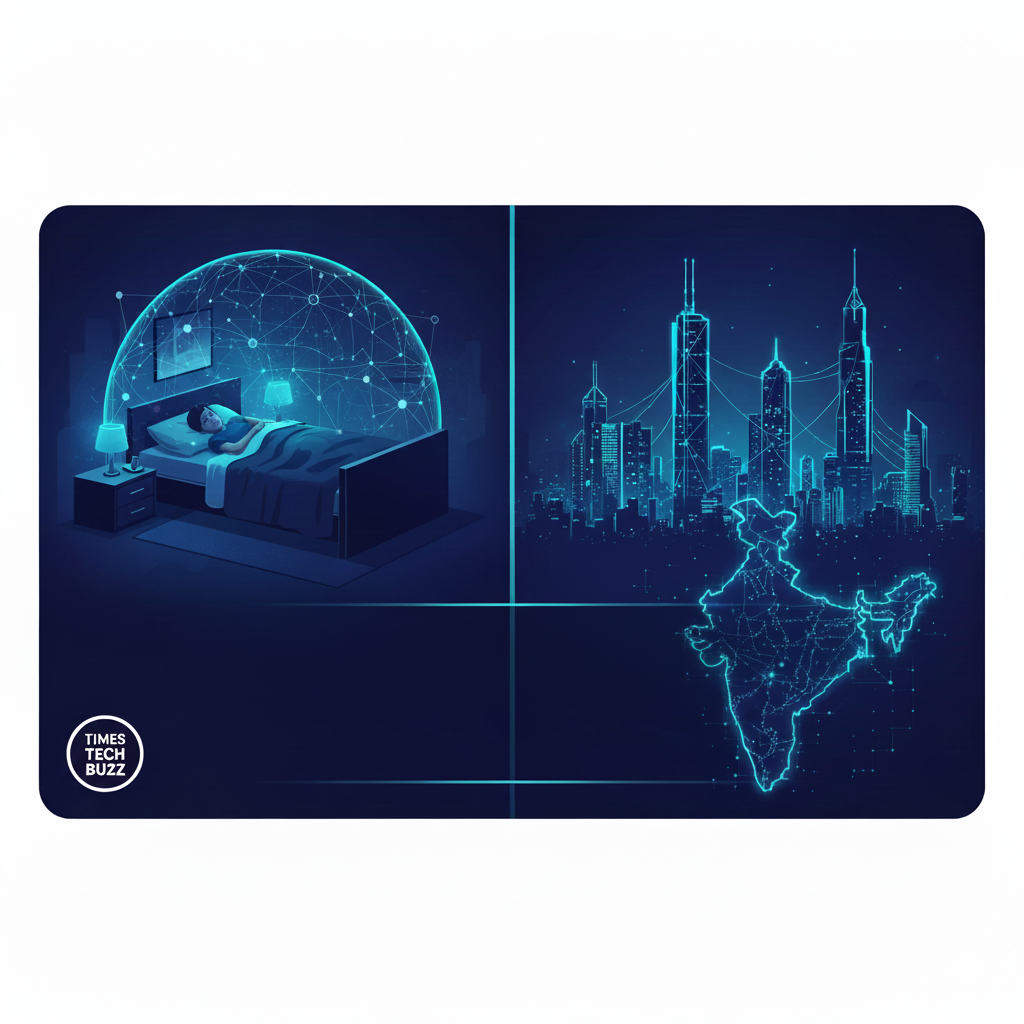
- India’s smart home market is projected to reach ₹1.4 lakh crore by 2028, growing from ₹90,000 crore in 2023, with 25–28% household penetration expected by 2028.
- AI voice assistants dominate adoption: 72% of Indian smart home users cite voice control as their most-used feature, with 45% of urban households owning at least one AI device.
- Cybersecurity threats are escalating: IoT devices are tripling by 2028, yet weak passwords, unpatched firmware, and unsecured networks remain the biggest vulnerabilities in Indian homes.
- Quantum encryption and edge computing are emerging as critical safeguards, alongside India’s data localization mandates and mandatory CERT-In incident reporting for critical IoT breaches.
- Policy alignment is urgent: Standards like Matter, BIS IoT norms, and new privacy regulations must keep pace with technology adoption to ensure safety, interoperability, and consumer empowerment.
The Smart Home Paradox
Your home turns on the lights as you walk in. Your thermostat adjusts temperature based on weather. Your security camera sends alerts when a delivery arrives. Coffee brews while you sleep. This is the smart home of 2025—convenient, efficient, and increasingly, a part of Indian middle-class life.
But there’s a catch: every device listening, every sensor recording, every automation decision creates digital footprints that can be exploited, leaked, or weaponized.
As India hurtles toward smart home adoption at breakneck speed—with projections of 15.4 million households by 2026—the question is no longer “should I go smart?” but rather: “Can I safely go smart?“
The Smart Home Market: India’s Tipping Point
Growth Explosion
India’s smart home market tells a dramatic story: nextmsc
- 2023: ₹90,000 crore (USD 3.68 billion)
- 2025: ₹73,000+ crore (USD 7.3 billion)
- 2028: ₹1.4 lakh crore (projected)
- CAGR: 20–30% (depending on adoption scenario)
This puts India in the top 5 global smart home markets, second only to the U.S. and China.
From Luxury to Necessity
A decade ago, smart homes were billionaire toys. Today, they’re middle-class staples:
- 45% of urban households in India now own at least one smart device (up from 28% in 2020)
- ₹2,299 retrofit security cameras (entry-level pricing) have democratized adoption
- Amazon Echo, Google Home, and Alexa penetration in tier-2 and tier-3 cities is accelerating
The shift from luxury to necessity is driven by affordability, 5G rollout, and consumer desire for energy savings—households with AI-managed thermostats report 25% lower electricity bills.
Breakthrough Technologies Powering Smart Homes
1. AI and Machine Learning
AI is the beating heart of modern smart homes.
- Predictive automation: Learns routines and anticipates needs (e.g., “It’s 6 AM on weekdays—turn on coffee, open blinds, queue morning news”)
- Adaptive energy management: Thermostats and lighting adjust based on occupancy, weather, and time-of-day utility pricing
- Anomaly detection: Security systems flag unusual behavior (e.g., TV turning on at 3 AM, unexpected door opens)
2. Voice and Natural Language Processing
72% of Indian smart home users rely on voice control as their primary interface.
- Amazon Alexa, Google Assistant, and local solutions (e.g., AnantAI, Gnani.ai) now support Indian languages and dialects
- Multi-turn conversational ability: “Dim the lights, lock the doors, and set the alarm for 7 AM”
- Accessibility boost: elderly and children navigate smarter with voice vs. complex apps
3. Interconnectivity and Universal Platforms
The “Matter” standard (approved for India) and BIS IoT norms aim to solve fragmentation:
- Seamless device communication: Amazon devices, Google devices, and third-party IoT products co-exist on one network
- Hub-and-gateway architecture: Central device (e.g., router or hub) orchestrates all automation
- Cloud + edge hybrid: Local processing for privacy-sensitive data, cloud for analytics and AI
4. Security Innovations
- Facial recognition (to verify residents vs. intruders)
- Quantum-resistant encryption (to future-proof against quantum computers)
- Hardware security modules (embedded chips that validate device identity and firmware integrity)
- Behavioral AI: Learns normal patterns and flags deviations in real-time
Key Smart Home Trends for 2026
Personalization Through Predictive Automation
AI learns your routines and pre-emptively adjusts your home.
Example: On Friday evenings, your home lowers lighting to 20% at 8 PM (your usual dinner time), queues ambient music, and sets the thermostat to 22°C—all without you asking.
Brand Compatibility and Standards
The “Matter” standard, endorsed by Apple, Google, Amazon, and Samsung, is critical:
- Devices from different vendors now work together on the same platform
- Reduces vendor lock-in risk
- Simplifies consumer choice and upgrades
Energy Efficiency as a Primary Driver
With energy bills and climate concerns rising, smart thermostats and grid-responsive devices are now value propositions, not luxuries.
- Air conditioning accounts for 40–60% of household electricity in India; AI-managed AC cuts consumption by 15–25%
- Solar integration: homes with rooftop PV + smart meters + batteries optimize self-consumption
Challenges: Cost, Installation, and Usability
Despite adoption surges, barriers persist:
- Upfront cost: Full-home automation (hub, cameras, sensors, smart appliances) can run ₹1–5 lakh+
- Installation complexity: Requires network setup, firmware updates, device pairing—often overwhelming for non-tech users
- Fragmentation: Devices from different brands require separate apps, creating cognitive overload
Security in the Era of Smart Homes
The Vulnerability Reality
India’s IoT devices are tripling by 2028—but so are attacks.
Common vulnerabilities in Indian smart homes:
| Vulnerability | Risk | Real-World Impact |
|---|---|---|
| Default/weak passwords | Unauthorized access | Attackers lock homeowners out or steal footage |
| Unpatched firmware | Exploit known bugs | Malware hijacks devices as botnets (e.g., Mirai variant attacks in 2024) |
| Unsecured Wi-Fi networks | Eavesdropping on device traffic | Passwords, video streams, biometric data intercepted |
| Device fragmentation | Inconsistent security patches | Old devices never patched; become permanent attack vectors |
| Cloud misconfigurations | Data exfiltration | Footage/logs publicly accessible due to misconfigured S3 buckets |
Emerging Security Solutions
Quantum-Resistant Encryption
Traditional encryption (RSA-2048) is vulnerable to future quantum computers. India is adopting quantum-safe algorithms (NIST Post-Quantum Cryptography standards) in new devices.
Edge Computing and Local Processing
Instead of sending all sensor data to the cloud, edge devices (local hubs) perform initial processing, reducing exposure:
- Facial recognition happens locally on your device—only flagged faces are cloud-queried
- Activity logs stay on your hub; only summaries sync to cloud
- Reduces latency, improves privacy
Behavioral Anomaly Detection
AI systems learn “normal” and flag deviations:
- Device communicates with unusual IP addresses → flagged
- Unexpected power surge patterns → checked
- User remotely accesses home from non-routine location → adaptive authentication triggered
Real-World Smart Home Experiences and Adoption Issues
The Ideal Morning Routine
6:00 AM: Your alarm triggers a pre-set “Wake” scene:
✓ Gradual lights fade-in (mimics sunrise)
✓ Thermostat shifts to 22°C
✓ Coffee machine powers on
✓ Smart speaker queues news, weather, and commute traffic
✓ Blinds gradually open
All hands-free, learned from your routines.
Remote Control and Energy Optimization
You’re abroad on vacation:
✓ Smart AC turns on 30 mins before you return (pre-cools home)
✓ Smart meter shows real-time consumption per room
✓ Solar inverter prioritizes battery charging during peak sun hours
✓ You get alerts if doors unlock unexpectedly
Real-World Challenges
But adoption reveals persistent friction:
- Privacy Concerns: “Who owns my data? Can Amazon/Google listen in on my conversations?”
Reality: Most devices only activate on wake words; however, audio logs are stored and shared with developers for improvement. - Cybersecurity Fears: “What if my smart lock is hacked?”
Reality: Multi-factor authentication (RFID + PIN + biometric) mitigates, but not all devices offer this. - Device Fragmentation: Buying a Samsung SmartThings hub, then an Amazon Echo, then a Philips Hue light system results in three separate apps, three logins, three inconsistent UX.
- Vendor Lock-In: Google discontinues a device; your automations break. Upgrading means replacing entire ecosystems.
India’s Smart Home Outlook for 2026
Expected Growth Drivers
Why India will reach 15.4 million smart households by 2026:
- Rising disposable incomes: India’s middle class is expanding; 45% of urban households have adopted at least one smart device already
- Digital infrastructure: 5G rollout, affordable fiber, and Wi-Fi 6 provide connectivity backbone
- Affordable IoT: Entry-level devices now cost ₹500–5,000 vs. ₹50,000–100,000 a decade ago
- Government push: Smart Cities Mission (100 cities), PM Surya Ghar rooftop solar, and Digital India create ecosystem support
- E-commerce accessibility: Amazon, Flipkart, and local startups democratize access to devices
Policy Imperatives
- Standards harmonization: Mandatory adoption of Matter, BIS IoT norms, and IEC standards to ensure interoperability
- Data localization: All personal data (video, biometrics, usage patterns) processed in India, per DPDP Act 2023
- Security-by-design: CERT-In and DSCI to mandate security audits for consumer IoT before market entry
- Consumer awareness: Public campaigns on strong passwords, firmware updates, and privacy settings
Decision-Making Perspectives: Who Must Act?
Developers and Manufacturers
✓ Design for interoperability: Build on Matter/BIS standards, not proprietary silos
✓ Security-first architecture: Embed TPMs (Trusted Platform Modules), secure boot, and OTA (Over-The-Air) update mechanisms
✓ User consent: Transparent data handling; ask before using audio/video for model training
✓ Regional adaptation: Support Indian languages, account for power instability, and localize data processing
Consumers
✓ Assess your threat model: Rural home (low theft risk) vs. urban flat (high risk) need different security postures
✓ Prioritize brands with strong security track records: Check for CERT-In certifications, regular patches, and bug bounty programs
✓ Invest in network security: Strong router passwords, VPN usage, guest networks for visitors (common in Indian homes)
✓ Read privacy policies: Understand what data is stored, how long, and who has access
✓ Value long-term sustainability: Choose devices from vendors likely to support security patches for 5+ years
Policymakers
✓ Foster standards adoption: Make Matter and BIS IoT compliance mandatory for government contracts, incentivizing industry
✓ Incentivize secure innovation: Tax breaks for domestic IoT manufacturers meeting security benchmarks
✓ Promote consumer awareness: Public service announcements on smart home security (like existing digital literacy campaigns)
✓ Harmonize regulations: Align DPDP Act 2023, IT Act 2000, and emerging cybersecurity norms so industry clarity is ensured
Conclusion

Smart homes are no longer a futuristic fantasy—they’re reshaping Indian living rooms right now. The convenience is real. The energy savings are tangible. The security risks are also real.
By 2026, India will likely have 15+ million smart households. The question is whether these will be empowered, resilient ecosystems—or ticking time-bombs of vulnerability.
The answer depends on three pillars:
- Technology: Quantum-resistant encryption, edge computing, and behavioral AI must mature.
- Policy: Standards, data localization, and security mandates must be enforced.
- Consumer awareness: Indians must understand that their smart homes are only as secure as their passwords, patches, and privacy choices.






+ There are no comments
Add yours