
Key Highlights
- Tactical edge computing deploys processing power directly at battlefield frontlines reducing latency from seconds to milliseconds enabling real-time decision-making in contested environments
- India’s DRDO has deployed 140 AI systems along LAC and LoC processing 1.2 petabytes of data daily with 97% intrusion detection accuracy demonstrating operational success
- Edge systems provide operational resilience during communication disruption through autonomous operation, distributed processing, and local AI-driven decision-making capabilities
- Advanced AI integration enables autonomous threat detection computer vision, predictive maintenance, and real-time intelligence analysis without cloud connectivity requirements
- Ruggedness challenges require specialized hardware operating in temperature extremes -50°C to +55°C while maintaining security against physical and cyber threats
In the rapidly evolving landscape of modern warfare, the ability to process and act upon intelligence in real-time at the point of collection has become a decisive factor separating victory from defeat. Tactical edge computing represents a paradigmatic shift from traditional centralized data processing to distributed computational power deployed directly at the battlefield’s edge – embedded in soldier equipment, vehicles, drones, and forward operating bases. This transformative technology enables sub-second decision-making by eliminating the latency inherent in transmitting data to remote command centers, while providing operational resilience in contested environments where communication links may be jammed, disrupted, or completely severed. As the U.S. Department of Defense allocates billions toward Joint Warfighting Cloud Capability initiatives and India’s DRDO deploys 140 AI systems along the Line of Actual Control (LAC) and Line of Control (LoC) processing 1.2 petabytes of data daily with 97% intrusion detection accuracy, tactical edge computing is rapidly becoming the cornerstone of next-generation military operations. basecampconnect sahanasystem
Defining Tactical Edge Computing: Technology at the Spearhead
Core Architecture and Operational Philosophy
Tactical edge computing fundamentally reimagines the military data processing paradigm by co-locating computational resources with data sources rather than relying on distant cloud infrastructure or centralized command centers.
Key Architectural Components:
- Soldier-worn devices: Tablets, smartphones, and wearable sensors providing individual combatants with real-time situational awareness
- Vehicle-mounted systems: Ruggedized computing platforms in armored vehicles, aircraft, and naval vessels
- Autonomous platforms: Drones and unmanned systems equipped with onboard processing capabilities
- Forward operating bases: Distributed computing nodes supporting battalion and company-level operations
- IoT sensor networks: Battlefield sensors providing continuous environmental and threat monitoring
Operational Philosophy:
The tactical edge approach prioritizes speed over perfection, autonomy over connectivity, and local intelligence over comprehensive analysis. This philosophy recognizes that in contested environments, a good decision implemented immediately often surpasses a perfect decision that arrives too late. rocket
Latency Reduction: The Millisecond Advantage
Traditional cloud-based military systems suffer from inherent latency penalties that can prove tactically catastrophic:
Latency Sources in Conventional Systems:
- Network transmission delays: 150-300 milliseconds for satellite communications
- Processing queues: Additional seconds waiting for cloud server availability
- Return transmission: Another 150-300 milliseconds for processed intelligence to reach operators
- Human interface delays: Additional seconds for operators to interpret and act on information
Edge Computing Advantage:
By processing surveillance feeds, sensor data, and threat detection algorithms locally, tactical edge systems can reduce decision cycles from seconds or minutes to milliseconds, providing critical advantages in fast-moving combat scenarios.
Strategic Benefits: Transforming Military Operations
Operational Resilience in Contested Environments

Modern adversaries increasingly employ electronic warfare tactics designed to disrupt communication networks and isolate military units from command and control structures. Tactical edge computing provides unprecedented resilience against such attacks.
Resilience Mechanisms:
- Autonomous operation: Edge systems continue functioning even when completely isolated from higher command
- Distributed processing: No single point of failure as computational power is spread across multiple nodes
- Adaptive networking: Mesh networking capabilities allow edge devices to maintain connectivity with nearby units
- Local decision-making: AI algorithms can make tactical decisions without requiring external authorization
India’s Border Security Implementation:
The Centre for Artificial Intelligence and Robotics (CAIR) under DRDO has demonstrated this resilience through deployment of 140 AI systems along India’s contested borders, achieving 97% intrusion detection accuracy while processing 1.2 petabytes of data daily even in communication-challenged environments.
Bandwidth Optimization and Resource Efficiency
Military operations generate enormous data volumes from multiple simultaneous sources:
- High-definition video streams: Multiple gigabytes per minute from drone surveillance
- Sensor telemetry: Thousands of data points per second from battlefield IoT devices
- Communications traffic: Voice, text, and data from hundreds of personnel
- Intelligence feeds: Satellite imagery, signals intelligence, and human intelligence
Edge Computing Solution:
Rather than transmitting raw data to distant processing centers, edge systems perform local filtering and analysis, sending only high-value intelligence summaries to command structures, reducing bandwidth requirements by 80-95% while improving information quality.
Advanced Technology Integration
Artificial Intelligence and Machine Learning at the Edge
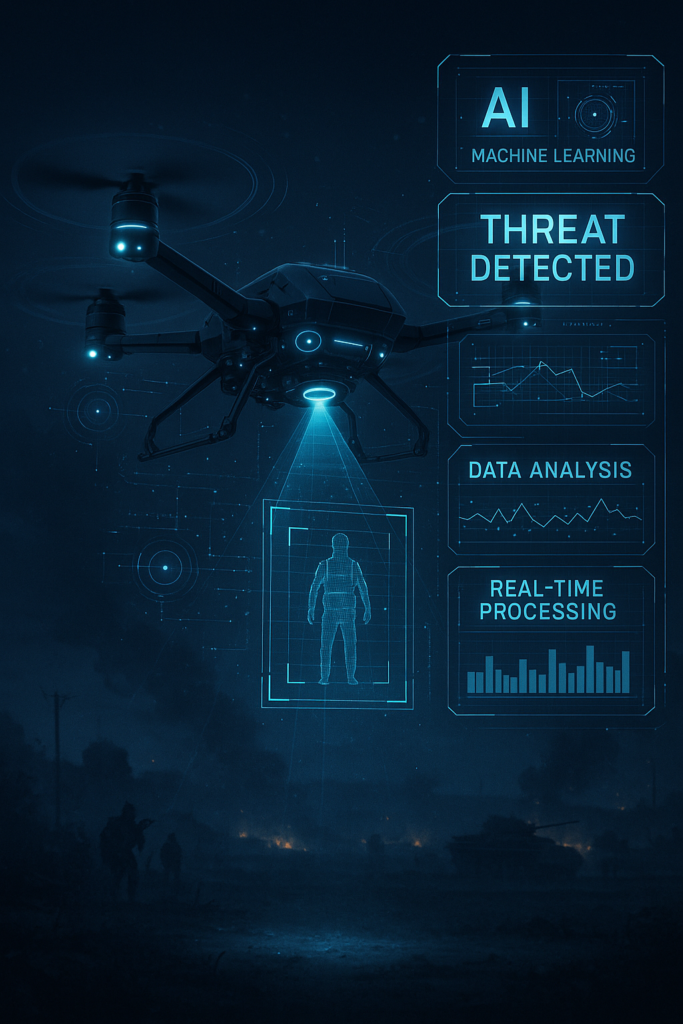
AI and ML algorithms deployed at the tactical edge enable autonomous threat detection, predictive analytics, and real-time decision support without requiring connectivity to cloud-based AI services.
AI Applications in Tactical Edge Computing:
- Computer vision: Automated identification of enemy personnel, vehicles, and equipment from drone footage
- Predictive maintenance: Algorithm-driven assessment of equipment condition preventing mission-critical failures
- Route optimization: Real-time analysis of terrain and threat data for optimal path planning
- Threat classification: Instant categorization of potential threats based on behavioral patterns and signature analysis
DRDO’s AI Edge Initiatives:
DRDO is developing neuromorphic chips and high-efficiency GaN power chips specifically designed for edge AI applications, addressing the critical challenge of power-efficient computing in resource-constrained battlefield environments.
Autonomous Systems and Robotic Integration
Tactical edge computing serves as the neural network for increasingly sophisticated autonomous military systems:
Autonomous Platform Applications:
- Unmanned aerial vehicles: Independent navigation and threat assessment without ground control station involvement
- Ground-based robots: Border patrol robots developed by IIT Guwahati under DSRL providing AI-powered surveillance across challenging terrains
- Autonomous vehicles: Convoy operations with minimal human oversight in contested areas
- Swarm systems: Coordinated operations of multiple autonomous platforms sharing real-time intelligence
India’s Strategic Framework and Implementation
DRDO’s Deep Technology Leadership
India’s Defense Research and Development Organisation (DRDO) has positioned itself at the forefront of tactical edge computing development, focusing on indigenous capabilities and technological sovereignty.
DRDO’s Edge Computing Initiatives:
- Quantum communication systems: 100 km secure quantum communication over fiber networks with IIT Delhi
- Advanced sensor development: Compound semiconductors and MEMS technologies for high-performance sensing
- Neuromorphic computing: Brain-inspired processors optimized for low-power AI applications
- Post-quantum cryptography: Advanced encryption algorithms securing edge communications against quantum threats
Border Security and Counter-Terrorism Applications
India’s unique geographical challenges – spanning Himalayan borders, desert regions, and island territories – provide ideal testing environments for tactical edge computing systems:
Operational Deployments:
- Line of Actual Control (LAC): AI-powered surveillance systems monitoring Chinese border incursions
- Line of Control (LoC): Automated threat detection systems identifying terrorist infiltration attempts
- Coastal surveillance: Maritime domain awareness through distributed sensor networks
- Counter-insurgency operations: Northeast India deployment of edge-enabled systems for jungle warfare scenarios
Policy and Budgetary Framework
India’s defense modernization efforts increasingly prioritize edge computing capabilities:
Funding and Investment:
- Defense budget: $81 billion in 2025 with 33% surge in tech investments since 2021
- Indigenous development: 78% of AI defense projects developed domestically according to NITI Aayog
- Startup ecosystem: Defense innovation corridors promoting private sector participation in edge computing development
- International partnerships: Strategic collaborations with Israel and other technology leaders
Technical Challenges and Engineering Solutions
Ruggedness and Environmental Resilience
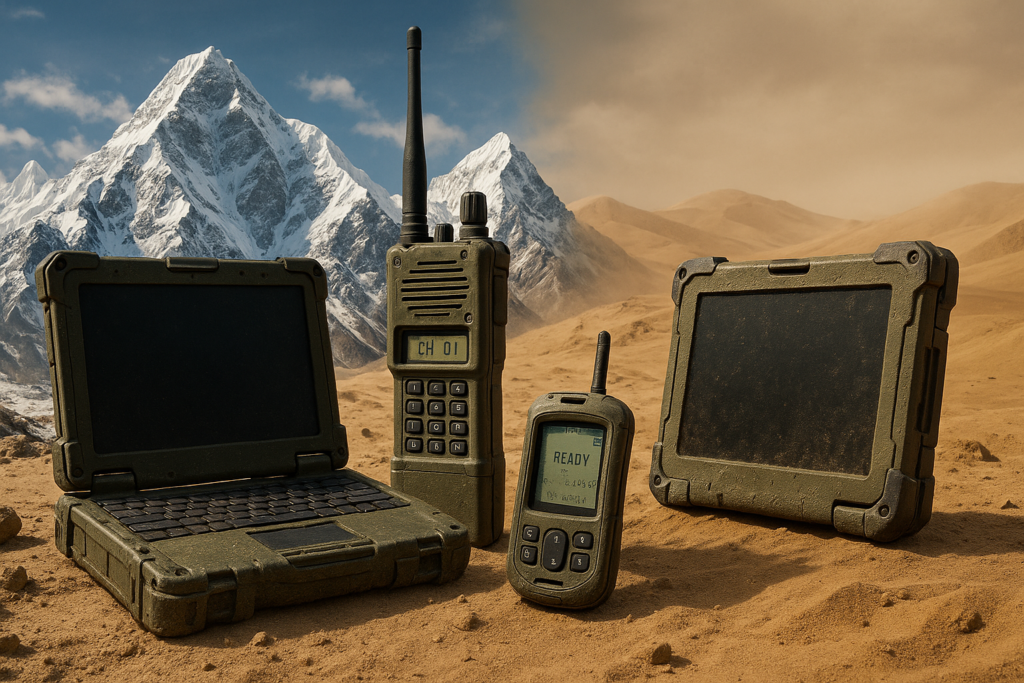
Military edge computing devices must operate reliably under extreme conditions that would destroy commercial computing equipment.
Environmental Challenges:
- Temperature extremes: -50°C to +55°C operational ranges in Arctic and desert environments
- Physical shock: Vibration and impact from vehicle movement and weapons fire
- Water and dust ingress: Complete sealing required for amphibious and desert operations
- Electromagnetic interference: Protection against jamming and electronic warfare attacks
- Solar radiation: High-altitude operations requiring radiation-hardened components
Engineering Solutions:
- Ruggedized enclosures: Military-grade housing meeting MIL-STD specifications
- Advanced cooling: Passive cooling systems and thermal management for high-power processors
- Redundant power systems: Battery backup and energy harvesting for extended operations
- Modular architecture: Field-replaceable components enabling rapid maintenance
Security and Cybersecurity Considerations
Edge computing devices present unique security challenges as they operate in forward positions where physical capture by adversaries is more likely:
Security Threats:
- Physical tampering: Device capture and reverse engineering by enemy forces
- Cyber infiltration: Remote hacking attempts targeting edge nodes
- Data exfiltration: Sensitive intelligence stored on forward-deployed devices
- Supply chain attacks: Compromised hardware or software components
Security Countermeasures:
- Tamper-evident hardware: Self-destruct mechanisms preventing unauthorized access
- Zero-trust architecture: Continuous authentication and authorization for all communications
- Homomorphic encryption: Processing encrypted data without decryption
- Secure boot processes: Hardware-based verification of system integrity
International Benchmarking and Comparative Analysis
U.S. Department of Defense Leadership
The U.S. military leads global tactical edge computing deployment through comprehensive programs like Joint Warfighting Cloud Capability (JWCC) and Project Maven:
U.S. Edge Computing Programs:
- One Stop Systems: $6.5 million contract for 80 high-performance servers and FPGA systems for mobile tactical environments
- Leonardo DRS: Artificial Intelligence Processor (AIP) providing ruggedized AI systems for real-time threat detection
- Air Force ABMS: Advanced Battle Management System using distributed networks for multi-domain operations
- Army’s Integrated Visual Augmentation System: Soldier-worn displays powered by edge computing
Chinese Military Modernization
China’s People’s Liberation Army is rapidly developing edge computing capabilities through military-civil fusion strategies:
Chinese Edge Computing Developments:
- Sixth-generation fighter jets: Integrated edge AI for rapid threat detection and UAV coordination
- Swarm systems: Coordinated drone operations using distributed edge processing
- Border surveillance: AI-powered monitoring systems along contested borders
- Naval applications: Edge computing on next-generation warships and submarines
Israeli Innovation and Integration
Israel’s compact geography and constant security threats have driven innovative edge computing solutions:
Israeli Edge Computing Applications:
- Iron Dome: Real-time interception systems using edge-based threat assessment
- Border security: Automated surveillance along Gaza and Lebanon borders
- Urban warfare: Soldier systems for complex terrain navigation
- Cyber-physical systems: Integration of cyber warfare with physical operations
Challenges Specific to Indian Operating Environment
Geographical and Environmental Constraints
India’s diverse operational theaters present unique challenges for tactical edge computing deployment:
Himalayan Challenges:
- Extreme altitude: Reduced air pressure affecting cooling systems and electronic performance
- Temperature variations: Rapid temperature changes causing thermal stress on components
- Limited infrastructure: Sparse road networks and communication infrastructure
- Weather extremes: Monsoon conditions and severe winters affecting equipment reliability
Desert and Arid Region Challenges:
- Sand infiltration: Fine particles penetrating equipment enclosures
- Solar radiation: High UV exposure degrading electronic components
- Temperature extremes: Daily temperature swings exceeding 40°C variations
- Limited water: Cooling system constraints due to water scarcity
Supply Chain and Manufacturing Considerations
India’s push for indigenous defense manufacturing faces challenges in edge computing component production:
Supply Chain Vulnerabilities:
- Semiconductor dependence: Limited domestic chip manufacturing capabilities
- Advanced sensors: Reliance on imported components for high-performance sensors
- Specialized materials: Rare earth elements and advanced composites sourcing
- Quality assurance: Military-grade certification processes for indigenous components
Make in India Initiatives:
- Semiconductor fab development: Government initiatives to establish domestic chip production
- Defense industrial corridors: Dedicated manufacturing zones for defense equipment
- Technology transfer agreements: International partnerships for knowledge acquisition
- Startup ecosystem: Supporting indigenous innovation in defense technology
Human Resource Development and Training Requirements
Skill Gap Analysis and Training Needs
Tactical edge computing requires specialized personnel capable of operating, maintaining, and securing complex distributed systems:
Critical Skill Requirements:
- Edge system administration: Managing distributed computing resources in field conditions
- AI/ML operations: Deploying and maintaining machine learning models at the edge
- Cybersecurity expertise: Securing edge devices against sophisticated threats
- Hardware maintenance: Field-level repair of ruggedized computing equipment
- Network administration: Managing mesh networks and communication systems
Training Infrastructure Development:
- Military academies: Curriculum updates incorporating edge computing concepts
- Technical institutes: Specialized courses for defense edge computing
- Industry partnerships: Private sector collaboration in training programs
- Continuous learning: Adaptive training programs keeping pace with technological evolution
Strategic Recommendations and Way Forward
Integration with Defense Digitalization Initiatives
Tactical edge computing must be seamlessly integrated with broader defense digitalization efforts:
Integration Priorities:
- Digital backbone: Unified communication protocols across all edge devices
- Data standardization: Common data formats enabling interoperability
- Command integration: Edge systems feeding into existing C4ISR architecture
- Logistics support: Integrated maintenance and supply chain management
Research and Development Acceleration
Sustained R&D investment is crucial for maintaining technological edge:
R&D Focus Areas:
- Next-generation processors: Quantum computing and neuromorphic architectures
- Advanced materials: Lighter, stronger materials for ruggedized enclosures
- Energy systems: Long-duration batteries and energy harvesting technologies
- Security innovations: Post-quantum cryptography and hardware security modules
Public-Private Partnership Models
Collaboration between government, industry, and academia can accelerate edge computing development:
Partnership Strategies:
- Innovation challenges: Competitive programs driving technological breakthroughs
- Test bed development: Shared facilities for technology validation
- Technology transfer: Efficient pathways from research to deployment
- International cooperation: Strategic partnerships with allied nations
Conclusion: The Edge of Tomorrow’s Battlefield
Tactical military edge computing represents more than technological advancement – it embodies a fundamental shift in how military forces will operate, decide, and dominate future battlefields. By bringing computational power directly to the point of action, this technology eliminates critical vulnerabilities while empowering individual soldiers with capabilities previously available only to major command centers.
India’s approach to tactical edge computing, led by DRDO’s innovative research and demonstrated through successful border deployments, positions the nation as a major player in this transformative technology. The integration of AI, ruggedness engineering, and indigenous manufacturing creates a comprehensive ecosystem capable of supporting India’s diverse operational requirements from Himalayan peaks to island territories.
The challenges ahead – from environmental resilience to cybersecurity threats – demand continued investment in research, training, and infrastructure development. However, the strategic advantages of tactical edge computing – reduced latency, enhanced resilience, and autonomous capabilities – make this investment not just beneficial but essential for maintaining military superiority in the 21st century.
As military operations become increasingly data-driven and AI-powered, the nations that successfully deploy and integrate tactical edge computing will possess decisive advantages in future conflicts. India’s commitment to this technology, combined with its unique operational requirements and growing indigenous capabilities, positions it to lead rather than follow in the next generation of military innovation.
The edge of tomorrow’s battlefield is here today, and India is ready to dominate it.
Mains
GS-3 (Defence Technology)
“Discuss the significance of tactical edge computing in modern warfare. In the Indian context, evaluate the opportunities and challenges in adopting this technology for defence readiness.”








+ There are no comments
Add yours