Key Highlights:
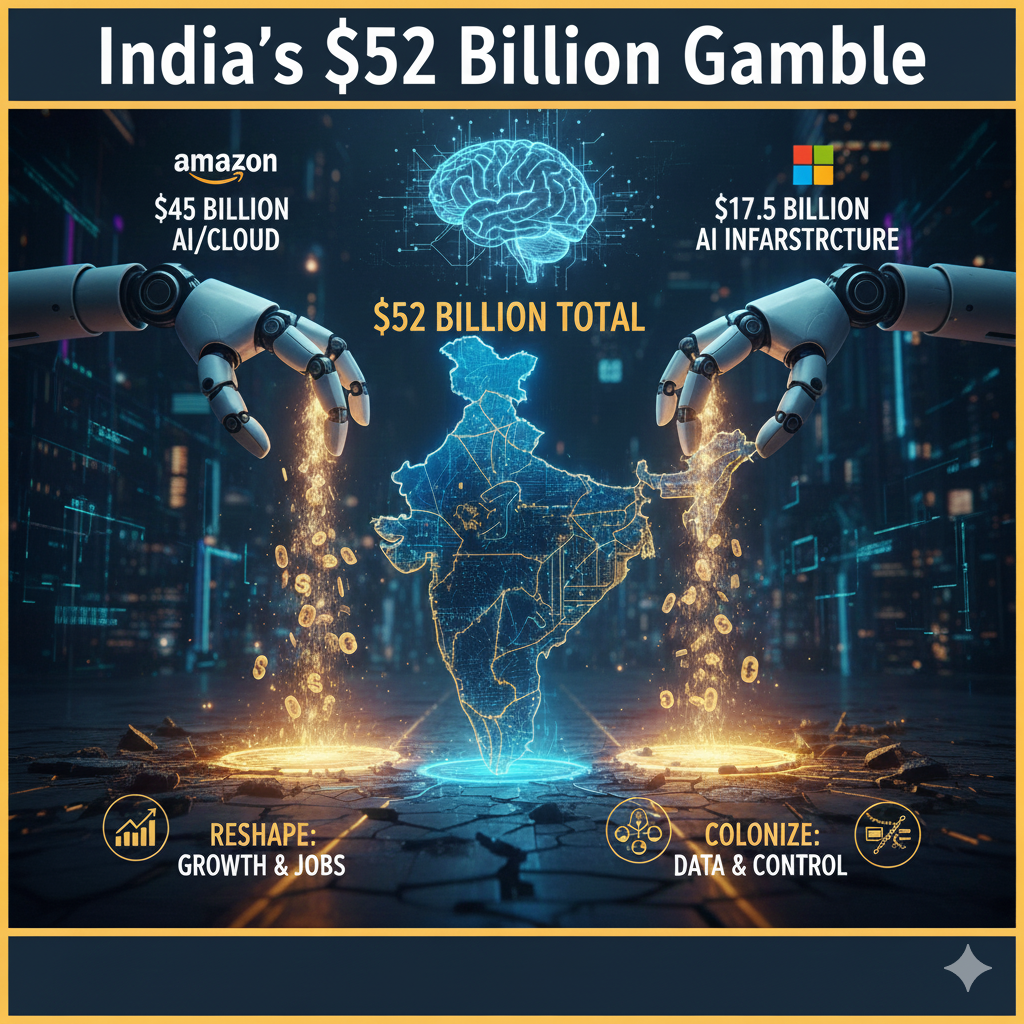
- Historic Investment Wave: Within 24 hours (December 9-11, 2025), Amazon ($35B by 2030), Microsoft ($17.5B for 2026-2029), and Google ($15B by 2030) announced a combined $67.5+ billion commitment—the largest foreign investment wave in India’s AI infrastructure history.
- Hyperscale Infrastructure Transformation: Microsoft’s hyperscale data center in Hyderabad (three availability zones equivalent to two Eden Gardens stadiums) launching mid-2026; Google’s 1 GW facility in Visakhapatnam (largest AI hub outside US) with subsea cable gateway; Amazon expanding cloud footprint across six metros—fundamentally reshaping India’s digital backbone.
- Employment and Digitization Goals: Amazon alone targets 3.8 million jobs (direct, indirect, seasonal) and $80 billion in cumulative exports by 2030; Microsoft’s 20 million AI skills target; combined investments enabling AI access for 15+ million Indian small businesses and entrepreneurs.
- Strategic Autonomy Dilemma: While Big Tech investment accelerates India’s AI journey, 34,000+ GPUs under IndiaAI Mission, and sovereign cloud initiatives emerge, the fundamental challenge remains: Can India leverage foreign capital while maintaining data sovereignty and technological independence?
The Investment Announcement—Scale and Timing
24 Hours That Changed India’s AI Story
On December 9, 2025, Microsoft CEO Satya Nadella announced $17.5 billion in new AI investment—the company’s largest-ever Asia commitment. The announcement followed Nadella’s personal meeting with Prime Minister Narendra Modi, signaling top-level government alignment with Big Tech’s India strategy.
The very next day, Amazon responded with an announcement of $35 billion investment by 2030—building on its already-stated cumulative $40 billion committed since 2010, making Amazon the “largest foreign investor” in India.
Within the same window, Google’s earlier October announcement of $15 billion for a Visakhapatnam AI hub (the world’s largest AI facility outside the United States) completed the triumvirate. pib.gov
Total Big Tech commitment: $67.5 billion.
To put this in perspective:
- India’s entire FDI for 2024 was approximately $85 billion. These three companies alone represent 79% of a year’s total foreign direct investment.
- Microsoft’s commitment alone equals India’s annual defense spending (approximately $72 billion), underscoring the infrastructure magnitude.
- Amazon’s $35 billion exceeds the annual budgets of most Indian states, representing state-scale capital flows.
Why the Timing Matters
This investment wave follows PM Modi’s expressed optimism about India’s AI prospects post-meetings with tech CEOs. It arrives just as India’s IndiaAI Mission has deployed 34,000+ GPUs—demonstrating government commitment to sovereign AI capabilities.
The timing also reflects global geopolitical shifts: US tech companies diversifying away from China amid sanctions; India positioned as the trusted alternative.
Breaking Down the $52B Investment: Amazon, Microsoft, and Google’s Commitments
Breaking Down the Three-Company Strategy
Microsoft’s Hyderabad Hyperscale Play
Microsoft committed $17.5 billion for 2026-2029, on top of $3 billion already announced for earlier in 2026, bringing total new commitment to $20.5 billion.
Infrastructure Specifics:
- Hyperscale Data Center, Hyderabad: Three availability zones collectively equivalent in size to two Eden Gardens stadiums—making it Microsoft’s largest data center region in India.
- Operational Timing: Official inauguration mid-2026
- Expansion of existing facilities: Chennai, Hyderabad, Pune regional data centers expanding to support increased AI workloads
- Cloud and AI capacity: Azure infrastructure hardened for mission-critical workloads, enterprise AI services, sovereign cloud options
Skills and Workforce:
- Doubling AI skilling target to 20 million Indians by 2030 (from earlier 10 million target)
- Government partnership: Integration with Ministry of Labour’s e-Shram portal and National Career Service platform for multilingual translation, AI-assisted job matching, skill prediction
- Operational expansion: Strengthening operations across Bengaluru, Hyderabad, Pune, Gurugram, Noida
Amazon’s Tripartite Strategy
Amazon committed $35 billion through 2030, adding to $40 billion already invested, making it the world’s largest foreign investor in India.
Three Strategic Pillars:
1. AI-Driven Digitization
- Cloud infrastructure expansion (AWS)
- AI services deployment for enterprises
- Digitizing 15 million small businesses (beyond the 12 million already digitized)
- Logistics digitization for last-mile delivery
2. Export Growth
- Target: $80 billion in cumulative e-commerce exports by 2030 (vs. $20 billion enabled to date)
- Supporting Indian SMEs with cloud tools and platforms
- Integration with international e-commerce channels
- “Made in India” global positioning
3. Job Creation
- Target: 3.8 million direct, indirect, induced, and seasonal jobs (vs. 2.8 million currently)
- Construction jobs from fulfillment centers and data center expansion
- Technology roles in cloud operations
- Logistics and e-commerce ecosystem jobs
Google’s Visakhapatnam Bet
Google committed $15 billion over 2026-2030 for the world’s largest AI facility outside the US in Visakhapatnam, Andhra Pradesh.
Infrastructure Vision:
- 1 GW (gigawatt-scale) hyperscale data center campus: Providing AI compute capacity for India and surrounding Asia-Pacific, Middle East, and African regions
- Subsea Cable Gateway: New international subsea cables landing in Visakhapatnam, establishing the city as a global AI and connectivity hub
- Clean Energy Integration: Powered by large-scale renewable energy sources
- Fiber-Optic Network: Expanded terrestrial connectivity complementing subsea infrastructure
Strategic Rationale:
Thomas Kurian, Google Cloud CEO, framed the investment as aligning with India’s Viksit Bharat (Developed India) Vision and India AI Mission objectives.
The Visakhapatnam hub will serve enterprises like MakeMyTrip, Meesho, TCS, and Indian startups like Sarvam AI, Glance, Invideo AI—bridging global and Indian innovation ecosystems.
Why India? The Strategic Drivers
Market Potential—Unmatched Scale
Demographic Dividend: India’s 1.4 billion population, youngest median age among major economies, and 800+ million internet users (second only to China) creates an unmatched market.
Digital Adoption: Rapid smartphone penetration, UPI ecosystem handling billions in daily transactions, Digital India infrastructure providing foundation, and 47% of enterprises already running GenAI in production signal readiness for AI services.
Economic Growth: India is the third-largest economy projected to become second by 2050; rising middle class (250+ million) increasingly consuming digital services and cloud-based solutions.
Cost Advantages
Engineering Talent: India has the world’s largest pool of engineers at competitive costs. Unlike developed markets where talent commands premium wages, India offers world-class capability at 30-40% cost.
Infrastructure Costs: Land, electricity, and construction costs for data centers are 40-50% lower than US/Europe, dramatically reducing CAPEX requirements.
24/7 Support: Time zone advantage for supporting global operations; India’s tech workforce services customers across Americas, Europe, Asia-Pacific simultaneously.
Policy and Regulatory Environment
100% FDI Allowed: Data centers qualify for automatic approval—no government clearance required for establishing infrastructure.
Tax Efficiency: Mauritius route provides favorable taxation; Singapore investments leverage India-Singapore CECA (Comprehensive Economic Cooperation Agreement); special economic zones offer tax holidays.
Infrastructure Status: Data centers granted “infrastructure” status, enabling easier financing, longer depreciation periods, and preferential lending rates.
Government Incentives: PLI (Production-Linked Incentive) schemes, viability gap funding, and land grants make investments financially attractive.
Government-Backed AI Infrastructure
IndiaAI Mission: ₹10,300 crore allocation over 5 years; 34,000+ GPUs deployed; subsidized compute access for startups and researchers.
India Datasets Platform: Curated training data in 22 official Indian languages—enabling language-specific AI development.
Centers of Excellence: AI Compute Infrastructure centers in Delhi, Bangalore, Hyderabad creating localized support and integration.
Sovereign Cloud Initiatives: Microsoft and others offering sovereign public/private cloud options with data localization compliance.
Geopolitical Positioning—China Plus One Strategy
The investments reflect multinationals’ “China+1” strategy: diversifying beyond China amid geopolitical tensions and potential sanctions.
India as Trusted Alternative: India’s democratic governance, strong US alliance, and strategic partnership with Quad nations (US, Japan, Australia) make it geopolitically palatable as a technology hub.
Export Hub Potential: Using India as base for serving Asia-Pacific, Middle East, Africa—regions where Chinese tech faces political resistance.
The Double-Edged Sword—Opportunities
India’s AI Compute Infrastructure: 34,000 GPUs Building Sovereign Capability
Economic Transformation
Leap to Knowledge Economy: AI infrastructure positions India to transition from business process outsourcing (BPO) to high-value AI services, software products, and innovation—multiplying economic value creation.
GDP Contribution: According to NASSCOM projections, the AI sector could create $500 billion in value and 750,000 jobs by 2030—transforming India’s employment landscape and economic structure.
Export Competitiveness: Amazon’s $80 billion export target by 2030 signals how AI and cloud tools empower Indian SMEs to compete globally—historically a structural weakness.
Infrastructure Modernization Catalyst: Data center construction and operation trigger broader infrastructure upgrades: power generation expansion, fiber-optic networks, smart city integrations, water treatment systems—creating multiplier effects.
Innovation and Startup Ecosystem
Access to Cutting-Edge Technology: Indian startups gain proximity to hyperscale infrastructure, reducing barriers to AI model development and deployment.
Research Partnerships: Google’s R&D centers in Bengaluru, Hyderabad, Pune collaborate with universities and startups, accelerating research commercialization.
Talent Attraction: World-class infrastructure attracts top Indian engineers to work on frontier AI projects domestically, reversing brain drain.
IP and Patent Generation: As India develops domain-specific AI models (agricultural, healthcare, financial), intellectual property assets accumulate—building long-term economic moats.
Social Development Applications
Healthcare Transformation: AI-powered diagnostics, telemedicine, drug discovery benefit from hyperscale infrastructure; reduces costs, improves access in rural areas.
Education at Scale: Personalized learning platforms, skill matching, educational content in 22 Indian languages—enabled by cloud infrastructure and foundational AI models.
Agricultural Intelligence: Precision farming, yield prediction, market linkages through AI-driven advisory systems benefit smallholder farmers.
Financial Inclusion: AI-based credit assessment, fraud detection, and inclusive fintech enabled by cloud compute capacity—extending banking access to 400 million unbanked Indians.
The Perilous Side—Risks and Challenges
Technology Dependency and Strategic Vulnerability
Critical Infrastructure Control: Data centers, cloud services, and AI systems—increasingly central to banking, healthcare, defense, governance—are controlled by foreign corporations.
Vendor Lock-In: Once Indian enterprises build on AWS, Azure, or Google Cloud, switching costs become prohibitive. These platforms become structural dependencies.
Sanction Risk: If US-India relations sour, sanctions could restrict access (precedent: Huawei in 5G).
Bargaining Power Asymmetry: Once infrastructure investments are sunk, tech giants have leverage over government policy—raising prices, extracting favorable terms, prioritizing global over national interests.
Data Sovereignty and Privacy Concerns
Extraterritorial Data Access: US CLOUD Act allows US government access to data stored anywhere globally by US-based companies. Sensitive Indian citizen data (health, financial, identity) becomes vulnerable to US government access.
Cross-Border Data Transfer: EU’s stricter GDPR and India’s Digital Personal Data Protection Act conflict with US companies’ data practices—creating regulatory friction and compliance gaps.
Surveillance Risk: Proprietary systems operating as “black boxes”; limited visibility into what algorithms do with Indian data.
Intellectual Property Leakage: Training data on Indian infrastructure may include proprietary insights exploited by tech giants to improve global models.
Economic Concentration and Market Power
Oligopoly Consolidation: Amazon, Microsoft, Google dominating cloud market means limited competition, pricing power, and potential anti-competitive behavior.
Homogenization Risk: All Indian enterprises adopting same cloud platforms, same foundational models, same architectural patterns—reducing diversity and innovation potential.
Local Company Disadvantage: Indian startups face uphill battle competing against global giants with captive cloud infrastructure.
Environmental Sustainability Concerns
Energy Intensity: Data centers are among most energy-intensive infrastructure; AI model training requires massive compute power and electricity.
Water Consumption: Cooling systems require significant water—problematic in water-stressed regions like Visakhapatnam and Hyderabad.
Carbon Emissions: Even with renewable energy commitments, scale of deployment conflicts with India’s net-zero by 2070 commitment.
E-Waste: Hardware lifecycle from installation to obsolescence generates significant electronic waste—requiring robust recycling infrastructure.
Socioeconomic Disruption
Job Displacement: AI and automation threaten 750,000+ low-skilled jobs in India (data entry, basic coding, customer service)—without adequate transition support.
Inequality Amplification: AI benefits (high-wage jobs, AI services) concentrated in urban hubs (Bangalore, Hyderabad, Pune); rural and tier-2 city populations left behind.
Gig Economy Precarization: Amazon and platform partners expand gig work—delivery, warehouse picking, customer service—often without employee protections or benefits.
Training Gap: Microsoft targets 20 million skilled Indians, but structured training lags; most workers self-educate through YouTube, creating quality variability.
Regulatory Capacity Gaps
Enforcement Challenge: India’s regulatory bodies (CCI for competition, Data Protection Board, sectoral regulators) lack technical expertise to audit and enforce standards against powerful multinationals.
Coordination Failures: Multiple ministries (MeitY, Commerce, Labor) involved with overlapping jurisdictions; lack of unified AI governance strategy.
International Law Gaps: Unclear accountability when US-based companies operating in India violate Indian law, privacy rights, or data protection standards.
India’s Counter-Strategy—Indigenous Capabilities
IndiaAI Mission: The Sovereign Foundation
34,000+ GPUs Deployed: As of mid-2025, India’s national AI compute capacity exceeded 34,000 GPUs—nearly 9 times that of DeepSeek (China’s largest open-source model), approximately two-thirds of ChatGPT’s estimated compute.
Investment: ₹10,300 crore ($1.25 billion) over 5 years from government budget.
Allocation Strategy:
- Foundation Models: Full subsidy for 4 selected companies (Sarvam AI, Gnani AI, GAN AI, Soket AI) developing sovereign LLMs
- Inference/Applications: 40% subsidy for startups deploying AI applications
- Open Access: Remaining capacity available to researchers and startups at market rates
Strategic Goal: Reduce dependency on foreign AI models; develop Indian-specific foundational models trained on Indian data in Indian languages.
TCS’s $6.5 Billion AI Data Center Play
India’s largest IT company, Tata Consultancy Services (TCS), announced independent $6.5 billion investment in a 1 GW AI data center matching India’s entire current installed capacity at one facility.
Significance: Signals shift from pure outsourcing to capital-intensive AI compute business; shows Indian companies willing to compete against global giants on infrastructure.
End-to-End Services: TCS positioning to offer enterprise AI training, GenAI workloads, and secure India-based AI clouds—reducing customer dependency on AWS/Azure/GCP.
Press Note 3 (2020) and National Security Screening
India’s Press Note 3 mandates government approval for any FDI from countries sharing land borders (China, Pakistan, Bangladesh, Nepal, Bhutan, Myanmar, Afghanistan).
Implication for AI: While US, EU, Japanese, and other non-border-country investments proceed with automatic approval, Chinese AI and cloud companies face mandatory screening—protecting strategic sectors.
Debate: Critics argue PN3 is overly restrictive and prevents beneficial investment; defenders argue national security necessitates caution given China’s tech espionage history.
Integrated Governance Challenge
Economic Policy and Development
FDI and Balance of Payments: $67.5 billion investment strengthens India’s foreign exchange position, though creates long-term payment obligations (profit repatriation, royalties).
Sectoral Concentration Risk: Over-reliance on technology sector FDI reduces economic diversification; manufacturing, agriculture, healthcare FDI falling.
Employment Quality: High-wage AI jobs benefit skilled workforce; lower-wage gig work benefits unskilled; massive gap in between needs bridging.
Technology Sovereignty and Strategy
Data Localization Mandates: RBI’s requirements for financial data, healthcare data regulations, and government data sovereignty norms increasingly conflict with cloud companies’ global operating models.
Indigenous Alternative Development: IndiaAI Mission’s 34,000 GPUs, sovereign cloud initiatives, and foundational model development attempting to create alternatives—but scale still lags foreign competitors.
Press Note 3 and Security: Balancing FDI openness with strategic autonomy; protecting against unfriendly actors while enabling beneficial investment.
Environmental Sustainability
Energy Transition: Can India’s power sector expand fast enough to support 1 GW+ additional data center capacity while transitioning to renewables?
Water Stress: Visakhapatnam and Hyderabad face water scarcity; data center cooling could exacerbate stress, requiring investment in recycling/alternative cooling.
Carbon Accounting: Google, Microsoft, Amazon committing to renewable energy; but “matching” renewable capacity to consumption geographically complex.
Ethics and Rights
Algorithmic Justice: AI systems making decisions affecting Indian citizens (loan approvals, benefit allocation, justice-related) lack explainability, transparency, and accountability.
Digital Divide: AI benefits reaching urban, educated, English-speaking populations; excluded: rural, low-income, vernacular speakers.
Labour Rights: Gig economy workers in Amazon logistics, delivery platforms facing precarious employment without protections.
Policy Recommendations for India
Immediate Actions (2025-2026)
1. Strengthen Regulatory Framework
- Expedite implementation of Digital Personal Data Protection Act, 2023 with enforcement mechanisms
- Develop comprehensive AI regulation with transparency, accountability, safety standards
- Update FDI policy clarity for AI and cloud sectors (balance openness with security screening)
- Amend competition law for digital markets; strengthen CCI capacity
2. Data Sovereignty and Localization
- Mandate data localization for critical sectors (defense, health, finance)
- Establish sovereign cloud certification standards
- Create audit mechanisms for data processing compliance
- Reciprocal data transfer agreements with trading partners
3. Cyber Security Infrastructure
- Designate major data centers as “Critical Information Infrastructure”
- Mandate security audits and penetration testing
- Incident response and recovery protocols
- Threat intelligence sharing frameworks
4. Environmental Safeguards
- Mandate renewable energy quotas for data centers (75%+ within 5 years)
- Water-efficiency standards and recycling mandates
- Carbon footprint disclosure and reduction targets
- Integration with National Action Plan on Climate Change
Medium-Term Reforms (2026-2028)
1. Build Indigenous AI Capabilities
- Accelerate IndiaAI Mission: expand GPU infrastructure to 50,000+
- National LLM development with focus on Indian languages, domains
- Semiconductor self-reliance for AI hardware
- Public open-source AI tools and platforms
2. Skills and Workforce Development
- National AI Literacy Mission targeting 10 million diverse learners
- Reskilling programs for automation-vulnerable sectors
- University curriculum integration across STEM and humanities
- Industry-academy partnerships for applied AI
3. SME and Startup Support
- Subsidized cloud credits for small businesses
- Technical assistance for AI adoption
- Government procurement preferences for Indian AI solutions
- Innovation sandboxes for safe experimentation
4. Social Safety Nets
- Universal Basic Income pilots for automation-displaced workers
- Strengthened unemployment insurance and retraining vouchers
- Platform worker rights and social security extension
- Digital literacy programs for marginalized communities
Long-Term Vision (2028-2047)
1. Global AI Leadership
- Position India among top 3 AI economies globally
- World-class AI research institutions and publications
- Patent and IP leadership in key domains
- Cultural and ethical AI alternatives to Western/Chinese models
2. Inclusive Development Framework
- AI benefits reaching all socioeconomic strata
- Vernacular language AI removing English barriers
- Accessibility features for differently-abled populations
- Cultural preservation through AI
3. Technology Sovereignty with Global Integration
- Self-sufficient in critical AI technologies
- Diversified partnerships avoiding single-country dependency
- Indigenous alternatives available for strategic sectors
- Fair technology transfer agreements
Conclusion: The Stakes Are Existential

Amazon, Microsoft, and Google’s $67.5 billion commitment represents India’s moment of technological inflection. The capital, infrastructure, and expertise on offer could accelerate India’s transformation into a global AI power.
Yet the same investments create structural dependencies that could persist for decades. Once Indian enterprises, government agencies, and citizens are woven into foreign cloud platforms, the costs of switching become prohibitive.
India faces a genuine dilemma:
Option A: Embrace foreign investment wholesale—faster growth, access to technology, job creation. But accept long-term vendor lock-in, data sovereignty risks, and technology colonialism.
Option B: Prioritize indigenous capability-building—slower growth, higher costs, but strategic autonomy. The IndiaAI Mission’s 34,000 GPUs are progress but still 1/3 the scale of Big Tech’s capacity.
The realistic path: Neither pure openness nor isolation, but “strategic openness.” Selective FDI inflow where it strengthens rather than weakens independence. Aggressive domestic capability-building. Robust data sovereignty mandates. Equitable development ensuring benefits reach beyond urban hubs.
India’s 2047 vision of a developed economy depends on this choice. Technology shaped by others will serve others’ interests. Technology shaped by India serves India’s people.
UPSC Practice Questions
Mains Questions (250 words each)
Q1: FDI and Strategic Autonomy
“Amazon and Microsoft’s combined $52.5 billion investment in India represents both unprecedented economic opportunity and potential technology dependency trap.” Analyze with reference to FDI policy, data sovereignty, and the case for indigenous capabilities. (GS-II/III, 250 words)
Q2: Data Sovereignty and Privacy
Examine the tension between attracting Big Tech investments in AI infrastructure and protecting India’s data sovereignty and privacy rights. What regulatory and institutional mechanisms can reconcile these competing objectives? (GS-II, 250 words)
Q3: Environmental and Social Implications
Large-scale AI data center development in Visakhapatnam and Hyderabad poses significant environmental (energy, water) and social (job displacement, inequality) challenges. How should India balance development gains with sustainability and equity concerns? (GS-III/IV, 250 words)
Q4: IndiaAI Mission and Indigenous Capability
Compare India’s IndiaAI Mission (34,000 GPUs, sovereign LLM development) with Big Tech’s massive private investments. Can indigenous capacity compete with multinational resources? What policy support is necessary? (GS-III, 250 words)
150-Word Quick Answer Questions
Q5: What is Press Note 3 (2020)? Discuss its application to AI-related FDI and national security implications.
Q6: Explain the concept of “vendor lock-in” in cloud infrastructure and its strategic implications for India.
Q7: How can India balance the economic benefits of Big Tech investment with concerns about data sovereignty?
Q8: Discuss NASSCOM’s projection of 750,000 AI jobs and $500B value creation—and the risks of job displacement.
Ethics Case Study
An Indian state government signs an MOU with a US cloud provider to migrate all citizen data (health, taxation, social security) to their global cloud infrastructure. Benefits: 70% cost savings, access to cutting-edge AI tools, job creation. Risks: US government can access data via CLOUD Act; proprietary algorithms create “black box” governance; local IT companies marginalized; environmental concerns in water-stressed region.
Questions:
- What ethical principles should guide the decision?
- How to balance cost efficiency with data sovereignty?
- What safeguards and oversight mechanisms?
- How to address competing stakeholder interests?
Key Terms Glossary
| Term | Definition |
|---|---|
| Hyperscale Data Center | Massive cloud facility (Microsoft Hyderabad, Google Visakhapatnam) serving regional and global AI compute needs |
| FDI (Foreign Direct Investment) | Cross-border investment where foreign entity acquires lasting interest in domestic enterprise |
| Press Note 3 (2020) | Policy mandating government approval for FDI from land-border countries (China, Pakistan, etc.) |
| Data Sovereignty | Nation-state’s legal control over data generated/stored within its borders |
| Vendor Lock-In | High switching costs trapping customers in proprietary cloud platforms |
| IndiaAI Mission | National initiative deploying 34,000+ GPUs for sovereign AI capabilities, foundational models |
| GPUs (Graphics Processing Units) | Specialized processors essential for AI/ML computations and model training |
| LLM (Large Language Model) | AI systems trained on vast text data (GPT, Gemini, Claude, Indian sovereign models) |
| Cloud Sovereignty | Ability to control data, algorithms, and infrastructure for sensitive applications |
| ESG (Environmental, Social, Governance) | Framework for corporate sustainability and ethical practice |
| Gig Economy | Labor market with platform-mediated, flexible, short-term contracts |
| Algorithmic Transparency | Requirement that AI systems explain their decision-making processes |








+ There are no comments
Add yours