
📌 Key Highlights
- India’s Digital Ambition: 60% of Indian organisations believe they must fundamentally reinvent their business models for decarbonisation (vs 49% globally); 61% expect AI to transform operations—signalling unprecedented technological transformation commitment according to Siemens Infrastructure Transition Monitor 2025 surveying 1,400 senior executives.
- Energy Transition Enabler: 64% of respondents view digitalisation as critical to the energy transition; 69% of Indian organisations believe their region is ready to implement autonomous grid systems that self-optimise under complex conditions, lowering operating costs and improving renewable integration.
- Building Decarbonisation Challenge: Buildings consume 32% of global energy and contribute 42% of global emissions, yet only 43% of Indian organisations currently have adequate building-level data for decarbonisation decisions (vs 50% globally); however, 69% plan to increase data integration investment.
- Autonomous Building Adoption: Over 51% of Indian organisations are ready to adopt autonomous building technology, with 60% saying benefits outweigh cybersecurity concerns; nearly two-thirds believe AI will transform business operations—showing readiness despite data and security gaps.
- Hard-to-Abate Industries: 57% of Indian respondents believe their country provides effective support for industrial decarbonisation; steel, cement, and chemicals require combined electrification, on-site generation, storage, and grid collaboration—digitalisation tools including AI, digital twins, and demand-side flexibility are emerging as critical levers.
The Digital Decarbonisation Imperative
India faces a paradox. The nation must achieve net-zero emissions by 2070 while growing its economy at approximately 7.6% annually to become developed by 2047—requiring energy demand to surge despite decarbonisation imperatives. Traditional approaches—incremental renewable capacity additions, efficiency retrofits, regulatory mandates—cannot bridge this gap at scale.
Enter digitalisation and artificial intelligence. The Siemens Infrastructure Transition Monitor 2025—a comprehensive survey of 1,400 senior executives across energy, buildings, and industrial sectors in 19 countries—reveals that India stands uniquely positioned in viewing technology as the core driver of infrastructure transformation. This isn’t merely about installing smart devices; it’s about fundamentally reimagining how cities, buildings, grids, and industries operate.
60% of Indian organisations believe they must completely reinvent their business models for decarbonisation. This compares to just 49% globally—a 22% gap signalling India’s aggressive technology-enabled transition vision. Combined with 61% expecting AI to transform operations and 69% ready for autonomous grids, India is charting a path where decarbonisation and digitalisation are inseparable.
The challenge now is scaling proven solutions, addressing data and security gaps, and coordinating across fragmented stakeholders to transform this digital vision into reality.
Context—The Siemens Infrastructure Transition Monitor 2025
Study Scope and Key Findings
The Siemens Infrastructure Transition Monitor 2025 (launched October 2025, ahead of COP30) surveyed 1,400 senior executives and government representatives across 19 countries, focusing on energy infrastructure, buildings, and industrial decarbonisation. mojo4industry
Global trends:
- Energy security now ranks #1 priority (up from #3 in 2023), with national energy independence overtaking global climate cooperation
- Digitalisation ranks #2 behind energy storage as factor accelerating clean energy transition
- AI expected to have greatest positive impact (66% believe AI makes infrastructure more resilient; 59% report using AI for decarbonisation)
India-specific standout metrics:
- 60% believe fundamental business model reinvention necessary (vs 49% globally)
- 61% expect AI to transform operations (above global average)
- 69% ready for autonomous grids (highest regional readiness)
- 51% ready for autonomous buildings (exceeds global hesitation)
- 69% plan increased data integration investment despite current data gaps
India’s Broader Policy Context
These survey findings align with India’s official net-zero framework:
- 2070 net-zero target (submitted as Long-Term Low Carbon Development Strategy to UNFCCC)
- 500 GW renewable capacity by 2030 (already achieved 220+ GW; target increased from earlier 450 GW)
- 50% non-fossil fuel installed capacity reached ahead of NDC schedule (achieved 5 years early)
- Smart Cities Mission encompassing 100 cities with 525 energy/green building projects
- National Mission for Sustainable Habitat (NMSH) integrating building, waste, and transport decarbonisation solarquater
The convergence is strategic: India’s policy framework demands digitalisation to manage renewable variability, optimize resource efficiency, and maintain grid reliability amid rapid electrification and urbanization.
Digitalisation as Core Energy Transition Enabler
Why Digitalisation Matters for Renewable Integration
Renewable energy’s fundamental challenge is variability. Solar generation peaks at mid-day; wind fluctuates with weather patterns. Traditional grids, built for centralized coal/thermal plants, struggle with this intermittency.
Digitalisation solves this through real-time optimization:
64% of respondents identify digitalisation as critical to managing renewable penetration. Key technologies include:
Digital Twins: Virtual 3D replicas of physical grids/buildings, updated with real-time data. Engineers simulate scenarios before implementation—testing grid behavior under peak solar generation, forecasting load under heatwave conditions, optimizing renewable dispatch.
Example: Singapore’s digital twin quantifies city-wide energy flows, predicts demand patterns, and proactively manages load balancing. India is adopting similar approaches: Rajasthan’s digital twin initiative (launched December 2025 with International Solar Alliance) creates virtual replicas of distribution networks, enabling AI-based management and optimal renewable integration.
IoT-Based Real-Time Monitoring: Distributed sensors across grids collect gigabytes of data—voltage fluctuations, transformer loads, renewable generation in real-time. Combined with cloud computing and analytics, this enables:
- Predictive maintenance: Equipment failures detected before occurrence, preventing cascading outages
- Demand forecasting: ML algorithms predict consumption 1-24 hours ahead, enabling utilities to pre-position renewable generation and storage
- Dynamic pricing: Real-time electricity rates incentivize consumption during renewable peaks, shifting load patterns
AI and Machine Learning: Pattern recognition algorithms analyze historical and real-time data identifying optimization opportunities. For example:
- AT&C loss reduction: India’s power distribution loses 20-25% of electricity to theft and technical losses. AI anomaly detection identifies theft patterns and billing irregularities, with proven deployments reducing losses by 3-5%
- Grid stabilization: Neural networks optimize power flow across transmission networks, balancing supply variability
- Weather-corrected forecasting: Algorithms incorporate meteorological data predicting solar/wind output with 85%+ accuracy
India’s Grid Modernization Progress
Smart grid initiatives under the Integrated Power Development Scheme (IPDS) and Revamped Distribution Sector Scheme (RDSS) are deploying:
- Smart metering: Real-time consumption visibility enabling demand response
- SCADA integration: Supervisory control and data acquisition systems automating grid operations
- IT-OT convergence: Information technology merged with operational technology enabling closed-loop optimization
Maharashtra’s initiative (announced December 2025) integrates AI-based digitisation with renewable integration, leveraging digital twins for solar and distributed energy resource management.
From Smart to Autonomous Energy Grids
The Next Frontier: Self-Optimizing Grids
Current smart grids depend on human operators making decisions—analyzing data, adjusting controls, responding to alarms. Autonomous grids take the next step: systems that continuously learn and self-optimize without human intervention.
69% of Indian organisations believe their region is ready to implement autonomous grid systems. Why the optimism?
Key capabilities of autonomous grids:
Autonomous Dispatch: AI continuously optimizes renewable dispatch, storage charging/discharging, and demand-side flexibility without operator decisions. When solar output peaks, algorithms automatically: reduce intra-day pricing to increase demand, charge distributed battery systems, curtail non-critical loads.
Predictive Resilience: Machine learning models predict grid stress points hours ahead—overloaded transformers, voltage violations, stability risks. Preventive actions automatically trigger: rerouting power flows, increasing spinning reserve, adjusting renewable curtailment.
Distributed Energy Resource Management: As rooftop solar, batteries, and microgrids proliferate, central operators lose visibility. Autonomous systems federate millions of distributed resources, orchestrating them as virtual power plants. When grid frequency dips, distributed batteries automatically inject power; during frequency peaks, distributed loads automatically engage.
Benefits documented across global deployments:
- Operating cost reduction: 20-30% through predictive maintenance and optimization
- Grid reliability improvement: 99.99% uptime (nine nines)
- Renewable integration: 60%+ renewable penetration sustainably managed (Denmark’s experience)
- Emissions reduction: Continuous optimization ensuring maximum renewable utilization
Challenges and Governance Gaps
Despite readiness, autonomous grids face implementation hurdles:
Cybersecurity vulnerabilities: Connected systems become attack surfaces. Grid-controlling AI compromised could cause widespread blackouts. India’s NCIIPC and CERT-In must develop specific cybersecurity standards for autonomous systems.
Data ownership ambiguity: Who owns the data autonomous grids generate? Can utilities leverage this data commercially? What privacy protections exist for consumer-level data? Clear data governance frameworks required spanning Centre, states, and DISCOMs.
Regulatory uncertainty: Autonomous grids may cut jobs in grid operations. Labor-transition policies needed. Tariff structures must evolve to reflect autonomous operations’ cost reductions, requiring rate review frameworks supporting innovation while protecting consumers.
Interoperability standards: Heterogeneous grid equipment from different vendors must interoperate. India should adopt IEC 61850 (power systems communication standard) and develop domestic standards for autonomous operations.
Decarbonising Buildings—Data Gaps and AI Opportunities
The Building Emissions Challenge
Buildings consume 32% of global energy and contribute 42% of global carbon emissions. In India, with 12+ million estimated buildings and rapid urbanization adding millions annually, building decarbonisation is strategically critical.
Yet India lags in foundational data: Only 43% of Indian organisations report having adequate building-level data for decarbonisation decisions (vs 50% globally). This 7% gap reflects fragmented building ownership (mix of municipal, private, residential), inadequate metering infrastructure, and limited data integration platforms.
What AI-Powered Buildings Can Achieve
Autonomous buildings equipped with AI learn operational patterns and continuously optimize energy use. Current pilots show:
HVAC optimization: AI learns occupancy patterns, weather forecasts, and thermal dynamics, automatically adjusting heating/cooling setpoints. Result: 15-20% energy savings vs conventional controls.
Lighting and plug-load management: Occupancy sensors combined with daylight harvesting algorithms adjust lighting in real-time, while AI identifies phantom loads and coordinates equipment switching. Result: 10-15% lighting energy reduction.
Integrated energy management: Solar rooftops, battery storage, grid connection, and on-site loads are orchestrated holistically. During peak solar generation, AI charges batteries and shifts loads; during grid peak-price periods, AI discharges batteries, minimizing costs while supporting grid stability.
Predictive maintenance: Sensors on HVAC equipment, lighting systems, and water management detect degradation early. Maintenance scheduled before failure, extending equipment life and reducing emergency repairs.
Real-world impact:
- Indira Paryavaran Bhawan, New Delhi: 930 kWp BIPV system achieving net-zero energy consumption with advanced HVAC, lighting, and water management integration
- CII-Sohrabji Godrej Green Business Centre, Hyderabad: Multiple award-winning green building demonstrating autonomous energy management
- Kolkata smart city building: 51% annual energy met through optimized solar rooftop orientation and facade BIPV
Policy Imperatives for Building Decarbonisation
Data Integration Investment: 69% of Indian organisations plan to increase data-integration technology investment. Government should:
- Mandate smart metering for commercial buildings >100,000 sq ft (pilot under RDSS)
- Establish data standards for building energy management systems enabling interoperability
- Create open-data portals aggregating building-level consumption data (anonymized) for research and benchmarking
Cybersecurity for Autonomous Buildings: AI-controlled buildings become attack surfaces. Compromised algorithms could cause occupant discomfort (thermal failures), energy waste, or physical harm (HVAC system failures in extreme weather). Standards needed for:
- Secure-by-design building management systems
- Encryption of building control communications
- Regular vulnerability assessments
- Incident response procedures
Decarbonisation Standards Evolution:
- Energy Conservation Building Code (ECBC): Updated in 2017; next revision should mandate data integration and autonomous building readiness
- Green Rating systems: GRIHA, IGBC, LEED India should recognize and incentivize AI-powered decarbonisation
- Building Energy Efficiency Program (BEEP): Scale from current 100+ commercial buildings to 1,000+
Hard-to-Abate Industries—Digital Tools for Decarbonisation
The Challenge: Steel, Cement, Chemicals
Steel and cement together account for 19% of India’s total emissions and 53% of industrial emissions. Unlike power or transport, where renewable energy and electrification are scalable alternatives, these sectors face inherent process emissions:
Steel production: Blast furnaces use coke (carbon-rich) to strip oxygen from iron ore—releasing CO₂ as unavoidable chemistry byproduct. Direct reduced iron routes rely on natural gas/coal for hydrogen production. Both emit 2+ tonnes CO₂ per tonne steel produced.
Cement: Limestone (calcium carbonate) calcined at 800°C releases CO₂ when converted to calcium oxide (clinker). This accounts for ~50% of cement’s emissions; energy accounts for remaining ~50%. Even 100% renewable electricity cannot eliminate process emissions.
Growth challenge: Demand for cement and steel expected to grow 3-4 fold by 2050 as India builds infrastructure (PM Gati Shakti, Housing for All). Without decarbonisation, sectoral CO₂ emissions would nearly triple, undermining net-zero targets.
How Digitalisation Enables Industrial Decarbonisation
57% of Indian respondents believe their country provides effective support for industrial decarbonisation—yet progress requires technology innovation. Digitalisation levers include:
Digital Twins for Process Optimization: Virtual replicas of blast furnaces or cement kilns simulate alternative operating conditions identifying efficiency improvements. Result: 3-5% energy intensity reduction through optimized fuel use, air/coal ratios, and waste heat recovery.
AI-Driven Demand-Side Flexibility: Algorithms coordinate industrial operations with grid signals. Steel mills shift production during renewable generation peaks (low grid prices), supporting grid stability while reducing input costs. Cement plants similarly time energy-intensive clinker production to renewable availability.
Material Efficiency via ML: Machine learning identifies optimal scrap-to-virgin metal ratios in steelmaking, minimizing raw material consumption. Computer vision inspects product quality early, reducing rework waste.
Alternative Fuel Integration: Digitalisation manages complex multi-fuel operations—blending coke, biomass, coal, waste-derived fuels—maintaining product quality while maximizing alternative fuel share. AI optimization monitors product properties in real-time, adjusting fuel mix dynamically.
Green Hydrogen Integration: Long-term, hydrogen-based direct reduction iron (DRI) and alternative cement chemistries offer near-zero pathways. Digitalisation manages intermittent hydrogen supply (from renewable-powered electrolyzers) matching production schedules.
Techno-Economic Reality
Cost-competitiveness remains central challenge:
- Producing near-zero steel/cement via carbon capture and electrification is 34-290% more expensive than conventional routes
- Costs declining at 8-54% per decade as technologies scale
- Green hydrogen cost critical: At current ₹250-300/kg, decarbonisation is uneconomical; cost must drop to ₹50-80/kg for competitiveness
India’s response mechanisms:
- Viability-gap funding for early-stage decarbonisation investments
- Carbon pricing via carbon markets: Carbon credit revenues offset decarbonisation costs
- Preferential procurement: Government tenders favoring low-carbon steel/cement (e.g., National Highways Authority)
- R&D support: CSIR, TERI, and industrial PSU labs developing alternative production routes
Cross-Cutting Governance and Policy Imperatives
Why Integrated Policy Framework Needed
Energy, urban development, and industry policies historically evolved in silos. Renewable energy ministry sets targets; urban development ministry funds smart cities; industry ministry supports manufacturing. This fragmentation creates inconsistencies:
- Smart City renewable integration plans disconnected from state power ministry strategies
- Building decarbonisation standards not aligned with renewable energy availability
- Industrial decarbonisation incentives misaligned with grid infrastructure readiness
Integrated governance ensures digitalisation investments create compounding benefits. Digital twins developed for building energy management can feed into urban planning models. Grid automation deployed for renewable integration simultaneously optimizes industrial demand-response. Data standards established for building metering support industrial energy auditing.
Regulatory Priorities
Data Standards and Sharing Frameworks:
- Building energy data: Standardized format enabling utilities, municipalities, and researchers to aggregate consumption patterns
- Grid data: Real-time frequency, voltage, renewable output standardization enabling third-party analytics
- Industrial data: Standardized energy audits and emissions reporting supporting policy evaluation
Cybersecurity Norms for Autonomous Systems:
- IEC 62443 adoption: International industrial control systems security standard
- Secure-by-design mandate: Autonomous systems must embed security from development phase
- Regular audits: Annual third-party penetration testing for grid, building, and industrial automation systems
- Incident response protocols: Rapid coordination among utilities, regulators, and law enforcement during cyber incidents
Incentive Mechanisms for AI/Digital-Twin Deployment:
- Tax benefits: Accelerated depreciation for digital infrastructure investments
- Green finance: Concessional lending for digital decarbonisation retrofits
- Performance-linked subsidies: Government co-funding autonomous building or grid projects with verified efficiency improvements
- Make-in-India support: R&D grants for domestic development of AI algorithms, digital twin software, and autonomous control systems
Conclusion: Digital Transformation as Climate and Economic Imperative
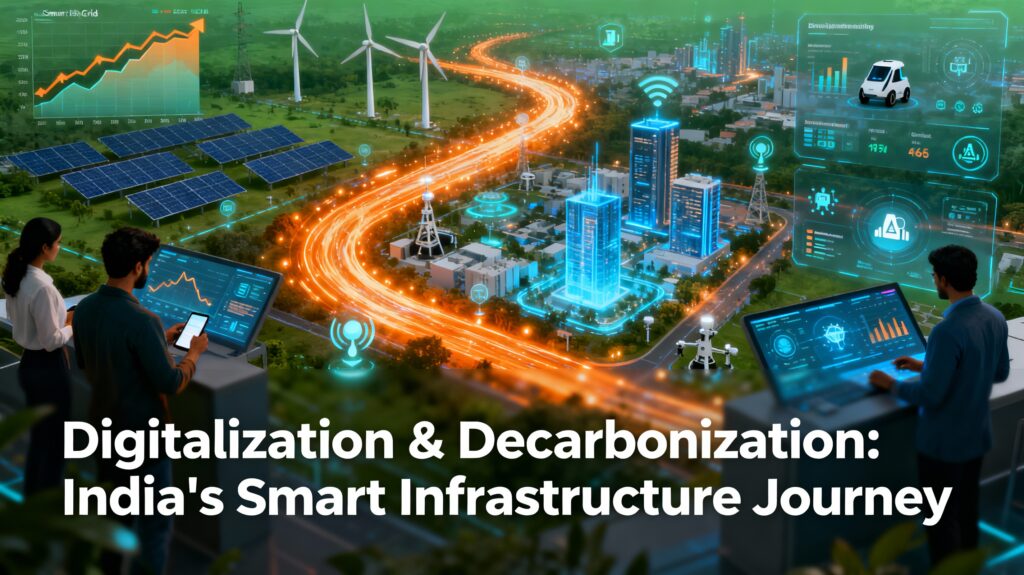
India’s belief in technology as a core driver of infrastructure transformation is unambiguous. 60% of organisations willing to fundamentally reinvent business models, 69% ready for autonomous grids, 51% ready for autonomous buildings—these aren’t aspirational statements but indicators of readiness for systemic change.
Yet readiness alone is insufficient. Implementation requires:
- Policy integration across energy, urban development, and industry sectors
- Data governance ensuring privacy, security, and consumer protection
- Financial mechanisms bridging cost premiums for decarbonisation technologies
- Workforce reskilling managing employment transitions from automation
- Cybersecurity protecting critical infrastructure from emerging threats
- Domestic capability reducing import dependence on algorithms, software, and hardware
The next 3-5 years are decisive. Autonomous grids piloted today become standard operations by 2030. Autonomous buildings deployed in early phases establish standards and best practices scaling to mass deployment. Industrial decarbonisation pathways proved at small scale guide sector-wide transformation.
The central challenge is not technological—it’s institutional. Digital solutions exist. Policy frameworks, standards, and regulatory clarity lag. Fragmented governance creates inefficiencies. Cybersecurity vulnerabilities remain unaddressed.
For India to leverage its technological readiness and decarbonise while maintaining growth and energy security, coordinated action across Centre, states, municipalities, utilities, and industry is essential. The intelligence beneath India’s infrastructure—AI-powered grid management, autonomous buildings, industrial optimization—will determine whether India achieves net-zero sustainably or faces cascading energy crises amid rapid urbanization and electrification.
The digital decarbonisation transition is underway. Whether India leads this transition or lags depends on policy choices made in 2025-2027.





+ There are no comments
Add yours