
Key Highlights
Historic Policy Initiative: India integrating AI and Computational Thinking from Class 3 (age 8-9) across all schools beginning 2026-27, making it potentially the first nation globally to embed foundational AI literacy at such scale and age
NEP 2020 Alignment: Policy aligns with National Education Policy 2020 and NCF SE 2023, treating AI as “basic universal skill” linked to “The World Around Us”
Expert-Led Curriculum: Prof. Karthik Raman (IIT Madras)-chaired CBSE expert committee developing age-appropriate curriculum emphasizing Computational Thinking, ethics, and problem-solving over coding
Teacher Training Challenge: Ministry must upskill 10+ million teachers via NISHTHA program in 18 months—unprecedented scale requiring scaffolded competency frameworks, micro-credentials, and continuous support
Equity-First Implementation: Mandatory offline-first content, device-sharing models, regional-language resources, and accessibility-by-design to bridge digital divide rather than deepen it
A Bold Experiment in Educational Transformation
On October 29, 2025, India’s Ministry of Education announced one of the most ambitious educational initiatives in the nation’s modern history: Artificial Intelligence and Computational Thinking will become part of the school curriculum from Class 3 onwards, beginning in the 2026-27 academic year. This means over 140 million schoolchildren will begin learning AI concepts by age 8-9, making India potentially the first nation to embed AI literacy at such a foundational level across its entire school system.
The policy is visionary in scope yet confronts brutal practical realities: training over 10 million teachers, ensuring equitable access across rural and urban divide, maintaining pedagogical quality, and protecting children from emerging digital harms. It’s simultaneously a blueprint for the future and a high-wire act where missteps could widen educational inequalities rather than bridge them.
The Central Board of Secondary Education has constituted an expert committee chaired by Prof. Karthik Raman from IIT Madras to develop the curriculum. Learning materials and teacher-training modules are targeted for completion by December 2025, giving just 14 months before rollout begins. The initiative aligns with NEP 2020 and the National Curriculum Framework for School Education (NCF SE) 2023, treating AI as a “basic universal skill” linked to “The World Around Us” (TWAU).
The Rationale: Why AI from Class 3?
Economic and Workforce Imperative
The urgency stems from one inescapable reality: the AI revolution isn’t coming—it’s here. Global enterprises are reshaping operations around AI capabilities, and India risks falling behind in developing talent equipped to lead this transition. Rather than playing catch-up when students reach college, embedding AI literacy from Class 3 creates foundations for deepened learning across secondary and higher education.
Secretary Sanjay Kumar articulated the vision: “Education in AI should be treated as a basic universal skill linked to The World Around Us. Every child’s distinct potential is our priority”. The unspoken calculation: AI-literate children will be better positioned for emerging jobs, and India needs to build this capacity at scale to remain competitive globally.
Pedagogical Advantages
Beyond workforce preparation, early AI exposure offers genuine learning benefits:
Personalization and adaptive learning: AI-enabled systems can tailor instruction to individual student pace and learning styles, supporting both accelerated learners and those needing additional support.
Multimodal learning: AI can generate diverse representations—text, images, simulations—to help children grasp abstract concepts more intuitively.
Critical thinking development: Learning to question AI outputs, understand data, and recognize bias fosters meta-cognitive skills essential for the 21st century.
Assistive technologies for inclusion: AI-powered tools can provide real-time translation for regional languages, text-to-speech for visually impaired students, and personalized scaffolding for students with learning disabilities.
What Will Children Actually Learn?
Age-Appropriate Progression
The curriculum isn’t importing college-level computer science into elementary schools—it’s designed with developmental appropriateness:
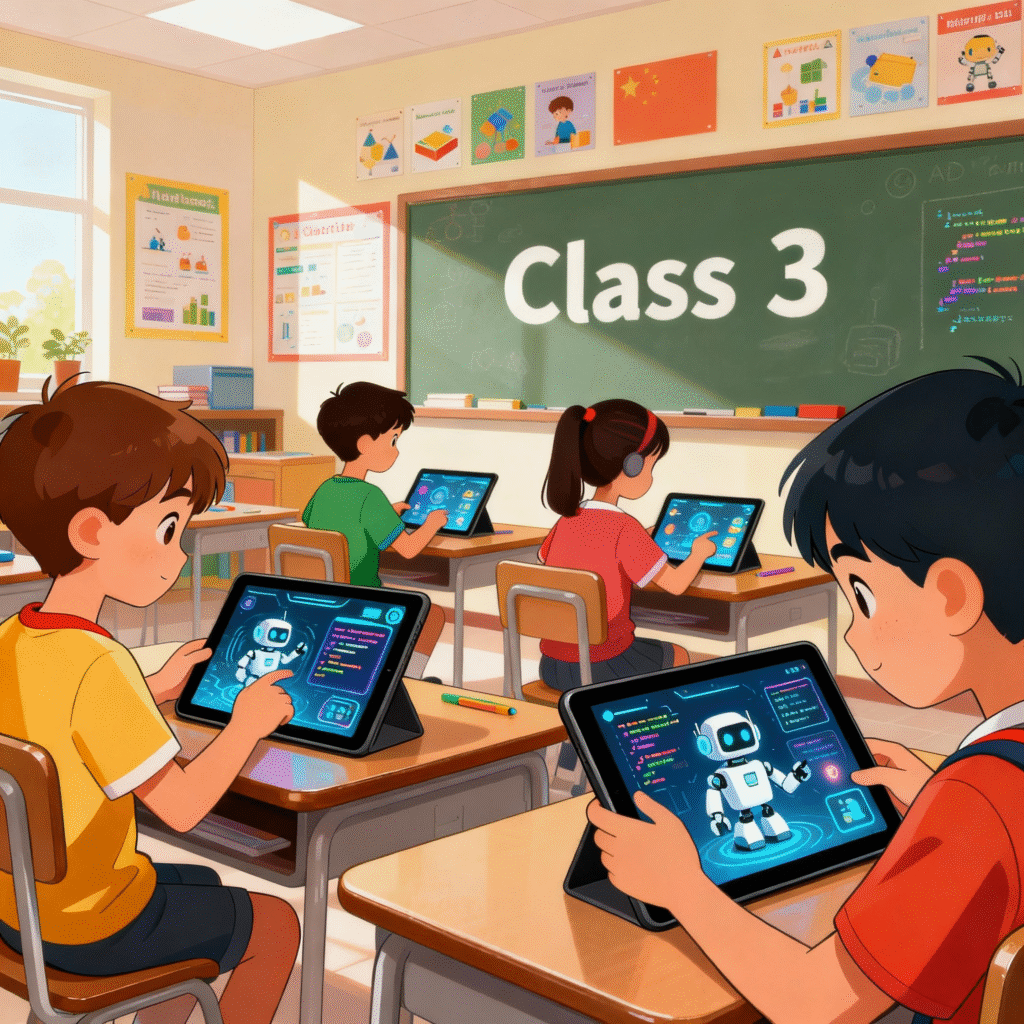
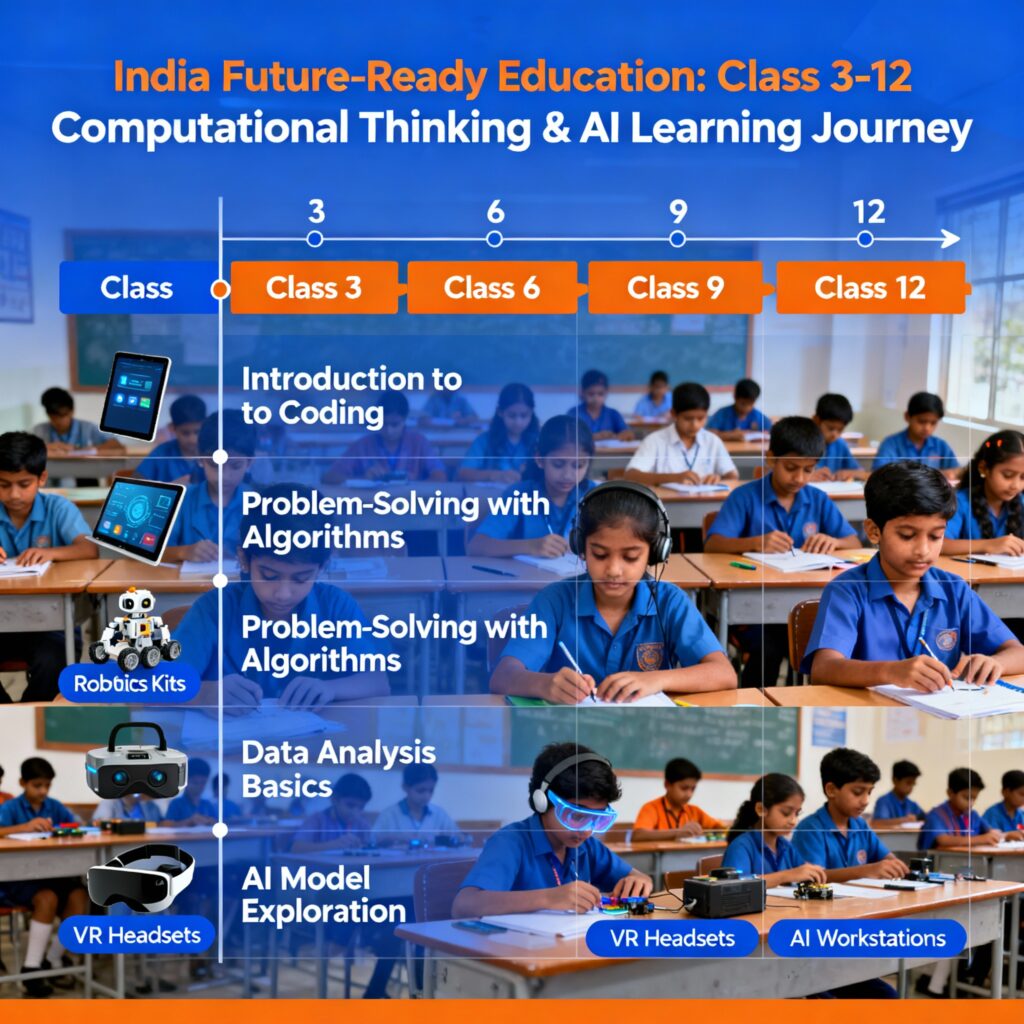
Class 3-5 (Primary Stage – Ages 8-11): Foundational AI literacy through interactive, playful lessons. Children will learn fundamentals like logic, pattern recognition, and problem decomposition—not coding, but algorithmic thinking applied to puzzles and games. They’ll explore how smart devices work, why recommendation systems suggest videos, and what data means.
Class 6-8 (Middle Stage – Ages 11-14): Guided exploration of AI tools and Computational Thinking applied to real-world problems. This stage blends hands-on experimentation with conceptual understanding—using AI-powered platforms to solve environmental, social, or mathematical challenges.
Class 9-12 (Secondary Stage – Ages 14-18): Deeper technical concepts including basic machine learning principles, neural networks, natural language processing, and capstone projects. This stage allows interested students to pursue AI at depth while maintaining foundational literacy for all.
Ethics as a Throughline
Critically, ethics isn’t an afterthought—it’s embedded from Class 3. Children will learn about AI bias, privacy, consent, transparency, and responsible technology use alongside technical concepts. The philosophy: understanding ethical implications helps students become informed citizens, not just skilled technologists.
Teacher Readiness: The Decisive Challenge
The 10-Million-Teacher Mountain
The implementation blueprint is clear, but success hinges entirely on one factor: can India upskill 10+ million teachers in less than 18 months?
This is unprecedented. The NISHTHA (National Initiative for School Heads’ and Teachers’ Holistic Advancement) program trained 4.2 million elementary teachers from 2019-2024. Scaling to 10+ million teachers in AI and Computational Thinking—subjects most Indian teachers never formally studied—is not incremental; it’s exponential. pib.gov
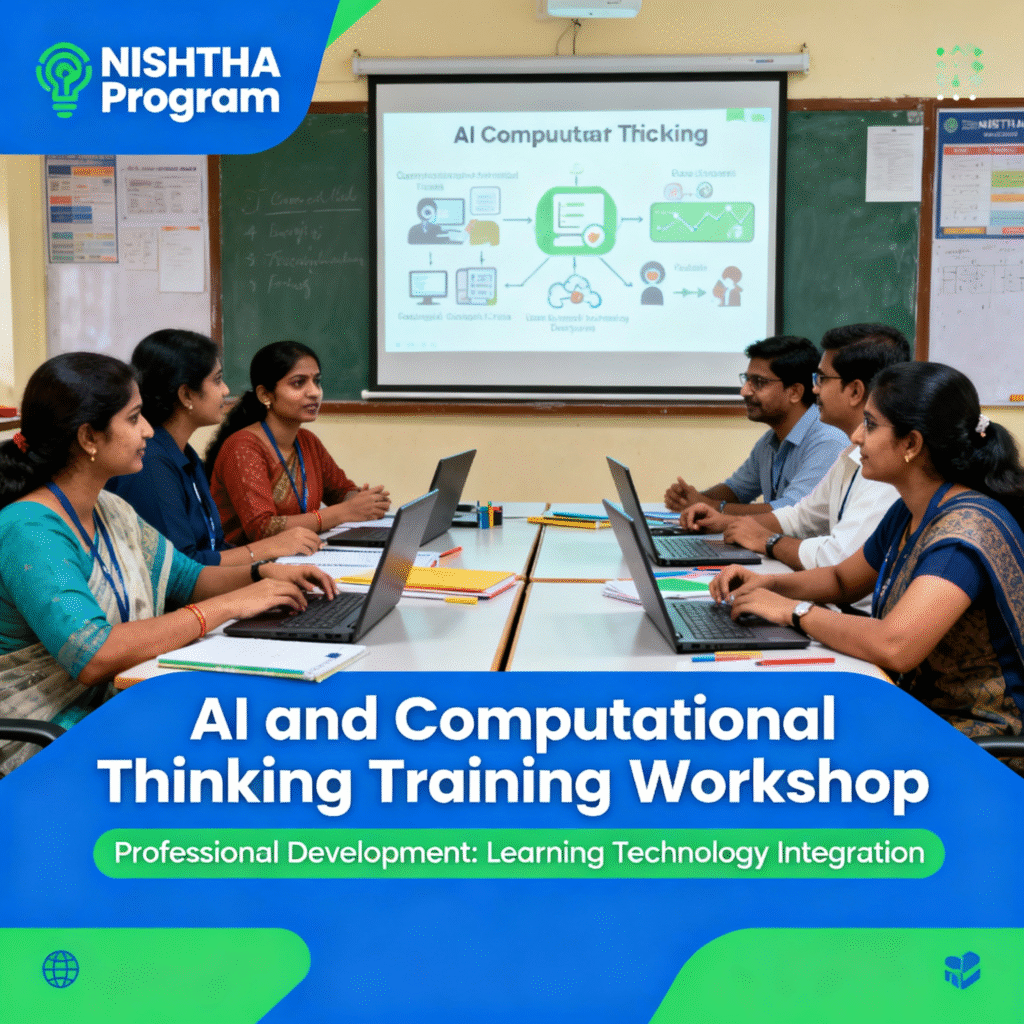
The Ministry’s approach combines several mechanisms:
NISHTHA-based modules: Structured, time-bound training modules delivered through established NISHTHA infrastructure. The Learning Management System (LMS) at https://nishtha.ncert.gov.in/ will distribute training content, track completion, and provide support.
Video-based learning resources: For teachers in schools with limited connectivity, pre-recorded video content demonstrating AI concepts and classroom activities.
Scaffolded competency frameworks: Rather than expecting teachers to become AI experts overnight, frameworks will define minimum competencies and allow progression through micro-credentials.
Continuous professional development: Ongoing support beyond initial training to help teachers stay current as AI evolves.
Dual learning approach: Teachers must both learn AI themselves and simultaneously prepare to teach AI—a dual transformation that Secretary Kumar recognizes as essential.
Curriculum Design Principles
Beyond Coding
Prof. Karthik Raman’s expert committee is designing curriculum around Computational Thinking, not coding. CT encompasses decomposition (breaking problems into parts), pattern recognition, abstraction, and algorithmic thinking—transferable problem-solving skills applicable across subjects and domains.
This distinction matters enormously. Coding-focused curricula quickly become outdated as languages evolve. Computational Thinking endures because it’s about fundamental problem-solving approaches.
Integration with TWAU
Rather than isolating AI in a separate subject, integration with “The World Around Us” connects AI concepts to existing curricula. When studying ecology in Science, children explore how AI monitors biodiversity. In Mathematics, they understand algorithms and data patterns. In Social Studies, they examine AI’s societal impacts.
This integrative approach prevents AI from becoming an add-on and instead positions it as a foundational lens through which to understand everything.
Project-Based Learning
The curriculum emphasizes problem-solving projects over passive knowledge acquisition. Rather than memorizing that neural networks have “neurons,” students might train a simple ML model to identify objects in classroom images, debug why it fails on certain inputs, and reflect on implications.
Infrastructure and Equity Challenges
The Digital Divide Reality
India’s digital divide remains stark. Over 70% of rural students lack reliable internet access; device ownership is far lower than urban counterparts. Rolling out AI curriculum simultaneously across Mumbai metropolitan schools and remote tribal villages without addressing infrastructure would deepen inequality, not bridge it.
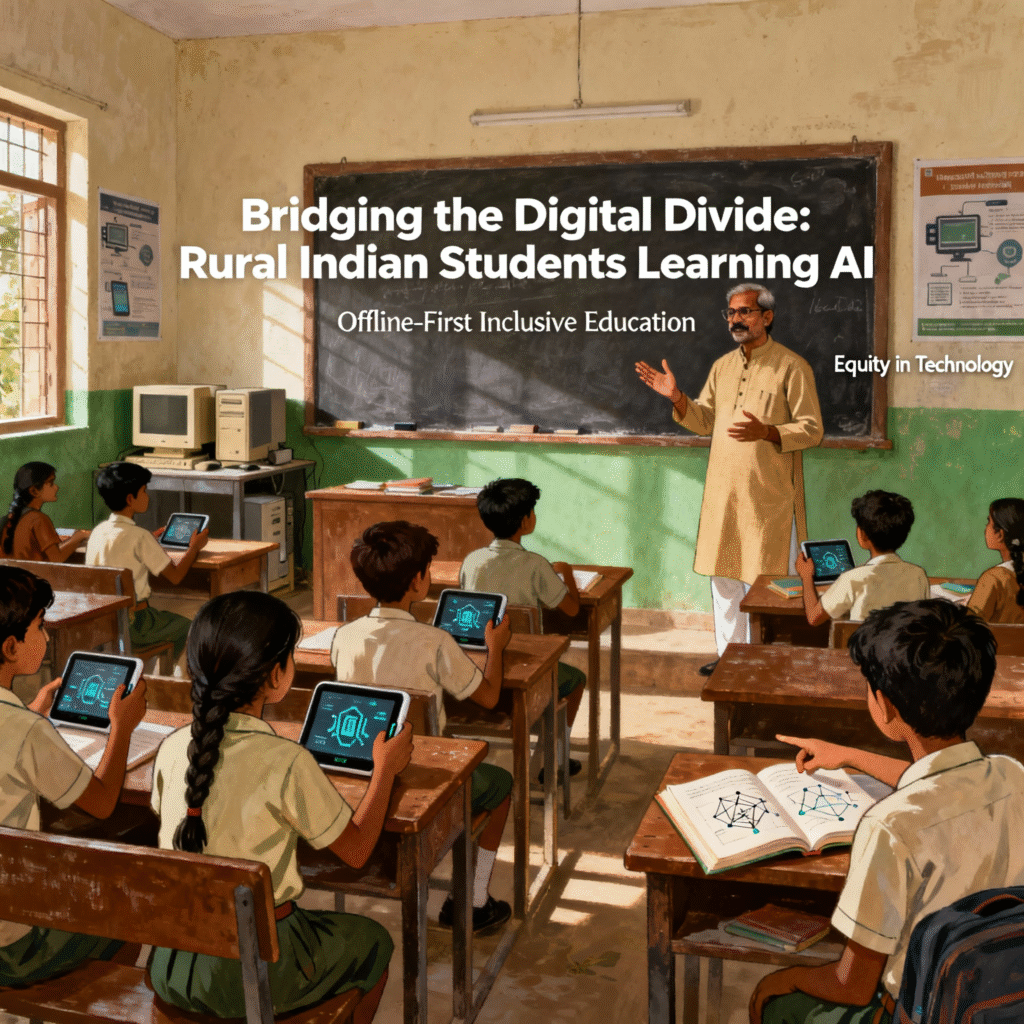
The Ministry recognizes this and mandates:
Offline-first content: Learning materials must work with minimal or no internet connectivity, downloadable and deployable on basic devices.
Device-sharing models: Rather than assuming 1:1 tablet-to-student ratios, curriculum supports classroom laptops that entire cohorts access in rotation.
Regional-language resources: AI education in English-medium schools reaches limited audiences. Curriculum must support learning in Hindi, Bengali, Tamil, Telugu, Gujarati, and other regional languages.
Accessibility by design: For students with visual, hearing, or motor disabilities, platforms must be inherently accessible—not retrofit afterward.
Despite these directives, implementation remains uncertain. If pilots in well-resourced schools and states proceed while rural areas lag, AI education could become another marker of inequality rather than a tool for inclusion.
Ethics, Safety, and Governance
Data Protection for Minors
AI systems collect vast data—behavioral patterns, learning preferences, demographic information. Without robust guardrails, this creates privacy vulnerabilities for minors under legal age.
Transparent data policies: Schools must clearly explain what data AI systems collect, why, and how it’s protected.
Parental consent frameworks: Genuine informed consent from parents/guardians before collecting children’s data.
Audit trails: Records of AI-generated recommendations or assessments so humans can review and override if needed.
Academic integrity safeguards: Clear guidelines on when students can use AI (learning tools vs. assignment submission) to prevent academic dishonesty.
Assessment Ethics
If AI systems assess student work, potential harms emerge. Biased algorithms could disadvantage students from underrepresented communities. High-stakes decisions (class placement, advancement) based on flawed AI recommendations could entrench inequities.
Human-in-the-loop assessment: AI supports but doesn’t replace human teacher judgment, especially for high-stakes decisions.
Bias audits: Regular testing of AI assessment tools for demographic disparities.
Transparency: Students understanding how their work is assessed, including how AI contributes.
Risks and Concerns
Cognitive Development Questions
Developmental psychologists raise concerns about early AI exposure:
Erosion of critical thinking: If children over-rely on AI for information retrieval and problem-solving, do they develop independent reasoning?
Screen time impacts: Elementary school already struggles with device use. Adding AI-dependent learning could worsen attention fragmentation and sleep disruption.
Creativity suppression: Bounded problem-solving with “correct” algorithmic answers might constrain divergent thinking and creative exploration.
These aren’t arguments against AI education—they’re arguments for thoughtful pedagogy rather than AI-for-AI’s-sake.
Implementation Capacity Gaps
Even with best intentions, execution risks loom:
Teacher workload: Already stretched teachers face curriculum additions without corresponding workload reduction. How much can one teacher absorb?
Content quality variance: With 28 state education boards and multiple textbook publishers, curriculum consistency becomes challenging. Some states/publishers may rush inferior content.
Uneven state readiness: Not all states have equivalent infrastructure, training capacity, or funding. Rollout timing matters—premature implementation without readiness creates negative experiences.
Vendor lock-in risks: If curriculum depends on specific proprietary AI platforms, schools become trapped, and educational choices narrowed.
Monitoring and Evaluation
Defining Success Metrics
What does effective AI education look like?
Learning outcomes rubrics: Assessing not just knowledge but skills—can students decompose problems, recognize patterns, think algorithmically?
Ethics understanding: Can students articulate AI bias, explain privacy concepts, discuss responsible technology use?
Problem-solving transfer: Do AI concepts learned in Class 5 transfer to solving real problems in other subjects?
Equity indicators: Are learning outcomes consistent across regions, languages, genders, and students with disabilities, or are gaps widening?
Third-party evaluation: Periodic independent assessments rather than relying solely on government self-reporting ensure accountability.
Public dashboards: Transparent reporting of outcomes, challenges, and equity metrics enables public scrutiny and course correction.
Budgeting and Procurement
Cost Realities
Implementing AI curriculum at national scale requires substantial investment:
Content development: Creating age-appropriate, pedagogically sound learning materials in 22+ languages costs tens of crores.
Teacher training: Upskilling 10+ million teachers, even with leveraged online platforms, requires significant resources.
Devices and connectivity: While not all schools need 1:1 ratios, baseline device access and internet connectivity remain expensive.
Platform maintenance: AI systems require ongoing updates, security patches, and infrastructure maintenance.
Safeguards and compliance: Data protection, audit systems, and monitoring infrastructure add non-trivial costs.
Encourage open-source solutions: Using open-source AI tools and platforms reduces vendor dependency and controls costs.
Support regional ecosystems: Funding content creation in regional languages and by local publishers builds capacity while supporting language preservation.
Implement PPP models thoughtfully: Public-private partnerships can leverage private sector efficiency, but with strict guardrails preventing exploitation.
Prioritize rural funding: Equitable rollout requires disproportionate investment in rural and aspirational districts, not equal allocation.
Conclusion: A Generational Bet with No Margin for Error
India’s AI education policy is simultaneously inspiring and daunting—a generational bet that exposing 140+ million children to AI literacy will equip them for a technology-driven future while cultivating ethical digital citizenship.
Success is possible. The Ministry has thought through design principles, timelines, and multi-stakeholder coordination. The NISHTHA infrastructure exists to scale training. The expert committee is credible.
But execution remains perilous. Teacher readiness is the decisive factor—without genuine educator capacity, curriculum becomes box-ticking theater. Digital infrastructure must follow curriculum, not vice versa—premature rollout before devices and connectivity are ready would create negative experiences. Equity must be anchored in policy and funding, not rhetoric.
If policymakers navigate these challenges, India’s 2026-27 classroom—with 8-year-olds learning to think computationally, question algorithmic bias, and solve problems using AI as a tool—could reshape what’s possible in global education.
If they stumble, the policy could become another well-intentioned initiative that widens inequality between well-resourced urban schools and under-resourced rural ones.

+ There are no comments
Add yours