
Key Highlights
- Historic Incident: Mid-2024 orbital near-miss with foreign spacecraft within 1km of ISRO satellite catalyzed bodyguard satellite program
- Massive Investment: $3 billion SBS-III program to deploy 52 surveillance satellites by 2029, with first launch accelerated to April 2026
- Technology Integration: Advanced LiDAR sensors, AI-enabled communications, and ground-based radar networks for comprehensive space protection
- Strategic Disparity: India’s 100+ satellites face threats from China’s 930+ satellite fleet and regional tensions with Pakistan’s limited capabilities
- Operational Urgency: ISRO performed 10 collision avoidance maneuvers in 2024, highlighting increasing orbital congestion and security challenges
India stands at a critical juncture in space security as the nation prepares to deploy revolutionary “bodyguard satellites” following a dangerous orbital encounter in mid-2024. The incident, involving an unidentified foreign spacecraft that approached within one kilometer of an Indian Space Research Organisation (ISRO) satellite, has accelerated India’s ambitious space protection program worth $3 billion.
This watershed moment has exposed vulnerabilities in India’s expanding satellite constellation and highlighted the urgent need for enhanced orbital security measures. As space becomes increasingly crowded and geopolitically sensitive, India’s response represents a paradigm shift in how nations protect their critical space assets.
Background: India’s Space Security Evolution
Historical Context of Satellite Threats
India’s space program has long operated under the shadow of potential threats from neighboring countries. The nation has engaged in multiple armed conflicts over seven decades with both Pakistan and China, nations possessing vastly different space capabilities. Pakistan operates merely eight satellites compared to India’s impressive fleet of over 100, while China maintains a formidable presence with more than 930 satellites.
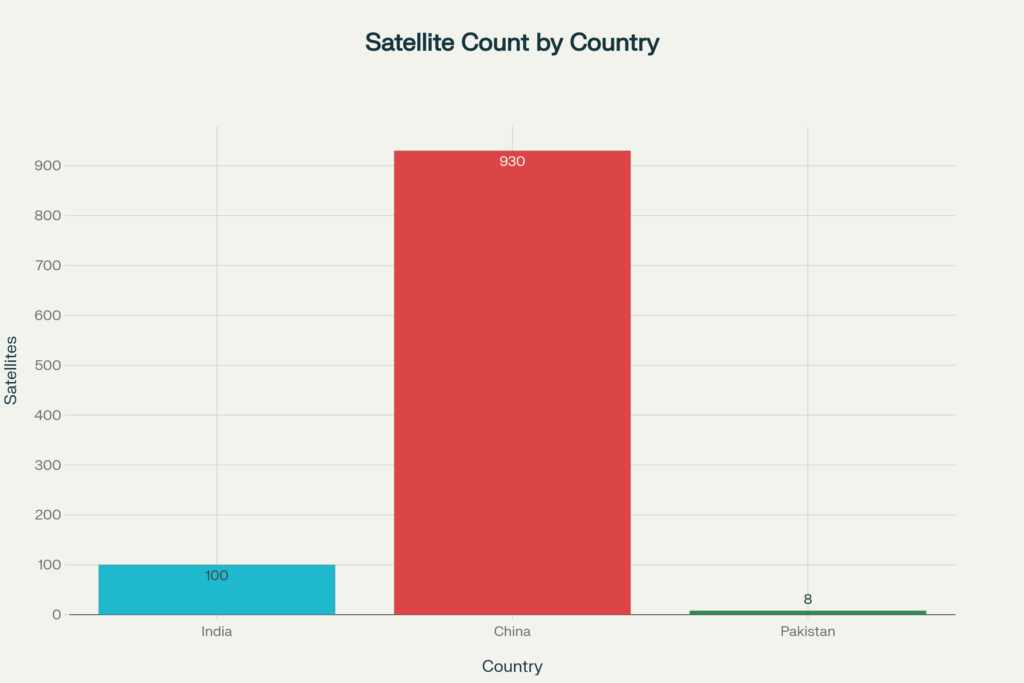
The growing militarization of space became evident during recent tensions between India and Pakistan in May 2025, when satellites played a crucial role in the conflict. During Operation Sindoor, over 400 ISRO scientists worked around the clock to provide real-time Earth observation and communication support. Reports suggest that China aided Pakistan by adjusting its satellite coverage during this period, demonstrating the asymmetric threats India faces in space.
Rising Orbital Congestion
The Low Earth Orbit (LEO) environment, particularly at altitudes of 500-600 kilometers where the near-miss occurred, is becoming increasingly congested. This region hosts numerous commercial constellations, including Elon Musk’s Starlink network, creating a complex operational environment where satellites must navigate through dense traffic.
ISRO’s Indian Space Situational Assessment Report (ISSAR) for 2024 reveals the agency performed 10 Collision Avoidance Manoeuvres (CAMs) to protect its satellites from potential collisions. The space agency issued over 53,000 alerts for potential collisions throughout 2024, demonstrating the scale of orbital traffic management required.
Core Analysis: The Mid-2024 Near-Miss Incident
Details of the Orbital Encounter
The previously unreported incident in mid-2024 involved an ISRO satellite performing critical tasks with potential military applications, including mapping and ground monitoring. The foreign spacecraft, from an unnamed neighboring country, approached dangerously close in the increasingly crowded LEO environment at 500-600 kilometers altitude. slguardian
Although no collision occurred, the unusually close approach of one kilometer was interpreted by defense analysts as a possible demonstration of capability or show of strength. The incident highlighted India’s vulnerability to hostile maneuvers in orbit and the need for enhanced protective measures.
Strategic Implications and Threat Assessment
The near-miss exposed critical gaps in India’s space situational awareness capabilities. Sudheer Kumar N, a former ISRO director now working as an independent consultant, acknowledged that “we currently lack round-the-clock in-orbit tracking capabilities”. This limitation becomes particularly concerning given China’s rapid expansion of space-based surveillance assets.
Chinese military officials and U.S. defense experts have warned about the growing threat from China’s People’s Liberation Army in space. Air Marshal Ashutosh Dixit cautioned in June 2024 that Beijing’s satellite program has grown rapidly in both scale and sophistication, posing significant risks to other nations including India.
India’s Bodyguard Satellite Program

Concept and Objectives
India’s bodyguard satellites represent a revolutionary approach to orbital security, designed to act as vigilant sentinels protecting critical space assets. These spacecraft will feature advanced sensors and high-level maneuverability, positioned to provide real-time threat detection and rapid response capabilities. spaceanddefense
The bodyguard concept involves specialized spacecraft that can detect, identify, and counter threats to valuable satellites through various means including surveillance, electronic warfare, and if necessary, physical intervention. These systems are designed to provide “reversible attacks” – temporary disruption of hostile spacecraft without permanent damage, serving as a de-escalation strategy. spaceanddefense
Integration of Advanced Technologies
The program will incorporate cutting-edge Light Detection and Ranging (LiDAR) technology to generate precise 3D maps of nearby orbital objects. LiDAR-equipped satellites can detect threats faster and more accurately than conventional radar systems, providing crucial time for ground teams to maneuver protected assets out of harm’s way.
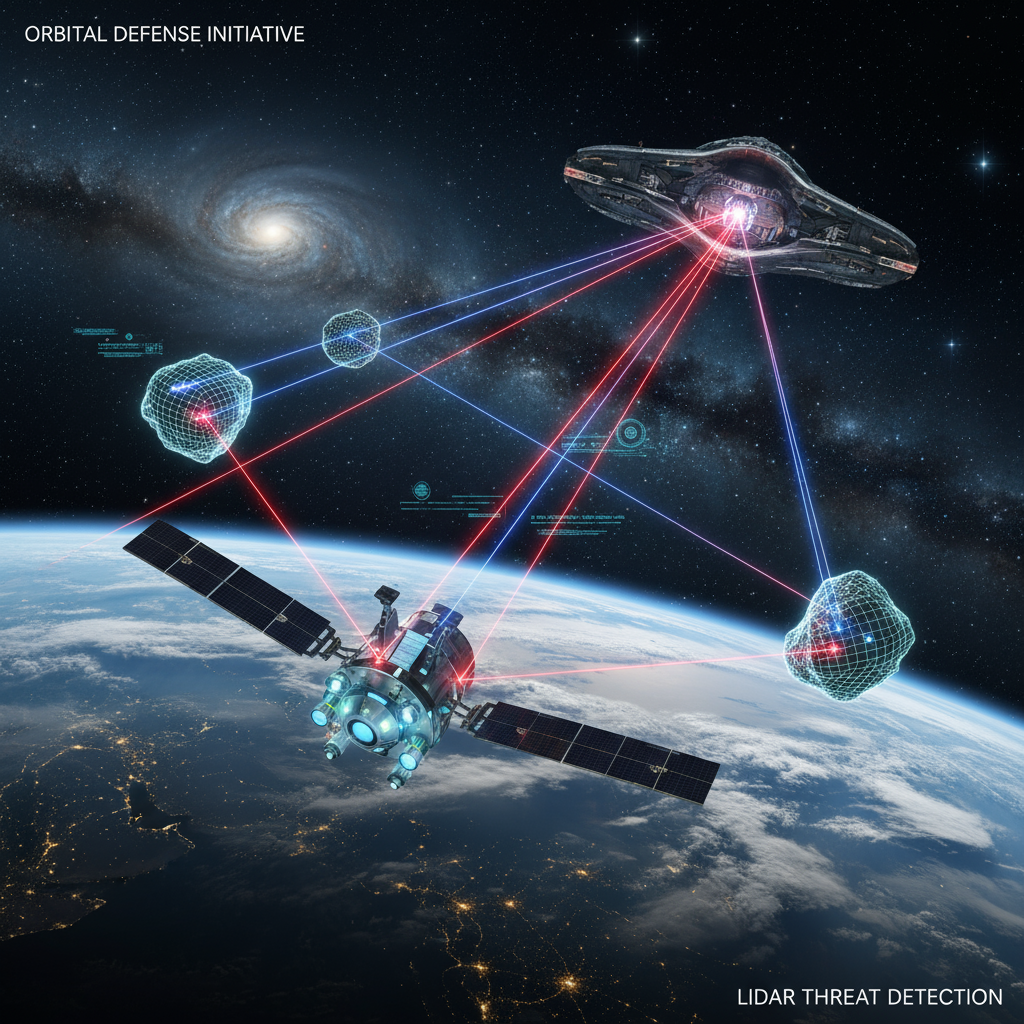
The bodyguard satellites will be integrated with an enhanced ground-based tracking network, including upgraded radars and optical telescopes, creating a comprehensive space surveillance system. This multi-layered approach ensures continuous monitoring and the ability to respond quickly to emerging threats.
Government’s Broader Space Initiative
Prime Minister Narendra Modi’s government has approved a comprehensive 270 billion rupee ($3 billion) plan to deploy approximately 50 surveillance satellites. This initiative, part of the Space-Based Surveillance Phase III (SBS-III) program, represents one of the most ambitious space security projects in India’s history.
The SBS-III program involves construction and launch of 21 satellites by ISRO and 31 by three private companies. Following Operation Sindoor, the timeline has been accelerated, with the first satellite now expected to launch by April 2026 instead of the original 2027 timeline.
Key Stakeholders and Implementation Framework
Primary Stakeholders
- ISRO and Department of Space: Leading the technical development and operational aspects of the bodyguard satellite program. The space agency brings decades of expertise in satellite design, launch capabilities, and mission operations.
- Defence Space Agency (DSA): Operating under the Integrated Defence Staff, DSA spearheads the SBS-III program and coordinates military space requirements. The agency serves as the primary liaison between civilian space capabilities and defense needs.
- Private Sector Partnerships: The Indian government is collaborating with domestic startups to develop innovative satellite protection technologies. Three private companies have been contracted to build 31 of the 52 surveillance satellites, demonstrating the government’s commitment to leveraging commercial space capabilities.
International Stakeholders
- Strategic Competitors: China’s expanding space presence, with over 930 satellites and advanced counter-space capabilities, represents the primary challenge driving India’s space security initiatives. Pakistan’s limited eight-satellite constellation poses a different but significant regional concern.
- Allied Nations: The United States and France are key partners in India’s space security development. France has entered into a “Loi agreement for defense space cooperation,” collaborating on 21 satellites under the SBS-III program.
Challenges and Critical Issues
Technical Limitations
- 24×7 Tracking Capabilities: India currently lacks continuous in-orbit tracking capability, a critical gap that bodyguard satellites and supporting infrastructure must address. This limitation prevents real-time threat assessment and response coordination.
- Integration Complexity: Developing an integrated space monitoring system requires seamless coordination between satellite-based sensors, ground-based radars, telescopes, and mission control centers. The technical complexity of such integration poses significant engineering challenges.
Strategic and Geopolitical Risks
- Regional Escalation: The deployment of bodyguard satellites could trigger an arms race in space, particularly with China and Pakistan. China’s demonstrated capabilities in anti-satellite weapons and space-based warfare systems raise concerns about potential escalation.
- Kessler Syndrome Risk: Increased military activity in space raises the probability of collisions that could trigger a cascade effect, making entire orbital regions unusable. The 500-600 kilometer altitude band, already congested with commercial satellites, faces particular vulnerability.
Financial and Resource Constraints
- Cost Management: The $3 billion SBS-III program represents a massive investment requiring careful resource allocation and long-term sustainability planning. Balancing military requirements with civilian space applications remains a significant challenge.
- Technology Development Timeline: Accelerating the deployment schedule while maintaining quality and reliability standards requires substantial additional resources and expertise. The compressed timeline increases both costs and technical risks.
Way Forward: Strategic Recommendations
Rapid Capability Development
- Public-Private Partnerships: Expanding collaboration with domestic startups and established aerospace companies can accelerate technology development while reducing costs. These partnerships should focus on specialized technologies like LiDAR sensors, autonomous maneuvering systems, and threat detection algorithms.
- International Cooperation: Strengthening alliances with space-faring nations, particularly the United States and France, can provide access to advanced technologies and shared threat intelligence. Such cooperation should include joint training programs and technology transfer agreements.
Infrastructure and Technology Investment
- Ground-Based Support Systems: Investing in advanced ground-based radars and optical telescopes creates a robust foundation for space surveillance activities. These systems should be strategically distributed across India to provide comprehensive coverage.
- Real-Time Data Analysis: Developing artificial intelligence and machine learning capabilities for real-time threat assessment and response coordination. AI-enabled systems can process vast amounts of satellite data and identify potential threats faster than human operators.
Policy and Regulatory Framework
- Space Traffic Management: Establishing clear protocols for satellite operations and threat response procedures. These guidelines should address both defensive and offensive capabilities while maintaining compliance with international space law.
- Transparency and Deterrence Balance: Developing policies that demonstrate defensive capabilities while avoiding provocative actions that could escalate regional tensions. This includes establishing clear rules of engagement for bodyguard satellites and communication protocols with potential adversaries.
Conclusion
India’s bodyguard satellite initiative represents a fundamental transformation in space security strategy, driven by the urgent reality of orbital threats and geopolitical tensions. The mid-2024 near-miss incident served as a wake-up call, demonstrating that India’s valuable space assets require active protection in an increasingly hostile environment.
The ambitious $3 billion program, encompassing 52 advanced surveillance satellites and revolutionary bodyguard protection systems, positions India among the leading space powers capable of defending their orbital interests. Success will depend on seamless integration of cutting-edge technologies, strategic international partnerships, and careful management of regional escalation risks.
As space emerges as the fifth domain of warfare, India’s bodyguard satellites may well define the nation’s ability to maintain its technological edge and strategic autonomy in the coming decade. The program’s success could serve as a model for other nations facing similar orbital security challenges, while failure could leave India’s critical space infrastructure vulnerable to future threats.









+ There are no comments
Add yours