
Key Highlights
- India achieved 4.8% fiscal deficit target in FY 2024-25, successfully reducing from pandemic peak of 9.5% while maintaining economic growth momentum
- GST collections reached record ₹22.08 lakh crore with 9.4% growth, demonstrating tax system maturity and contributing significantly to fiscal consolidation efforts
- Constitutional framework through Articles 112, 280, and 293 provides robust foundation for fiscal discipline while FRBM Act ensures statutory accountability
- Capital expenditure prioritized at ₹10.18 lakh crore (21.6% of total spending) focusing on infrastructure development with higher economic multiplier effects
- Gradual consolidation path targets 4.4% deficit by 2025-26 balancing fiscal prudence with development financing needs for $5 trillion economy goal
India’s journey toward fiscal consolidation represents one of the most critical challenges in contemporary economic governance, balancing the imperative for sustainable public finances with the nation’s ambitious development goals. With the fiscal deficit successfully reduced to 4.8% of GDP in FY 2024-25 from the pandemic peak of 9.5% in 2020-21, India demonstrates remarkable resilience in navigating complex macroeconomic pressures while maintaining growth momentum. The Union Budget 2025-26 further commits to achieving 4.4% fiscal deficit, showcasing the government’s unwavering dedication to the gradual fiscal glide path outlined in the Fiscal Responsibility and Budget Management (FRBM) Act, 2003. pib
Constitutional and Institutional Architecture of Fiscal Governance
Foundational Framework Through Constitutional Provisions
India’s fiscal consolidation strategy rests on a robust constitutional foundation that establishes clear roles, responsibilities, and constraints for fiscal management across different levels of government. iaiest
Article 112 – Annual Financial Statement (Union Budget):
- Mandates comprehensive presentation of government’s annual revenue and expenditure
- Establishes parliamentary control over public finances through budget approval process
- Ensures transparency in fiscal operations and accountability to elected representatives
- Provides constitutional basis for fiscal targets and consolidation measures
Article 293 – State Borrowing Regulations:
- Restricts state borrowing without Central government consent when indebted to Centre
- Establishes federal fiscal discipline preventing unsustainable state debt accumulation
- Balances state fiscal autonomy with overall macroeconomic stability requirements
- Enables coordinated approach to national fiscal consolidation efforts
Article 280 – Finance Commission:
- Constitutionally mandated body providing fiscal roadmap for Centre and States
- 15th Finance Commission recommendations guide current consolidation framework
- Ensures equitable resource distribution while maintaining fiscal discipline
- Balances competing demands of growth, equity, and fiscal sustainability
FRBM Act: Institutional Framework for Fiscal Discipline
The Fiscal Responsibility and Budget Management Act, 2003 provides the statutory framework for India’s consolidation efforts with specific targets and accountability mechanisms:
FRBM Targets (Current Framework):
- Fiscal deficit: Reduce to 4.5% of GDP by 2025-26 (currently 4.8% in 2024-25)
- Revenue deficit: Achieve 1.5% of GDP in 2025-26 from 1.9% in 2024-25
- Debt-to-GDP ratio: Maintain Central government debt below 60% including States
- Debt sustainability: Ensure declining debt trajectory as percentage of GDP prsindia indiabudget.gov
Medium-Term Fiscal Framework:
- Three-year rolling targets for fiscal indicators (though not provided since 2021-22)
- Escape clauses for extraordinary circumstances like natural disasters or economic crises
- Parliamentary accountability through annual fiscal policy statements
- Transparency measures including publication of fiscal impact assessments
Recent Fiscal Performance and Consolidation Trajectory
COVID-19 Impact and Recovery
India’s fiscal consolidation journey faced unprecedented challenges during the COVID-19 pandemic, requiring substantial fiscal expansion while maintaining medium-term sustainability:
Pandemic Fiscal Response (2020-21):
- Fiscal deficit widened to 9.5% of GDP to support economic recovery
- Revenue deficit peaked due to reduced tax collections and increased expenditure
- Counter-cyclical fiscal policy prevented deeper economic contraction
- Gradual consolidation path resumed post-pandemic recovery
Consolidation Progress (2021-25):
- 2021-22: 6.7% fiscal deficit (Budget Estimate)
- 2022-23: 6.4% fiscal deficit (Actual)
- 2023-24: 5.6% fiscal deficit (Actual)
- 2024-25: 4.8% fiscal deficit (Achieved target)
- 2025-26: 4.4% fiscal deficit (Budget Estimate) prsindia
Current Fiscal Health Indicators
FY 2024-25 Fiscal Performance:
- Total receipts: ₹31.47 lakh crore (excluding borrowings)
- Net tax receipts: ₹25.57 lakh crore
- Total expenditure: ₹47.16 lakh crore
- Capital expenditure: ₹10.18 lakh crore (21.6% of total expenditure)
- Fiscal deficit: ₹15.77 lakh crore (4.8% of GDP)
Revenue Enhancement Strategies
GST Revolution and Tax Base Expansion
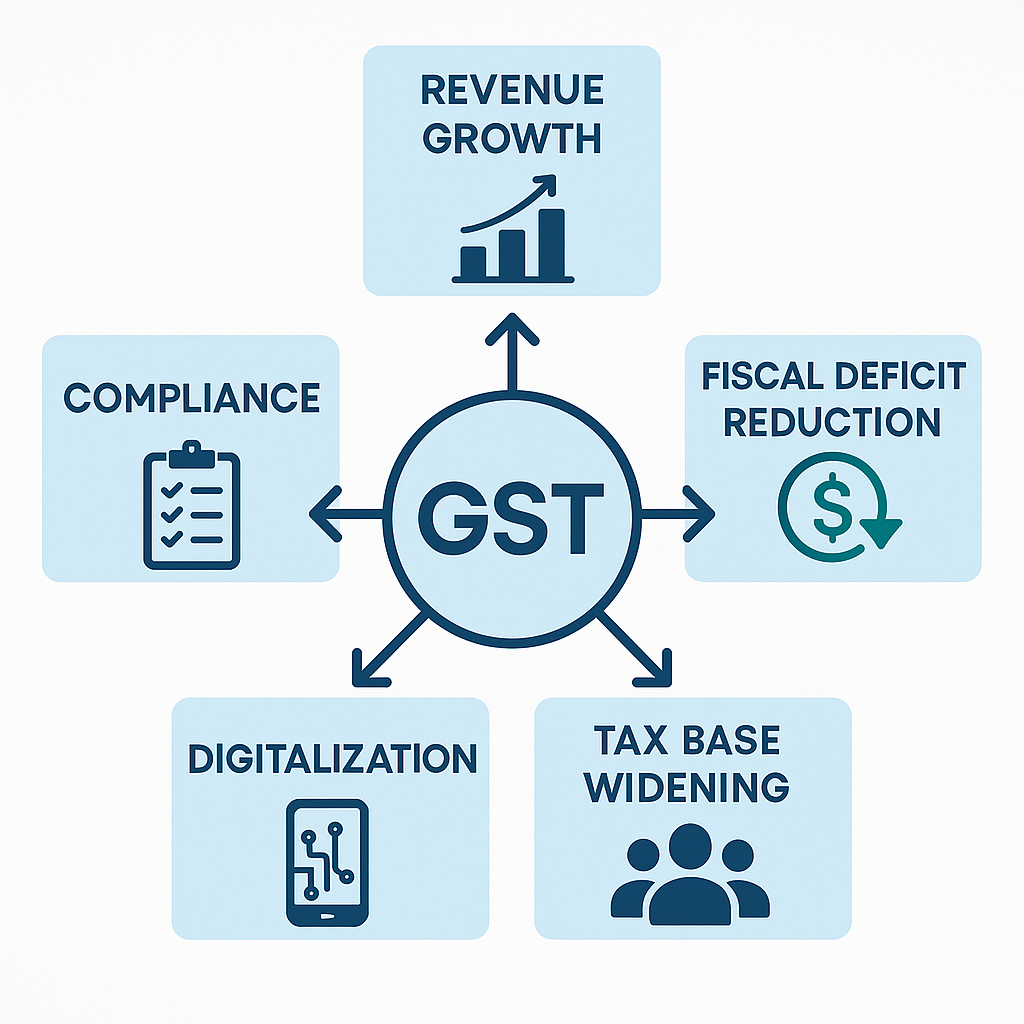
The Goods and Services Tax (GST) implementation represents the most significant revenue enhancement measure in India’s fiscal consolidation strategy, transforming the indirect tax landscape and boosting collection efficiency. ijarsct
GST Performance Metrics:
- Record collections: ₹22.08 lakh crore in FY 2024-25 (9.4% YoY growth)
- Monthly average: ₹1.84 lakh crore demonstrating system maturity
- Tax base expansion: 1.51 crore active registrations bringing businesses into formal economy
- Revenue buoyancy: Consistent growth above nominal GDP expansion
GST’s Role in Fiscal Consolidation:
- Unified tax structure eliminating cascading effects and improving compliance
- Digital infrastructure reducing tax evasion through real-time monitoring
- Enhanced transparency through e-invoicing and automated systems
- Federal cooperation through GST Council ensuring coordinated tax policy
Direct Tax Reforms and Digital Administration
Corporate Tax Reforms:
- Corporate tax rate reduced from 30% to 25% for eligible companies
- New manufacturing companies can opt for 15% tax rate
- Simplified compliance procedures reducing business costs
- Enhanced tax buoyancy through broader base and improved compliance
Digital Tax Administration:
- Faceless assessment reducing taxpayer interface and corruption
- AI-powered risk assessment improving audit efficiency
- Real-time data analytics for better compliance monitoring
- Simplified return filing encouraging voluntary compliance
Expenditure Rationalization and Efficiency Measures
Subsidy Reforms Through Direct Benefit Transfers (DBT)
India’s subsidy rationalization program represents a significant achievement in expenditure efficiency, with DBT implementation saving substantial fiscal resources while improving targeting:
DBT Success Story:
- ₹2.78 lakh crore transferred directly to beneficiaries in 2023-24
- Elimination of middlemen reducing leakages and corruption
- Better targeting ensuring subsidies reach intended beneficiaries
- Administrative cost reduction through digital delivery mechanisms
Major Subsidy Categories:
- LPG subsidies: Direct transfer to bank accounts based on consumption
- Fertilizer subsidies: Payment to manufacturers based on actual sales
- Food subsidies: Through Public Distribution System with Aadhaar linking
- MGNREGA payments: Direct transfer reducing delays and leakages
Capital Expenditure Prioritization
Capex Enhancement Strategy:
- Capital expenditure: ₹10.18 lakh crore in 2024-25 (21.6% of total expenditure)
- Infrastructure focus: Railways, highways, urban development, rural connectivity
- Multiplier effect: Higher economic returns compared to revenue expenditure
- Private sector crowding-in: Public capex encouraging private investment
Disinvestment and Asset Monetization Strategy
PSU Disinvestment for Fiscal Resources
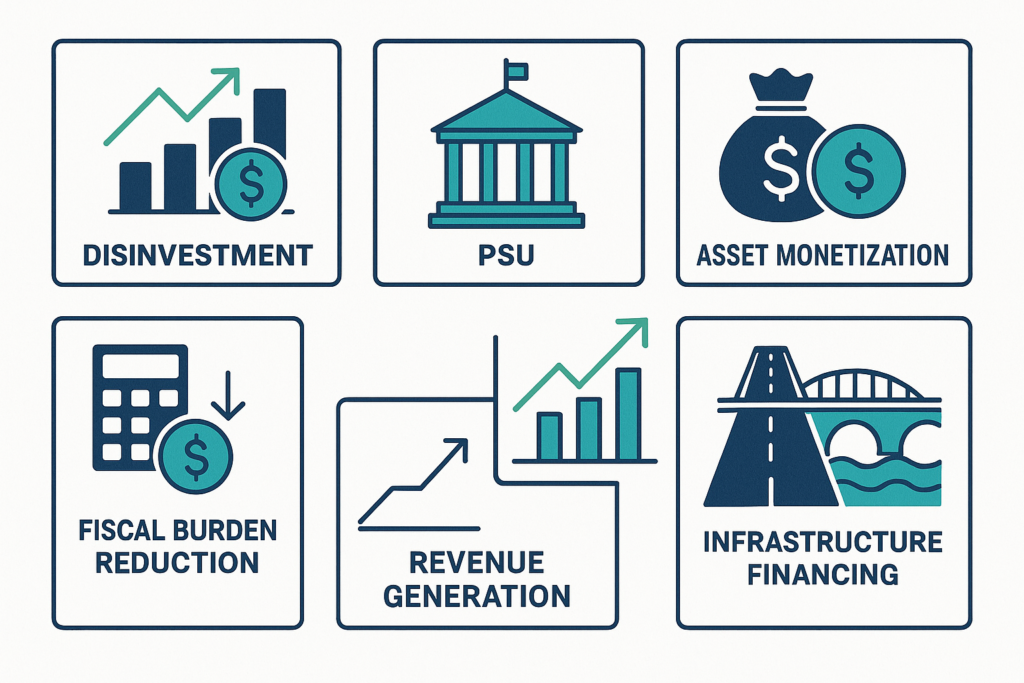
India’s disinvestment program serves as a crucial component of fiscal consolidation, helping reduce the fiscal burden while improving economic efficiency.
Disinvestment Objectives:
- Reduce fiscal deficit by generating non-debt capital receipts
- Improve PSU efficiency through private sector participation
- Focus government resources on core activities and social spending
- Enhance market competition and economic efficiency
Revenue Utilization:
Despite initial objectives of using proceeds for debt reduction or PSU restructuring, the government has primarily used disinvestment receipts to finance current deficits, making it effectively a revenue measure rather than capital restructuring.
National Monetisation Pipeline
Asset Monetization Strategy:
- ₹6 lakh crore asset pipeline over 4 years (2021-25)
- Railways, highways, airports, telecom assets for monetization
- Revenue generation without ownership transfer
- Infrastructure investment financing through asset recycling
Key Sectors:
- Railways: Station redevelopment, dedicated freight corridors
- Roads: Toll-operate-transfer models for national highways
- Airports: Private operation of existing facilities
- Power: Transmission assets and electricity distribution
Centre-State Fiscal Dynamics
Federal Fiscal Challenges
GST Compensation Issues:
- States’ revenue autonomy significantly reduced post-GST implementation
- Compensation cess provided until 2022 for revenue shortfalls
- Post-compensation challenges requiring alternative revenue sources
- Federal negotiation through GST Council for rate adjustments
Borrowing Coordination:
- Article 293 restrictions on state borrowing requiring Central consent
- FRBM targets for states limiting fiscal deficit to 3% of GSDP
- Fiscal flexibility provisions for states meeting debt and interest payment criteria
- Coordinated borrowing calendars preventing market crowding-out
Global Context and International Comparisons
International Fiscal Frameworks
European Union’s Stability & Growth Pact:
- 3% of GDP deficit limit for member countries
- 60% of GDP debt threshold for government debt
- Excessive Deficit Procedure for non-compliance
- Country-specific recommendations for fiscal adjustments
India’s Comparative Position:
- FRBM targets align with international best practices
- 4.5% deficit target higher than EU but appropriate for developing economy needs
- Combined Centre-State debt maintained below 60% threshold
- Flexible framework accommodating development financing requirements
Challenges in Fiscal Consolidation
Structural Expenditure Pressures
Subsidy Burden:
- Food, fertilizer, and fuel subsidies constitute significant fiscal outlays
- Political economy constraints in subsidy rationalization
- Universal programs like PMGKY requiring substantial resources
- Balancing act between welfare needs and fiscal discipline
Interest Payment Burden:
- Interest payments consume ~40% of Central government revenue receipts
- Debt service obligations limiting fiscal space for development expenditure
- Interest rate risk affecting fiscal sustainability
- Need for debt management strategy minimizing borrowing costs
Economic and Political Constraints
Growth-Fiscal Trade-offs:
- Counter-cyclical fiscal policy requires flexibility during downturns
- Infrastructure investment needs demand sustained capital expenditure
- Social protection expansion competing with consolidation objectives
- Private investment crowding-in requiring public capex support
Electoral Cycle Pressures:
- Populist welfare schemes announced during election periods
- State-level fiscal indiscipline affecting overall consolidation
- Short-term political gains vs. long-term fiscal sustainability
- Building consensus for painful but necessary reforms
Way Forward: Sustainable Fiscal Framework
Medium-Term Fiscal Strategy
Enhanced Flexibility Framework:
- State-contingent fiscal rules allowing response to economic shocks
- Investment protection clauses safeguarding capital expenditure during consolidation
- Automatic stabilizers providing counter-cyclical support
- Debt anchor approach focusing on debt sustainability rather than rigid deficit limits
Revenue Enhancement Roadmap
Tax System Modernization:
- Direct tax reforms simplifying compliance and broadening base
- Property tax improvements at state and local levels
- Digital tax administration reducing costs and improving efficiency
- International tax coordination addressing base erosion and profit shifting
Expenditure Quality Improvement
Outcome-Based Budgeting:
- Performance measurement linking spending to results
- Program evaluation ensuring value for money
- Zero-based budgeting eliminating obsolete expenditures
- Sunset clauses for schemes requiring regular justification
Building Sustainable Fiscal Architecture
India’s fiscal consolidation journey represents a sophisticated balancing act between immediate development needs and long-term fiscal sustainability. The successful achievement of 4.8% deficit target in 2024-25 demonstrates the government’s commitment to fiscal discipline while maintaining growth momentum toward the $5 trillion economy vision.
The constitutional framework combining Articles 112, 280, and 293 with the FRBM Act provides a robust institutional foundation for fiscal management. However, success depends on continuous adaptation to changing economic circumstances while maintaining core principles of transparency, accountability, and sustainability.
Future priorities include strengthening revenue systems through digital transformation, improving expenditure efficiency through outcome-based budgeting, and enhancing federal coordination through cooperative fiscal federalism. The GST success story demonstrates that well-designed reforms can simultaneously improve compliance, expand the tax base, and enhance revenue productivity.
As India progresses toward developed country status by 2047, fiscal consolidation will remain central to macroeconomic stability, providing the fiscal space necessary for infrastructure investment, social protection, and climate action while maintaining investor confidence and sustainable debt levels.
The path forward requires political commitment, institutional strengthening, and social consensus around the importance of fiscal responsibility in achieving inclusive and sustainable development. Success in this endeavor will determine India’s capacity to finance its development aspirations while maintaining macroeconomic stability in an increasingly complex global environment.
Mains (GS-3)
Q1. What is fiscal consolidation? Discuss its importance for India’s economic stability. Highlight the recent measures adopted by the government in this regard.
Q2. “Fiscal consolidation in India must balance prudence with growth and welfare priorities.” Critically examine in the context of recent budgetary trends.










+ There are no comments
Add yours