
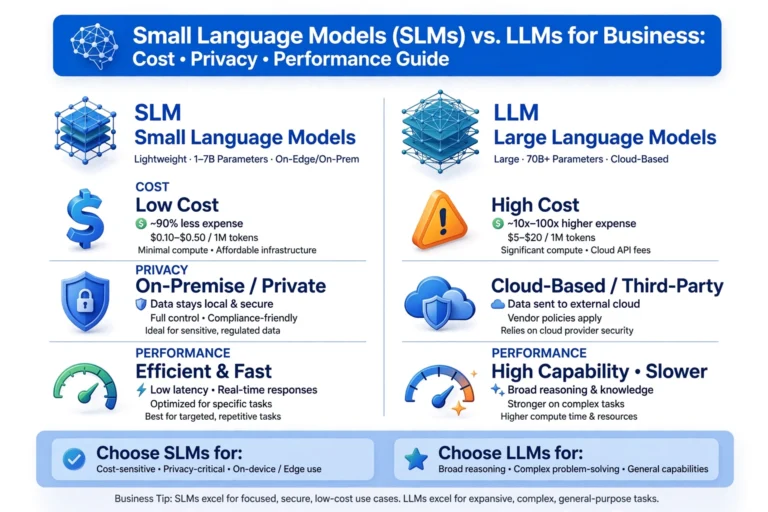
As enterprise AI moves rapidly into 2026, autonomous systems are evolving beyond isolated prompt engineering and custom integrations. To achieve true scalability, organizations require standardized communication layers across tools, multi-agent networks, and user interfaces. As highlighted in our analysis of Small Language Models (SLMs) vs LLMs for Business, specialized models depend heavily on robust protocols to interact seamlessly with enterprise data.
For an in-depth breakdown of standard protocols, consult the comprehensive AI Agent Protocols 2026 Complete Guide.
The Core Protocols Standardizing Enterprise AI
1. Model Context Protocol (MCP)
Model Context Protocol (MCP) has emerged as the universal standard for connecting AI models to external tools, databases, and enterprise APIs. By defining a clean, secure JSON-RPC interface, MCP enables autonomous agents to inspect schema, invoke functions, and maintain persistent state across disparate enterprise systems without bespoke glue code.
2. Agent2Agent (A2A) Protocol
While MCP standardizes how agents interact with tools, the Agent2Agent (A2A) protocol governs peer-to-peer inter-agent communication. A2A handles agent discovery, task negotiation, shared context serialization, and state synchronization across heterogeneous multi-agent systems, enabling cross-departmental automation across complex enterprise environments.
3. AG-UI Protocol: Dynamic User Interfaces
The AG-UI (Agent-User Interface) protocol standardizes human-agent interaction by enabling agents to dynamically render interactive UI elements, forms, and approval dashboards directly within user-facing applications. This bridges the gap between background autonomous reasoning and real-time human-in-the-loop governance.
Comparative Analysis of Enterprise AI Protocols
| Protocol | Primary Layer | Core Functionality | Key Enterprise Use Case |
|---|---|---|---|
| MCP | Data & Tool Abstraction | Standardized JSON-RPC tool calling and database schema discovery | Connecting agents to legacy ERP, CRM, and internal databases |
| A2A Protocol | Inter-Agent Coordination | Peer discovery, sub-task delegation, state synchronization | Cross-departmental multi-agent workflows and supply chain coordination |
| AG-UI Protocol | Human-Agent Interface | Dynamic UI component rendering and structured input capture | Human-in-the-loop review, approval gates, and real-time UI dashboards |
Practical Enterprise Applications & Workflow Architecture
Implementing open protocol standards transforms enterprise workflow architecture. Building on our framework for Autonomous Agentic AI for Supply Chain Optimization, standard protocols allow enterprise fleets of specialized SLMs and LLMs to collaborate securely.
Industry leaders are rapidly adopting these standards. Explore key industry insights in Top 5 AI Agent Protocols to Know in 2026, monitor overall ecosystem shifts in Agentic AI Trends 2026, and review the detailed landscape in the 2026 Agentic AI Catch-Up Guide.
Frequently Asked Questions (FAQ)
What is the primary difference between MCP and A2A protocol?
MCP standardizes model-to-tool and model-to-data interfaces, allowing an AI agent to execute tools and read databases. A2A protocol standardizes agent-to-agent communication, enabling independent AI agents to discover, negotiate, and delegate tasks to each other.
How does AG-UI facilitate human-in-the-loop control?
AG-UI allows agents to dynamically generate interactive UI widgets, decision prompts, and validation forms. This ensures human operators can inspect intermediate agent states and grant approval before critical enterprise actions are finalized.
Why are standardized protocols crucial for enterprise AI in 2026?
Without standardized protocols, enterprise AI deployments suffer from proprietary lock-in, fragmented custom integrations, and fragile tool pipelines. Open standards like MCP, A2A, and AG-UI establish scalable, secure, and vendor-agnostic architecture across multi-agent environments.



+ There are no comments
Add yours