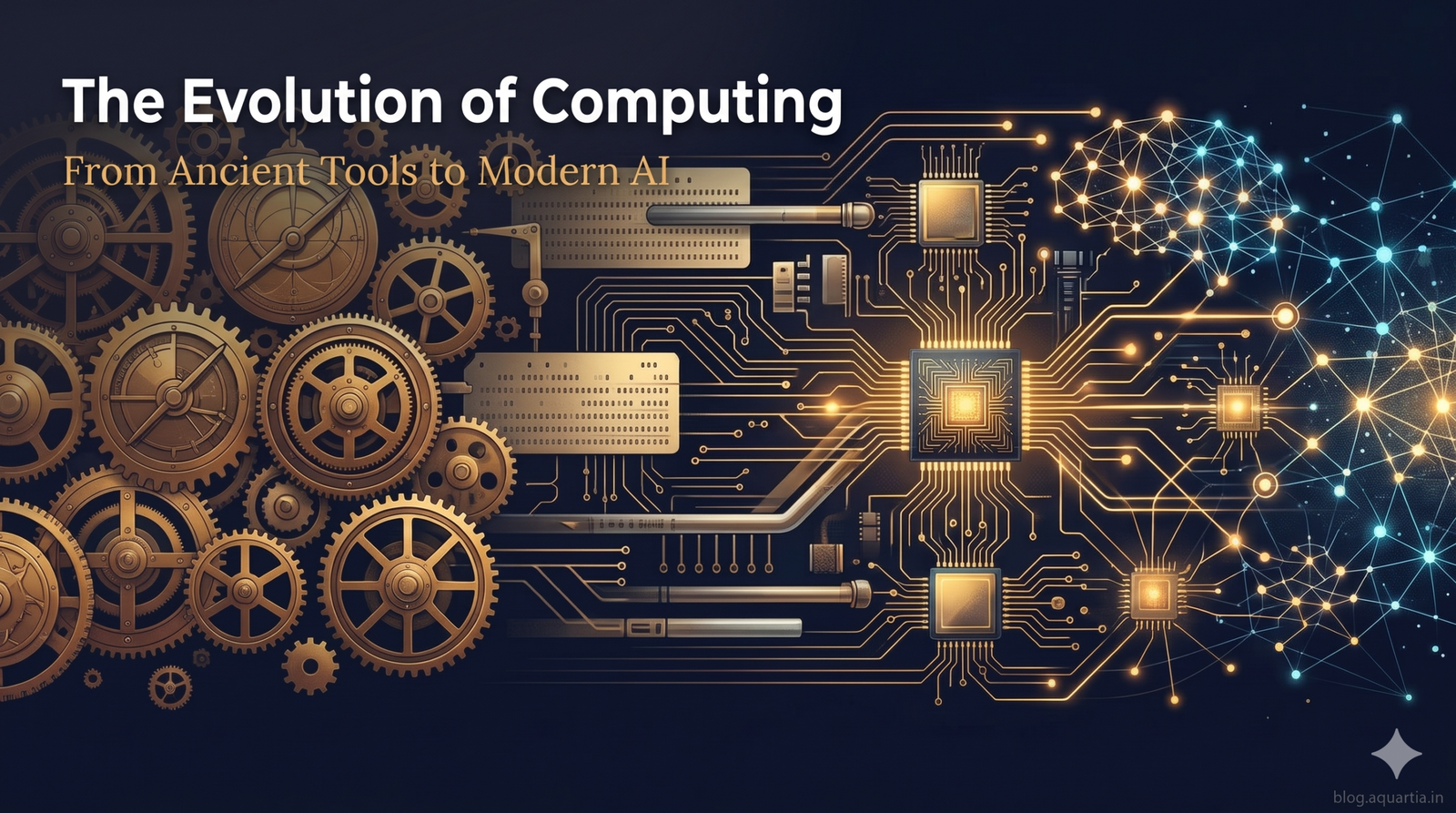
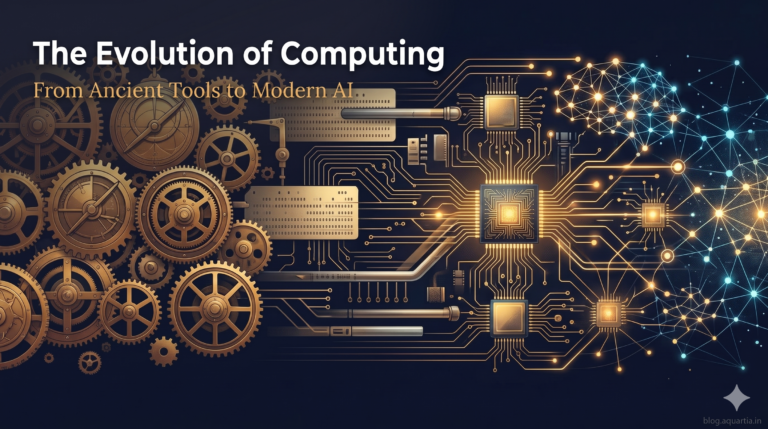
Every smartphone, cloud data center, and artificial intelligence model operating today rests on a multi-century chain of mathematical and engineering breakthroughs. Understanding the evolution of computing reveals how humanity moved from counting beads on wooden frames to orchestrating billions of parallel matrix operations across silicon accelerators.
Rather than appearing overnight, modern computers emerged through five distinct paradigm shifts: mechanical calculation, theoretical computability, vacuum-tube electronics, solid-state semiconductors, and distributed intelligent systems.
1. Mechanical Foundations: From the Abacus to the Analytical Engine
Long before electricity, civilizations built physical instruments to reduce human arithmetic errors. Ancient merchants relied on the abacus for rapid addition and subtraction, while seventeenth-century European mathematicians such as Blaise Pascal and Gottfried Wilhelm Leibniz engineered geared mechanical calculators capable of performing all four basic arithmetic operations.
The decisive conceptual leap arrived in the 1830s, when English mathematician Charles Babbage designed the Analytical Engine. Unlike single-purpose calculators, Babbage’s steam-driven design separated memory (the “Store”) from processing (the “Mill”) and used punched cards—inspired by the Jacquard loom—to accept both data and conditional instructions.
In 1843, mathematician Ada Lovelace published extensive notes on the Analytical Engine containing a step-by-step algorithm to compute Bernoulli numbers. Historians recognize this work as the first published computer program, and Lovelace famously foresaw that general-purpose machines could manipulate symbols, logic, and even music—not merely numbers.
2. Theoretical Computability: Alan Turing and the Universal Machine
Nearly a century after Babbage, computing shifted from mechanical gears to formal mathematical logic. In 1936, British mathematician Alan Turing published On Computable Numbers, defining an abstract “universal computing machine” capable of simulating any algorithmic process by reading and writing symbols on a tape according to finite rules.
This theoretical model—now called the Turing machine—established that a single programmable hardware architecture could execute an unlimited variety of software tasks simply by changing its stored instructions.
3. The Electronic Era: ENIAC and Vacuum-Tube Computing
During the 1940s, wartime ballistic and cryptographic demands accelerated the transition from electromechanical relays to high-speed electronic circuits. Completed by early 1946 at the University of Pennsylvania, ENIAC (Electronic Numerical Integrator and Computer) became the first programmable, electronic, general-purpose digital computer.
ENIAC occupied a 50-by-30-foot room, contained roughly 18,000 vacuum tubes, consumed 150 kilowatts of electrical power, and executed up to 5,000 additions per second. While revolutionary in speed, vacuum tubes were fragile, power-hungry, and prone to frequent burnout—making large-scale reliability a constant engineering challenge.
4. The Semiconductor Revolution: Transistors to Microprocessors
The bottleneck of fragile vacuum tubes ended in December 1947, when physicists John Bardeen and Walter Brattain demonstrated the point-contact transistor at Bell Laboratories under Solid State Physics Group leader William Shockley. By controlling electrical current through a solid semiconductor crystal, the transistor replaced bulky glass tubes with a compact, durable, low-power switch.
Over the next three decades, integrated circuits packed thousands—and eventually billions—of transistors onto silicon wafers. Microprocessors standardized personal computing in the 1970s and 1980s, while global networking protocols transformed isolated machines into the modern internet.
5. Comparative Timeline of Computing Paradigms
| Era | Key Milestone | Core Technology | Primary Breakthrough |
|---|---|---|---|
| Mechanical (1830s–1840s) | Analytical Engine & Lovelace Notes | Brass gears & punched cards | Separation of memory, processing, and stored algorithms |
| Theoretical (1936) | Universal Turing Machine | Formal mathematical logic | Proof that one machine can run any computable algorithm |
| First-Gen Electronic (1945–1946) | ENIAC | ~18,000 vacuum tubes | High-speed electronic digital calculation |
| Solid-State (1947–1970s) | Bell Labs Transistor & ICs | Silicon semiconductors | Miniaturization, reliability, and exponential scaling |
| Intelligent Era (2010s–Present) | GPU Clusters & Foundation Models | Parallel tensor silicon | Autonomous reasoning, multimodal AI, and agentic workflows |
6. Modern AI Architectures: Continuing the Historical Arc
Today’s artificial intelligence systems represent the latest chapter in this same architectural lineage. Rather than executing purely sequential scalar instructions, modern AI accelerators perform massive parallel matrix multiplications across thousands of cores—bringing Ada Lovelace’s vision of symbolic and creative machine manipulation to global scale. To explore how these architectures are applied today, browse our guides on Artificial Intelligence and Chip Technology.
Frequently Asked Questions
Who designed the first programmable general-purpose computer?
Charles Babbage designed the Analytical Engine in the 1830s as the first blueprint for a programmable general-purpose computer, and Ada Lovelace wrote the first published algorithm for it in 1843.
Why was ENIAC a turning point in computing history?
ENIAC demonstrated that all-electronic digital computation using vacuum tubes could perform thousands of arithmetic operations per second—orders of magnitude faster than mechanical or electromechanical machines.
How did the 1947 Bell Labs transistor change computers?
The transistor replaced fragile, high-heat vacuum tubes with a tiny, reliable semiconductor switch, enabling integrated circuits, microprocessors, smartphones, and modern cloud data centers.
What is the connection between Alan Turing and modern AI?
Alan Turing formalized the universal computing model in 1936 and later explored machine intelligence, establishing the theoretical foundation for both modern software and artificial intelligence.
Conclusion
From Babbage’s mechanical Mill and Store to Turing’s universal logic, Bell Labs’ transistor, and modern AI silicon, the evolution of computing has consistently been driven by one goal: turning abstract human reasoning into reliable, scalable machines. For more deep dives into technology and AI infrastructure, explore the latest articles on Aquartia Blog.





+ There are no comments
Add yours