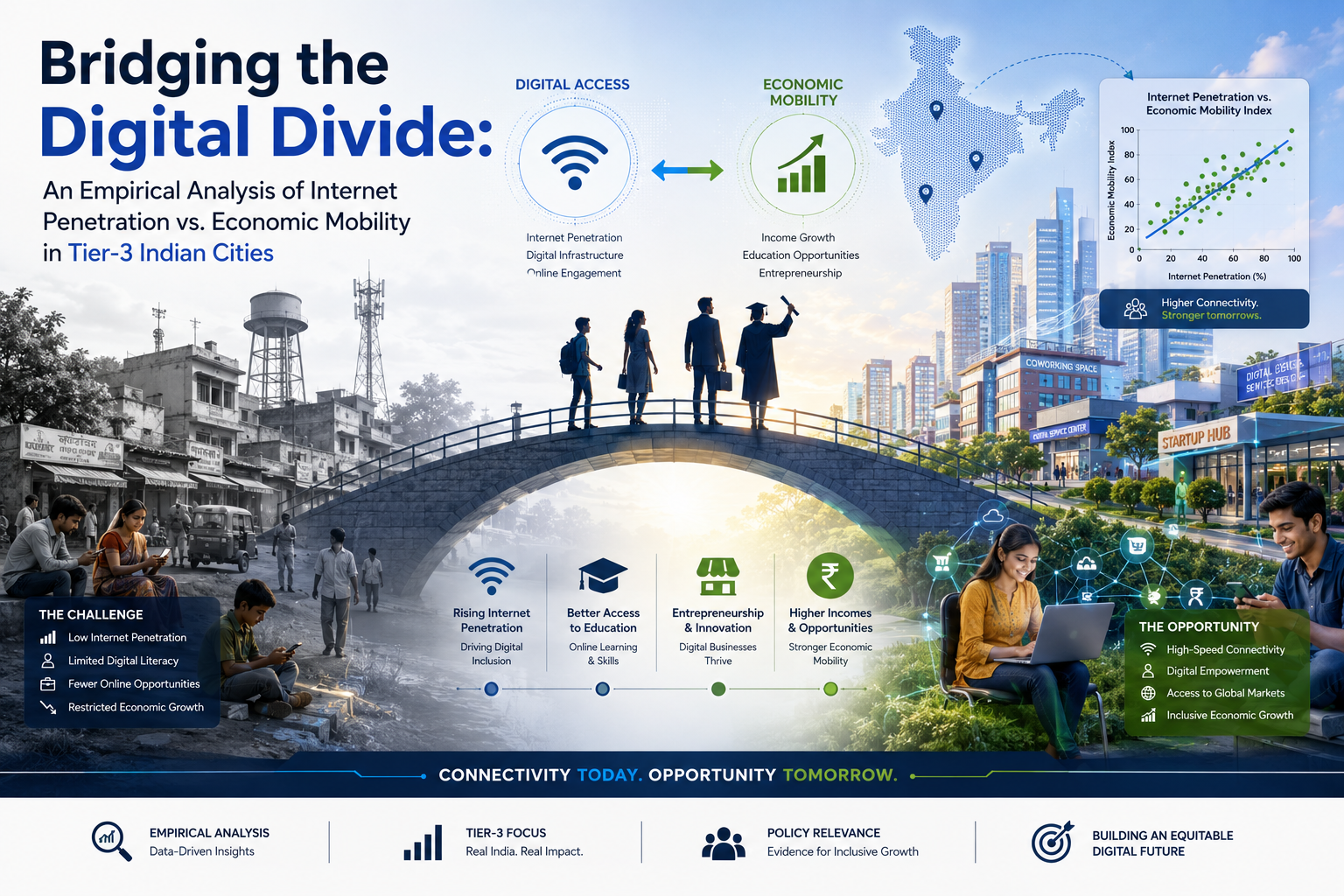
For years, the phrase “digital divide” was used by economists and policymakers to describe a simple, binary problem: those who had access to the internet versus those who lived in complete connectivity dark zones. However, recent infrastructure transformations have fundamentally shifted this landscape.
With the explosive expansion of nationwide optical fiber networks (via initiatives like BharatNet) and dropping data tariffs, sheer connectivity access is no longer the primary bottleneck. Industry data from the IAMAI and Kantar reveals that India’s active internet user base has scaled past 950 million, with rural and semi-urban regions accounting for over 57% of all active users.
Yet, as connectivity reaches saturation in Tier-3 cities and small towns, a deeper, more complex question emerges: Does internet penetration automatically translate into upward economic mobility? This empirical analysis explores the structural transition from the “Connectivity Gap” to the “Opportunity Gap,” examining how digital public infrastructure impacts local economies and what roadblocks still prevent smaller cities from fully converting megabytes into household income.
1. From Connectivity to Capability: The Two Phases of the Divide
To understand how internet adoption influences economic mobility, we must categorize the evolution of the digital divide into two distinct operational phases:
- Phase 1: The Infrastructure Gap (Resolved): This phase was characterized by a lack of physical hardware, high data costs, and a lack of cell towers. This gap has effectively been bridged. High-speed 4G and 5G networks cover over 95% of the country, and data costs have plummeted, making digital access universally affordable.
- Phase 2: The Cognitive & Opportunity Gap (Active): This is the current frontier. While a user in a Tier-3 city has access to the exact same high-speed connection as an individual in a Tier-1 tech hub, their capacity to leverage that connection for wealth generation differs drastically. This gap is defined by digital financial literacy, language barriers, and access to localized digital employment.
2. The Mechanics of Economic Mobility via Digital Infrastructure
When a Tier-3 city experiences a surge in internet penetration, economic mobility is triggered across three primary vectors:
A. Democratization of Market Intelligence
Before widespread mobile internet, small-scale local manufacturers, artisans, and agricultural traders in Tier-3 towns relied entirely on local middlemen to sell their goods. This information asymmetry kept profit margins razor-thin.
With open internet access, local businesses use digital platforms to check real-time commodity prices, discover cross-country demand, and bypass traditional supply chain layers. A local textile micro-enterprise can now showcase products directly to national audiences via e-commerce marketplaces and social commerce tools.
B. Decentralization of Technical Education
Historically, acquiring specialized tech skills required migrating to major Tier-1 metropolitan hubs—a move that carries prohibitive living expenses. Universal connectivity has decentralized this pipeline.
Through online open-source platforms, coding bootcamps, and digital knowledge networks, a developer in a Tier-3 town can master advanced Python, web development, or data analytics from their home office. This allows regional talent to participate in the global gig economy or work remotely for metropolitan firms, injecting high-value currency directly back into the local economy.
C. Financial Infrastructure Integration
Internet access serves as the direct pipeline for Digital Public Infrastructure (DPI). The integration of zero-cost real-time payment frameworks allows micro-merchants to move away from inefficient cash hoarding.
Every digital payment processed creates a clean, auditable cashflow ledger. Local banks can analyze this transaction data to instantly underwrite business loans, providing Tier-3 entrepreneurs with formal working capital that was previously inaccessible.
3. Structural Barriers Restraining Tier-3 Economic Velocity
Despite the clear pathways to growth, internet penetration does not automatically yield economic prosperity. Empirical studies point to several structural friction points:
[Universal 5G / Fiber Access] ──► [High Entertainment Usage (Short Video/Audio)]
                                        │
                                        ▼ (The Consumption Trap)
                                 [Low Economic Conversion / Monetization]
- The Consumption vs. Production Trap: Data shows that over 60% of short-video consumption and audio social platform activity originates outside metro areas. A massive portion of internet bandwidth in Tier-3 towns is utilized for passive content consumption rather than digital production, upskilling, or commerce.
- The Language Bottleneck: While the technical plumbing of the internet is universal, the highest-paying digital opportunities, documentation, and advanced development tools remain heavily biased toward English. The slow adaptation of highly nuanced, contextual local language tools limits non-English speaking users to basic application interfaces.
- The Shared-Device Constraint: According to the IAMAI, nearly 18% of internet users in non-metro areas still access the web via a shared family device. For an individual attempting to run a digital business or learn a complex technical skill, the lack of dedicated personal hardware acts as a major drag on productivity.
4. Conclusion: Policy Frameworks to Unlock “Distributed Intelligence”
To fully convert widespread internet access into sustained economic mobility outside of major metropolitan areas, the strategy must shift from building physical towers to fostering digital capability.
This requires treating advanced digital skills and compute power as public infrastructure—expanding local common service centers, encouraging localized language AI models, and incentivizing tech companies to set up satellite offices in smaller towns. When a Tier-3 city transitions from being a passive consumer of digital content to an active producer of digital value, true, decentralized national economic growth is unlocked.
Reference Links
- Internet and Mobile Association of India (IAMAI): https://www.iamai.in/
- NITI Aayog Research Reports: https://niti.gov.in/
- Press Information Bureau (PIB) Digital Progress Updates: https://www.pib.gov.in/




+ There are no comments
Add yours