
Key Highlights
- First Systematic Digital Mapping: The Annual Survey of Unincorporated Sector Enterprises (ASUSE) 2026, launching January 2026, marks India’s first comprehensive measurement of digital adoption across informal enterprises—a paradigm shift from traditional asset and employment metrics.
- Rapid Digital Growth: In July-September 2025, 40% of informal enterprises used online tools for business operations—up dramatically from 34% at start of 2025, indicating accelerating digital integration.
- Gig Economy Officially Counted: For the first time, platform economy workers (Ola/Uber drivers, delivery agents, tutors, homestays) are included in national statistics through new occupational codes, moving them from statistical invisibility to formal tracking.
- Quarterly Data Now Available: The NSO’s new Quarterly Bulletin of Unincorporated Sector Enterprises (QBUSE) provides high-frequency insights instead of waiting for annual reports, enabling faster policy response.
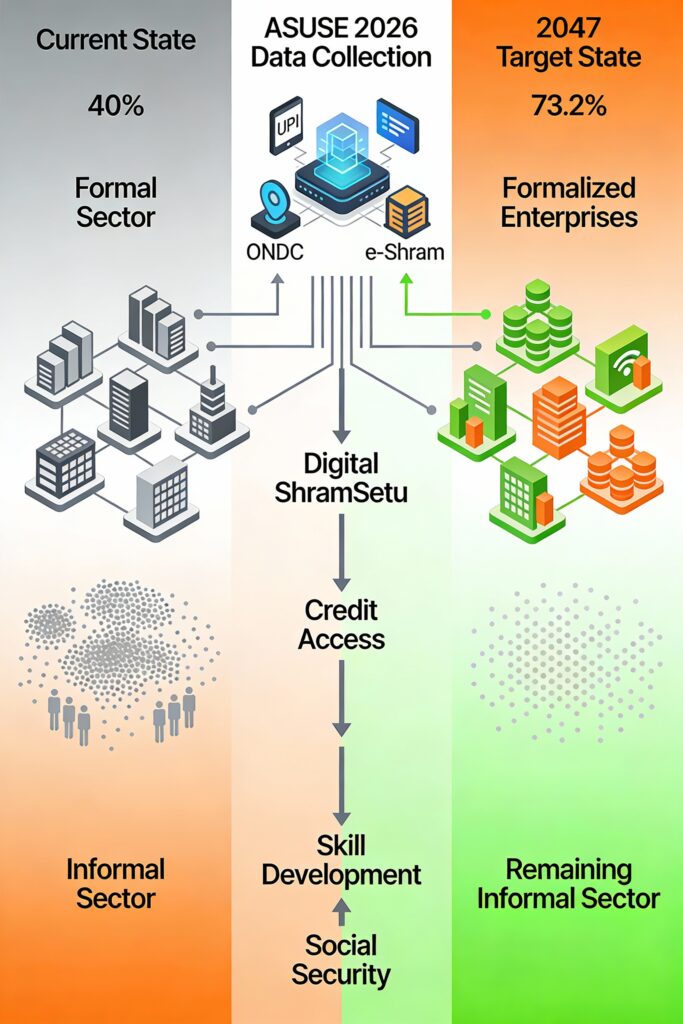
- Ambitious Formalization Vision: By 2047, India aims to formalize 73.2% of currently informal enterprises and reduce the informal sector’s share to 40%—ASUSE 2026 data provides the baseline for achieving this transformational goal.
Why This Survey Matters—The Invisible Economy Problem
The Scale of Invisibility
India’s informal sector is massive yet invisible. It constitutes 90% of India’s workforce and generates nearly 45-50% of GDP. Yet, comprehensive data on this sector’s digital characteristics barely exists. southasianherald
A street vendor using WhatsApp to take orders. A carpenter accepting UPI payments. A delivery agent navigating an app-based gig. These economic activities—happening millions of times daily across India—remain largely uncounted and unmeasured by official statistics. pib.gov.in
This data gap has profound consequences for policymaking. How can the government design financial inclusion programs without knowing how many informal enterprises use digital payments? How can they formulate skill development initiatives without understanding digital literacy gaps by region and sector? How can they tax fairly without transparency on digital transactions?
The Digital Shift Nobody Was Tracking
Between 2022-23 and 2023-24, internet usage for entrepreneurial purposes jumped from 21.1% to 26.7% nationally—a stunning 5.6 percentage point increase. In urban areas, it surged from 30.2% to 37%. Even rural enterprises increased digital adoption from 13.5% to 17.9%. epw
Yet, no single authoritative source captured this shift comprehensively. QBUSE, launched in 2025, finally filled that gap—revealing that by April-June 2025, 36.03% of informal enterprises were using internet-based tools, up from 34.2% just one quarter earlier.
For policymakers relying on year-old data or rough estimates, this rapid transformation was invisible. For entrepreneurs hoping to access credit based on digital transaction records, the lack of official measurement meant no credit trail. For platforms like ONDC and UPI trying to measure real-world adoption, the granular data was missing.
Understanding ASUSE 2026—What Gets Measured
What is ASUSE?
The Annual Survey of Unincorporated Sector Enterprises (ASUSE) is conducted by the National Statistical Office (NSO) under the Ministry of Statistics and Programme Implementation (MoSPI). It covers non-agricultural, unincorporated enterprises in manufacturing, trade, and services sectors—essentially, all businesses not registered as formal companies.
ASUSE 2026 will run from January to December 2026 and represents a major evolution from previous rounds.
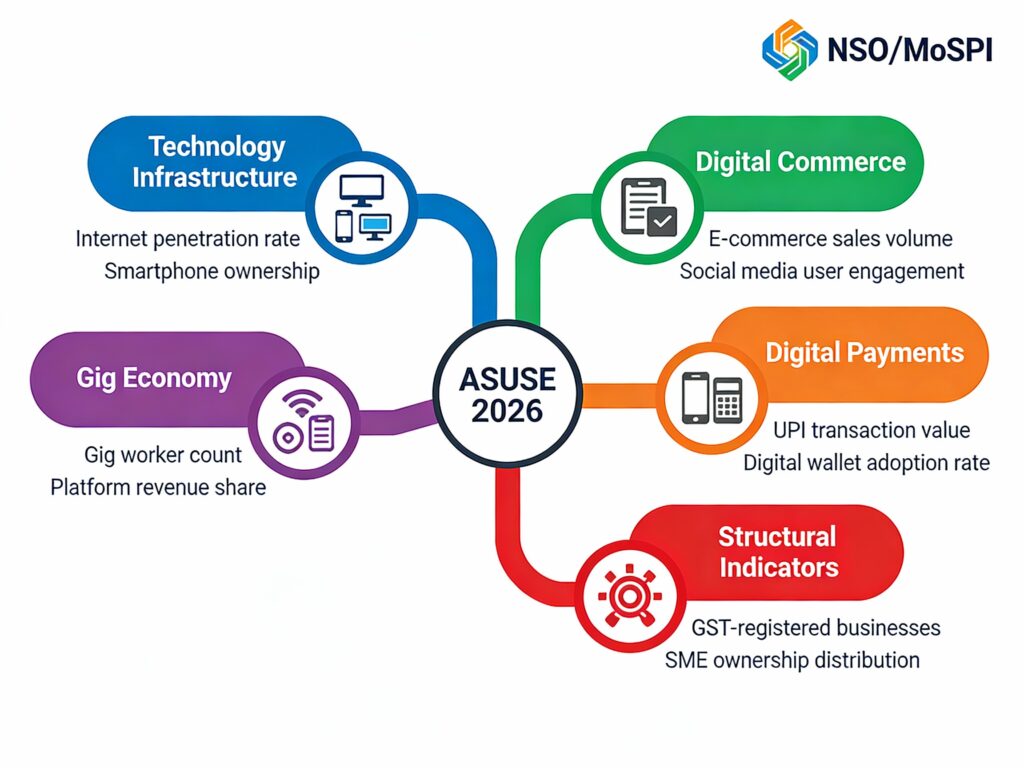
The Digital Metrics Being Tracked
ASUSE 2026 introduces an entirely new section on technology and digital behavior:
Technology Infrastructure
- Computer and smartphone usage for business purposes
- Internet connectivity and frequency of usage
- Website presence and social media pages
- Digital accessibility of business information
Digital Commerce
- Product listings on e-commerce marketplaces (Amazon, Flipkart, etc.)
- Online order reception capabilities
- Digital delivery of goods and services
- Platform marketplace reliance (e.commerce, social commerce)
Digital Financial Transactions
- UPI payment adoption and transaction frequency
- Point-of-Sale (PoS) device usage for card payments
- Internet banking utilization
- Integration with digital payment gateways
- Digital accounting and bookkeeping practices (use of software, cloud tools)
Gig and Platform Economy (NEW)
- Ola/Uber/Rapido driving as primary or secondary occupation
- Delivery services via platforms (Zomato, Dunzo, etc.)
- Home tutoring and educational services
- Homestay and accommodation-sharing operations
- Household maintenance and repair services
- Private moneylending activities
Structural Indicators
- GST registration status and compliance
- Ownership type (proprietorship, partnership, family business)
- Seasonal vs. perennial operations
- Working capital sources (personal savings, bank loans, informal credit)
- Input-output relationships and supply chains
Why This Matters: The Data Gap Being Filled
Traditional ASUSE rounds focused on fixed assets, employment numbers, and gross value added—backward-looking operational metrics. They asked “How many workers did you employ in 2023-24?” but rarely asked “Are you selling on Amazon?” or “Do you accept UPI?”
This gap was critical because digital adoption is increasingly the determinant of access to credit, welfare schemes, and market opportunities. A micro-enterprise with UPI transaction records can now access loans from fintech platforms. A street vendor with an ONDC registration gains access to formal supply chains. A gig worker with verified work history can access social security schemes.
Without systematic measurement, policy remained based on assumptions rather than evidence.
The Gig Economy Finally Enters Official Statistics
Invisible Workers, Now Counted
India’s gig economy is booming but statistically invisible. Exact numbers are debated—estimates range from 8 million to 18 million gig workers, but they don’t appear in official labor statistics.
Why? Because gig workers don’t fit traditional employment categories. They’re neither employees (with contracts and benefits) nor full-time entrepreneurs. They’re platform-mediated, flexible, and often hold multiple concurrent jobs.
ASUSE 2026 changes this by introducing entirely new occupational codes for gig activities:
- Platform-based transportation: Ola, Uber, Rapido drivers
- Last-mile delivery: Swiggy, Zomato, Dunzo delivery partners
- Skill-based gig work: Freelance tutors, consultants, designers on platforms
- Accommodation and tourism: Airbnb hosts, OYO owners
- Household services: Maintenance workers, plumbers, electricians booked via apps
- Informal lending: Private moneylending through digital platforms
This is significant because gig workers will now feature in national employment statistics, welfare program design, and labor policy. They become countable, and countability is the first step toward policy inclusion.
Why Gig Workers Matter for 2047 Formalization
NITI Aayog’s Vision document on “AI for Inclusive Societal Development” (October 2025) explicitly targets 490 million informal workers for digital integration by 2047. This includes gig workers.
The proposed Digital ShramSetu Mission envisions a federated ecosystem where gig workers receive:
- Verifiable work credentials: Portable proof of work history across platforms
- Access to social security: Micro-pensions, accident insurance, skill credits
- Credit access: Digital footprint enabling formal lending
- Income support and skill development: AI-matched training to upgrade earning potential
But none of this is possible without first counting gig workers. ASUSE 2026 provides that foundation.
From Annual to Quarterly Data—A Revolution in Timeliness
Why Quarterly Data Changes Everything
Under the previous system, policymakers waited an entire year for ASUSE results. By the time 2023-24 data was released in early 2025, economic conditions had shifted.
In 2025, MoSPI introduced the Quarterly Bulletin of Unincorporated Sector Enterprises (QBUSE), providing high-frequency snapshots:
- Q1 2025 (Jan-Mar): Internet usage at 34.2%
- Q2 2025 (Apr-Jun): Internet usage at 36.03%
- Q3 2025 (Jul-Sep): 40% of informal enterprises using online tools
This quarterly cadence means:Policy can now respond in real-time to digital adoption trends instead of relying on stale annual data.
For instance, when Q3 2025 revealed that digital tool usage had jumped 6 percentage points in one quarter, it immediately signaled:
- Accelerating market adoption of e-commerce platforms
- Growing comfort with UPI and digital payments among informal traders
- Potential for targeted subsidies or incentives for holdout enterprises
- Need for urgent digital literacy interventions in lagging sectors
This responsiveness is essential for formalization, financial inclusion, and welfare scheme targeting.
Multi-Dimensional Governance Implications
Economic Significance and Policy
Formalization Agenda: India targets 73.2% enterprise formalization by 2047 while reducing informal sector share from current ~60% to 40%. ASUSE 2026 provides the baseline data for calibrating formalization policies.
GDP Measurement: The informal sector contributes ~45-50% of India’s GDP but is poorly measured, leading to underestimated national accounting. Better digital adoption data allows more accurate GDP attribution and growth forecasting.
Tax Revenue Potential: Digital payment trails and GST registration data revealed through ASUSE can identify revenue leakage and target tax compliance interventions. A trader accepting UPI payments leaves a digital trail; traditional cash-only enterprises remain opaque.
Financial Inclusion: UPI adoption metrics from ASUSE indicate real progress in banking penetration. By 2025, nearly 40% of informal enterprises used digital payments—a proxy for broader financial inclusion success.
Governance and Constitutional Dimensions
Evidence-Based Policymaking: Granular, sector-by-sector, region-by-region data on digital adoption enables targeted interventions rather than one-size-fits-all policies.
Digital Public Infrastructure Assessment: ASUSE measures effectiveness of UPI, ONDC, and other DPI initiatives. Real adoption rates inform whether DPI investments are delivering inclusive growth.
Regulatory Framework Development: Data on gig economy workers informs labor regulation. Are Ola drivers employees or contractors? ASUSE data on gig work prevalence, income volatility, and social security gaps will shape the answer.
Data Protection vs. Transparency Trade-off: ASUSE involves tracking digital transactions of informal workers. Under the Digital Personal Data Protection Act, 2023, this raises questions: How are enterprise digital profiles protected? Who can access ASUSE data? Can it be used for tax enforcement without prior consent?
Science & Technology and Innovation
AI for Informal Sector: NITI Aayog’s Digital ShramSetu Mission relies on ASUSE data to design AI interventions. Voice-first AI interfaces (overcoming language barriers) need datasets of informal worker speech; skill-matching algorithms need data on current digital competencies.
Digital Divide Mapping: ASUSE reveals stark rural-urban gaps. In 2023-24, rural digital adoption was 17.9% vs. urban 37%—a 19.1 percentage point gap. This geographic targeting enables infrastructure investment and digital literacy programs.
Platform Economy Growth: First official measurement of gig workers creates data for understanding platform economy dynamics, labor market implications, and technology diffusion patterns.
Ethics and Fundamental Rights
Privacy vs. Formalization: Tracking digital activity of informal enterprises enables welfare access but also potential surveillance. How do we balance financial inclusion (requiring visibility) with privacy rights?
Power Asymmetries: Informal enterprises have weak bargaining power with formal institutions. ASUSE data could be misused for tax crackdowns before offering support. Conversely, without data, inclusive policies cannot be designed.
Fairness in Welfare Distribution: ASUSE enables means-tested welfare targeting but also risks excluding those unable to prove digital footprints. Unregistered workers and digitally illiterate enterprises might be left out.
Opportunities and Challenges—A Balanced Assessment
Significant Opportunities
1. Comprehensive Economic Portrait
For the first time, India will have integrated data on:
- Physical enterprises (traditional micro-businesses)
- Digital enterprises (e-commerce sellers, app-based services)
- Hybrid enterprises (offline shops with online presence)
- Gig workers (platform-mediated labor)
This holistic view enables evidence-based economic policy across sectors and regions.
2. Policy Precision
Instead of broad-brush formalization programs, policymakers can target:
- Digitally excluded sectors (e.g., traditional agriculture-related crafts) with tailored digital literacy
- High-potential enterprises (already digital-active) with credit and growth programs
- Sector-specific interventions (e-commerce platforms need different support than gig workers)
3. Global Competitiveness
Transparent data on informal sector size and digital integration makes India more attractive to:
- International investors seeking clarity on market size
- Development agencies evaluating formalization progress
- Technology companies seeking user growth in informal segments
4. Social Security Extension
With official gig worker data, policymakers can design portable benefits—micro-pensions, accident insurance, skill credits—that follow workers across platforms and geographies.
Substantial Challenges
1. Data Collection Trust Deficit
Informal enterprises fear surveys. A carpenter receiving an ASUSE enumerator might worry: “Will this lead to tax scrutiny? Will the government use this to regulate me?”
Unless trust is built—through clear messaging that ASUSE is for policymaking, not tax enforcement—underreporting is likely.
2. Privacy and Data Protection
ASUSE will collect sensitive information:
- Digital payment trails
- Platform marketplace activity
- Income and asset details
- GST registration status (which enterprises might hide)
Under India’s Digital Personal Data Protection Act, 2023, safeguards are required against misuse. Clarity is needed: Who can access ASUSE data? Can income tax authorities use it? How long is data retained?
3. Dynamic Gig Economy
Gig workers have fluid, multi-job relationships. A person driving for Uber three days weekly while doing freelance tutoring doesn’t fit traditional “establishment” definitions. Capturing this dynamism without overcomplicating questionnaires is difficult.
4. Language and Literacy Barriers
ASUSE enumerators must explain digital concepts in vernacular languages. In rural areas, explanations of “digital payment gateway” or “e-commerce marketplace” require calibration to local understanding.
5. Implementation Feasibility
Surveying 80+ million unincorporated enterprises quarterly is logistically massive. Training thousands of enumerators, quality assurance, and timely data processing are resource-intensive.
International Comparison—Where Does India Stand?
Developed Countries: Sophisticated Infrastructure, Narrow Coverage
OECD approach: Countries like Germany, France, the US track informal employment primarily through tax compliance data and labor surveys, focusing on social security gaps rather than digital behavior.
They measure “informal employment” (workers without written contracts or tax registration) rather than “informal enterprises” (unincorporated businesses). The focus is enforcement, not inclusion.
Lesson for India: Developed countries’ smaller informal sectors mean simpler measurement. India’s scale (490 million informal workers) requires different architecture—ASUSE’s enterprise focus is more suited to India’s context.
Developing Countries: Minimal Digital Measurement
Most developing economies lack ASUSE-equivalent surveys. Brazil has begun digital cadastres for informal workers; Kenya tracks mobile money penetration; Indonesia pilots platform economy surveys.
But none systematically measure digital adoption across unincorporated enterprises at quarterly frequency—making India’s ASUSE 2026 potentially a model for the Global South.
SDG Relevance
The UN’s SDG 8 (“Decent Work and Economic Growth”) requires countries to report on “Proportion of informal employment in total employment” (Indicator 8.3.1). Most countries rely on modeled estimates and labor force surveys.
India’s enterprise-level digital data offers richer evidence for SDG 8.3 progress than survey averaging.
Policy Recommendations and Way Forward
Immediate Actions (Pre-ASUSE 2026 Launch)
1. Stakeholder Sensitization Campaign
- Publicize ASUSE objectives: Understanding, not enforcement
- Testimonials from past survey beneficiaries (e.g., enterprises that accessed credit after being counted)
- Language-specific materials explaining survey confidentiality
- Clear messaging: “Being counted helps you access schemes and credit”
2. Enumerator Training
- Train on digital terminology in vernacular languages
- Sensitize on informal enterprise trust-building
- Quality assurance protocols for data accuracy
3. Data Governance Framework
- Pre-launch clarity on data protection safeguards
- Memoranda of Understanding (MoUs) specifying which agencies can access ASUSE data
- Penalties for misuse (e.g., using ASUSE for surprise tax audits)
- Public Data Governance Board for transparent access decisions
Medium-Term Reforms (2026-2028)
1. Legislative Modernization
Amend the Copyright Act and introduce new labor codes ensuring:
- Clear status for gig workers (not employees, but entitled to portable benefits)
- Definitional standards for digital enterprises
- Safe harbor for digital transactions disclosed to ASUSE (protection from retroactive tax claims)
2. Integration with Existing Databases
- Link ASUSE with GST Network for tax compliance insights
- Cross-reference with Aadhaar-based beneficiary databases for welfare targeting
- Coordinate with State Statistical Offices for granular state-level analysis
3. Technology Integration
- Digital survey instruments (tablets) for enumerators replacing paper forms
- Real-time data validation and anomaly detection
- Blockchain for data integrity assurance
Long-Term Vision (2028-2047)
1. Real-Time Digital Dashboard
Move beyond quarterly/annual reporting to real-time monitoring through:
- API feeds from payment platforms (NPCI, fintech companies) with privacy safeguards
- E-marketplace registrations tracked continuously
- Predictive analytics for informal sector trends
2. Inclusive Development Roadmap
Use ASUSE data to design:
- Micro-credentials: Digital proof of skills for informal workers
- Targeted skilling: AI-matched training based on adoption gaps
- Customized credit products: Digital footprints enabling formal lending
- Smart contracts for gig workers: Transparent, automatic wage payments
3. Achieving 2047 Targets
Formalize 73.2% of enterprises by building:
- Incentive structures: Tax holidays for newly formalized digital enterprises
- Benefits-linked registration: Access to welfare schemes upon registration
- Gradual compliance pathways: Simplified requirements for micro-enterprises
Conclusion: Visibility as the Gateway to Inclusion

ASUSE 2026 is more than a statistical exercise. It represents a philosophical shift: making India’s invisible economy visible—and in visibility, enabling dignity, access, and opportunity.
For a street vendor using WhatsApp, ASUSE 2026 means: “My business will finally be counted. I can show digital transaction proof to access a bank loan.”
For policymakers, it means: “I have granular evidence, not assumptions. I can design formalization policies that fit real enterprises.”
For gig workers, it means: “I’m no longer a statistical blind spot. Labor law and social security can now include me.”
For India’s 2047 vision of a developed economy, it means: “We have the data foundation to realize inclusive, dignified growth.”
The challenges—trust deficits, privacy concerns, implementation complexity—are real. But they are surmountable with transparent governance, legal safeguards, and commitment to ethical data stewardship.
What’s your perspective? Do you think systematic measurement of informal enterprises will accelerate formalization, or could it create surveillance risks? How should policy balance transparency with privacy for informal workers and entrepreneurs?
Key Terms Glossary
| Term | Definition |
|---|---|
| ASUSE | Annual Survey of Unincorporated Sector Enterprises; tracks economic characteristics of informal non-agricultural enterprises |
| QBUSE | Quarterly Bulletin of Unincorporated Sector Enterprises; provides high-frequency data on informal sector dynamics |
| Unincorporated Enterprises | Businesses not registered as companies under formal corporate law; proprietorships, partnerships, family businesses |
| Digital Adoption | Integration of digital technologies (internet, e-commerce, UPI, apps) in business operations |
| Gig Economy | Labor market with platform-mediated, flexible, short-term contracts (Uber, Zomato, Upwork) |
| Formalization | Process of bringing informal economic activities into formal regulatory, tax, and social security frameworks |
| Digital ShramSetu Mission | NITI Aayog’s proposed national mission to empower 490 million informal workers through AI, blockchain, and digital credentialing |
| Informal Sector | Economic activities operating outside formal registration and regulatory frameworks; ~90% of India’s workforce |
| Extended Collective Licensing (ECL) | System where rights/benefits cover not just registered but also non-registered participants |
| Data Governance | Framework defining who can access, use, and control data; safeguards against misuse |
UPSC Practice Questions
Mains Questions (250 words each)
Q1: Governance and Data Revolution
“ASUSE 2026 represents a shift from traditional employment and asset measurement to comprehensive digital behavior tracking.” Discuss how this paradigm shift can advance India’s formalization agenda and developmental goals, while critically examining challenges in implementation and data protection. (GS-II, 250 words)
Q2: Economic Policy and Inclusive Growth
Analyze the relationship between measuring digital adoption in unincorporated enterprises (ASUSE 2026) and India’s ambitious target of formalizing 73.2% of enterprises by 2047. How can quarterly data (QBUSE) enable more responsive policymaking compared to annual surveys? (GS-III, 250 words)
Q3: Gig Economy and Labor Rights
For the first time, India’s ASUSE 2026 will systematically count gig workers. Examine the implications for labor regulation, social security extension, and worker rights. How should policy balance platform worker flexibility with livelihood protection? (GS-II/III, 250 words)
Q4: Technology and Social Equity
NITI Aayog’s Digital ShramSetu Mission proposes using AI to empower 490 million informal workers. How does ASUSE 2026 data serve as foundation for this vision? Discuss potential benefits and risks of AI-driven formalization. (GS-III, 250 words)
150-Word Quick Answer Questions
Q5: What is ASUSE? Why does ASUSE 2026 represent a paradigm shift?
Q6: Explain the significance of quarterly data (QBUSE). How does it improve policymaking?
Q7: Why is gig economy measurement critical for India’s 2047 vision?
Q8: What are the privacy implications of digital adoption tracking in informal enterprises?
Ethics Case Study
A small family-run textile business operating informally has recently started selling on social media marketplaces and accepting UPI payments. During ASUSE 2026 enumeration, the owner is hesitant to disclose digital activity, fearing tax department scrutiny and loss of informal economy advantages (flexibility, no compliance burden). However, disclosure could help them access formal credit at better rates and welfare schemes. As a policy advisor, what framework would reconcile the owner’s legitimate concerns with the government’s formalization objectives? How can trust be built?







+ There are no comments
Add yours