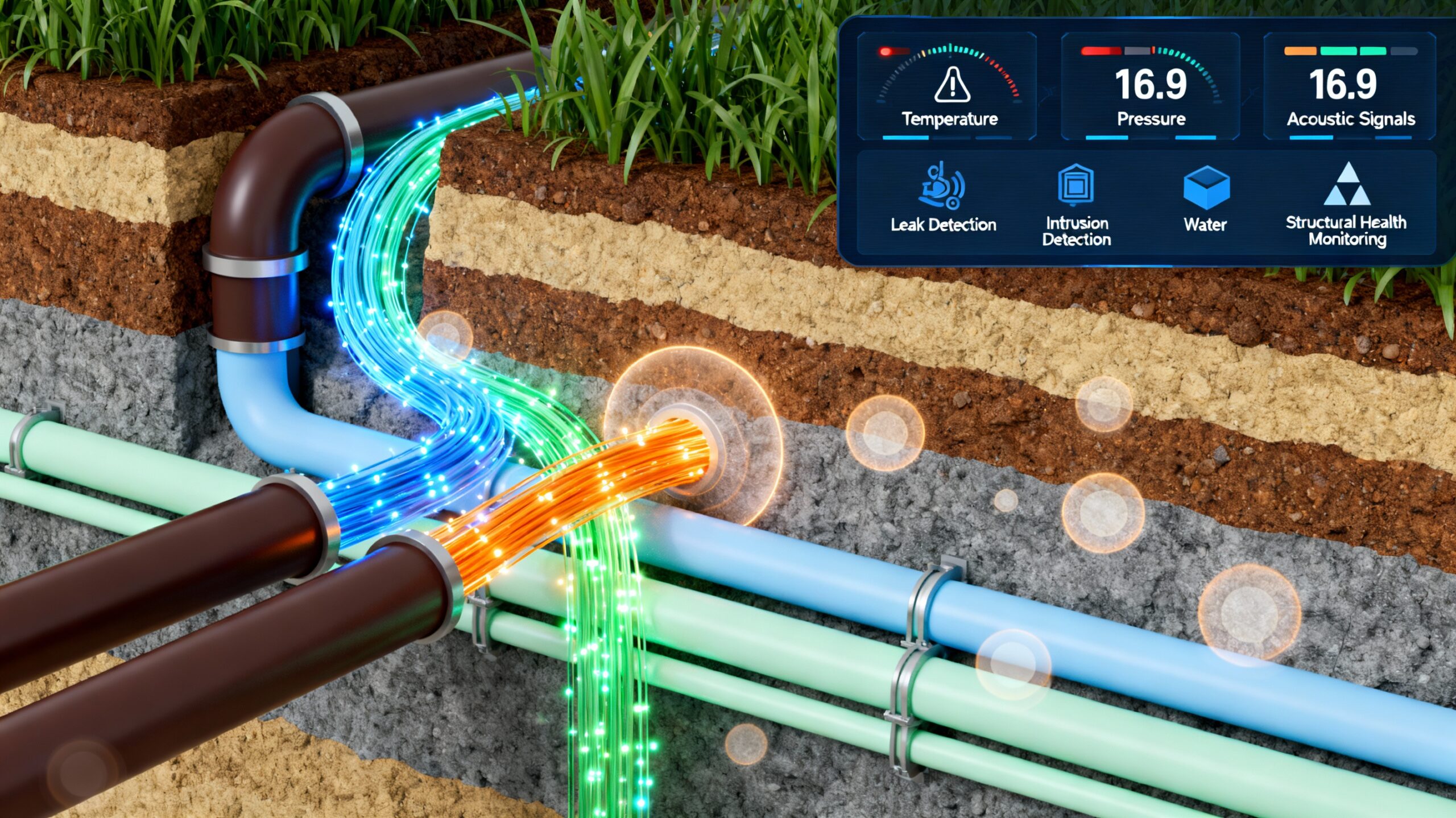
📌 Key Highlights
- Scale of India’s Pipeline Network: India operates 25,429 km of natural gas pipelines (with 10,459 km under construction as of March 2025) and 9,301 km of petroleum pipelines (with 4,263.5 km under construction), serving as critical infrastructure for energy security, industrial growth, and urban water supply (Jal Jeevan Mission).
- Fiber Optic Sensing Advantages: Single fiber optic cables replace hundreds/thousands of point sensors, enabling continuous distributed monitoring over 30-80 km per interrogator unit, with zero blind spots, millisecond response time (DAS), and operational lifespan of 20-25 years—reducing long-term operational costs by 60-80% compared to traditional sensors.
- Real-World Performance Data: Fiber optic DAS systems detect pipeline leaks from 4mm holes with signal-to-noise ratios of 4.65 dB and detection accuracy rates exceeding 90%; diagnostic timeline reduced by 85% versus conventional tools for well integrity assessment.
- Security and Theft Prevention: DAS intrusion detection identifies excavation, tapping, and sabotage activities in real-time; India lost substantial revenue to documented pipeline theft operations (40-100 meter tunnels), yet current monitoring remains reactive and manual.
- Policy Alignment Opportunity: Fiber optic sensing aligns with One Nation One Gas Grid, Jal Jeevan Mission, critical infrastructure protection mandates—enabling early leak detection reducing environmental damage, supporting polluter-pays enforcement, and strengthening national security.
Why Pipeline Monitoring Matters for India
India’s critical infrastructure depends on invisible arteries carrying oil, gas, and water beneath the earth. The nation operates over 25,000 km of natural gas pipelines, 9,000+ km of petroleum pipelines, and millions of kilometers of water distribution pipes created under the Jal Jeevan Mission. These pipelines are the backbone of India’s energy security, industrial competitiveness, and urban livability. Yet our monitoring approach remains largely reactive and manual—periodic inspections revealing problems only after failures occur.
The risks are mounting. Pipeline leaks waste valuable resources and damage environments. Third-party damage from theft, sabotage, and unauthorized excavation represents a major threat—documented cases show sophisticated operations constructing 40-100 meter tunnels to extract crude oil, operating undetected for months. Corrosion in aging pipelines risks catastrophic ruptures. Economic losses from pipeline failures, combined with environmental remediation costs, run into thousands of crores annually.
Fiber optic sensing technology offers transformation from reactive inspection to intelligent, predictive monitoring. By converting fiber optic cables into continuous sensors measuring strain, temperature, vibration, and acoustic signals, India can detect leaks minutes after onset, identify intrusions before major theft occurs, monitor structural health in real-time, and prevent catastrophic failures through early intervention.
For a nation pursuing energy independence (“One Nation, One Gas Grid”), water security (Jal Jeevan Mission), and critical infrastructure protection, fiber optic sensing is not merely a technology upgrade—it is a strategic imperative.
What Is Fiber Optic Sensing Technology?
Fundamental Concept
Fiber optic sensing transforms optical cables laid alongside or embedded within pipelines into continuous distributed sensors. Unlike point sensors (discrete measurements at fixed locations), fiber optic systems measure physical phenomena—strain, temperature, vibration, acoustic signals—at every meter along the cable, creating thousands of virtual sensors from a single cable.
The principle is elegant: laser pulses traveling through optical fiber scatter backward when encountering changes in the fiber caused by physical phenomena. By analyzing these scattered photons, interrogator units at surface level reconstruct detailed profiles of conditions throughout the entire pipeline network.
Four Primary Sensing Techniques
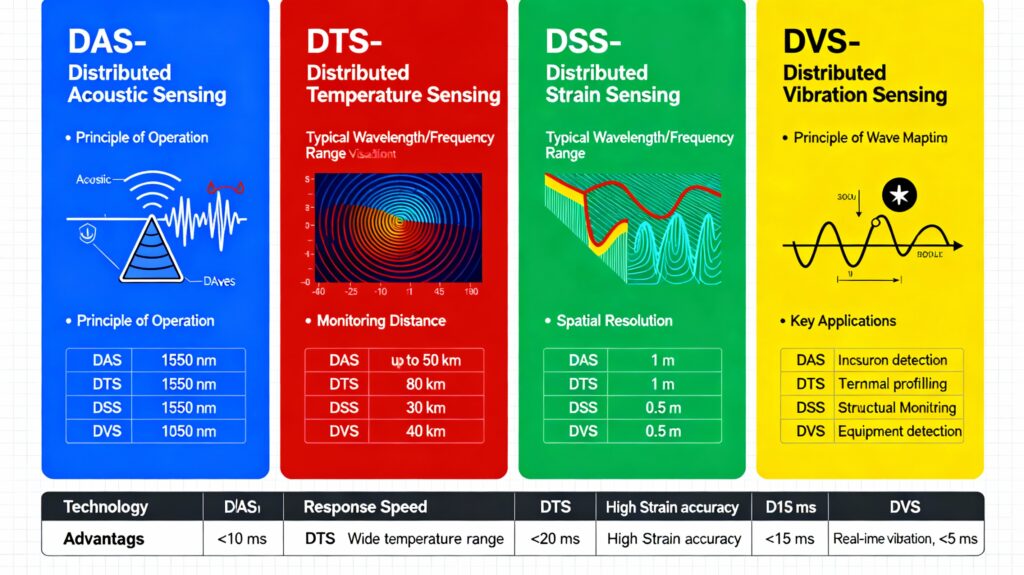
Distributed Acoustic Sensing (DAS): Utilizes Rayleigh scattering—laser pulses cause fiber strain variations when acoustic waves, vibrations, or pressure disturbances propagate through the pipeline. Changes in optical phase reveal acoustic signatures in real-time (millisecond resolution), enabling detection of leaks, intrusions, vibrations. Single fiber can monitor 40-80 km per interrogator unit.
Distributed Temperature Sensing (DTS): Based on Raman scattering—temperature variations along the fiber cause measurable changes in backscattered light intensity. Temperature profiles reveal fluid entry points (in production wells), pipeline thermal anomalies indicating corrosion or abnormal flow, and thermal propagation along water pipes. Response time: 1-10 seconds; monitoring distance: 10-30 km per interrogator.
Distributed Strain Sensing (DSS): Employs Brillouin scattering—frequency shift in backscattered light correlates with both strain and temperature. Ideal for structural health monitoring—detecting pipeline deformation, ground movement stress, and subtle shifts indicating potential failures. Resolution: ±20 microstrain; monitoring distance: 30-50 km.
Distributed Vibration Sensing (DVS): Specialized variant optimizing Rayleigh scattering for vibration frequency analysis. Excels at identifying vibration patterns indicating rotating equipment faults or mechanical degradation. Used for condition-based maintenance of pumping stations and compressor units.
Core Advantages Over Point Sensors
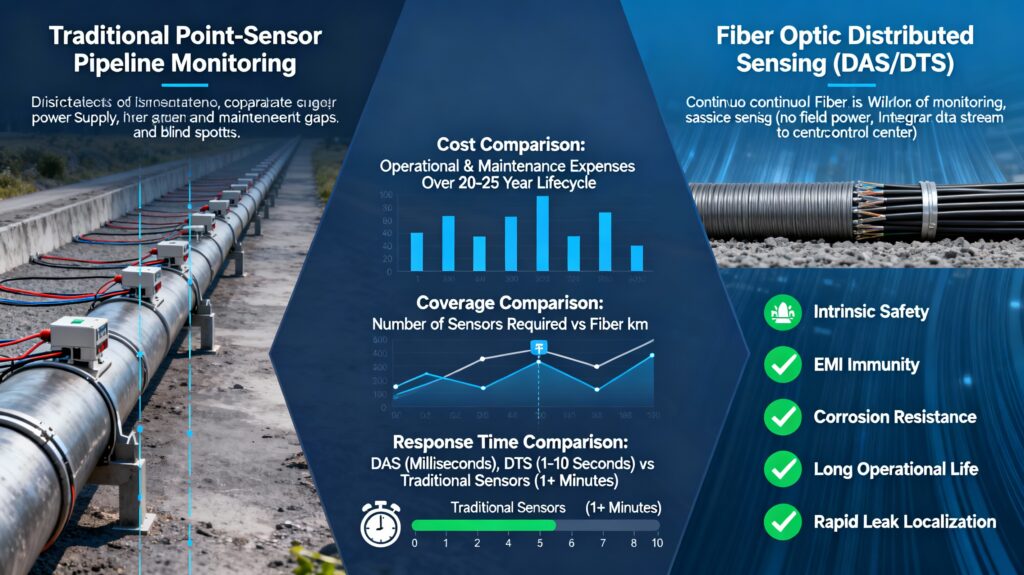
Continuous Coverage: A single fiber optic cable acts as thousands of virtual sensors. Traditional approaches require hundreds of discrete sensors at intervals, leaving blind spots between measurement points. DAS/DTS/DSS eliminate blind spots entirely.
Long-Distance Monitoring: Single interrogator units monitor 30-80 km continuously. For comparison, traditional sensor networks require installation at every 5-10 km, multiplying costs and complexity.
Passive Sensing: Fiber optic cables require no electrical power at field locations—a critical safety advantage in hazardous environments (pipelines carrying flammable hydrocarbons). No ignition risk from electrical equipment or corrosion-induced short circuits.
Intrinsic Safety: Fiber is immune to electromagnetic interference (EMI), operates in temperature extremes (-200°C to +600°C), withstands corrosive chemicals, and exhibits zero signal degradation over 20-25 year operational lifespan.
Economic Lifecycle: Single fiber replaces hundreds of point sensors, dramatically reducing wiring, installation, and maintenance costs. Long-term operational savings: 60-80% compared to traditional sensor arrays.
Key Functional Capabilities
1. Early Leak Detection—Minutes, Not Days
Pipeline leaks represent simultaneous economic and environmental disasters. Traditional inspection identifies leaks only during routine maintenance (every 1-2 years) or after visual signs appear (pooling liquid, discoloration, unusual odors). By then, thousands of liters have escaped.
DAS-based leak detection identifies leaks within minutes of onset. When fluid escapes through a breach, it generates characteristic acoustic signatures—pressure waves, friction noise, acoustic frequency patterns. Machine learning algorithms analyze these signatures to locate leaks with meter-level precision along hundreds of kilometers of pipeline.
Real-world performance: DAS systems detected 4mm leakage holes with signal-to-noise ratios of 4.65 dB and error rates under 10%—far exceeding traditional methods’ sensitivity. In CO₂ storage wells, DTS detected thermal anomalies revealing injection profile dynamics in real-time, enabling operational optimization.
India-specific application: GAIL operates 25,429 km of pipelines where even 0.1% leakage represents losses of millions of liters. Early detection reduces repair costs (emergency response 10x costlier than planned maintenance) and prevents secondary damage escalation.
2. Structural Health Monitoring—Tracking Aging Infrastructure
India’s pipeline network includes systems installed 30+ years ago. Aging brings creeping risks: corrosion thinning walls, ground settlement stressing joints, coating degradation enabling moisture ingress. These processes develop silently until rupture.
DSS-based structural monitoring tracks micro-deformations indicating developing problems. Distributed strain sensing reveals:
- Pipeline deformation from ground subsidence or external loading (construction, heavy traffic)
- Circumferential stress from internal pressure or external ground movement
- Joint integrity detecting separation or misalignment
- Coating degradation revealing corrosion initiation sites
Combined with temperature data (DTS), structural monitoring provides holistic health assessment—distinguishing between normal operational strain and degradation signatures requiring intervention.
3. Security and Intrusion Detection—Real-Time Threat Response
Pipeline theft and sabotage represent persistent threats in India. The 2025 Rajasthan case illustrates sophistication: organized gangs constructed elaborate tunnels, installed extraction equipment, and operated undetected for months, stealing crude oil worth crores.
DAS intrusion detection identifies these threats in real-time by monitoring for:
- Excavation vibrations (digging, drilling equipment)
- Mechanical impacts (cutting, grinding, tamping)
- Unauthorized tapping (drilling into pipeline wall)
- Vibration patterns characteristic of extraction equipment
When detected, DAS localizes threats to within 5-10 meters along the pipeline, enabling rapid security response. Response time: milliseconds to minutes versus the hours/days required for traditional patrol-based detection.
For India’s vast, remote pipeline corridors, especially cross-border sections vulnerable to sabotage, DAS provides force-multiplying security capability reducing reliance on labor-intensive manual surveillance.
4. Predictive Maintenance—Extending Asset Life
Traditional maintenance follows fixed schedules (every 12-24 months) or reactive responses to failures. Both approaches waste resources: scheduled maintenance may occur when equipment is healthy; reactive responses cause extended downtime and secondary damage.
Predictive maintenance uses continuous monitoring data to identify earliest signs of degradation—slight thermal changes indicating corrosion, vibration frequency shifts indicating bearing wear, acoustic changes indicating flow anomalies. Maintenance is then scheduled before failure occurs, extending asset life by 10-15% while reducing emergency repairs.
For water pipelines under Jal Jeevan Mission (expected to include millions of kilometers), predictive maintenance translates to uninterrupted water supply to rural households, avoiding crisis situations where water rationing becomes necessary.
India’s Pipeline Infrastructure—Scale and Challenges
Natural Gas Pipeline Network
India’s “One Nation, One Gas Grid” initiative represents one of the world’s largest integrated pipeline projects. As of March 2025: indianinfrastructure
- 25,429 km of natural gas pipelines operational (connecting producer regions to major demand centers)
- 10,459 km under construction (targeting 33,475 km by 2030, nearly doubling current network)
- Major corridors: Urja Ganga (3,546 km PM project connecting eastern India), Indradhanush Gas Grid (North-East connectivity), East-West Pipeline (southern corridor)
- Investment scale: ₹8.44 billion announced by GAIL alone for Dahej-Uran capacity upgrade; ₹180 billion total pipeline construction spend
Monitoring challenges: Current inspection regime relies on periodic pigging operations (robotic sensors pulled through pipeline) and manual patrols. Pigging can be performed only 1-2 times annually due to operational disruption; remote, sparsely inhabited sections receive minimal surveillance.
Oil and Petroleum Pipelines
Operating crude oil and product pipelines present distinct challenges:
- 9,301 km petroleum pipelines operational with 4,263.5 km under construction (as of March 2025)
- Major corridors: Mundra-Panipat (western corridor), Paradip-Hyderabad (eastern corridor), Mumbai-Manmad-Bijwasan (central corridor), Kochi-Coimbatore-Karur (southern corridor)
- IndianOil alone operates 20,000+ km with throughput of 96.9 million metric tonnes annually
Specific risks: Crude oil’s high value makes these pipelines prime targets for theft. LPG pipelines (2,600 km operational, 4,000 km under construction) pose detonation hazards if breached. Product quality degradation from contamination requires rapid isolation to prevent widespread damage.
Water Pipeline Infrastructure—Jal Jeevan Mission Scale
The Jal Jeevan Mission (2019-2024, extended to 2028) represents India’s largest water infrastructure program:
- 6.41 lakh water supply schemes approved with millions of kilometers of pipelines laid to provide tap connections to 12.74 crore rural households
- Expenditure to date: ₹3.91 lakh crore, with enhanced support through 2028
- Monitoring needs: Water distribution networks span villages with hundreds of daily small leaks, costing crores in water loss and service interruptions
Jal Jeevan Mission pipelines now being mapped on PM Gati Shakti (GIS-based platform), creating opportunity to integrate fiber optic monitoring infrastructure from inception rather than retrofitting existing networks.
Implementation Challenges and Constraints
Challenge 1: High Capital Expenditure
Fiber optic sensing system costs include:
- Fiber cable installation: ₹5-15 lakh per km (trenching, splicing, termination)
- Interrogator units: ₹50-100 lakh per unit (laboratory-grade optical equipment)
- Data acquisition and analytics platform: ₹2-5 crore per city/region
- Integration with SCADA systems: ₹1-3 crore
For a 500 km pipeline, total installation cost approaches ₹50-100 crore. For PSUs and state water utilities operating on constrained budgets, this capex barrier is formidable.
Solution approaches emerging:
- Phased deployment: Prioritize high-risk corridors (cross-border sections, urban stretches, ecologically sensitive areas) for initial fiber installation
- Viability-gap funding: Government cofunding to bridge difference between upfront cost and long-term benefits
- Accelerated depreciation: Tax incentives for infrastructure operators deploying monitoring systems
- Green-tagged finance: Concessional financing for environmental protection infrastructure
Challenge 2: Retrofitting Existing Buried Infrastructure
Most of India’s 25,000+ km of operational pipelines are already buried, often decades old. Installing fiber alongside existing pipelines requires excavation, pipeline exposure, and complex installation methodologies—costly and operationally disruptive.
Strategic approach:
- Integrate fiber in new pipeline construction: PM Urja Ganga, Jal Jeevan Mission expansions, and all future corridors should mandate fiber optic sensing integration from inception
- Retrofit high-risk sections first: Cross-border sections, urban stretches with high third-party damage risk, and pipelines in ecologically sensitive zones
- Develop retrofit-friendly fiber solutions: Wrapped fiber installed in parallel trenches, subsurface installation techniques minimizing disruption
Challenge 3: Data Management and Analytics
Fiber optic systems generate terabytes of continuous data:
- DAS: Gigabytes per hour from high-sensitivity interrogators
- DTS: Continuous thermal profiles across hundreds of km
- Real-time processing: Leak detection, intrusion identification require sub-second algorithmic response
Challenges:
- Data storage infrastructure: Secure, scalable systems for decades of archived data
- Analytics capability: Machine learning models detecting signal patterns amid noise, trained on Indian pipeline-specific data
- Skilled workforce: Engineers capable of interpreting fiber optic data, troubleshooting systems, and maintaining platforms
Solutions under development:
- Cloud-based analytics: Centralized platforms processing data from multiple operators (GAIL, IOCL, state utilities)
- AI/ML algorithm development: Domestic R&D supported through Make in India initiatives
- Capacity building: Training programs at IIT, ONGC, and Water Resources institutes
Challenge 4: Institutional Coordination
Multiple agencies govern pipeline infrastructure: Oil & gas operators (GAIL, IOCL), Regulators (PNGRB, Ministry of Petroleum), Water authorities (state departments, Jal Jeevan Mission), Security agencies (Ministry of Home Affairs, critical infrastructure protection).
Fragmented decision-making complicates integration of sensing systems. Standards development, cybersecurity protocols, and data sharing frameworks require inter-agency coordination currently lacking.
Regulatory, Security, and Privacy Considerations
Standards and Technical Guidelines
India lacks comprehensive, mandatory standards for fiber optic-based pipeline monitoring. Current guidance is fragmented across BIS, PNGRB, and international standards (ISO, IEEE, SPE).
Regulatory imperative:
- Develop BIS standards for DAS/DTS/DSS deployment in oil, gas, and water pipelines
- PNGRB should mandate fiber optic sensing on high-risk corridors
- ISI certification for fiber optic cables, interrogators, and software platforms
Cybersecurity of Monitoring Systems
Fiber optic sensing introduces new cyber vulnerabilities: interrogator unit compromise, data transmission interception, software vulnerabilities, denial-of-service attacks.
Cybersecurity framework requirements:
- Encryption standards: AES-256 for data at rest; TLS 1.3 for data in transit
- Authentication: Multi-factor authentication; public key infrastructure (PKI)
- Intrusion detection: Anomaly detection algorithms
- Secure-by-design: All software must undergo security audits before deployment
Data Ownership and Legal Admissibility
Fiber optic systems generate vast datasets—which party owns this data? Can sensor data be used as evidence in legal proceedings?
Recommendations:
- Data governance policy: Define ownership, retention periods, and access protocols
- Legal admissibility framework: Establish procedures ensuring sensor data meets evidence standards in criminal and environmental courts
- Regulatory reporting mandates: Require operators to report pipeline incidents detected via fiber optic systems within defined timeframes finsindia
Strategic Roadmap and Recommendations for India
Priority 1: Deployment on High-Risk Corridors (2025-2027)
High-risk corridors for pilot deployment:
- Cross-border gas pipelines: Indradhanush Grid (North-East, international connectivity risk)
- Urban dense stretches: Delhi-Panipat corridor (high third-party damage risk)
- Ecologically sensitive zones: Western Ghats sections, Himalayan regions
- High-value corridors: Paradip-Hyderabad oil pipeline
- Jal Jeevan Mission water systems: Pilot in 2-3 states covering 1,000+ km
Investment: ₹3,000-5,000 crore for 5,000-7,500 km deployment
Expected outcomes:
- Detect leaks 10-50 times faster than current methods
- Identify 95%+ of intrusion attempts before theft occurs
- Reduce emergency maintenance costs by 30-40%
Priority 2: Incentivize Operator Adoption (2025-2030)
Solution mechanisms:
Viability-Gap Funding (VGF): Government bridges difference between upfront cost and NPV-equivalent subsidy.
Accelerated Depreciation: Allow fiber optic infrastructure to depreciate over 5 years, reducing taxable income during deployment phase.
Green-Tagged Finance: SIDBI, NABHARD issue concessional financing for water and gas pipeline monitoring.
Expected mobilization: ₹15,000-20,000 crore public-private investment through 2030
Priority 3: Build Domestic Capability—Make in India
Hardware Manufacturing:
- Fiber optic cables: Establish manufacturing at Jio Fiber facilities; target 30% import substitution by 2028
- Interrogator units: Partner with TCS, Infosys, L&T for development
- Supporting electronics: Leverage existing Indian electronics manufacturing base
Software Development:
- Signal processing algorithms: Develop at C-DAC, IIT research labs
- Cloud analytics platforms: Indigenous development by TCS, Infosys, HCL
- Integration software: Bridge fiber optic systems with existing SCADA platforms
Investment: ₹2,000-3,000 crore in R&D and manufacturing capacity building through 2030
Priority 4: Capacity Building Program
Training infrastructure:
- National Training Center: At ONGC/GAIL headquarters providing 40-50 day specialized courses
- University programs: 6-month postgraduate certificates at IIT, NIT institutions
- Regulatory capacity: PNGRB, state water authorities, environmental ministry officials trained
Target: Train 1,000+ engineers, 200+ regulators, 500+ operators by 2030
Cost: ₹200-300 crore
Priority 5: Integrate with Critical Infrastructure Protection Framework
NCIIPC mandate expansion:
- Develop cybersecurity standards specific to fiber optic monitoring systems
- Establish data-sharing protocols enabling real-time threat intelligence among operators
- Coordinate disaster response: Integrate fiber optic detection with emergency management systems
Legal framework: Enact Critical Infrastructure Protection Act codifying:
- Mandatory monitoring on high-risk pipelines
- Cybersecurity requirements
- Data admissibility standards for legal proceedings
- Incident reporting timelines to regulators
Alignment with National Missions and Climate Goals
Energy Security and One Nation One Gas Grid
Natural gas is India’s transition fuel toward renewable energy. Expanding gas infrastructure securely depends on reliable monitoring ensuring supply continuity. Fiber optic sensing enables this by preventing leaks, detecting intrusions, and maintaining optimal operating conditions.
Jal Jeevan Mission—Water Security
Jal Jeevan Mission aims to provide tap water to 12.74 crore rural households. Leaking distribution networks undermine this goal. Early leak detection via DTS/DAS ensures water reaches intended households, reducing non-revenue water loss from current 40%+ to <20%.
Environmental Compliance
Early pipeline leak detection directly supports:
- Polluter-pays principle: Operators quickly contain leaks before soil/water contamination
- Environmental Impact Assessment: Provides continuous baseline data; enables rapid detection of pipeline-caused contamination
- Climate commitment: Reducing methane leaks from gas pipelines supports India’s pledge to reduce methane emissions 30% by 2030
Conclusion: From Reactive to Intelligent Pipeline Stewardship

India stands at an inflection point in pipeline management. Current reactive, manual monitoring cannot serve a nation operating 25,000+ km of critical pipelines while expanding aggressively. Catastrophic failures, persistent theft, and environmental damage will escalate without technological transformation.
Fiber optic sensing offers this transformation. Early leak detection, intrusion identification, structural health monitoring, and predictive maintenance are proven, commercially available technologies. For India, the strategic imperative is to deploy at scale, with domestic capability development, integrated into critical infrastructure protection frameworks.
The next 3-5 years are decisive:
- Pilot deployments on high-risk corridors will demonstrate economic returns
- Policy support through VGF, accelerated depreciation, and green finance will overcome capex barriers
- Make in India initiatives will reduce import dependence and create employment
- Standards development and cybersecurity integration will ensure resilient infrastructure
The eyes beneath the earth—fiber optic sensors continuously watching over millions of kilometers of pipelines—will transform India’s infrastructure from vulnerable to secure, from reactive to intelligent, from wasteful to resilient.






+ There are no comments
Add yours