
The United States has raised tariffs on Indian goods up to 50%, marking a dramatic escalation in bilateral trade tensions that highlights the vulnerabilities of export-dependent sectors to geopolitical shocks. This move—comprising a 25% reciprocal tariff plus 25% punitive tariff for India’s Russian oil purchases—underscores the critical importance of trade diversification and domestic resilience while revealing the complex interplay between foreign policy and economic strategy.
Key Highlights
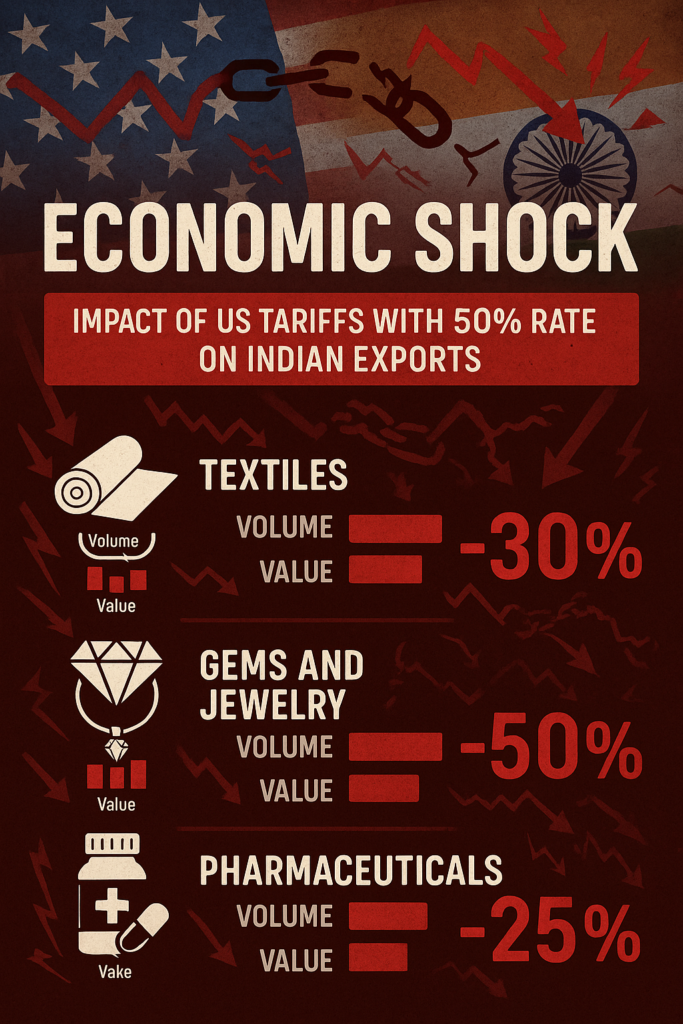
- Massive tariff escalation: Combined 50% tariffs affect $48.2 billion worth of exports, making 66% of Indian products to US commercially unviable
- Sectoral devastation: Textiles, gems & jewelry, seafood face 60-70% export decline; textiles tariffs surge from 13.9% to 61%, gems from 2.1% to 52.1%
- MSME vulnerability exposed: 45% of India’s exports come from MSMEs, with textiles (70% MSME share), gems (80% Surat dominance), and chemicals (40% MSME share) hardest hit
- Economic resilience demonstrated: Despite tariffs, India’s Q1 GDP surged 7.8%—highest in five quarters—driven by 61.4% domestic demand, proving resilience against trade shocks
- Strategic diversification accelerated: India pursues FTAs with UK, EU, EFTA while promoting “Swadeshi” self-reliance and domestic manufacturing through Make in India 2.0
The Tariff Shock: Understanding the 50% Impact
Dual Tariff Structure and Implementation
The 50% tariff represents a two-pronged approach: an initial 25% “reciprocal” tariff announced in July 2025, followed by an additional 25% “punitive” tariff imposed specifically due to India’s continued purchases of Russian oil. This punitive component reflects the intersection of trade policy with geopolitical positioning.
Implementation details include:
- Effective date: August 27, 2025, at 12:01 AM EDT
- Coverage: Most Indian goods under HTSUS 9903.01.84
- Exemptions: Steel, aluminum, passenger vehicles, humanitarian donations, pharmaceuticals (currently), electronics
- Transit provision: Goods shipped before August 27 and cleared by September 17 avoid additional duties india-briefing
Sectoral Impact Analysis
The Global Trade Research Initiative (GTRI) projects India’s US exports could plummet to $49.6 billion in FY2026—a 43% decline from $86.5 billion in the previous year. This represents a potential GDP impact of 0.19% reduction and 1.87% total export decline.
Export Sector Vulnerabilities Exposed
Textiles: The Hardest Hit
India’s textile sector—employing 45 million people—faces catastrophic impact with 28% of exports going to the US. The Tiruppur cluster, accounting for 30% of ready-made garment exports, will see tariffs rise to 61%, making Indian products uncompetitive against Bangladesh (31% tariff) and Vietnam. newindianexpress
Major affected companies include:
- Welspun India, Raymond, Trident
- KPR Mill, Alok Industries
- Home textile exporters (60% US market share)
- Carpet manufacturers (50% US exports)
Gems and Jewelry: Surat’s Crisis
India’s gems and jewelry sector—with $10 billion US exports (30% of global sales)—faces tariffs jumping from 2.1% to 52.1%. Surat, processing 80% of world’s rough diamonds, already experiences declining orders and buyer confidence erosion.
Impact cascades through:
- MSMEs with limited mitigation options
- Major players: Titan, Kalyan Jewellers, Rajesh Exports, Vaibhav Global
- Supply chain disruption across cutting, polishing, and trading equitymaster
Seafood: Marine Export Collapse
Shrimp exports—representing 40% of India’s $2.6 billion seafood trade with the US—face total tariffs of 60% (50% new tariff plus 10% existing countervailing duty). This disadvantages Indian exporters against Ecuador (15% tariff) and other competitors.
Economic Resilience: India’s Domestic Strength
GDP Growth Defies Trade Headwinds
Despite tariff pressures, India’s economy delivered a surprising 7.8% GDP growth in Q1 FY26—the highest in five quarters. This resilience stems from 61.4% domestic demand dependency, making India less vulnerable to export shocks compared to export-led economies like China or Germany.
Resilience factors include:
- Domestic consumption driving private demand growth
- Infrastructure investment maintaining momentum
- Services sector expansion compensating for manufacturing stress
- Digital economy growth supporting economic diversification
Foreign Investment Confidence
Foreign Direct Investment (FDI) reached $50.01 billion in FY2024-25—a 13% increase—demonstrating continued investor confidence despite trade tensions. Manufacturing sector FDI rose 18% to $19.04 billion, driven by Production-Linked Incentive (PLI) schemes and business-friendly reforms.
Strategic Response: Trade Diversification and Self-Reliance
Geographic Market Diversification
India’s response emphasizes strategic diversification away from US market dependency. Active initiatives include:
- India-UK Comprehensive Economic Partnership Agreement (CEPA)
- EU-India Free Trade Agreement negotiations
- EFTA partnership providing duty-free access
- Deepened ties with Russia for energy security
- Enhanced ASEAN engagement for export alternatives
Domestic Manufacturing Push
“Make in India 2.0” and “Swadeshi” movement gain renewed momentum as external pressures drive internal strengthening. Prime Minister Modi’s emphasis on “vocal for local” translates into practical policy measures promoting domestic production and import substitution.
Key initiatives:
- PLI schemes expanding to semiconductors, defense, electronics
- Bonded manufacturing zones and export hubs
- MSME support through export consortia
- Technology upgradation funds for competitiveness enhancement
Geopolitical Implications: Foreign Policy Meets Economics
Strategic Autonomy vs. Alliance Pressure
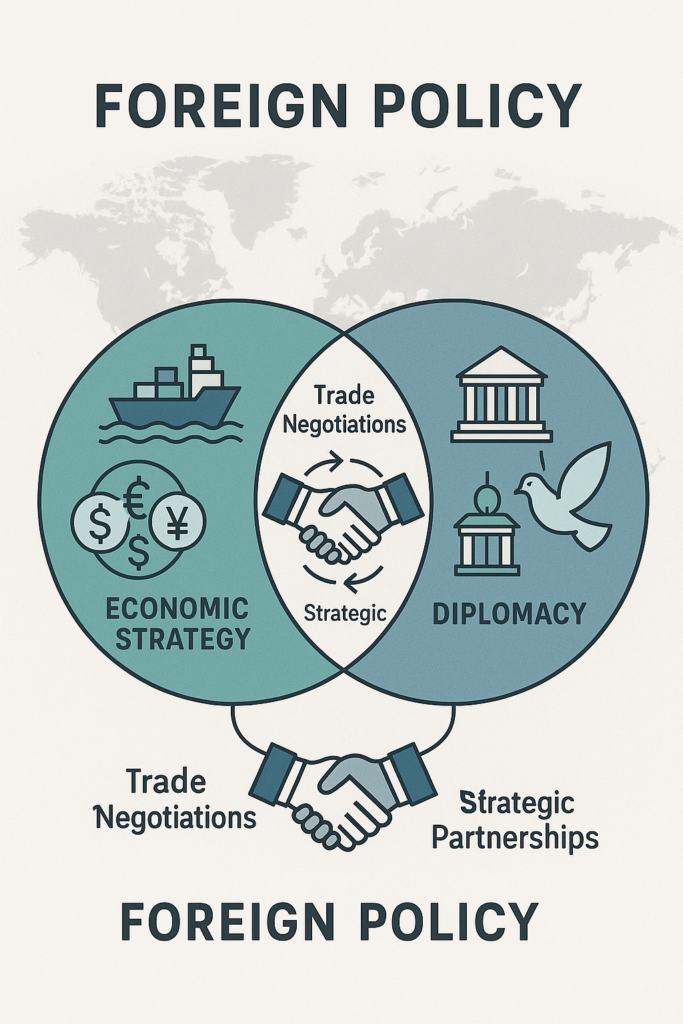
India’s continued Russian oil purchases—triggering the 25% punitive tariff—reflect strategic autonomy prioritization over alliance alignment. This geo-economic foreign policy approach demonstrates how economic considerations now drive diplomatic decisions.
Strategic trade-offs include:
- Energy security through discounted Russian oil
- Defense cooperation continuity with Moscow
- US relationship strain despite Indo-Pacific partnership
- Balancing act between Western alignment and national interests
Economic Diplomacy as Foreign Policy Tool
Trade policy has become a primary instrument of Indian foreign policy, with economic considerations affecting diplomatic relationships. India’s G20 presidency, multilateral engagement, and bilateral partnerships increasingly reflect geo-economic priorities over traditional geopolitical alignments.
MSME Vulnerability and Social Impact
Small Business Devastation
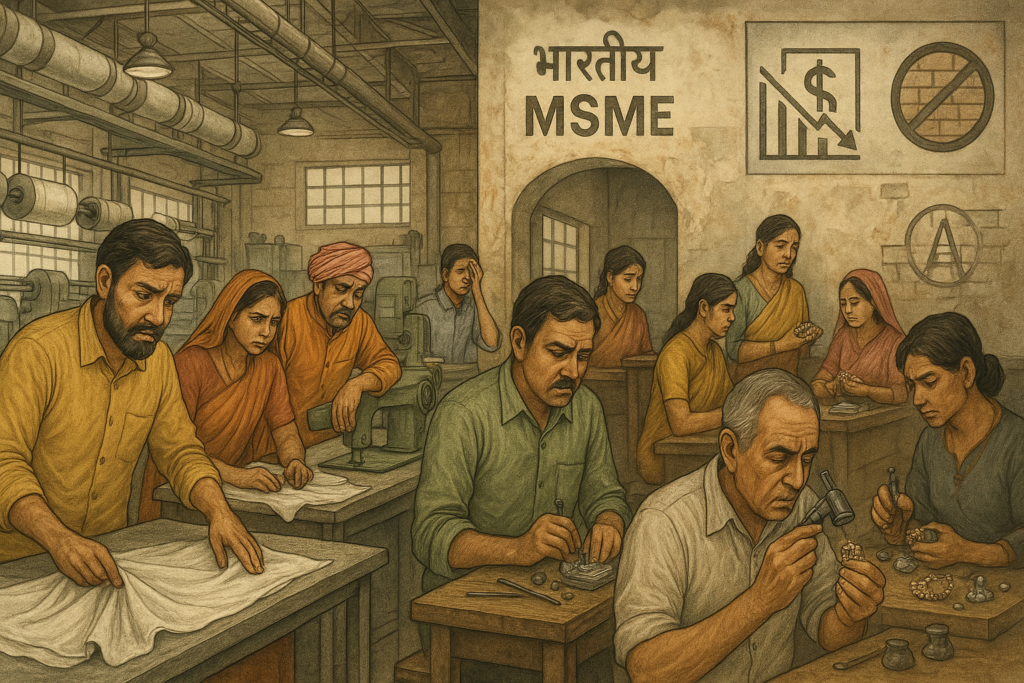
Micro, Small, and Medium Enterprises (MSMEs)—contributing 45% of India’s total exports—face disproportionate impact. These labor-intensive sectors lack resources for rapid adaptation, creating immediate employment concerns and social distress.
Vulnerable MSME clusters:
- Surat diamond polishing (80% global market share)
- Agra leather footwear manufacturers
- Tiruppur garment exporters
- Coastal shrimp processing units
Employment and Social Consequences
Industry estimates suggest hundreds of thousands of jobs at risk across affected sectors. Women workers in textile manufacturing and rural communities dependent on seafood processing face immediate income loss and limited alternative opportunities.
Policy Recommendations and Mitigation Strategies
Immediate Relief Measures
Industry associations seek government intervention through:
- Targeted duty drawback schemes covering 25-50% of tariff impact
- Cash support and loan moratorium for distressed sectors
- Fast-tracked FTA negotiations with alternative markets
- Export finance facilitation for market diversification
Long-term Structural Reforms
Sustainable resilience requires comprehensive reforms:
- Technology upgrading for productivity enhancement
- Quality certification and sustainability standards
- E-commerce platform development for direct market access
- Joint ventures in FTA-partner countries for tariff avoidance
Global Context: Trade Wars and Economic Nationalism
Broader Protectionist Trend
Trump’s tariff policy reflects broader global trend toward economic nationalism and supply chain reshoring. Similar measures against Canada (25%), China, and Brazil indicate systematic approach to trade policy as foreign policy instrument.
Multilateral System Challenges
Traditional multilateral trading system faces unprecedented stress as bilateral relationships increasingly determine trade terms. WTO dispute mechanisms prove inadequate for addressing geo-economic competition masquerading as trade policy.
Future Outlook: Building Economic Resilience
Diversification Success Metrics
India’s recovery will depend on successful execution of diversification strategy. Key performance indicators include:
- Alternative market penetration rates
- Domestic consumption growth sustainability
- Manufacturing competitiveness improvement
- FDI attraction in strategic sectors
Lessons for Economic Policy
Current crisis provides valuable lessons for economic policy design:
- Over-dependence on single markets creates systemic vulnerability
- Domestic demand provides crucial buffer against external shocks
- Strategic autonomy may require economic sacrifices
- Geo-economic considerations must inform trade policy
Conclusion
The US imposition of 50% tariffs on Indian goods represents more than a trade dispute—it exemplifies the new reality where economic policy serves geopolitical objectives and foreign policy decisions carry immediate economic consequences. India’s response demonstrates both vulnerabilities and strengths: while export-dependent sectors suffer severe disruption, the domestic economy’s resilience and strategic diversification efforts offer pathways to recovery.
The crisis accelerates India’s transformation toward greater self-reliance and economic sovereignty, potentially strengthening long-term competitiveness despite short-term pain. Success will depend on effective implementation of diversification strategies, domestic manufacturing enhancement, and maintenance of strategic autonomy while managing great power relationships.
This episode underscores a fundamental shift in global economics: the era of purely economic trade policy has ended, replaced by geo-economic competition where trade, technology, and geopolitics intersect in complex and unpredictable ways. India’s navigation of this new landscape will determine not only its economic future but also its position in an increasingly multipolar world.
Mains Questions
- Analyze the implications of the U.S. doubling tariffs for Indian exporters and outline policy measures to cushion the blow and retain trade competitiveness.
- Examine the strategic importance of trade diversification and domestic demand in India’s economic resilience amidst global protectionism.





+ There are no comments
Add yours