
Key Highlights
- Remarkable Unicorn Growth: India boasts 120+ unicorns as of 2025, with 36% growth in 2019-20 and 100% growth in 2021, projected to overtake China as the second-largest unicorn ecosystem by 2025
- Semiconductor Strategic Push: India Semiconductor Mission with $10 billion investment aims to achieve domestic chip manufacturing by end-2025, reducing 90% import dependence and establishing strategic tech autonomy
- Democratic Tech Model: Unlike China’s state-controlled ecosystem, India maintains competitive market structure with Digital Stack (UPI, Aadhaar) creating level playing field and preventing monopolistic dominance
- R&D Investment Challenge: India’s 0.7% GDP on R&D versus China’s 2.4% highlights critical innovation funding gap, though venture capital inflows reached $25-30 billion in 2023 compared to China’s $70-75 billion
- Global Trust Dividend: Indian startups benefit from democratic governance, data compliance, and English proficiency, emerging as preferred innovation partner for Middle East, Europe, Southeast Asia amid growing Chinese tech scrutiny

The Atmanirbhar Vision: Beyond Import Substitution
India’s Atmanirbhar Bharat initiative, launched during the COVID-19 pandemic in May 2020, represents far more than economic nationalism or protectionist policies. It embodies a comprehensive strategy for technological sovereignty that recognizes digital infrastructure as the new battleground for global power and economic influence.
The five pillars of Atmanirbhar Bharat – Economy, Infrastructure, Technology, Demand, and Vibrant Demography – create a holistic framework for indigenous innovation. Prime Minister Modi’s emphasis on local manufacturing, innovation, and vocal-for-local products has seamlessly integrated with Startup India, creating an entrepreneurial surge that has fundamentally transformed India’s digital landscape.
Government schemes provide comprehensive scaffolding: Fund of Funds for Startups (FFS) committed over ₹10,000 crore, tax exemptions under Section 80-IAC offering three-year profit holidays, and NIDHI grants up to ₹15 lakh for prototype development. The Atal Innovation Mission (AIM) established over 10,000 Atal Tinkering Labs, fostering grassroots innovation from school level. risingindia
Semiconductor Mission: The Foundation of Tech Sovereignty
Strategic Imperatives and National Security
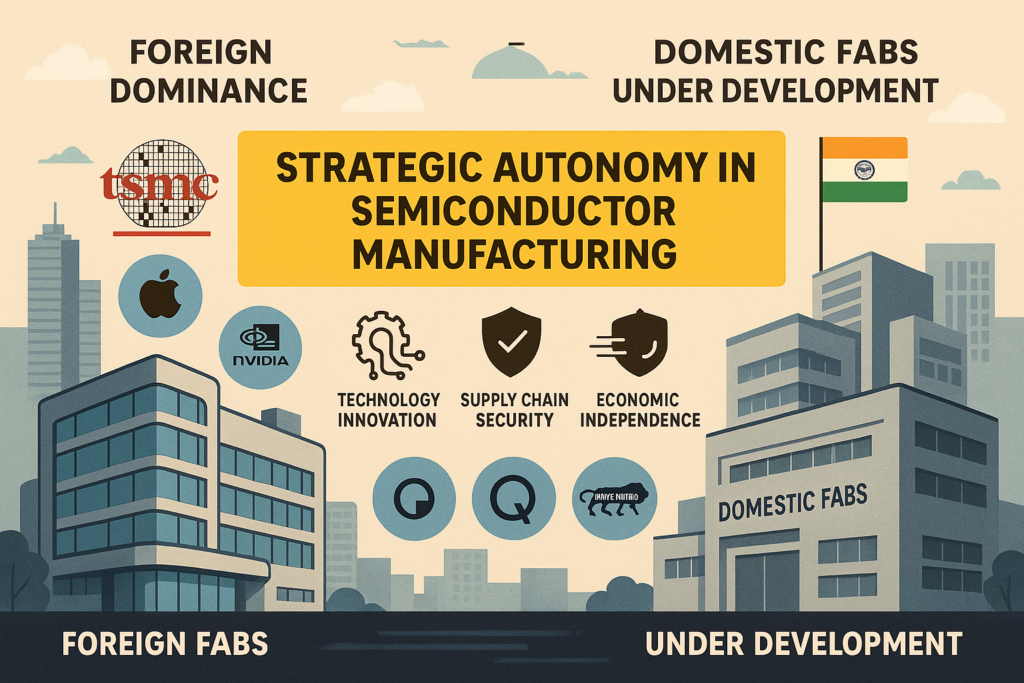
India’s semiconductor ambitions represent the most critical component of technological self-reliance, addressing the stark reality that semiconductors are vital for national security, particularly in defense and telecommunications. Current import dependence of approximately 90% makes India vulnerable to supply chain disruptions and geopolitical pressures. uccindia
The India Semiconductor Mission, launched in 2021 with a $10 billion investment, aims to create a comprehensive ecosystem covering design, fabrication, assembly, testing, marking, and packaging (ATMP). Prime Minister Modi’s declaration of indigenous chip production by end-2025 signals unprecedented political commitment to semiconductor manufacturing.
Geopolitical tensions and the COVID-19 pandemic exposed risks of over-dependence on Taiwan, Japan, and South Korea for semiconductor supplies. China’s mature-node surge and global competition threaten viability without stronger R&D, partnerships, and ecosystem support.
Building Manufacturing Capabilities
India’s holistic semiconductor strategy encompasses full-stack ecosystem development: design capabilities, fabrication facilities, assembly and testing, with emphasis on next-generation technologies including AI chips, quantum computing, and electric vehicle semiconductors. pib
Recent progress includes multiple fabrication projects approved under the Production-Linked Incentive (PLI) scheme, partnerships with global leaders like Tokyo Electron, and establishment of specialized economic zones for semiconductor manufacturing. SEMICON India 2025 showcases synergy between India’s ambitions and international technology partnerships.
Challenges persist including capital-intensive investments requiring billions of dollars, resource management issues particularly water usage, and skill development for highly specialized manufacturing processes. Success depends on sustained government support, private sector investment, and effective international collaboration.
Democratic Tech Model: India vs China Paradigm
Competitive Market Structure
India’s tech ecosystem presents a stark contrast to China’s concentrated platform economy, featuring a fragmented market structure that encourages competition and boasts numerous innovative startups. China’s major platforms like Alibaba, Tencent, and Baidu dominate through extensive service ecosystems, while India maintains competitive diversity across multiple sectors. Vaneck
Market concentration analysis reveals significant differences: top five holdings of the CSI Overseas China Internet Index represent 33% of MSCI China Index, while top five holdings of the MVIS Digital India Index represent only 19% of MSCI India Index. This concentration difference underscores different market structures with China dominated by fewer large firms.
India’s Digital Stack ensures essential services like payments (UPI) and KYC remain free and universally accessible, preventing monopolistic moats around critical functions. UPI’s success exemplifies how public digital infrastructure can enable competition rather than concentration.
Performance and Investment Trends
Since 2022, Indian tech companies have notably outperformed their Chinese counterparts, driven by different stages of market maturity. India remains in a mass adoption phase with extensive digital growth potential, while China’s mature market contends with regulatory measures and slowing consumption growth.
Funding patterns reflect different ecosystem dynamics: Chinese startups collectively raised $82 billion in 2021, far outpacing India’s $42 billion. However, India’s growth rate in minting unicorns shows 36% growth from 2019-20 and over 100% growth in 2021, compared to China’s 8% and 14% respectively. youtube
Investment landscape demonstrates India’s openness: Flipkart owned by Walmart exemplifies transparent international ownership, while Chinese companies face questions about actual investor control versus CCP influence. This transparency advantage enhances India’s appeal to global investors.
Digital Infrastructure: The Democratic Advantage
India Stack and Open Architecture
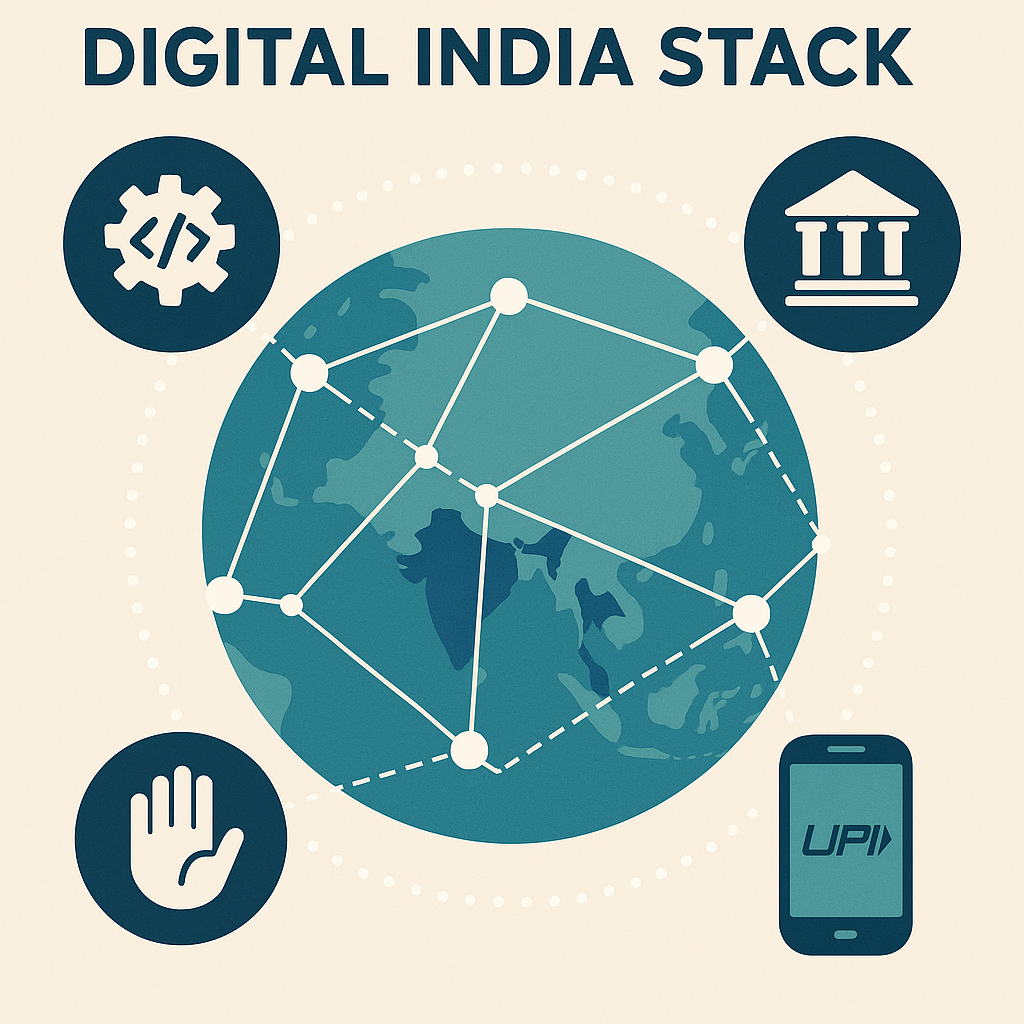
India’s Digital Stack represents a revolutionary approach to digital public goods, creating foundational infrastructure that enables innovation rather than stifling competition. Core components include Aadhaar (identity), UPI (payments), eKYC (verification), and emerging platforms like ONDC (Open Network for Digital Commerce). tice
UPI’s phenomenal success – processing over 100 billion transactions annually – demonstrates how open, interoperable systems can drive financial inclusion while maintaining competitive markets. Unlike closed payment systems in other countries, UPI enables any bank or fintech to participate equally.
Open Network for Digital Commerce (ONDC) extends this philosophy to e-commerce, preventing platform monopolies by enabling small retailers to access digital markets without exclusive dependence on large platforms. This approach contrasts sharply with platform-centric models that concentrate power in few companies.
Global South Leadership
India’s digital public goods model positions it as a natural leader for Global South cooperation in technology development. Countries wary of Chinese digital colonization actively seek Indian alternatives in fintech, healthtech, and B2B SaaS.
Digital diplomacy through technology sharing includes UPI exports to multiple countries, Aadhaar-inspired identity systems, and collaborative development of open-source solutions. This approach builds soft power while creating sustainable technology partnerships.
Democratic values embedded in India’s tech approach – data protection, privacy rights, competitive markets – offer attractive alternatives to authoritarian tech models. Digital Personal Data Protection Act 2023 ensures data sovereignty while respecting individual privacy.
Innovation Ecosystem: Challenges and Opportunities
R&D Investment Gap
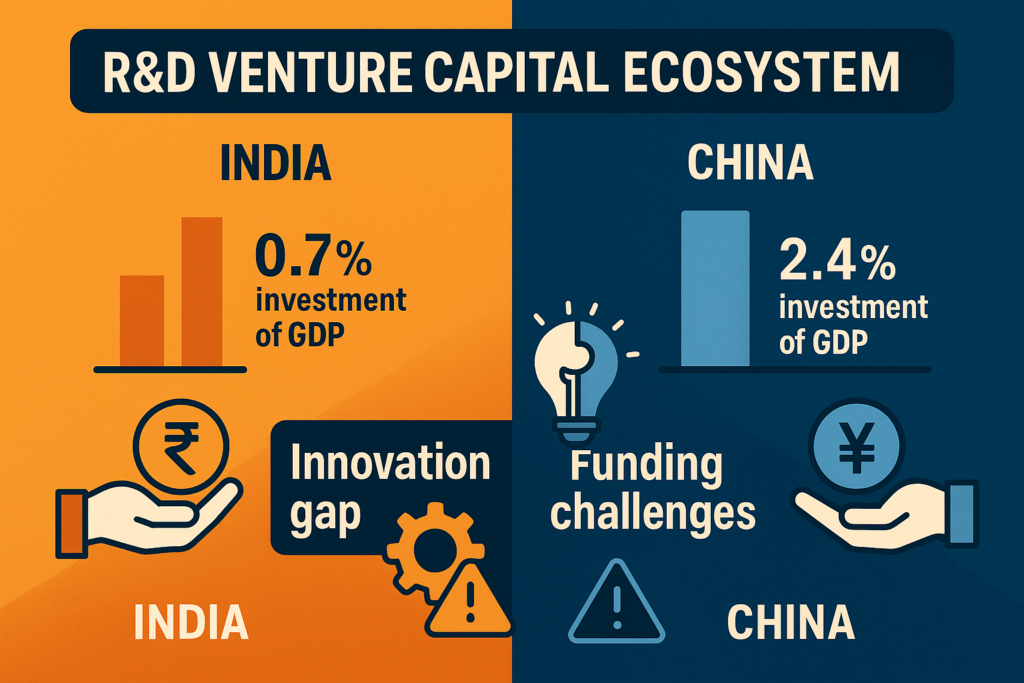
India’s R&D spending at 0.7% of GDP significantly trails China’s 2.4%, creating fundamental constraints on breakthrough innovation and technology development. This innovation funding gap limits indigenous technology creation and dependence on foreign innovation.
Venture capital availability remains lower than optimal despite recent growth: Indian startups raised $25-30 billion in 2023 compared to China’s $70-75 billion. Capital intensity of advanced technology sectors requires substantially higher investment levels for competitive capability.
Government initiatives attempt to bridge funding gaps through various schemes: National Research Foundation, Technology Development Fund, and sector-specific missions in AI, quantum computing, and biotechnology. Public-private partnerships essential for scaling R&D investment.
Talent and Skills Development
India’s demographic dividend – majority youth population that is creative and innovative – provides substantial advantages for technology development. English proficiency and democratic education create globally competitive talent pool.
Skill development challenges include transitioning from service-oriented training to product development and deep technology capabilities. Traditional IT giants like TCS, Infosys, Wipro excelled in services but limited consumer-facing product success.
Government focus on entrepreneurship in higher education institutes and various policies promoting innovation contributed to India’s climb in Global Innovation Index. Startup community resilience and innovation during COVID-19 demonstrated ecosystem maturity.
Constitutional and Legal Framework
Rights-Based Innovation Environment
Article 19(1)(g) guaranteeing right to practice trade and business creates enabling environment for Indian startups and innovation. This constitutional foundation ensures entrepreneurial freedom while preventing arbitrary restrictions on business development.
Competition Act 2002 provides legal framework for preventing monopolistic dominance by foreign Big Tech companies, enabling fair competition for domestic enterprises. Recent actions against global platforms demonstrate regulatory commitment to competitive markets.
Digital Personal Data Protection Act 2023 ensures data sovereignty – critical for building domestic tech ecosystems while respecting privacy rights. Data localization requirements and consent frameworks create level playing field for Indian companies.
Regulatory Balance
Democratic governance requires careful balance between market freedom and strategic regulation. India’s approach avoids heavy-handed state control while ensuring national security and competitive fairness.
Tech diplomacy enables collaboration with Quad partners, BRICS nations, and EU for technology cooperation while maintaining strategic autonomy. Multi-alignment policy maximizes technology access without excessive dependence.
Environmental regulations increasingly important for sustainable technology development. Green data centers, renewable energy integration, and e-waste management essential for responsible innovation aligned with net-zero 2070 goals.
Economic and Industrial Transformation
Make in India and Manufacturing
Make in India initiative combined with Startup India created strong foundation: 1.2 lakh startups and 100+ unicorns demonstrate robust entrepreneurial ecosystem. Manufacturing focus through PLI schemes covers electronics, semiconductors, EVs, incentivizing domestic production. pib
Industrial transformation from service-led model to manufacturing and innovation requires sustained effort. Tech giants could generate high-value jobs and reduce dependency on traditional service exports.
Export potential for Indian tech products grows as global supply chains diversify away from China-centric manufacturing. “China+1” strategies by multinational companies create opportunities for Indian manufacturing.
Employment and Social Impact
Employment generation by tech sector extends beyond direct jobs to ecosystem employment in logistics, support services, and allied industries. Inclusive growth through technology enables participation by women, rural populations, and marginalized communities.
Cultural diversity and multilingual markets require adaptive innovation unlike China’s relatively homogeneous market. This complexity creates challenges but also opportunities for specialized solutions.
Digital divide with approximately 50% internet penetration needs addressing for inclusive technology access. Rural connectivity and affordable devices essential for broad-based digital participation.
Comparative Analysis: Learning from Global Models
China Model Lessons
China’s success with Alibaba, Tencent, Huawei resulted from strong state-led protectionism combined with massive domestic market and patient capital. Early market protection allowed domestic companies to achieve scale before facing international competition.
State support included preferential policies, protected markets, and strategic investments in key technologies. Government coordination enabled rapid infrastructure development and technology transfer.
Limitations of China model for India include different political systems, democratic constraints on state control, and international concerns about authoritarian tech governance.
Silicon Valley Innovation
Silicon Valley’s success factors include venture capital ecosystem, entrepreneurial culture, university-industry linkages, and talent mobility. Risk-taking culture and failure tolerance enable breakthrough innovation.
Network effects and ecosystem clustering create self-reinforcing advantages for innovation hubs. India’s tech hubs in Bangalore, Hyderabad, Pune attempt to replicate these dynamics.
Global market access from inception enables Silicon Valley companies to achieve scale rapidly. Indian companies increasingly adopt global mindset from early stages.
Strategic Path Forward
Technology Sovereignty Priorities
Critical technology areas for strategic autonomy include AI, semiconductors, 5G, quantum computing, and cybersecurity. National missions in these sectors provide focused investment and policy support.
Supply chain resilience requires diversification away from single-country dependence while building domestic capabilities. Strategic partnerships with trusted allies provide technology access and market opportunities.
Data sovereignty through data localization and Digital Rupee development creates foundation for domestic digital economy. Financial infrastructure independence reduces vulnerability to external pressures.
Innovation Ecosystem Development
R&D enhancement through increased public investment and private sector incentives. Tax benefits for R&D spending and patent development encourage indigenous innovation.
Venture capital expansion requires policy support for domestic fund formation and international investment. Regulatory clarity and ease of doing business attract long-term investment.
Talent development through specialized education programs, industry-academia partnerships, and international exchange programs. Skill upgradation for emerging technologies essential for competitive advantage.
Global Positioning Strategy
Tech diplomacy with Global South countries creates alternative models to Western and Chinese approaches. Affordable digital infrastructure and open-source collaboration build sustainable partnerships.
International standard-setting participation ensures Indian interests in global technology governance. Leadership in digital public goods creates soft power advantages.
Export promotion for Indian tech products and services through trade agreements and market access initiatives. Brand India development in technology sectors enhances global competitiveness.
Environmental and Social Considerations
Sustainable Technology Development
Green technology focus aligns with net-zero 2070 commitments and global climate goals. Clean energy integration in data centers and manufacturing reduces environmental footprint.
Circular economy principles in technology manufacturing and e-waste management address sustainability concerns. Responsible innovation avoids replicating global Big Tech’s environmental problems.
Social impact measurement and inclusive design ensure technology benefits reach all segments of society. Digital inclusion programs address access barriers.
Cultural Preservation and Innovation
Traditional knowledge integration with modern technology creates unique value propositions. India’s cultural diversity enables specialized solutions for different markets.
Language technology development for Indian languages enhances accessibility and cultural preservation. Multilingual AI and content platforms serve diverse populations.
Values-based technology design incorporates Indian philosophical and ethical traditions into product development. Responsible AI development with cultural sensitivity.
Future Outlook and Scenarios
Optimistic Scenario: Tech Giant Success
Successful semiconductor manufacturing by 2025-26 establishes foundation for advanced technology development. Indigenous chip production enables competitive consumer electronics and strategic applications.
Multiple Indian companies achieve global scale in AI, fintech, healthtech, and enterprise software. Decacorn emergence (companies valued over $10 billion) demonstrates ecosystem maturity.
Global leadership in digital public goods and open-source technology creates sustainable competitive advantages. Technology exports become significant contributor to Indian economy.
Realistic Scenario: Gradual Progress
Steady growth in startup ecosystem with increasing unicorn creation and international expansion. Semiconductor capabilities develop gradually with initial success in assembly and testing.
Niche leadership in specific technology sectors where India has advantages: financial technology, healthcare AI, and enterprise software. Services to products transition accelerates.
Regional leadership in South Asia and Africa for technology solutions. Balanced approach between domestic market focus and global expansion.
Challenging Scenario: Competitive Pressures
Intense global competition from established players and emerging ecosystems limits Indian market share. Resource constraints slow technology development and scaling.
Geopolitical tensions restrict technology access and market opportunities. Trade barriers and technology transfer limitations impact growth.
Brain drain to more attractive ecosystems reduces domestic talent availability. Capital flight to safer or higher-return markets.
Conclusion
India’s quest to build indigenous tech giants under Atmanirbhar Bharat represents an ambitious yet achievable vision that combines democratic values with strategic economic objectives. With 120+ unicorns and exponential growth rates in startup creation, India has demonstrated remarkable progress in building a vibrant entrepreneurial ecosystem that rivals global benchmarks.
The semiconductor mission with $10 billion investment and commitment to domestic chip production by end-2025 addresses the most critical component of technological sovereignty. Success in semiconductors will unlock capabilities across multiple sectors from defense to consumer electronics, establishing India as a serious technology power.
India’s democratic tech model offers a compelling alternative to China’s state-controlled approach, creating competitive markets through digital public goods like UPI and Aadhaar while preventing monopolistic concentration. This open architecture has already attracted global trust and positioned India as a preferred partner for democratic nations.
Critical challenges persist, particularly the R&D investment gap at 0.7% of GDP versus China’s 2.4% and limited venture capital availability compared to established ecosystems. Addressing these constraints through increased public investment and policy incentives will determine the pace of technological advancement.
Constitutional foundations in Article 19(1)(g) and regulatory frameworks like the Competition Act and Data Protection Act provide strong legal basis for nurturing innovation while preventing unfair dominance. Balancing market freedom with strategic regulation remains crucial for sustainable growth.
The comparison with China reveals different but valid paths: while China achieved scale through state protection and concentrated market power, India’s fragmented competitive structure may produce more sustainable and globally acceptable outcomes. Indian companies’ outperformance since 2022 validates this democratic approach.
Global positioning through tech diplomacy and Digital Stack exports creates soft power advantages while building sustainable partnerships with Global South countries. Leadership in digital public goods offers genuine alternatives to both Western and Chinese models.
Environmental sustainability and social inclusion considerations ensure that India’s tech development aligns with broader development goals and global climate commitments. Green technology focus and inclusive design principles differentiate Indian innovation.
Future success depends on sustained commitment to R&D investment, talent development, infrastructure building, and international cooperation. Semiconductor success will catalyze broader technology capabilities, while continued unicorn creation demonstrates ecosystem vitality.
The vision of Indian tech giants competing globally while respecting democratic values and serving diverse populations represents more than economic ambition. It offers hope for technology development that empowers rather than exploits, connects rather than divides, and preserves cultural diversity while enabling global integration.
India’s tech giant quest under Atmanirbhar Bharat is not just about competing with existing players but about creating a new model of technological progress that serves humanity’s broader interests. Success in this endeavor will reshape global technology and demonstrate that democratic innovation can achieve both economic success and social progress.
📌 Mains Practice Questions
Q1. Atmanirbhar Bharat in technology is not merely an economic policy but a strategic necessity. Critically analyze India’s potential to build global tech giants, comparing with China’s experience.
Q2. Discuss the constitutional, socio-economic, and environmental dimensions of India’s push for self-reliance in digital technology. How can India balance innovation with regulation?
Q3. Evaluate the role of initiatives such as PLI schemes, Digital India, and the Data Protection Act in shaping India’s technology sovereignty.





+ There are no comments
Add yours