Key Highlights:
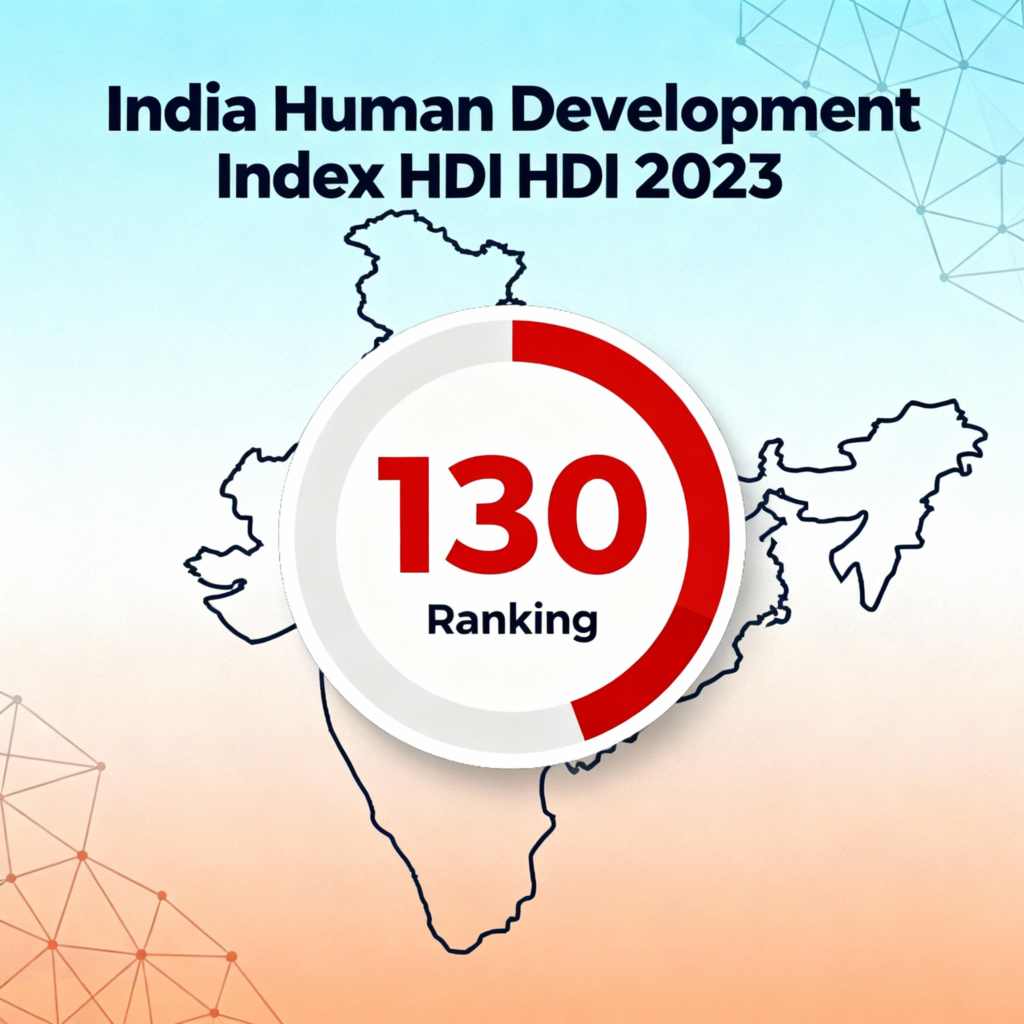
- India ranked 130th out of 193 countries in HDI 2023, improving from 133rd in 2022 with HDI value increasing from 0.676 to 0.685, approaching high development threshold of 0.700 but remaining in medium category
- Life expectancy reached record high of 72 years in 2023 up from 58.6 years in 1990, attributed to health programs like National Health Mission, Ayushman Bharat, and Janani Suraksha Yojana showing healthcare system improvements
- 24.82 crore Indians escaped multidimensional poverty between 2013-14 to 2022-23 with headcount ratio declining from 29.17% to 11.28%, though rural areas still show 19.28% poverty versus 5.27% urban
- Gender Inequality Index shows India at 102nd rank with 0.403 score indicating persistent gender gaps despite 41.7% female labour force participation and improvements in women’s political representation
- Inequality-Adjusted HDI reveals 30.7% loss for India among highest globally, with poorest 40% population holding only 20.2% income share highlighting structural inequalities despite overall progress
The Paradox of Progress in India’s Human Development Journey
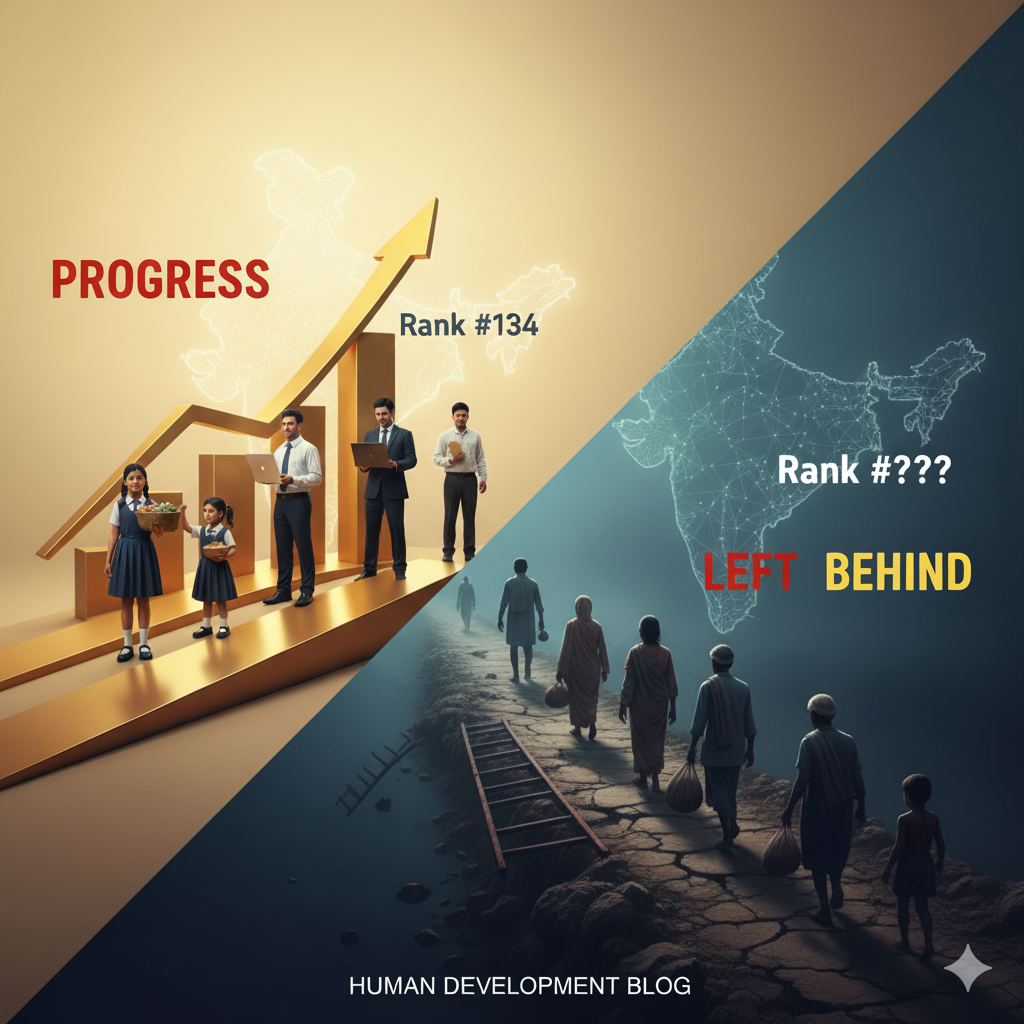
India’s human development narrative presents a compelling paradox: steady progress on composite indices accompanied by persistent structural inequalities that affect hundreds of millions of citizens. The 2025 Human Development Report places India at 130th position out of 193 countries, marking an improvement from 133rd in 2022. Yet this statistical progress masks complex realities that UPSC aspirants and policymakers must understand comprehensively.
The Human Development Index (HDI) serves as a crucial metric for assessing balanced development beyond mere economic indicators. With an HDI value increasing from 0.676 in 2022 to 0.685 in 2023, India approaches the threshold for high human development (≥0.700) while remaining firmly in the medium development category. This positioning reflects both significant achievements and persistent challenges in health, education, and income dimensions. undp
Understanding India’s HDI performance requires examining multiple dimensions: the remarkable progress in life expectancy reaching 72 years (highest since index inception), educational improvements through policy interventions, yet persistent inequalities where the Inequality-Adjusted HDI shows a 30.7% loss – among the highest globally.
Conceptual Framework: HDI and Human Development
Understanding HDI as Composite Development Measure
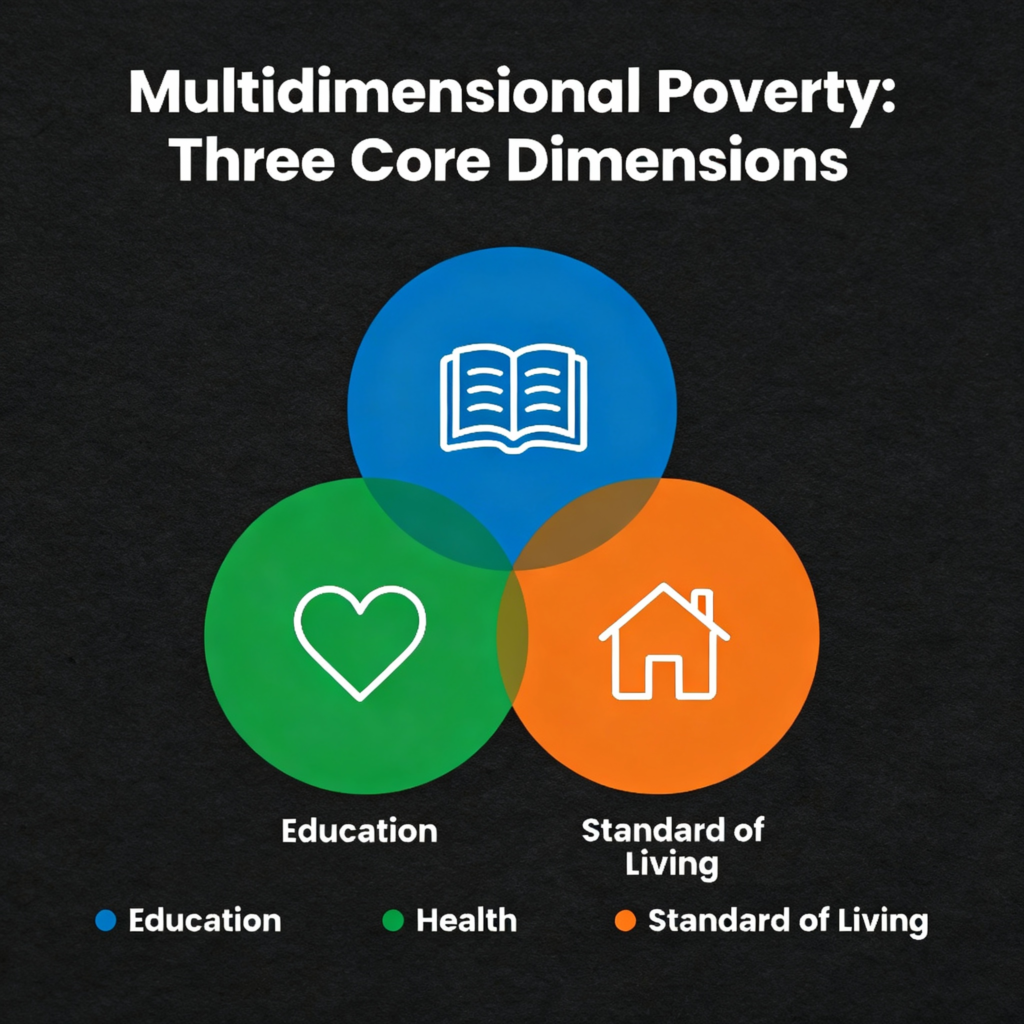
The Human Development Index represents a paradigm shift from GDP-centric development to human well-being focused approaches. Developed by Pakistani economist Mahbub ul Haq and Indian economist Amartya Sen in 1990, HDI measures average achievement across three fundamental dimensions:
Health Dimension: Life expectancy at birth reflecting SDG 3 (Good Health and Well-Being)
Education Dimension: Expected years of schooling and mean years of schooling connecting to SDG 4 (Quality Education)
Income Dimension: Gross National Income (GNI) per capita (PPP adjusted) linking to SDG 8 (Economic Growth).
Current Status: India’s Human Development Indicators Deep Dive
Recent Progress Analysis (2023 Data)
India’s HDI trajectory demonstrates consistent improvement with over 53% growth since 1990, outpacing global and South Asian averages: undp
Health Achievements:
- Life expectancy increased from 58.6 years (1990) to 72 years (2023)
- Post-pandemic recovery showing resilience in healthcare systems
- National health programs including Ayushman Bharat, National Health Mission contributing significantly
Education Progress:
- Expected years of schooling: 13 years (substantial improvement from 8.2 years in 1990)
- Mean years of schooling: 6.9 years (gradual increase from historical lows)
- Policy interventions like Right to Education Act and NEP 2020 showing impact
Income Growth:
- GNI per capita: $9,047 (PPP 2021) up from $2,167 in 1990
- Economic growth translating to improved living standards despite inequality concerns
Global Comparative Positioning
Regional comparison reveals mixed performance:
Better Performing Neighbors:
- China: 78th rank (significantly ahead)
- Sri Lanka: 89th rank (traditionally strong in human development)
- Bhutan: 125th rank (focus on Gross National Happiness)
Comparable Performance:
- Bangladesh: 130th rank (same as India, remarkable progress from lower base)
Lower Performing Neighbors:
Education Dimension: Policy Framework and Critical Challenges
Government Policy Architecture
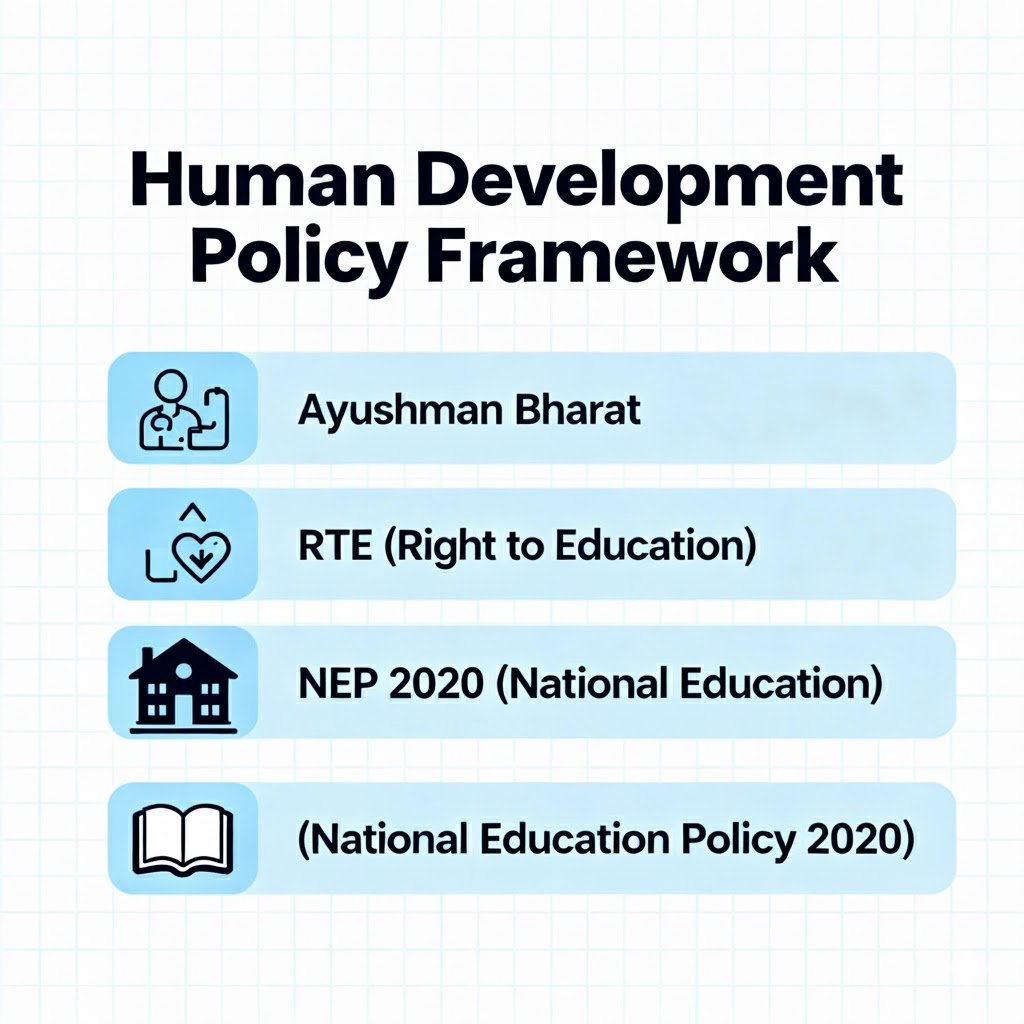
India’s education policy framework represents comprehensive attempts at systemic transformation:
Right to Education Act (RTE) 2009: Constitutional mandate for free and compulsory education for ages 6-14, creating legal framework for universal access
National Education Policy (NEP) 2020: Paradigm shift focusing on foundational literacy and numeracy by Standard 2, multilingual education, and critical thinking development
Samagra Shiksha Abhiyan: Integrated approach to school education from pre-school to Class XII, addressing quality and equity simultaneously
Mid-Day Meal Scheme: World’s largest school feeding program addressing nutrition and attendance while reducing dropout rates
Skill India Mission: Bridging education-employment gap through vocational training and industry-relevant skills
Critical Implementation Challenges
Despite policy interventions, significant challenges persist:
Quality vs. Enrollment Gap: ASER 2024 findings reveal that over 50% rural pupils fail core literacy and 44% lack numeracy at grade 5, indicating quality deficits despite high enrollment rates
Digital Divide: Limited access to technology infrastructure in remote regions exacerbating learning inequalities, particularly post-COVID when digital learning became essential
Gender Disparities: Persistent barriers for girls, particularly in rural areas, including safety concerns, early marriage pressures, and household responsibilities
Marginalized Group Dropouts: High dropout rates among Scheduled Castes, Scheduled Tribes, and economically disadvantaged students due to economic pressures and social discrimination
Health Dimension: Achievements and Persistent Gaps
Government Health Initiatives Impact
India’s health policy architecture shows measurable impact on population health outcomes:
Ayushman Bharat: World’s largest health assurance scheme providing free healthcare coverage for economically vulnerable families, covering over 50 crore beneficiaries
National Health Mission (NHM): Strengthening rural healthcare systems through infrastructure development, human resource deployment, and service delivery improvements
Mission Indradhanush: Universal immunization coverage targeting previously unreached populations with life-saving vaccines
POSHAN Abhiyaan: Integrated nutrition programs addressing malnutrition across lifecycle with particular focus on pregnant women and children under 5
Healthcare System Challenges
Despite policy successes, structural challenges remain:
Primary Healthcare Access: India’s life expectancy at 60 years remains 4 years below high-income countries, indicating scope for improvement in healthcare quality and accessibility
Health Insurance Adoption: Low adoption rates despite free and liberal eligibility, with network effects significantly influencing demand for health insurance
Malnutrition Burden: India has highest number of stunted children globally (one-third of global total), reflecting complex nutritional challenges
Infant Mortality Rate: 35.2 per 1,000 live births (NFHS-5) shows progress but remains higher than developed country standards
Poverty and Inequality: The Critical Analysis Framework
Multidimensional Poverty Assessment
NITI Aayog’s Multidimensional Poverty Index provides comprehensive poverty measurement beyond monetary indicators:
Remarkable Progress Statistics:
- 24.82 crore people escaped multidimensional poverty between 2013-14 to 2022-23
- Headcount ratio declined from 29.17% to 11.28% (reduction of 17.89 percentage points)
- India on track to achieve SDG Target 1.2 (reducing multidimensional poverty by half) much ahead of 2030 timeline
State-wise Performance:
- Uttar Pradesh: 5.94 crore people escaped poverty (largest absolute number)
- Bihar: 3.77 crore people (significant improvement from historically high poverty)
- Madhya Pradesh: 2.30 crore people
- Rajasthan: 1.87 crore people
Rural-Urban Disparities:
- Rural poverty: 19.28% (down from 32.59% in 2015-16)
- Urban poverty: 5.27% (down from 8.65% in 2015-16)
- Rural areas show faster absolute reduction but maintain higher poverty levels
Inequality Impact on Human Development
The Inequality-Adjusted HDI (IHDI) reveals India’s structural challenge:
Inequality Metrics:
- 30.7% loss in HDI due to inequality (among highest regional losses)
- Poorest 40% population holds only 20.2% income share
- Wealth concentration: 5% population owns over 60% of national wealth (Oxfam 2022)
Structural Characteristics:
- Caste-based discrimination: Scheduled Castes constitute one-fourth of multidimensionally poor
- Regional variations: Significant disparities across states in development outcomes
- Rural-urban divide persisting despite urbanization trends
Gender Dimensions: Progress and Persistent Challenges
Gender Development Indicators
India’s gender development shows mixed progress:
Positive Indicators:
- Female Labour Force Participation Rate: 41.7% in 2023-24 (substantial increase from historical lows)
- Gender Inequality Index: Improved to 102nd rank with 0.403 score in 2023
- Educational attainment: Gender parity in primary education largely achieved
Persistent Gender Gaps
Structural challenges continue to limit women’s development:
Economic Participation: Significant gaps in earnings, workplace safety, and career advancement opportunities
Political Representation: Women’s Reservation Bill passed but implementation timeline remains uncertain, affecting political empowerment
Safety and Mobility: Street harassment significantly impacts women’s urban mobility and economic participation, with innovative interventions like police patrol experiments showing positive results
Social Norms: Early marriage, household responsibilities, and cultural constraints continue to limit women’s choices and opportunities
Emerging Contemporary Issues
Demographic and Social Transitions
India faces new challenges requiring policy attention:
Mental Health Crisis: Worsening post-COVID across age groups, particularly affecting youth and requiring integration into healthcare systems
Youth Unemployment: High rates despite increased educational attainment, indicating skills-jobs mismatch and need for employability focus
Digital Transformation: Digital literacy becoming key driver of youth preparedness in rural India, with AI-era opportunities and risks requiring proactive policy responses
Unintended Policy Consequences
Evidence-based policy assessment reveals complex outcomes:
Bihar Alcohol Prohibition: Research indicates negative impact on adolescents’ mental health, highlighting need for comprehensive impact evaluation of well-intentioned policies
COVID-19 Impact: Learning losses, mental health effects, and economic disruption require sustained recovery efforts and system resilience building
Government Policy Architecture: Governance Perspective
Integrated Developmental Approach
India’s policy framework emphasizes convergence across sectors:
Universal Coverage Programs: RTE Act, Ayushman Bharat, MGNREGA providing foundational social protection
Targeted Interventions: Specific schemes for vulnerable groups including Scheduled Castes, Scheduled Tribes, women, and children
Institutional Mechanisms: NITI Aayog coordinating policy implementation across ministries and states with monitoring frameworks
Resource Allocation Patterns
Government spending priorities reflect human development focus:
Public Distribution System: 60% of social assistance budget, demonstrating commitment to food security
Healthcare Investment: Substantial allocations for health infrastructure, insurance coverage, and nutrition programs
Education Infrastructure: Focus on quality improvement, teacher training, and technology integration
Critical Evaluation
Progress vs. Challenges Matrix
Achievements:
- Rising HDI value and improved global ranking
- Record life expectancy and educational access
- Massive poverty reduction in absolute terms
Persistent Gaps:
- Quality of services lagging behind access
- Inequality deepening despite overall progress
- Jobless growth patterns not translating to equitable development
Structural Constraints Analysis
Rural-Urban Divide: Persists despite urbanization, requiring targeted rural development and urban planning interventions
Caste-Based Discrimination: Continues limiting opportunities for marginalized communities despite legal protections and affirmative action
Federal Structure Challenges: Implementation varies across states due to different capabilities and political priorities
Resource Constraints: Competing priorities and fiscal limitations affecting program scaling and quality improvement
Policy Recommendations: Way Forward for Human Development
Short-term Priority Actions
Quality Improvement Focus: Move beyond enrollment metrics to learning outcomes and service delivery quality in health and education
Inequality Reduction: Strengthen income redistribution mechanisms and improve targeting of vulnerable populations
Technology Integration: Leverage digital infrastructure for service delivery, monitoring, and citizen engagement
Medium-term Structural Reforms
Institutional Capacity: Strengthen implementation capabilities at state and local levels through capacity building and resource allocation
Evidence-Based Policymaking: Utilize research evidence from institutions and rigorous impact evaluations for program design
Community Participation: Enhance citizen involvement in program planning and implementation for better outcomes and accountability
Long-term Transformation Vision
Human Capital Development: Focus on skills, creativity, and critical thinking to prepare workforce for future economy
Environmental Sustainability: Integrate climate considerations into development planning for sustainable progress
Global Integration: Position India as knowledge economy leveraging demographic dividend and technological capabilities
Conclusion: Balancing Progress with Persistent Challenges
India’s human development journey represents a remarkable story of steady progress amidst complex challenges. The improvement from 133rd to 130th rank in HDI, life expectancy reaching 72 years, and 24.82 crore people escaping multidimensional poverty demonstrate significant policy successes and institutional capabilities. These achievements reflect the impact of comprehensive programs like Ayushman Bharat, Right to Education Act, and targeted poverty alleviation initiatives.
However, the reality of 130th rank out of 193 countries and remaining in medium development category highlights substantial work still required. The Inequality-Adjusted HDI showing 30.7% loss reveals that benefits of growth are not reaching all sections equally, with structural inequalities persisting across caste, gender, and regional lines. Rural areas maintaining 19.28% multidimensional poverty versus 5.27% urban demonstrates continued development disparities.
For UPSC aspirants, this human development analysis provides crucial insights into balanced development challenges that frequently appear in both Prelims and Mains examinations. Understanding the interplay between policy intentions, implementation realities, and outcome measurements becomes essential for comprehensive answers on social justice, governance, and economic development topics.
The path forward requires addressing quality deficits in education and healthcare, strengthening inequality reduction mechanisms, and ensuring that technological advancement like AI integration benefits all sections of society. Success in human development will ultimately determine India’s progress toward becoming a developed nation that truly serves all its 1.4 billion citizens.
The lessons for policymakers are clear: statistical progress must be complemented by qualitative improvements that address root causes of inequality and exclusion. Only through sustained focus on human capabilities, institutional effectiveness, and inclusive growth can India achieve its development aspirations while ensuring no one is left behind.






+ There are no comments
Add yours