Key Takeaways
- Data Precision: The massive 2026 update integrates 100+ first-party metrics natively, essentially eliminating the reliance on probabilistic third-party estimates for iOS financial tracking.
- Behavioral Context: Advanced cohort tracking enables developers to isolate user segments by date or source, accurately measuring the true lifetime ROI of specific marketing campaigns or seasonal promotional offers.
- Competitive Insight: Differential privacy-backed benchmarks safely reveal exactly where an application stands against industry category averages in critical metrics like conversion and revenue per download.
- Economic Impact: The underlying analytics infrastructure supports massive global economies, helping localized developers access international markets—as vividly demonstrated by India’s ₹44,447 crore App Store footprint.
- Regulatory Blindspots: Mobile developers must remain highly cautious regarding data architecture in the EU, as DMA-driven alternative payments will not register in Apple’s native analytics dashboards, creating data silos.
The global application economy operates on a razor-thin margin of user attention and sustained retention. For years, iOS developers and mobile growth marketers have navigated this highly competitive landscape relying heavily on third-party attribution platforms to approximate their fundamental financial health. On March 25, 2026, the ecosystem experienced a paradigm shift. Apple released the most comprehensive update to App Store Connect Analytics since its inception, fundamentally altering how developers track monetization, subscriptions, and user behavior.
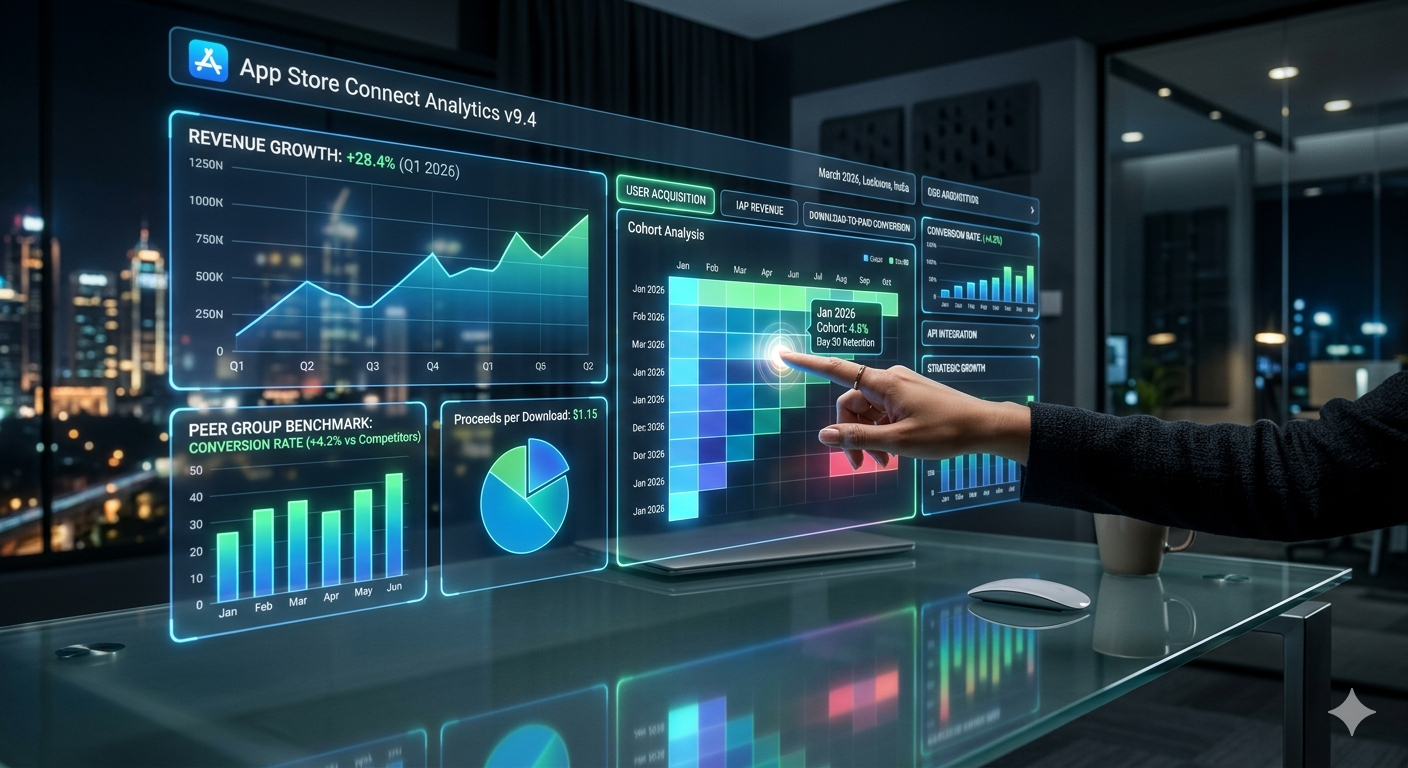
This overhaul integrates more than 100 new metrics directly into the native iOS developer console. By offering first-party, privacy-compliant data, the update bridges the historical gap between top-of-funnel app discovery and long-term financial performance.
The integration of advanced cohort analysis and peer group benchmarks provides developers with unprecedented visibility into user journeys. Understanding this update requires looking beyond surface-level dashboards. The introduction of these metrics intersects with broader geopolitical and economic shifts, from the European Union’s Digital Markets Act (DMA) to the explosive growth of India’s digital ecosystem.
Why This Topic Matters Today
The digital landscape of 2026 is defined by stringent privacy regulations and increasingly fragmented platform ecosystems. Following the rollout of App Tracking Transparency (ATT) in previous years, mobile attribution became significantly more complex. Third-party tools struggled to provide accurate user-level data, forcing developers to rely on probabilistic models and complex data science approximations.
The 2026 App Store Connect update matters immensely because it restores deterministic accuracy to financial reporting. Developers no longer need to guess their true monthly recurring revenue (MRR) or rely on delayed server-to-server webhook configurations to understand subscription churn. Native dashboards now deliver exact figures directly from Apple’s internal payment processing servers.
Furthermore, the timing aligns with a critical juncture in global technology policy. As alternative app stores emerge in Europe due to the DMA , and as emerging markets like India generate billions in app-facilitated commerce , localized and precise analytics are no longer optional. They are mandatory for operational survival. Without exact data on how specific regional cohorts convert from free trials to paid subscriptions, mobile businesses risk allocating massive advertising budgets to entirely unprofitable user segments.
Key Highlights
The March 2026 App Store Connect Analytics update introduces several foundational capabilities that redefine mobile app management.
| Feature Category | Description of 2026 Update Enhancements |
| Monetization Metrics | Over 100 new data points covering In-App Purchases (IAP), MRR, full-price renewals, and promotional offer tracking. |
| Cohort Capabilities | Advanced user grouping by download date, acquisition source, and offer start date to track long-term behavioral trends. |
| Peer Group Benchmarks | Contextual tracking for “download-to-paid conversion” and “proceeds per download” compared to category competitors. |
| Data Privacy | Implementation of differential privacy through cryptographic noise injection, ensuring individual app revenue data remains secure. |
| Enterprise Integrations | Two new subscription reports available via the Analytics Reports API for automated offline data warehousing. |
| Advanced Filtering | A new 7-tier filtering system allowing deep segmentation across devices, regions, custom product pages, and campaigns. |
Background / Context
To appreciate the magnitude of this update, one must examine the historical evolution of Apple’s developer ecosystem tools. Originally known as iTunes Connect, the platform was rebranded to App Store Connect in 2018 to streamline the overarching app management process. However, while submission workflows improved, its analytical capabilities historically lagged behind the sophisticated needs of modern mobile developers.
For years, developers expressed frustration that native reporting offered only superficial metrics like “Total Downloads,” “Impressions,” or basic “Crash Rates”. To understand subscription durability—such as determining exactly how many users canceled after a 7-day introductory trial—developers were forced to pay for third-party mobile measurement partners (MMPs) like Adjust, or dedicated subscription infrastructure tools like RevenueCat.
While these third-party tools offered superior, highly customizable dashboards, they operated on external Software Development Kits (SDKs). These external SDKs eventually became subject to Apple’s tightening privacy framework, specifically the SKAdNetwork and ATT protocols.
The 2026 update represents Apple’s strategic maneuver to bring core financial analytics securely in-house. By offering native MRR, active subscriber counts, and install-to-paid conversion rates, Apple provides a compelling reason for developers to rely entirely on first-party data, reducing dependencies on external vendors while maximizing user privacy.
Core Explanation: The Anatomy of the 2026 Update

The Analytics dashboard in App Store Connect has been fully restructured. It fundamentally shifts the platform’s focus from simple user acquisition tracking to comprehensive, long-term business health monitoring.
What It Is: The 100+ Metrics
The injection of over 100 new metrics transforms the dashboard into a high-fidelity financial terminal. Previously, developers had to extrapolate revenue data from lagging, monthly sales reports. The new system categorizes metrics into distinct, logical customer lifecycle stages: acquisition, monetization, and retention.
The dashboard tracking includes precise details on active plans, full-price renewals, preserved price renewals, and churn rates measured over rolling 13-week periods. For the very first time, developers have native access to granular lifecycle details, such as how many users transitioned seamlessly from a promotional “win-back” offer to a standard paid subscription.
How Cohort Analysis Works
Cohort analysis is arguably the most powerful strategic addition to the platform. Instead of viewing all acquired users as a single, indistinguishable monolith, developers can now isolate specific groups sharing a defined common attribute.
For instance, an app publisher can create a discrete cohort of users who downloaded the application specifically during a heavily funded Black Friday advertising campaign. By tracking this distinct group over the subsequent six months, the developer can measure the precise lifetime value (LTV) of that specific marketing push. Cohorts can be defined by the exact download date, the original App Store search source, or the specific date a subscription trial offer was activated.
Key Components: The 7-Filter System and API Access
To make actionable sense of this massive influx of raw data, Apple introduced a robust 7-tier filtering system. Developers can now slice their data simultaneously across multiple dimensions to locate highly specific insights.
A single analytical query can now filter by device type (e.g., isolating iPad users), OS version, geographical territory, specific custom product page, inbound marketing campaign link, and app version.
For larger enterprise studios that require custom, overarching dashboards, Apple simultaneously updated the Analytics Reports API. This programmatic upgrade allows data science teams to automatically request and export the two new subscription reports, securely feeding first-party Apple data directly into proprietary internal intelligence systems, data lakes, or BI tools like Tableau.
Technical Conceptual Breakdown: Differential Privacy and Benchmarking
One of the most heavily scrutinized and highly anticipated features of the March 2026 update is the “Peer Group Benchmarks” tool. App publishers naturally want to know how their “proceeds per download” or retention rates stack up against their direct competitors. However, aggregating and sharing exact financial averages across app categories poses a massive corporate security and data privacy risk.
To solve this complex problem, Apple utilizes a sophisticated algorithmic methodology known as Differential Privacy.
The Mathematics of Anonymity
Differential privacy is a cryptographic and statistical concept designed to extract broad, highly accurate patterns from a massive dataset while mathematically guaranteeing the strict privacy of any single entity within that dataset.
When the App Store Connect system calculates the median “download-to-paid conversion” for the Health & Fitness category, it does not simply aggregate and average the raw backend data. Instead, the system deliberately injects calculated statistical “noise” into the data points of individual apps before the aggregation process begins.
Because of this localized noise injection, it becomes mathematically impossible for any developer or external analyst to reverse-engineer the benchmark output to determine the exact revenue, churn rate, or conversion metric of a specific competing application.
Protection Thresholds
To further protect corporate identities and proprietary financial data, benchmarks are only processed and displayed if a specific peer group contains a strict minimum threshold of applications. If a niche sub-category or highly specific business model filter yields a group that is too small, no benchmark is provided to the end user.
Apple additionally groups these apps based on App Store category, defined business model (such as Freemium vs. Subscription), and overall weekly download volume (Low, Medium, or High). This ensures that an indie developer is not benchmarking their revenue against a multinational corporate conglomerate, maintaining the operational relevance of the data.
Real-World Examples and Case Studies
To understand the practical, day-to-day application of these advanced tools, consider a hypothetical mid-sized language learning application aiming to aggressively expand into emerging international markets.
Localizing Monetization Strategies
A mobile development studio notices a sudden, high volume of downloads originating from the Indian market, but a disproportionately low overall MRR. Prior to the 2026 update, diagnosing the root cause of this required complex, often inaccurate third-party event tracking.
Using the new native Cohort Capabilities, the developer isolates the specific segment of users who downloaded the app in India during the month of March. The cohort data clearly reveals that while Day 1 and Day 7 engagement retention is exceptionally high, the “Day 35 Download to Paid Conversion” rate is near zero.
The growth marketer then references the Peer Group Benchmarks for educational apps specifically within the Indian region. The dashboard reveals that their app’s “proceeds per download” is currently 60% below the category median. Realizing that their rigid global pricing model is entirely incompatible with local purchasing power parity, the developer acts immediately.
They initiate an A/B test utilizing Custom Product Pages, directing Indian traffic to a newly optimized funnel offering a heavily discounted, region-specific annual subscription. Six weeks later, a fresh cohort analysis confirms that the localized pricing strategy successfully increased the regional conversion cohort by over 400%, dramatically lifting the overall MRR.
Benefits and Advantages for Developers
The deep integration of these analytical tools into the native Apple ecosystem provides structural advantages that fundamentally alter modern mobile app development and marketing.
| Core Advantage | Operational Impact on Developers |
| First-Party Data Accuracy | Third-party analytics tools often suffer from massive discrepancies due to network ad-blockers, missing SDK implementations, or dropped server webhooks. App Store Connect pulls data directly from Apple’s secure payment servers, offering the ultimate single source of truth for all revenue metrics. |
| Overhead Cost Reduction | Historically, small development teams and independent creators had to allocate a massive portion of their operating budget to expensive SaaS analytics platforms just to track active subscriptions. Native MRR and churn tracking deeply democratize this data access. |
| Automated Privacy Compliance | As global data regulations tighten significantly, maintaining strict user privacy is a heavy legal imperative. By relying entirely on aggregated, differential privacy-backed metrics generated by Apple, developers drastically reduce their legal liability regarding the handling of personally identifiable information (PII). |
| Seamless ASO Integration | The new data architecture directly integrates with native App Store Optimization (ASO) tools. Developers can now instantly map the exact financial outcome and subscription LTV resulting from a specific app icon change tested via Product Page Optimization. |
These enhancements empower growth teams to spend less time auditing conflicting data streams and more time optimizing the actual user experience. Integrating autonomous monitoring through these dashboards is akin to embedding AI in business operations, where insights are served proactively rather than pulled reactively.
Challenges, Risks, and the DMA Fragmentation
Despite the undeniable technological leap represented by the March 2026 update, it arrives during a period of intense regulatory fragmentation, posing unique systemic challenges.
The European Union Digital Markets Act (DMA)
In Europe, the strict implementation of the Digital Markets Act has forced Apple to fundamentally alter its closed ecosystem. To comply with the European Commission, Apple now permits sideloading, alternative app marketplaces, and third-party alternative payment gateways for users residing within the EU.
While this regulatory shift promotes market contestability, it creates a massive, structural blind spot for the new App Store Connect Analytics dashboard.
If an iOS developer in Germany chooses to process subscription payments via an alternative payment system (such as Stripe or PayPal) to avoid Apple’s standard commission rate, those specific financial events are classified by Apple as “steered transactions”. Because the actual financial exchange occurs entirely outside Apple’s native In-App Purchase (IAP) secure infrastructure, the App Store Connect servers never see the transaction.
Consequently, App Store Connect cannot natively track the MRR, renewal rate, churn, or lifetime value of those specific EU users.
The Data Silo Dilemma
This regulatory reality creates a highly bifurcated ecosystem. Developers operating within the European Union must now manually stitch together analytics from App Store Connect (for download and top-of-funnel discovery data), their alternative payment provider (for revenue and churn data), and potentially multiple alternative app stores.
The overarching promise of a unified, 100+ metric first-party dashboard breaks down significantly when the underlying distribution and payment model fragments. Developers must invest heavily in proprietary data warehousing to reconcile these disparate data streams, increasing operational complexity and technical debt.
Strategic and Global Implications: The Indian App Economy
The sophisticated analytics provided by Apple are not operating in a vacuum. They are digital instruments managing billions of dollars in global commerce. To truly understand the macroeconomic scale of the App Store ecosystem, one must look to the comprehensive economic study conducted by Professor Viswanath Pingali from the Indian Institute of Management (IIM) Ahmedabad, formally published by Apple in 2025.
The ₹44,447 Crore Ecosystem
The landmark IIM Ahmedabad study revealed that the App Store ecosystem in India facilitated a staggering ₹44,447 crore (approximately $5.31 billion) in developer billings and sales in the year 2024 alone. This metric highlights the rapid maturation and scale of India’s digital consumer base.
Crucially, more than 94 percent of these total billings accrued entirely to the developers and underlying businesses, without any commission being paid to Apple. This massive retention of capital is largely because Apple’s policy does not charge a standard commission on physical goods and services facilitated through native applications.
Breakdown of the Indian Digital Engine
The ₹44,447 crore figure is driven by distinct, rapidly evolving sectors of the mobile economy :
| Economic Sector | Estimated 2024 Value (₹ Crore) | Percentage of Total | Key Market Drivers |
| Physical Goods & Services | ₹38,906 | 88% | M-commerce (Retail), Travel booking, Ride-hailing, Food delivery. |
| In-App Advertising | ₹3,014 | 7% | Free-to-use utility, gaming, and social apps monetizing via ad networks. |
| Digital Goods & Services | ₹2,527 | 6% | Traditional In-App Purchases, SaaS subscriptions, digital media streaming. |
Global Reach and Export Capabilities
Perhaps the most significant macroeconomic takeaway from the IIM Ahmedabad study is the sheer export capability of Indian software developers. In 2024, nearly 80 percent of the total earnings generated by India-based app developers actually originated from users located outside of India. Furthermore, Indian developers saw their applications downloaded over 755 million times globally.
This data conclusively demonstrates that platform ecosystems like the iOS App Store function as frictionless digital export hubs. An independent developer operating in Bengaluru can leverage Apple’s 250,000 developer APIs—such as Core ML for artificial intelligence or HealthKit for wellness tracking—to build a consumer product and instantly reach affluent consumers in 175 countries.
By providing advanced, enterprise-grade tools like the 2026 Cohort Analytics and Peer Benchmarks, Apple directly empowers these emerging developers to finely tune their pricing and retention strategies for highly specific global markets. This data parity accelerates digital export revenue, allowing small Indian studios to compete toe-to-toe with established Silicon Valley conglomerates.
For deeper perspectives on how geopolitics and regional technology policies actively shape supply chains and markets, explore related macroeconomic analyses on manufacturing excellence and technological self-reliance.
Future Trends
The massive evolution of App Store Connect in 2026 signals a much broader trend in software development: the total commoditization of complex data science.
- AI-Driven Analytics Queries: As the sheer volume of tracked data increases exponentially, expect future iterations of App Store Connect to deeply integrate generative artificial intelligence. Instead of manually applying seven layered filters to locate a regional churn issue, product managers will likely query the system using natural language prompts: “Why did my premium subscription renewals drop in Germany last week compared to my peer group?”
- The Convergence of ASO and Lifecycle Marketing: The historical line between acquiring a user (marketing) and retaining them (product) is officially blurring. The native integration of Custom Product Page performance with long-term cohort revenue proves that App Store Optimization is no longer just about keyword density; it is about aligning the initial store messaging perfectly with the long-term product experience.
- The Privacy Premium: As third-party cookies and cross-app tracking SDKs face total extinction due to global regulatory pressure, platforms that own the underlying hardware and operating system hold a functional monopoly on deterministic data. Highly secure, first-party analytics tools will become the ultimate gold standard by default, forcing marketers to adapt to privacy-first methodologies.
Comparison Table: Native ASC vs. Third-Party MMPs
Understanding when to use App Store Connect versus an external Mobile Measurement Partner (MMP) is critical for strategic resource allocation.
| Feature / Capability | App Store Connect (March 2026 Update) | Third-Party MMPs (e.g., RevenueCat, Adjust) |
| Data Accuracy | 100% Deterministic (Direct from Apple’s payment servers) | Probabilistic (Subject to SDK blocks and ATT opt-outs) |
| Platform Support | Apple Ecosystem (iOS, iPadOS, macOS, visionOS) | Cross-platform integration (iOS, Android, Web billing) |
| Cohort Analysis | Native, highly accurate based on download/offer dates | Highly customizable across custom in-app user events |
| Competitive Benchmarks | Yes (Utilizing secure Differential Privacy peer groups) | Estimated (Based on aggregated market panel data) |
| EU DMA Transactions | Blind to alternative payment gateways (“steered transactions”) | Can seamlessly integrate external gateway webhooks |
| Operational Cost | Free (Included with standard Apple Developer Account) | Tiered SaaS pricing scaling based on revenue/events |
Conclusion
The early “App Store Dream” of passive, organic discovery is entirely obsolete. In 2026, building a successful application in the digital marketplace requires aggressive funnel optimization, a deep psychological understanding of user intent, and meticulous, continuous financial tracking.
Apple’s comprehensively overhauled analytics dashboard effectively eliminates the guesswork from mobile growth. By transforming previously opaque raw data into highly actionable strategic insights—such as exact regional cohort conversion rates and contextual, privacy-safe industry benchmarks—the platform fundamentally empowers developers to build sustainable, highly profitable businesses. The world-class tools are now freely available; the ultimate competitive advantage goes to those who learn to read the data correctly and act decisively.
FAQ Section
1. What are the major features of the March 2026 App Store Connect update? The update is the largest structural overhaul to App Store Connect Analytics since its initial launch. It introduces over 100 new metrics focused heavily on deep monetization and subscription tracking. Key flagship features include advanced cohort analysis, peer group benchmarks for conversion and revenue, and two entirely new subscription reports exportable via the Analytics Reports API.
2. How does the new Cohort Analysis work in App Store Connect? Cohort analysis allows product teams to group users by shared, specific attributes—such as the exact date they downloaded the app, their initial acquisition source, or when they started a free trial. Developers can then track these specific groups chronologically over time to measure long-term behavior, retention drops, and lifetime value, providing much deeper insights than daily aggregate vanity metrics.
3. What are Peer Group Benchmarks, and how do they protect privacy? Peer group benchmarks allow developers to contextualize their app’s performance against similar apps in their specific category and volume tier. The 2026 update added crucial “download-to-paid conversion” and “proceeds per download” metrics. To prevent competitors from reverse-engineering exact revenue numbers, Apple uses Differential Privacy, injecting calculated cryptographic noise into the data before aggregating the averages.
4. Can App Store Connect track revenue from third-party payment gateways in the EU? No. Under the European Union’s Digital Markets Act (DMA), developers can legally utilize alternative payment systems. Because these “steered transactions” bypass Apple’s native secure In-App Purchase infrastructure entirely, App Store Connect cannot natively track the recurring revenue, renewals, or churn associated with those external payments.
5. How does this update impact the need for third-party tools like RevenueCat or Adjust? For iOS-exclusive independent developers, the native addition of Monthly Recurring Revenue (MRR) and subscription cohort tracking heavily reduces the operational need for paid third-party tools. However, developers operating complex cross-platform apps (iOS, Android, and Web) still strictly require third-party tools to aggregate data globally and manage complex, multi-platform dunning and billing logic.
6. What did the IIM Ahmedabad study reveal about the Indian App Store ecosystem? A highly detailed 2025 study by Prof. Viswanath Pingali showed the App Store facilitated ₹44,447 crore ($5.31 billion) in developer billings and sales in India during 2024. Remarkably, over 94% of this commerce accrued directly to developers without Apple taking any commission, largely driven by the massive scale of physical goods and services like ride-hailing, e-commerce, and food delivery.
7. How has the Indian mobile developer ecosystem expanded globally? The IIM Ahmedabad economic study highlighted that Indian software is a massive global export. In 2024, nearly 80% of all earnings for India-based developers actually came from users outside of India. Their applications were downloaded over 755 million times globally, doubling the volume seen just five years prior.
8. Are the new App Store Connect Analytics tools free to use? Yes. The entirely revamped Analytics dashboard, including the 100+ new metrics, advanced cohort tools, and peer group benchmarks, is integrated directly into App Store Connect. It is available out-of-the-box at no additional cost to all registered members of the Apple Developer Program.








+ There are no comments
Add yours