Introduction: The Catalyst of a New Global Energy Order
The global macroeconomic architecture is currently undergoing its most severe structural stress test since the turbulent energy crises of the 1970s. The rapid escalation of hostilities in the Middle East in early 2026, culminating in the unprecedented military campaign codenamed Operation Epic Fury and the subsequent retaliatory closure of the Strait of Hormuz, has engineered a catastrophic supply-side shock to global energy markets. Unlike previous cyclical commodity downturns or speculative price spikes, the 2026 fuel crisis is fundamentally rooted in physical infrastructural devastation and the strategic weaponization of the world’s most critical maritime chokepoints.
As geopolitical tensions have pushed Brent crude prices to multi-year highs—peaking dramatically at $126 per barrel—the crisis has transcended the traditional boundaries of the petroleum sector. The shockwave has metastasized into a multifaceted global economic contagion, severely disrupting liquefied natural gas (LNG) shipments, paralyzing complex petrochemical supply chains, triggering acute agricultural input shortages, and forcing a fundamental recalibration of monetary policy and global equity valuations.
The underlying dynamics of this disruption suggest that the global economy is forcefully transitioning from an era defined by hyper-financialized, “just-in-time” supply chains to a defensive paradigm defined by “just-in-case” strategic autonomy, where energy security, economic stability, and national security are inextricably linked. This transition is occurring at a moment when central banks are already grappling with the lingering effects of post-pandemic inflation, and global supply chains have yet to fully recover from the trade realignments sparked by the 2022 Russo-Ukrainian conflict.
This comprehensive analysis examines the anatomical structure of the 2026 global energy crisis. It explores the geopolitical triggers that ignited the conflict, the quantitative mechanics of the hydrocarbon price shock, the subsequent macroeconomic and supply chain contagions, and the specific strategic vulnerabilities of heavily import-dependent emerging markets. Furthermore, it provides a detailed examination of India’s strategic responses across the interrelated domains of fiscal policy, emergency energy reserves, military artificial intelligence modernization, and the accelerated transition toward green hydrogen ecosystems.
The Geopolitical Catalyst: Operation Epic Fury and the Hormuz Blockade
The immediate geopolitical catalyst for the 2026 energy crisis was the initiation of Operation Epic Fury on February 28, 2026. This coordinated military campaign, executed jointly by the United States and Israel (under the parallel operational codename Roaring Lion), aggressively targeted the military installations, nuclear infrastructure, and supreme political leadership of the Islamic Republic of Iran. The precision strikes resulted in the death of Supreme Leader Ali Khamenei, an event that fundamentally altered the regional balance of power and prompted immediate, asymmetrical, and highly disruptive retaliation from Tehran.
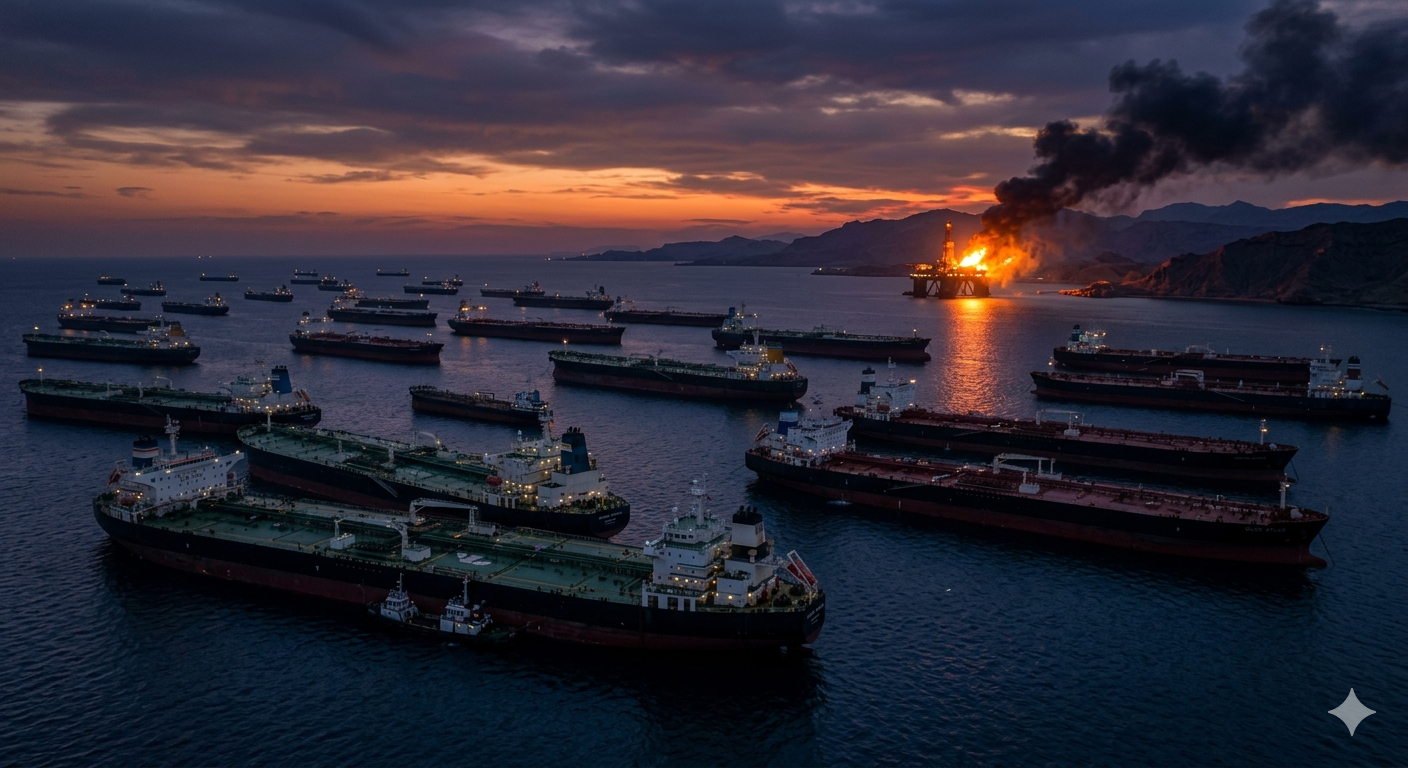
Faced with an overwhelming conventional military disadvantage, Iran deployed its primary geoeconomic retaliatory lever: the operational closure of the Strait of Hormuz. This 21-mile-wide maritime bottleneck, connecting the Persian Gulf to the Gulf of Oman and the broader Arabian Sea, serves as the central artery for the global hydrocarbon trade. The Islamic Revolutionary Guard Corps (IRGC) officially declared the strait prohibited to commercial shipping on March 2, 2026, utilizing a combination of drone swarms, fast-attack vessels, and the persistent threat of coastal ballistic missile batteries to enforce the blockade. This action immediately resulted in a 95% drop in tanker traffic compared to pre-war baselines, effectively trapping vast quantities of global energy supplies. discoveryalert
| Energy Commodity | Normal Daily Volume Through Hormuz | Share of Global Trade/Supply | Immediate Market Consequence |
| Crude Oil | ~21 million barrels | 21% of global supply | Global price spikes; storage capacity exhausted in Gulf states |
| Refined Products | ~3.2 – 3.3 million barrels | 8% of global trade | Regional shortages of diesel and aviation fuel |
| Liquefied Natural Gas (LNG) | ~60 million cubic meters | 20% – 25% of global LNG | Asian and European power generation shortfalls; price surges |
| Petrochemicals (LPG/Naphtha) | ~1.5 million barrels LPG | 15% – 30% of Middle East exports | Paralysis of global plastics and advanced manufacturing sectors |
The conflict rapidly expanded beyond the geographic confines of the strait, methodically targeting alternative export infrastructure designed to bypass the chokepoint. Saudi Arabia, anticipating maritime disruptions, attempted to redirect approximately 4.2 million barrels per day of its crude output through the East-West pipeline to its Red Sea port of Yanbu. However, Iranian proxy forces successfully targeted the Yanbu port’s Samref refinery with drones and intercepted ballistic missiles, exposing the acute vulnerability of the region’s primary redundancy mechanism for oil exports.
Concurrently, offensive strikes on Qatar’s flagship Ras Laffan LNG plant incapacitated an estimated 17% of the nation’s total production capacity. Given the highly complex and specialized nature of LNG infrastructure, industry analysts estimate that repairing the Ras Laffan facility could take several years, drawing ominous parallels to the 18-month repair timeline required following the much smaller 2022 Freeport LNG accident in Texas.
By the third week of March 2026, the strategic standoff reached a highly volatile inflection point. U.S. President Donald Trump issued a strict 48-hour ultimatum, demanding that Tehran guarantee uninterrupted commercial navigation through the Strait of Hormuz or face the complete obliteration of its domestic power infrastructure. This escalatory rhetoric, combined with Iran’s counter-threats to target energy assets across neighboring Gulf states and lay mines across the entire Gulf coast, effectively embedded a massive, seemingly permanent geopolitical risk premium into global energy markets, signaling to investors that a swift diplomatic resolution was highly improbable.
The Anatomy of the Hydrocarbon Price Shock
The transformation in global oil markets following the outbreak of hostilities was exceptionally rapid and violently disruptive. Prior to the escalation in late February 2026, international benchmark Brent crude traded at relatively stable equilibrium levels of approximately $67 to $70 per barrel, reflecting a balanced global supply-demand outlook and adequately provisioned global inventories. Within weeks of the conflict’s escalation, prices surged dramatically, shattering previous institutional forecasts.
Crude Oil Volatility and Production Shut-ins
The sudden disruption of 20% of global oil supplies pushed Brent crude past the psychological $100 per barrel threshold on March 8, 2026, marking the first time prices had breached this level in four years. At the absolute peak of the market panic in mid-March, Brent touched $126 per barrel, while Dubai crude—the primary pricing benchmark for Middle Eastern oil destined for Asian markets—reached an unprecedented $166.80 per barrel on March 19. West Texas Intermediate (WTI), the U.S. benchmark, simultaneously smashed through the $100 barrier, fundamentally altering the domestic economic outlook. ebc
| Benchmark | Pre-War Price (Jan/Feb 2026) | Peak Crisis Price (March 2026) | Approximate Percentage Increase |
| Brent Crude | $67.00 – $70.00 / bbl | $126.00 / bbl | ~88% |
| WTI Crude | $64.50 – $67.00 / bbl | $100.00+ / bbl | ~55% |
| Dubai Crude | ~$65.00 / bbl | $166.80 / bbl | >150% |
| U.S. National Average Gasoline | $2.98 / gallon | $3.84 / gallon | ~29% |
The extreme price trajectory reflects both the immediate loss of physical supply and the rapid repricing of effective global spare capacity. Because shipping lanes were impassable, crude storage facilities in Gulf states rapidly filled to maximum capacity. Without the ability to export or store excess production, major oil producers such as Iraq, Kuwait, and Saudi Arabia were forced into involuntary production shut-ins. The International Energy Agency (IEA) estimated that Gulf countries cut total oil production by at least 10 million barrels per day, creating the largest simultaneous supply disruption in the history of the global oil market. In response, IEA member countries agreed on March 11 to an unprecedented emergency release of 400 million barrels of oil from their strategic reserves to inject liquidity into the suffocating market.
Institutional forecasts were aggressively revised upward to account for the structural nature of the disruption. Goldman Sachs adjusted its 2026 average forecast for Brent crude to $85 per barrel (up from $77), and warned clients that a prolonged 10-week disruption of the strait could necessitate a massive risk premium, potentially pushing prices to $135 per barrel to generate the precautionary demand destruction required to balance the market. Conversely, J.P. Morgan Global Research maintained a somewhat contrarian long-term view, predicting that once geopolitical premiums recede, soft underlying supply-demand fundamentals could eventually pull Brent back toward $60 per barrel by the end of 2026, though they acknowledged the extreme short-term volatility.
The Liquefied Natural Gas (LNG) Dimension
While crude oil dominates consumer headlines, the 2026 crisis is uniquely severe due to its concurrent, devastating impact on global natural gas markets. Unlike the oil shocks of the 1970s, the modern global economy is heavily reliant on Liquefied Natural Gas (LNG) for baseline power generation and industrial heating. Qatar alone supplies approximately 20% of the world’s LNG, heavily concentrated in export routes bound for energy-hungry Asian markets.
The closure of the Strait of Hormuz represents an insurmountable barrier for LNG trade. While some heavily insured crude oil tankers might risk transit utilizing “shadow fleet” tactics—disabling transponders and obscuring ownership—or under heavy naval escorts, LNG carriers are highly combustible and operate under incredibly strict international insurance mandates. Consequently, LNG vessels will not run the strait under threat of drone or missile attack, leaving Qatari gas functionally trapped within the Persian Gulf.
This dynamic immediately sent European gas prices, measured via Netherlands day-ahead contracts, surging 30% to a three-year high of 148p a therm. In Asia, spot markets witnessed intensified competition and soaring premiums, with analysts projecting that a prolonged cutoff would lead to severe electricity rationing, industrial output contractions, and forced fuel-switching across heavily import-dependent nations like Thailand, South Korea, and Japan.
Historical Precedents: Contextualizing the 2026 Shock
To fully comprehend the macroeconomic threat posed by the 2026 crisis, economists and geopolitical analysts have heavily benchmarked the event against the seminal oil shocks of the 20th and early 21st centuries. The executive director of the IEA explicitly equated the current crisis to the combined force of the twin oil shocks of the 1970s and the fallout from Russia’s 2022 invasion of Ukraine. In absolute volume, the 2026 disruption—exceeding 10 to 11 million barrels per day lost—dwarfs previous energy shocks. gulfnews
| Historical Oil Shock | Primary Geopolitical Catalyst | Price Impact (Nominal) | Global Economic Consequence |
| 1973 – 1974 | Yom Kippur War / OAPEC Embargo | $3.00 to $11.50 / bbl | Deep global recession; structural stagflation |
| 1979 – 1980 | Iranian Revolution / Iran-Iraq War | $14.00 to >$30.00 / bbl | Back-to-back US recessions; double-digit inflation |
| 1990 – 1991 | Iraqi Invasion of Kuwait | $16.00 to $36.00 / bbl | Brief recession; swift coalition military resolution |
| 2007 – 2008 | Demand Spike / Financial Crisis | ~$60.00 to $147.00 / bbl | Contributed to severity of the Great Recession |
| 2022 | Russian Invasion of Ukraine | ~$75.00 to ~$120.00 / bbl | European energy crisis; multi-decade peak inflation |
| 2026 | Operation Epic Fury / Hormuz Blockade | $67.00 to $126.00 / bbl | Severe stagflation risk; global supply chain paralysis |
Despite the massive volume of oil removed from the market in 2026, the transmission mechanisms of the economic pain differ significantly from the 1970s. A key mitigating factor is that the energy intensity of global GDP—the amount of petroleum required to produce a single unit of economic output—has fallen steadily over the last five decades. Decades of efficiency gains, the structural shift toward a service-based economy, and the early stages of commercial electrification have substantially shrunk oil’s share of aggregate production costs. Furthermore, the United States’ transformation into a net energy exporter, courtesy of the shale revolution, buffers its domestic economy from the severe current account drains and trade imbalances experienced during the Carter and Nixon administrations.
However, the 2026 crisis introduces novel vectors of vulnerability that did not exist during the Cold War era. While advanced economies have substituted oil for electricity in many sectors, power generation is now heavily reliant on natural gas at the margin. The stranding of 20% of the world’s LNG trade creates an immediate electricity pricing crisis in Europe and Asia that cannot be solved by releasing crude oil from strategic reserves. Additionally, the modern “just-in-time” global supply chain is entirely unequipped to manage a simultaneous disruption of this magnitude across both liquid and gaseous hydrocarbon markets, leading to rapid cascading failures across interrelated industries.
Macroeconomic Contagion: Stagflation, Monetary Policy, and Equity Markets
The energy shock triggered by the Iranian conflict has swiftly translated into a macroeconomic contagion, reviving the persistent threat of stagflation—a devastating economic condition characterized by stagnant growth, high unemployment, and entrenched inflation.
Inflationary Pressures and Growth Downgrades
Barclays analysts calculated that a sustained oil price of $100 per barrel effectively acts as a massive global tax, reducing global GDP growth by 0.2 percentage points and compressing it to an estimated 2.8% for the year. Concurrently, headline inflation is projected to rise by 0.7 percentage points to 3.8%, reversing years of painful monetary tightening efforts. In the United States, economists at JPMorgan estimated that the 42% surge in pre-war oil prices could push domestic inflation from 2.4% in January to over 3% by the spring, with secondary effects rippling through the economy for months. This imported inflation permeates every layer of the economy, driving up the cost of diesel for transportation and logistics, increasing the cost of petrochemical packaging, and ultimately raising the price of basic retail goods and groceries. https://intellectia.ai/
The Central Bank Dilemma
This sudden inflationary impulse has entirely upended the global monetary policy landscape. Prior to the conflict, financial markets had optimistically priced in a series of interest rate cuts by major central banks aiming to stimulate growth. However, the Federal Reserve, in its March 2026 meeting, was forced to abruptly abandon this trajectory and hold interest rates steady for the second consecutive time.
Fed Chair Jerome Powell explicitly acknowledged the dual threat facing policymakers: higher energy prices push inflation up while simultaneously suppressing economic growth by destroying consumer purchasing power. Cutting rates in this environment risks accelerating inflation and unanchoring consumer expectations, while holding rates high risks tipping a slowing, energy-starved economy into a deep recession. Reflecting this sticky, energy-driven inflation, Goldman Sachs subsequently delayed its forecast for the first Fed rate cut from June to September 2026. Sovereign bond markets reacted violently to this higher-for-longer narrative, with yields rising sharply across the curve; the German Bund, for instance, reached its highest yield since the sovereign debt crisis of 2011 as European markets priced in the devastating economic impact of the LNG shortage.
Equity Market Contractions and Sectoral Shifts
Global equity markets experienced pronounced, sustained volatility as investors rapidly digested the implications of higher input costs, delayed rate cuts, and escalating geopolitical peril. In the United States, the S&P 500, the Dow Jones Industrial Average, and the Nasdaq Composite all faced significant downward pressure, recording four consecutive weeks of decline and slipping close to correction territory. Major international indices mirrored this aggressive sell-off. The UK’s FTSE 100 suffered a 2.75% drop—its steepest one-day fall in 11 months—while Japan’s Nikkei plunged by 3.1% and South Korea’s Kospi crashed by a staggering 7.2%, reflecting the acute vulnerability of energy-importing Asian manufacturing hubs.
The sectoral impact within equities has been highly asymmetrical. While energy producers and defense contractors significantly outperformed the broader market, capitalizing on the conflict premium, consumer discretionary, transportation, and industrial sectors faced severe margin compression due to surging fuel and operational costs.
Crucially, the crisis threatens to stall the momentum of the global technology and artificial intelligence (AI) boom, which had previously propped up broad market indices. The World Trade Organization’s chief economist, Robert Staiger, warned that the highly energy-intensive nature of AI data centers makes the sector exceptionally vulnerable to prolonged electricity and energy price spikes. If energy prices remain elevated, the capital expenditure required to sustain AI infrastructure growth may become prohibitive, potentially crimping the tech-driven investment supercycle.
The Cryptocurrency Paradox
Cryptocurrency markets demonstrated a highly complex, non-linear reaction function to the geopolitical shock, testing the limits of the “digital gold” narrative. Upon the initial news of the strikes comprising Operation Epic Fury, Bitcoin plummeted by approximately 4%, falling to the $63,000 range as panicked retail and institutional investors indiscriminately dumped risk assets in a desperate flight to traditional safe havens. Conversely, physical gold surged past $5,200 an ounce, absorbing $16 billion in ETF inflows while Bitcoin ETFs saw $4.5 billion in net outflows.
Alternative cryptocurrencies (altcoins) experienced even sharper drawdowns, with high-beta assets like Solana losing up to 70% of their value in a massive deleveraging event that flushed weak market structures. However, as the crisis progressed and conventional equities displayed sustained weakness, Bitcoin unexpectedly rebounded, oscillating near $70,000 and pushing its market dominance above 57%. This recovery was driven by anticipatory positioning by macro investors betting that the ensuing economic slowdown would eventually force central banks to abandon their inflation fight and inject massive liquidity into the system to prevent a systemic recession—an environment historically highly favorable to scarce digital assets.
Cascading Supply Chain Disruptions and the Chemical Pressure Point
The physical blockade of the Strait of Hormuz has generated a logistical and manufacturing paralysis that extends far beyond the immediate flow of raw hydrocarbons to gasoline pumps. The entire maritime transport system and advanced manufacturing supply chain are experiencing catastrophic bottlenecks.
Maritime Logistics and Defensive Naval Operations
In an attempt to secure vital shipping lanes, the European Union extended the mandate of “Operation Aspides,” a defensive naval mission headquartered in Larissa, Greece, through February 2027. Operating strictly under a defensive posture authorized to fire only if attacked, the fleet—comprising warships from France, Greece, and Italy—provides critical escorts to commercial shipping and works to neutralize multi-domain attacks.
The mission has been highly active, successfully intercepting 18 UAVs and 20 explosive drone boats, rescuing 50 seafarers from stricken vessels, and systematically debunking Houthi propaganda claiming false victories. However, despite these tactical successes, the mission cannot guarantee schedule certainty or fully mitigate the prohibitive war-risk insurance premiums—which surged from $200,000 to over $1 million per voyage—that have deterred major shipping lines from entering the region. Consequently, global trade flows worth an estimated $1.2 trillion annually are exposed to systemic delays, rerouting costs around the Cape of Good Hope, and severe capacity constraints.
The Petrochemical and Semiconductor Vulnerability
A highly critical, yet frequently underreported, third-order effect of the refinery shut-ins in the Middle East is the strangulation of the global petrochemical supply chain. The Gulf region normally supplies approximately 30% of global seaborne exports of liquefied petroleum gas (LPG) and roughly 24% of seaborne naphtha. These compounds serve as the foundational feedstocks for global plastic production, packaging, and synthetic materials; their absence guarantees widespread manufacturing inflation.
More alarmingly, the crisis has exposed a hidden “Chemical Pressure Point” deeply relevant to advanced manufacturing and global technology supply chains. Over 90% of the world’s sulphur is produced as a direct byproduct of oil refining and natural gas processing. The immediate halt in refining activity across the Gulf, combined with the suspension of operations at Qatar’s Ras Laffan, has severely throttled the global supply of sulfuric acid. As a highly critical chemical input required for semiconductor etching and silicon wafer cleaning, this acute shortage threatens to disrupt global microchip production. This vulnerability demonstrates how a kinetic conflict over Middle Eastern energy can rapidly paralyze high-tech manufacturing hubs in Taiwan, South Korea, and the United States, even if electrical power supplies to those factories remain uninterrupted.
Agricultural Contagion: Fertilizers and Global Food Security
The intricate interplay between global energy markets and the agricultural sector has catalyzed a severe secondary crisis in food production. Modern high-yield agriculture is deeply reliant on hydrocarbon inputs, specifically natural gas, which serves as the primary chemical feedstock and energy source for synthesizing nitrogen-based fertilizers.
The disruption in Qatari LNG and the broader spike in global natural gas prices immediately transmitted into global fertilizer markets, which were already strained. Prices for essential nutrients like Diammonium Phosphate (DAP) and Monoammonium Phosphate (MAP) surged above $700 per metric ton (MT), while Urea—the most common nitrogen fertilizer—crossed the $600/MT threshold shortly after the conflict began. multibagg.ai
| Fertilizer Type | Pre-Crisis Baseline ($/MT) | March 2026 Crisis Level ($/MT) | Agricultural Impact |
| Urea | ~$350 – $400 | >$600 | Critical for nitrogen-intensive crops; drives down overall yields |
| DAP/MAP | ~$450 – $500 | >$700 | Impacts root development; subject to severe global shortages |
| Potash | ~$300 – $315 | >$330 | Muted price impact due to geographic diversification of sourcing |
This exponential surge in agricultural input costs presents a severe, systemic threat to global food security. As fertilizer becomes prohibitively expensive, farmers operating on thin margins are forced to reduce application rates or shift their planting intentions away from nutrient-intensive crops like corn, pivoting instead toward less intensive alternatives such as soybeans. This crop substitution alters the global supply of animal feed, inevitably driving up the cost of meat and dairy production.
Furthermore, the elevated cost of diesel fuel directly impacts the operational economics of farm machinery, harvesting equipment, and the vast logistics networks required to transport perishable goods (which also rely heavily on petrochemical-based refrigeration and plastic packaging). Organizations such as the United Nations and the World Bank have warned that these cascading disruptions disproportionately impact low-income and developing economies, setting the stage for a prolonged period of severe food price inflation and potential localized food shortages.
The Sanctions Trilemma and the Reordering of Energy Geopolitics
The 2026 energy shock has triggered a profound realignment in global geopolitical leverage, creating an impossible “sanctions trilemma” for Western policymakers who are attempting to penalize adversaries without crashing the global economy.
Desperate to alleviate the extreme supply deficit and suppress domestic gasoline prices ahead of critical political cycles, the U.S. Treasury Department was forced into a tactical retreat regarding its broader economic warfare strategy. In early March 2026, the U.S. issued a targeted 30-day waiver explicitly allowing India and other nations to purchase Russian oil that was already at sea, deliberately softening the strict embargo enacted during the Russo-Ukrainian war in order to keep crude flowing to Asian markets.
Subsequently, in a highly controversial move, the Trump administration issued Iran General License U (GL U), a one-month authorization permitting the sale and delivery of approximately 140 million barrels of heavily sanctioned Iranian crude that was stored on vessels at sea. Treasury Secretary Scott Bessent defended the measure as a “narrowly tailored, short-term authorization” necessary to relieve temporary pressure on supply and prevent Iran from holding global energy hostage.
While U.S. officials argued these waivers were strictly pragmatic economic measures, the geopolitical ramifications are immense and highly counterproductive to overarching Western strategic goals. Russia has emerged as an immediate, unmitigated strategic beneficiary of the Middle East conflict; the tightening of global LNG markets intrinsically increases the leverage and relative value of Russian pipeline gas to Eurasia, potentially netting the Kremlin billions in windfall revenues and blunting the impact of previous sanctions on entities like Rosneft and Lukoil.
Similarly, China, which had been quietly hoarding discounted Iranian and Russian oil prior to the conflict, finds itself in a highly advantageous position. Unconstrained by Western naval coalitions, China is utilizing selective Iranian access through the Strait of Hormuz to build a parallel, sanction-proof energy corridor, strengthening its energy security while Western nations grapple with shortages. These maneuvers have exposed widening transatlantic rifts, as European nations deliberate tightening sanctions regimes while Washington unilaterally issues emergency waivers to manage domestic economic pain.
Strategic Vulnerability and Adaptation: The Case of India
No major economy exemplifies the structural vulnerabilities of the 2026 energy crisis more acutely than India. As the world’s third-largest energy consumer, India imports approximately 85% to 88% of its crude oil requirements and nearly 50% of its natural gas, with a historical reliance on the Gulf region for over half of these volumes. The effective closure of the Strait of Hormuz has forced New Delhi to navigate a perilous convergence of macroeconomic instability, imported inflation, and immense national security challenges.
Macroeconomic Impact and Currency Pressures
The immediate macroeconomic consequence for India is a severe, rapid deterioration of its external balances. Economic models indicate that every $10 increase in the price of a barrel of crude oil adds an estimated $13 billion to $14 billion to India’s annual import bill. With crude spiking from $70 to well over $100, the massively expanded oil trade deficit threatens to push the Current Account Deficit (CAD) beyond 3.1% of GDP, an unsustainable level for an emerging market.
This massive capital outflow has exerted immense downward pressure on the Indian Rupee. Having already faced weak foreign direct investment and portfolio outflows over the preceding year, the currency breached the psychological 92-per-dollar mark in early March 2026. Economic modeling by institutional analysts indicates that if oil averages $100/barrel through the 2026-27 fiscal year, the rupee could depreciate significantly further, potentially weakening to 98.5 or even 100 to the dollar. Such currency depreciation creates a vicious, self-reinforcing cycle of “imported inflation,” as the cost of all dollar-denominated imports—from advanced electronics to the critical minerals necessary for the green transition—surges proportionately.
Domestic Fuel Pricing and Sectoral Strain
The Indian government and state-owned Oil Marketing Companies (OMCs) like IOCL, BPCL, and HPCL have engaged in a delicate, politically sensitive balancing act to shield the domestic retail consumer while managing harsh fiscal realities. Retail prices for standard petrol and diesel for the general public have remained frozen—with petrol hovering around ₹94.77 in Delhi and ₹94.69 in Lucknow—to suppress headline consumer inflation. However, the harsh economic reality of $120 oil necessitated aggressive, targeted price hikes elsewhere.
In late March 2026, OMCs implemented a massive ₹21.92 per litre (25%) increase on bulk industrial diesel—raising the price in Delhi from ₹87.67 to ₹109.59. Premium-grade petrol saw a modest hike of roughly ₹2 per litre, pushing it to ₹101.89 in the capital.
| Major Indian City | Regular Petrol (₹/L) | Regular Diesel (₹/L) | Bulk Industrial Diesel (₹/L) |
| New Delhi | 94.77 | 87.67 | 109.59 |
| Mumbai | 103.54 | 90.03 | Proportionately Hiked |
| Lucknow | 94.69 | 87.76 | Proportionately Hiked |
| Bengaluru | 102.96 | 88.94 | Proportionately Hiked |
Source: OMC Retail Data, March 2026.
The severe hike in bulk diesel directly assaults the operating margins of the logistics, transport, manufacturing, and agricultural sectors. Because diesel accounts for nearly 70% of operating costs for heavy commercial vehicles, transport unions immediately implemented fuel surcharges of 12% to 15%, increasing freight rates that will inevitably cascade into the price of fast-moving consumer goods and food staples, driving up the cost of living for the common man.
The critical fertilizer sector faces parallel, acute stress. India is exceptionally vulnerable to the disruption of Qatari LNG and Middle Eastern urea exports. Prior to the crisis, the nation maintained domestic stocks of 180.12 Lakh Metric Tonnes (LMT) of total fertilizers, including 61.51 LMT of Urea and 25.17 LMT of DAP. While this provides a temporary buffer for the Kharif sowing season, government mandates capping fertilizer plant gas supplies at 70% (in order to prioritize domestic cooking gas/LPG for households) ensure that domestic fertilizer production will contract precisely when global import prices are skyrocketing. The fiscal burden of shielding farmers via fertilizer subsidies is expected to significantly overshoot the budgeted ₹1.86 lakh crore for 2025-26, straining the national exchequer.
The Role of Strategic Petroleum Reserves (SPR)
The 2026 crisis has starkly highlighted the inadequacy of India’s shock-absorption capacity regarding physical hydrocarbon storage. As of March 2026, the Indian Strategic Petroleum Reserve Limited (ISPRL) maintained a total capacity of 5.33 Million Metric Tonnes (MMT) across specialized underground caverns located in Visakhapatnam (1.33 MMT), Mangaluru (1.5 MMT), and Padur (2.5 MMT).
Government data revealed these strategic reserves were only 64% full at the onset of the crisis, holding roughly 3.372 MMT of crude stock. While official statements from the Petroleum and Natural Gas Ministry indicated that working inventory at refineries combined with SPR crude provided roughly 25 days of crude cover and 25 days of product cover (50 days total), the strategic buffer remains dangerously thin compared to the strict 90-day mandates of IEA member states, or China’s aggressive 110-140 day stockpile. m.economictimes
| SPR Location | Total Capacity (MMT) | Operational Status | Strategic Function |
| Visakhapatnam (AP) | 1.33 | Active | East coast supply buffer |
| Mangaluru (KA) | 1.50 | Active | West coast supply; ADNOC commercial leasing |
| Padur (KA) | 2.50 | Active | Largest facility; West coast supply |
| Chandikhol (OD) / Padur II | 6.50 (Combined) | Planned (Phase II) | Expansion approved in 2021; pending execution |
Although Phase II expansion plans to add 6.5 MMT of capacity in Odisha (Chandikhol) and Karnataka (Padur expansion) were approved in 2021, the sluggish deployment of these vital infrastructure assets leaves the nation heavily reliant on diplomatic agility and short-term sanctions waivers—such as the rapid procurement of Russian crude—to bridge supply deficits during active conflicts.
National Security and Military AI Integration in a Capital-Constrained Era
The intersection of extreme energy costs, fiscal constraints, and imperative national security has forced a rapid, unprecedented evolution in military doctrine across the globe. This phenomenon is vividly illustrated by India’s recent military modernization efforts. Following the May 2025 “Operation Sindoor”—an 88-hour, intense conflict with Pakistan triggered by cross-border terrorism that targeted facilities of Jaish-e-Mohammed and Lashkar-e-Taiba—the Indian military apparatus recognized the absolute unsustainability of traditional, manpower-heavy warfare.
With nearly 50% of the defense budget consumed by fixed personnel costs (pay and pensions), and energy import bills simultaneously draining national coffers due to the Hormuz crisis, fiscal rigidity demanded a radical strategic pivot. The solution, heavily reflected in the Union Budget 2026-27 which boosted overall public capital expenditure to ₹12.2 lakh crore and increased the armed forces’ revenue budget by approximately 17% to 22%, is the aggressive integration of Artificial Intelligence (AI) to maximize the “teeth-to-tail” ratio.
In early 2026, the Indian Army showcased a comprehensive “Smart Combat Ecosystem” at the AI Impact Summit in New Delhi. Core pillars of this integration include:
- Command and Control: The SAM-UN System, a geospatial intelligence platform utilizing AI for complex mission planning, disaster response, and integration with smart command centers.
- Cyber and Information Warfare: Implementation of systems like XFace for facial recognition-based identity verification, and advanced Deepfake Detection suites to counter cognitive warfare and synthetic media manipulation.
- Logistical Optimization: The deployment of Nabh Drishti for real-time telemetry reporting, and AI-enabled Driver Fatigue Detection devices to secure supply lines and prevent accidents under operational stress.
- Autonomous Swarms: The Air Force contracted 200 AI-powered loitering munitions for swarm attacks, shifting away from expensive conventional platforms.
While the Evaluating Trustworthy AI (ETAI) framework provides a robust operational governance model unmatched by many great powers, true interoperability remains hindered by institutional inertia and siloed data across the Army, Navy, and Air Force. Nevertheless, this technological pivot underscores a broader strategic reality: in an era of severe resource scarcity and crippling energy inflation, algorithmic warfare, edge computing (AI-in-a-Box), and autonomous systems are viewed not just as tactical military advantages, but as vital economic necessities for sustaining national defense.
Geoeconomic Realignments: Connectivity Corridors and the Green Transition
The 2026 fuel crisis has definitively proven that reliance on narrow, geographically concentrated maritime chokepoints is an unacceptable sovereign risk. Consequently, nations are rapidly reevaluating multilateral trade agreements and accelerating massive investments into domestic energy transitions to buffer against future shocks.
The Stalling of IMEC and the Search for Strategic Alternatives
The India-Middle East-Europe Economic Corridor (IMEC), unveiled to great global fanfare at the 2023 G20 Summit in New Delhi, was meticulously designed as a multimodal rail and maritime trade route to bypass traditional maritime chokepoints and offer a strategic, democratic alternative to China’s Belt and Road Initiative (BRI).
However, the war in the Levant and the subsequent Iranian conflict have effectively stalled its implementation. The acute vulnerability of the Saudi-Jordan-Israel infrastructure backbone, coupled with the Houthi disruption of the Red Sea and the closure of Hormuz, underscores the extreme fragility of regional infrastructure projects amidst active, multi-front conflict. While the long-term strategic rationale for IMEC—building resilient, multi-node supply chains that do not rely on a single waterway—has only been strengthened by the 2026 crisis, its near-term realization is firmly on pause. This delay acts as a strategic boon for China, which views IMEC as a direct rival and benefits from Western supply chain chaos.
Acceleration of the Green Hydrogen Mission
The most profound, permanent structural outcome of the 2026 fossil fuel shock is the forced, rapid acceleration of the global energy transition. As the UN Climate Change Executive Secretary noted at the Green Growth Summit in Brussels, fossil fuel dependency strips away national security, replacing it with subservience to petro-states and subjecting economies to the chaos of geopolitical strong-arm tactics.
For major importing nations, decarbonization has rapidly shifted from a long-term environmental mandate to a strict, immediate economic and national security imperative. Global clean energy spending quietly hit new records, passing $2.2 trillion, as governments utilized industrial policy to build resilient local supply chains.
India’s response has been the aggressive execution of its National Green Hydrogen Mission, supported by a massive budget allocation of ₹19,744 crore aiming to develop 5 MMT of production capacity by 2030. By 2026, significant infrastructural milestones were reached, including the commissioning of the nation’s largest operational green hydrogen plant by JSW Energy. Furthermore, the advancement of India’s first mega project—a 10,000 tonnes per annum (TPA) facility at the IOCL Panipat Refinery expected by December 2026—and the development of a nearly 2 GW Green Hydrogen Hub in Kakinada signal a clear intent to build massive domestic capacity and export supply chains.
These investments aim to replace imported fossil fuels in hard-to-abate sectors like steel refining and, crucially, ammonia/fertilizer production. By shifting fertilizer production to green ammonia, India directly attacks the exact import vulnerabilities—LNG and Urea pricing—exposed by the Hormuz blockade, proving that renewable energy is the ultimate tool for strategic autonomy.
Synthesis and Strategic Outlook
The 2026 global energy crisis, ignited by Operation Epic Fury and the subsequent strangulation of the Strait of Hormuz, represents a watershed moment in modern economic and geopolitical history. It has irrevocably demonstrated the severe fragility of an interconnected global economy that remains overly reliant on concentrated maritime chokepoints and the uninterrupted flow of Middle Eastern hydrocarbons.
The systemic effects of this disruption—ranging from Brent crude peaking at a staggering $126 per barrel, to the stranding of a fifth of the world’s LNG trade, to the paralysis of advanced petrochemical and agricultural supply chains—have injected a persistent, dangerous stagflationary impulse into the global economy. Central banks find themselves constrained by imported inflation, equity markets must digest a new reality of permanently higher input costs and delayed rate cuts, and emerging markets face severe currency depreciation and crippling fiscal strain.
Crucially, the crisis has highlighted the severe limits of traditional 20th-century energy security architectures. Strategic Petroleum Reserves, while useful for minor shocks, proved vastly insufficient for prolonged, multi-commodity blockades. Defensive naval escorts, such as Operation Aspides, could secure individual vessels but could not restore the broad commercial confidence required to normalize global trade routes and lower insurance premiums. Furthermore, the deployment of emergency sanctions waivers by the United States revealed the inherent contradictions of leveraging economic warfare during a physical supply deficit, ultimately empowering geopolitical rivals like Russia and China.
As a result, the geopolitical risk premium currently embedded in energy markets is highly unlikely to dissipate swiftly, even if immediate military de-escalation occurs. The global economic system has received a definitive warning regarding the true cost of fossil fuel dependency. In the long term, the 2026 crisis will act as the ultimate catalyst for the structural redesign of global energy systems. The transition toward renewable infrastructure, electrified domestic grids, and sovereign green hydrogen economies is no longer viewed merely as a climate objective; it is recognized universally by policymakers and military strategists as the sole viable mechanism for securing strategic autonomy, controlling inflation, and insulating national sovereignty from the devastating volatility of petro-state conflicts. Until that transition fully matures, the global economy will remain precariously balanced on the edge of the next inevitable geopolitical fracture.







+ There are no comments
Add yours