Key Highlights
- Scale as a Strength: India’s 1.4 billion population provides the diverse datasets necessary for “population-scale” AI solutions.
- DPI Integration: AI is being layered on top of existing structures like Aadhaar, UPI, and Ayushman Bharat.
- Sovereign AI: The government’s push for a domestic AI stack to ensure data sovereignty.
- Bhashini: A revolutionary tool breaking the digital language barrier for millions.
- Global Export: India’s AI-for-good models are becoming blueprints for the Global South.
Imagine a country where a farmer in a remote village in Bihar can ask a smartphone—in his local dialect—about the best time to sow seeds based on real-time satellite weather data. Imagine a student in a municipal school in Tamil Nadu receiving personalized AI tutoring in Tamil, bridging a gap that human resources alone could never fill.
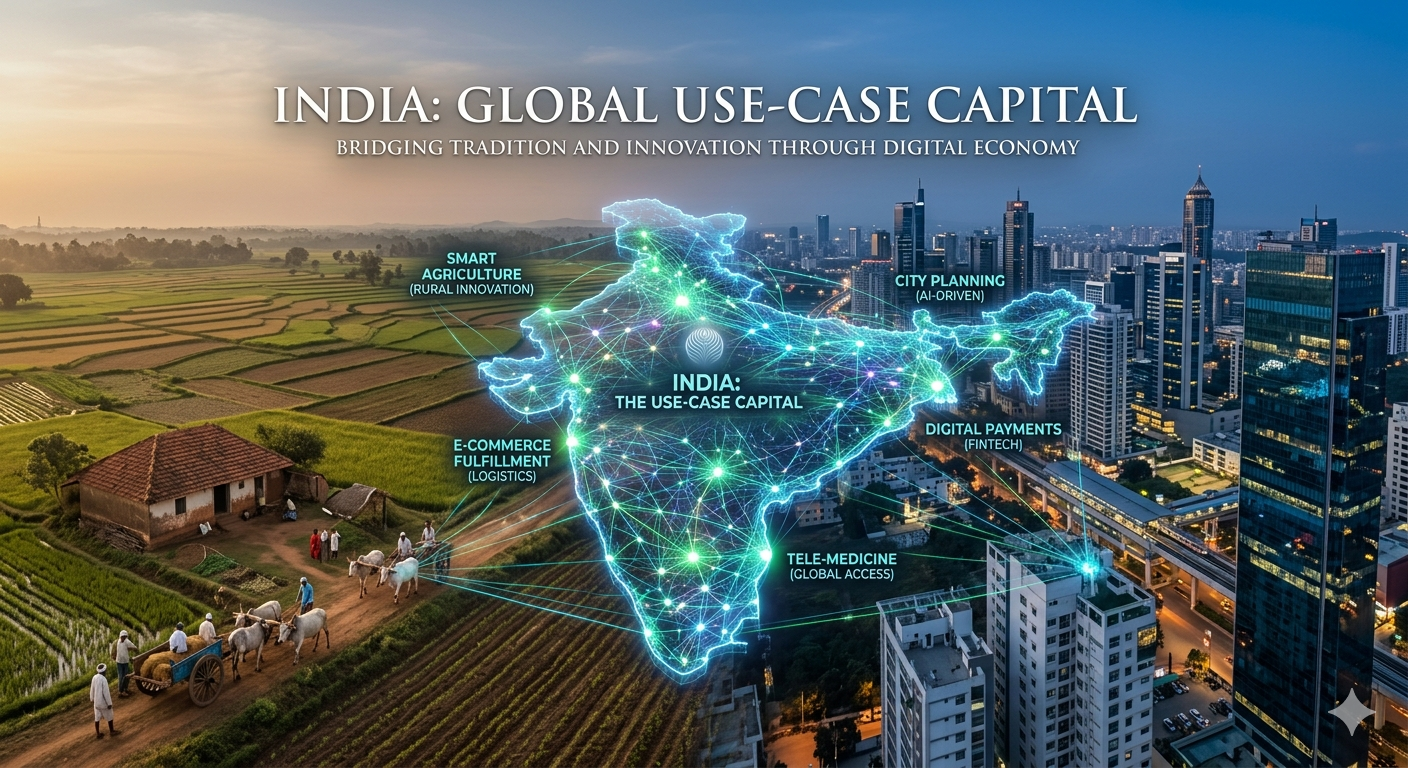
This isn’t a futuristic sci-fi script; it is the unfolding reality of India. While Silicon Valley builds the world’s most powerful Large Language Models (LLMs), India is building something arguably more significant: the world’s largest laboratory for AI use-cases. India is rapidly emerging as the “Use-Case Capital” of the world. This title signifies a shift from being a mere consumer of technology to becoming the definitive arena where AI is tested, refined, and deployed for the collective public good.
Why This Topic Matters Today
The global discourse around Artificial Intelligence is often dominated by “compute power” and “frontier models.” However, for a model to be useful, it needs a problem to solve and data to learn from. India offers both at an unprecedented scale.
As the world grapples with the ethical and monopolistic risks of AI, India’s approach—centered on Digital Public Infrastructure (DPI)—offers a democratic alternative. For UPSC aspirants and policy researchers, understanding this shift is crucial because it redefines India’s geopolitical standing and its internal governance strategy. AI in India is not about luxury; it’s about survival, inclusion, and efficiency.
Background and Context: From IT Hub to AI Lab
For decades, India was known as the “Back Office of the World.” The IT revolution of the 1990s and 2000s established India’s prowess in software services. However, the last decade has seen a metamorphosis.
The introduction of the India Stack—a set of digital identity, payment, and data sharing layers—democratized access to the internet. With the cheapest data rates in the world and a massive digital-first population, the stage was set.
The National Strategy for Artificial Intelligence (2018), released by NITI Aayog, first coined the philosophy of “AI for All.” This wasn’t just a slogan; it was a policy pivot toward using AI to solve “wicked problems” in healthcare, education, and agriculture.
Core Explanation: What Makes India the “Use-Case Capital”?
To understand why India is the use-case capital, we must look at three specific pillars: Data, Diversity, and Demand.
1. Data at Scale
AI thrives on data. Through the Digital India initiative, India has digitized everything from land records to health identities. This creates a “data-rich” environment. Unlike the West, where data is often siloed in private corporations, India’s use of Data Empowerment and Protection Architecture (DEPA) allows for a more fluid (yet secure) exchange of data for public services.
2. Unmatched Diversity
India is a “continent-sized” country. Any AI model that works across India’s 22 official languages and thousands of dialects is automatically robust enough for the rest of the world. This diversity makes India the perfect “stress-test” environment for AI.
3. The “Public Good” Philosophy
In many regions, AI is driven by advertising revenue or productivity gains for the elite. In India, the primary driver is Public Good. Whether it’s reducing the pendency of court cases or identifying pests in cotton crops, the focus is on basic human needs.
Technical and Conceptual Breakdown: The Layers of Indian AI
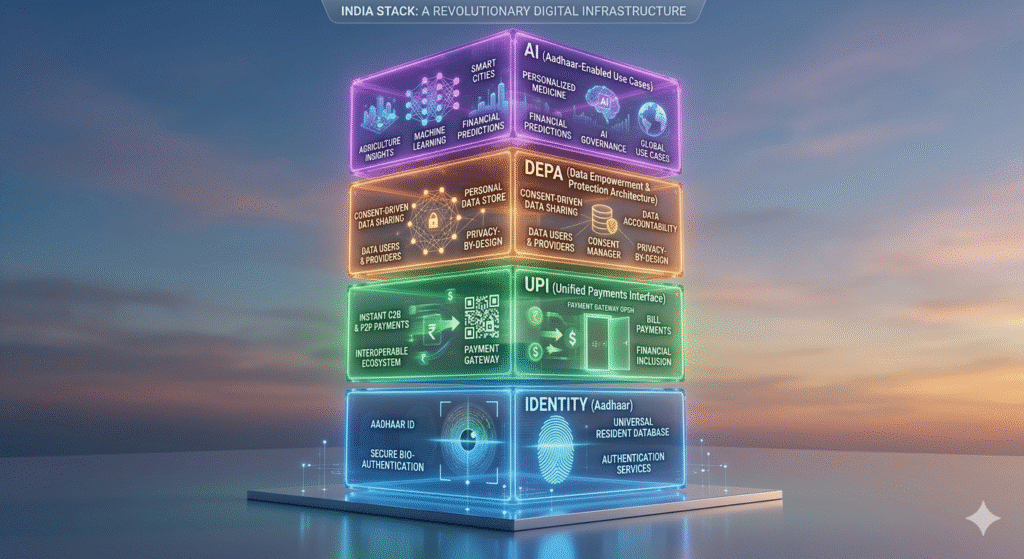
India’s AI journey is built on a specific structural hierarchy:
- The Identity Layer: Aadhaar provides the foundation for identifying beneficiaries.
- The Payments Layer: UPI allows for the seamless transfer of incentives or payments for AI services.
- The Language Layer (Bhashini): This is perhaps the most critical technical component. Bhashini uses AI to provide real-time translation, allowing non-English speakers to interact with the digital economy.
- The Compute Layer: Through the India AI Mission, the government is investing $1.2 billion to build GPU-based compute power, ensuring that Indian startups aren’t solely dependent on foreign clouds.
Expert Tip: For those tracking tech policy, watch the “Airavat” project—India’s AI supercomputer aimed at boosting research and development.
Real-World Examples and Case Studies
1. Agriculture: The AI-Sowing App
In Andhra Pradesh, Microsoft and ICRISAT developed an AI-based sowing app. By analyzing 30 years of climate data, the AI sends a text message to farmers telling them exactly when to plant. The result? A 30% increase in yield without any additional hardware.
2. Healthcare: Early Cancer Detection
Indian startups like Niramai are using AI-driven thermal imaging to detect breast cancer at a much earlier stage than traditional mammography. This is portable, low-cost, and non-invasive—perfect for rural healthcare camps.
3. Governance: The Justice System
The Supreme Court of India has begun using SUVAS (Supreme Court Vidhik Anuvaad Software), an AI tool to translate legal documents into regional languages, making justice more accessible to the common man.
Benefits and Advantages
- Inclusivity: AI breaks the literacy and language barrier.
- Efficiency: Automating bureaucratic processes reduces corruption and “red tape.”
- Cost-Effectiveness: India’s frugal engineering (Jugaad) applied to AI leads to solutions that cost a fraction of their Western counterparts.
- Economic Growth: A potential $967 billion addition to India’s GDP by 2035 (as per Accenture estimates).
Challenges, Risks, and Criticism
Despite the optimism, the path is not without hurdles:
- The Digital Divide: While internet penetration is high, “AI literacy” is low.
- Bias in Algorithms: If the training data contains historical biases (caste, gender), the AI will replicate them.
- Privacy Concerns: The transition to a “data-rich” society requires a robust Data Protection Act (DPDP Act 2023) to be strictly enforced.
- Compute Infrastructure: India still lacks the massive GPU clusters required to train world-class “Frontier Models” from scratch.
Strategic, Policy, and Global Implications
India is positioning itself as the leader of the Global South. By showcasing how AI can be used for public good, India offers a “Third Way”—different from the US’s market-led model and China’s state-led surveillance model.
The export of the “India Stack” to countries like Singapore, UAE, and various African nations proves that India’s use-case-first approach is highly sought after. In the realm of Semantic SEO, this establishes India not just as a labor market, but as a thought leader in “Responsible AI.”
Future Trends and Outlook
- Edge AI: Moving AI processing from the cloud to the device, crucial for areas with poor connectivity.
- Generative AI in Education: Personalized learning paths for every child in the country.
- AI-Driven Urban Planning: Using AI to manage India’s massive urbanization and traffic challenges.
Comparison Table: AI Approaches
| Feature | Silicon Valley Model | Chinese Model | Indian Model (Use-Case Capital) |
| Primary Driver | Profit / Market Dominance | State Control / Security | Public Good / Inclusion |
| Data Source | User interactions (Social Media) | Surveillance / State data | Digital Public Infrastructure (DPI) |
| Key Strength | Frontier Models (LLMs) | Mass Hardware / Monitoring | Implementation at Scale |
| Accessibility | Paid / Proprietary | State-distributed | Open-source / Democratic |
5. FAQ SECTION
1. What does “AI Use-Case Capital” actually mean?
Being the “Use-Case Capital” means India is the primary destination where AI is applied to solve practical, large-scale problems. While other countries might focus on building the foundational technology (the “engine”), India focuses on the “vehicle” and the “destination.” It refers to the application of AI in sectors like healthcare, agriculture, and education for millions of people, providing a blueprint for how technology can serve society.
2. How does Digital Public Infrastructure (DPI) support AI in India?
DPI, like Aadhaar and UPI, acts as the “railway tracks” on which AI “trains” run. It provides a standardized way to identify users, make payments, and share data securely. Without this infrastructure, AI would be siloed. DPI allows AI developers to access massive, diverse datasets (with consent), making it possible to build solutions that are interoperable across different regions and sectors.
3. What is Bhashini and why is it important for AI?
Bhashini is India’s AI-led language translation platform. It is crucial because only a small fraction of Indians are fluent in English, yet most of the internet is in English. By using AI to translate speech and text across 22 Indian languages in real-time, Bhashini democratizes the internet, allowing people to access government services and markets in their mother tongue.
4. Is India building its own ChatGPT?
India is focusing on “Sovereign AI.” While there are projects like ‘Krutrim’ and ‘Hanooman’ aiming to build Indian LLMs, the government’s focus is on creating the infrastructure (compute power and datasets) so that many “Indian ChatGPTs” can be built, tailored to local needs and languages rather than just imitating Western models.
5. How is AI helping Indian farmers?
AI helps farmers through “precision agriculture.” Tools use satellite imagery and weather data to predict pest attacks, suggest optimal sowing times, and monitor soil health. This reduces the wastage of seeds and fertilizers, increases crop yields, and helps farmers mitigate the risks of climate change.
6. What are the ethical risks of AI in a country like India?
The primary risks include algorithmic bias, where the AI might discriminate based on caste or gender present in historical data. There are also concerns regarding data privacy and the potential for increased surveillance. Ensuring “Responsible AI” involves transparent algorithms and strict adherence to the Digital Personal Data Protection (DPDP) Act.
7. Can India’s AI model be used by other countries?
Yes, this is often called the “India Stack” export. Many countries in the Global South face similar challenges to India—lack of formal identity, fragmented markets, and language barriers. India’s low-cost, scalable AI-on-DPI model is an attractive alternative for these nations compared to more expensive or closed systems.
8. What is the role of the India AI Mission?
The India AI Mission is a government-led initiative with a budget of over ₹10,000 crore. Its goal is to establish a comprehensive AI ecosystem. This includes building a “GPU cluster” for compute power, creating a “Datasets Platform,” and funding AI startups that focus on social impact.






+ There are no comments
Add yours