
Key Highlights:
- Nationwide Defence Announced: Prime Minister Modi announced Operation/Mission Sudarshan Chakra on Independence Day 2025, committing to a nationwide, integrated, multi-layered air and missile defence shield by 2035, encompassing counter-UAS grids, offensive strike capabilities, and hypersonic interception.
- Hypersonic Integration: Sudarshan Chakra now explicitly includes hypersonic missile defence as core component, with Phase-II (by early-to-mid 2030s) integrating Project Kusha anti-hypersonic interceptors (M1/M2/M3 at 150/250/350 km ranges) with 80-90% kill probability in salvo mode.
- Real-World Validation: On May 7-8, 2025 (Operation Sindoor), India’s S-400 “Sudarshan Chakra” system (same name as nation-wide mission) successfully neutralised 15 Pakistani drone/missile saturation attack across 15 cities, demonstrating operational efficacy and regional credibility.
- Threat Context: Reports indicate China offering DF-17 hypersonic glide vehicles (Mach 5+, 2000-2500 km range, unpredictable trajectory) to Pakistan; capability would compress India’s decision-times to 5-10 minutes, necessitating AI-enabled automated response systems.
Understanding Operation Sudarshan Chakra
What is Mission Sudarshan Chakra?
On August 15, 2025, PM Modi announced Operation/Mission Sudarshan Chakra—a comprehensive, nationwide initiative to build an integrated, multi-layered air and missile defence system by 2035, specifically named after the mythological divine weapon of Lord Vishnu. chintan.indiafoundation
Unlike previous point-defence systems (protecting specific cities or bases), Sudarshan Chakra aspires to nationwide coverage—a shield protecting India’s strategic assets, civilian infrastructure, and population across multiple domains simultaneously.
Core Architecture
Sensor Grid: Fusion of space-based early-warning satellites, over-the-horizon radars (>1500 km range), AESA radars, electro-optical systems, and passive sensors to detect stealth aircraft, drones, cruise missiles, ballistic missiles, and hypersonic vehicles.
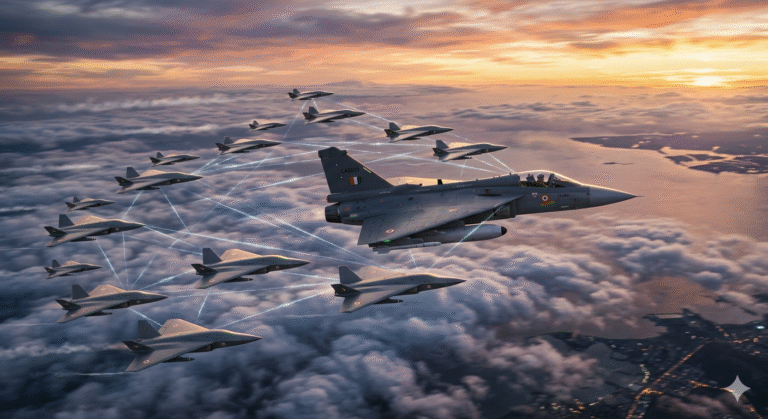
Integrated Command: The Integrated Air Command and Control System (IACCS)—AI-enabled battle management system fusing data from all sensors in real-time, performing threat classification, predictive tracking, and optimal interceptor selection within milliseconds.
Multi-Tiered Shooters:
- S-400 Sudarshan Chakra: Existing Russian system serving as the upper tier (400 km range, simultaneous engagement of 36 targets)
- Project Kusha: Indigenous long-range interceptor system (M1: 150 km, M2: 250 km, M3: 350 km)
- Akash/MR-SAM/QR-SAM: Medium and short-range systems
- Directed-Energy Weapons: Lasers, high-power microwaves, counter-UAS systems for close-in defence
Offensive Integration: Sudarshan Chakra integrates with the Integrated Rocket Force via IACCS, enabling simultaneous detection, interception, and counter-strike as a single operational loop—not just passive defence.
The Hypersonic Missile Challenge
What Makes Hypersonic Missiles Unique
Define Hypersonic: Missiles or glide vehicles traveling above Mach 5 (6,174 km/h) with extreme manoeuvrability and unpredictable trajectories, fundamentally different from traditional ballistic missiles.
Why They Destabilise:
- Compressed Decision Times: Launch-to-impact time reduced to 5-10 minutes vs. 25-30 minutes for ICBMs, compressing leaders’ decision windows for retaliation
- Unpredictable Trajectory: Glide vehicles manoeuvre mid-flight, evading predictive interception algorithms
- Radar Gaps: Speed and manoeuvrability enable evasion of existing air defence radar coverage
- Defence Bypass: Traditional layered air defence (designed for ballistic missile arcs) insufficient against low-trajectory, manoeuvring threats
Regional Threat Profile
Chinese DF-17: Hypersonic glide vehicle with 2,000-2,500 km range, already operational, represents existential strategic threat to Indian command centres and nuclear bases.
Pakistani Acquisition Risk: Reports indicate Pakistan negotiating for DF-17 transfer from China—would enable “decapitation strike” doctrine crippling India’s C2 infrastructure within minutes of launch, raising accidental escalation risks.
Existing Indian Gaps: S-400 designed for traditional ballistic threats; BMD Phase-I offers limited anti-hypersonic capability (terminal-phase interception only); comprehensive hypersonic defence absent until Sudarshan Chakra completion.
Integrating Hypersonic Defence into Sudarshan Chakra
Phase-Based Implementation
Phase I (by 2028-29): Initial protection of Delhi-NCR and high-value areas using S-400, existing BMD Phase-II, and medium-range systems; primarily based on imported + in-service platforms.
Phase II (early-to-mid 2030s): Integration of Project Kusha interceptors with dedicated anti-hypersonic capability; extended-range radars (>1500 km); AI-enabled fire-control compressing OODA (Observe-Orient-Decide-Act) cycles to subsecond response times.
Final Vision 2035: Nationwide shield with 150+ km altitude capability, multi-front deterrence, seamless offensive-defensive integration, and specialized anti-hypersonic Phase-III interceptors under development.
Technical Features: Hypersonic Interception Layer
Sensor Upgrades: Space-based infrared early-warning satellites detecting hypersonic vehicle boost-phase; jamming-resistant AESA radars tracking manoeuvring targets; multi-static radar networks for target correlation.
Interceptor Profile: High-acceleration, hit-to-kill vehicles with active guidance and agile divert thrusters; 80-90% single-shot kill probability (98%+ in salvo mode); engagement envelope potentially extending to 500+ km range and 150+ km altitude.
AI-Enabled Battle Management: Predictive algorithms anticipating hypersonic trajectory; threat classification prioritising high-value targets; automated handoff between interceptor tiers; human-on-the-loop decision support (humans approve/deny within 2-3 second windows).
Strategic Significance and Deterrence
Deterrence by Denial
Sudarshan Chakra fundamentally shifts deterrence doctrine from “Mutually Assured Destruction” to “Deterrence by Denial”—raising the cost and uncertainty of missile attacks, making aggression irrational for adversaries.
By demonstrating capability to intercept 80-90% of incoming hypersonic missiles (vs. earlier inability to intercept any), India changes the strategic calculus: aggressor must now assume majority of attack will be negated, making first-strike non-viable.
Tri-Service Integration and Multi-Domain Defence
Sudarshan Chakra unifies Army, Navy, Air Force air-defence assets, integrating cyber, space, and electronic-warfare layers—creating true multi-domain shield.
Reduces duplication, improves response times, and enables joint situational awareness on national scale—unprecedented operational integration in Indian military history.
Regional and Global Positioning
Positions India among elite group (US, Russia, China) actively developing hypersonic defence, raising profile in export controls, arms-control talks, and technology partnerships with US, France, Israel.
Could trigger new arms-race dynamics: Pakistan/China may respond with more MIRVs, decoys, or cyber-attacks on sensor networks—complicating stability further.
Critical Challenges and Concerns

Technological Frontier
Hypersonic interception remains frontier technology with significant unknowns:
- Hit-to-kill accuracy at Mach 5+ speeds unproven at scale
- Integration complexity fusing legacy S-400, Project Kusha, BMD, Akash into one resilient network
- Cyber-vulnerability of AI-enabled systems to spoofing, jamming, data corruption
Decision-Making Under AI Automation
Compressing OODA loops to subsecond timescales necessitates delegating targeting decisions to AI with limited human oversight—raising ethical concerns about autonomous weapon systems and potential for cascading errors.
“Super OODA Loops” (AI-accelerated decision-making) could inadvertently lock humans out of critical decisions, especially during saturation attacks or false-alarm scenarios.
Cost and Opportunity Costs
National-level shield + hypersonic defence estimated at $100-200 billion over decade—raising questions about fiscal prioritization vs. land forces modernisation, naval expansion, and social sector spending.
Is it more cost-effective to shoot down missiles with expensive interceptors, or to develop deterrence-by-denial through offensive cyber, space, and conventional strike capabilities?
Arms Race and Escalation Spiral
Robust missile defence can embolden offensive doctrine escalation: Pakistan/China responding with saturation attacks (swarms), MIRVs, or decoys, eventually overwhelming defence.
May trigger broader South Asian arms race: Pakistan acquiring more missiles, China upgrading its arsenal, India expanding Sudarshan Chakra scope—classic security dilemma spiral.
Policy Recommendations
For India’s Immediate Strategy
- Phased Threat-Based Deployment: Start with key metros (Delhi, Bangalore, Mumbai), command nodes, nuclear bases; expand as technology matures
- Heavy R&D Investment: Hypersonic wind tunnels, hardware-in-the-loop simulations, radiation-hardened semiconductors, advanced materials
- Tri-Service Theatre Commands: Joint training centred on Sudarshan Chakra scenarios; inter-service standardisation
For International Partnerships
- Technology Cooperation: With US (possibly co-production of interceptor variants), France, Israel on seekers and propulsion
- Arms-Control Diplomacy: Regional confidence-building measures with Pakistan/China on accidental escalation risks
- Norms Development: Participate in UN/G20 discussions establishing norms for hypersonic weapon use and defence
For Parliamentary Oversight
- Transparent Cost Accounting: Public disclosure of budgets, timelines, performance benchmarks
- Civil-Military Balance: Parliamentary committees overseeing fiscal trade-offs between defence and development
- Ethical Framework: Codifying rules of engagement for AI in lethal decision-loops; ensuring human-in-the-loop remains non-waivable
Conclusion: The New Deterrence Frontier

Operation Sudarshan Chakra represents India’s answer to a fundamental security challenge: how to protect 1.4 billion people from increasingly sophisticated aerial threats in an age of hypersonic weapons, drone swarms, and AI-enabled warfare.
The project is ambitious, technologically challenging, expensive, and strategically necessary. It signals to adversaries that India is serious about protecting itself and capable of doing so with indigenous, credible, multi-layered systems.
Yet success is uncertain. Hypersonic defence remains frontier technology. Integration complexity is staggering. Fiscal pressures may force delays. Ethical questions about AI automation demand careful governance.






+ There are no comments
Add yours