Key Highlights:
- WYDE Launch Breakthrough: Launched December 10, 2025, as the world’s first “Impact Exchange” where cryptocurrency trading automatically funds verified nonprofits like Feeding America, eliminating the need for separate charitable donation decisions.
- $EAT Token Mechanism: Each trade allocates 1-5% fees: 25% directly to hunger relief nonprofits, 25% to token holder rewards, 25% to platform operations, 25% to infrastructure—with projections showing $912.5M annually to food banks at $500M market cap.
- Wyoming DUNA Legal Innovation: WYDE operates under Wyoming’s 2024 Decentralized Unincorporated Nonprofit Association framework, enabling token holders (starting 2026) to vote on nonprofit recipients, funding amounts, and impact priorities—bridging blockchain technology with nonprofit law.
- Governance Tension: Year 1 protects nonprofits through centralized agreements; 2026 transition to full token holder voting raises questions about wealth concentration, speculative incentives, and whether democratic governance improves (or harms) charitable impact.
WYDE Explained—The Mechanism
The Vision: Shopping Where Every Transaction Helps
Imagine every purchase at your local supermarket automatically sent 1-2% of the transaction to food banks. You don’t actively donate; giving happens as a byproduct of normal commerce. Money flows from commercial activity to those in need, without friction, without decision fatigue, without guilt.
WYDE (Wyoming Decentralized Exchange) applies this logic to cryptocurrency trading.
Launched December 10, 2025, WYDE is the world’s first “Impact Exchange”—a decentralized cryptocurrency exchange where trading activity automatically generates charitable contributions through embedded fee allocation and smart contracts.
The first token: $EAT, specifically funding hunger relief through organizations like Feeding America and No Kid Hungry.
How $EAT Works: The Fee Distribution
When you buy or sell $EAT on WYDE, a 1-5% dynamic trading fee is charged. Here’s where it goes:
| Fee Allocation | Percentage | Destination |
|---|---|---|
| Cause Impact | 25% | Direct funding to verified nonprofit partners (Feeding America, No Kid Hungry, etc.) |
| Holder Rewards | 25% | Distributed back to token holders as incentives |
| WYDE Operations | 25% | Covers liquidity, marketing, platform stability |
| Infrastructure | 25% | Technical infrastructure, blockchain costs |
| Additional | 0.20% | Clanker/Farcaster protocol for token deployment |
Real-World Impact Projection: At a $500 million market cap with 2x daily trading velocity ($365 billion annual volume at 1% average fee):
- 25% of 1% fee to hunger relief = $912.5 million annually to food banks
- Compare: Feeding America (2024) distributed approximately $5 million meals from donations
- WYDE-equivalent would enable 260 million meals annually from trading fees alone
Smart Contract Automation
The genius of WYDE is smart contracts—self-executing code on the Base blockchain that automatically:
- Splits trading fees into four portions
- Transfers cause funds directly to nonprofit wallets
- Distributes holder rewards
- Records every transaction immutably on blockchain
No intermediaries. No discretion. No accounting fraud possible.
All 1.6 million nonprofit organizations in the US—historically reliant on episodic donations, grant cycles, and fundraising campaigns—suddenly have access to an alternative: revenue from market activity aligned with their mission. youtube
The Wyoming DUNA Innovation—Legal Framework
Wyoming’s Blockchain Bet: DAOs Get Legal Status
In March 2024, Wyoming Governor Mark Gordon signed into law the Decentralized Unincorporated Nonprofit Association (DUNA) framework—the nation’s first legal structure enabling DAOs (Decentralized Autonomous Organizations) to operate with legal recognition. internetnative
Prior Problem: Blockchain-based organizations faced legal limbo. Token holders were “members” with no formal legal status. Contracts with nonprofits were unenforceable. No liability protection. No entity capable of owning property or entering agreements.
DUNA Solution: Recognizes token holders as association members with governance rights; creates legal entity status separate from individual members; provides liability protection; enables contracts, property ownership, and court representation.
WYDE chose to operate as a DUNA because:
- Legal Entity Status: WYDE can enter binding agreements with nonprofits, ensuring charitable funding commitments are enforceable
- Token Holder Governance: Members (token holders) gain formal legal recognition with voting power
- Liability Protection: Individual token holders not personally liable for platform actions
- Credibility: Legal structure reduces regulatory risk and attracts institutional donors and nonprofits
Governance Model: From Centralization to Democracy
Year 1 (Bootstrapping Phase):
- WYDE and founding nonprofit partners set initial agreements
- Protects early nonprofits by preventing harmful or arbitrary funding changes
- Allows community to learn governance participation without disrupting funds
2026 Onward (Full Decentralized Governance):
Starting in 2026, $EAT token holders vote on:
- Which hunger relief organizations receive funding
- Quarterly distribution amounts
- Impact priorities (geographic focus, beneficiary demographics)
- Nonprofit performance evaluation and potential removal
This is plutocratic democracy: One token = one vote. Larger holders wield more influence. Theoretically transparent and participatory; practically vulnerable to wealth concentration and gaming.
Opportunities—Why This Matters
Philanthropy Reimagined
Passive Giving Without Decision Fatigue
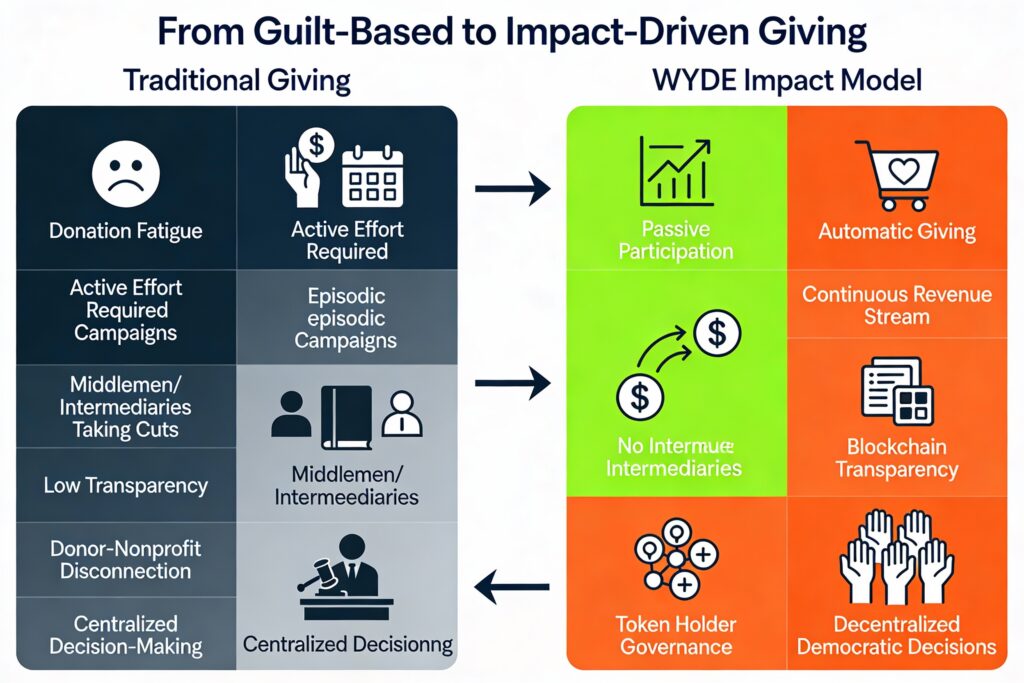
Donor fatigue is real. Major donors face endless solicitations; average citizens feel overwhelmed choosing charities. WYDE inverts this: giving happens naturally through trading, not through separate donation decisions.
If you trade $EAT because you believe in its appreciation potential, hunger relief funding is a byproduct. You don’t have to choose to be charitable; you are, automatically.
Nonprofits Get Stable Revenue Streams
Unlike episodic campaigns or grant cycles, WYDE-funded nonprofits receive continuous revenue tied to trading volume.
- No fundraising overhead
- No grant writing and rejection cycles
- Predictable (if volatile) income enabling multi-year planning
- Access to crypto wealth demographics (young, tech-savvy, globally distributed)
For the 1.6 million US nonprofits competing for donations, this is transformative.
Transparency Through Blockchain
Every dollar from trading fee to nonprofit wallet is recorded on an immutable ledger, visible to donors, regulators, and beneficiaries.
Corruption and misappropriation become technically impossible (though accounting fraud and fund misuse by nonprofits remain possible).
Democratized Governance
Token holders shape philanthropic decisions. Unlike traditional models where wealthy donors or foundation trustees control grantmaking, WYDE distributes voting power more broadly—though wealth concentration remains a risk.
Risks and Ethical Tensions
The Speculation Problem
Here’s the uncomfortable truth: $EAT is not primarily a charitable vehicle. It’s an investment token.
Traders buy $EAT hoping price appreciation nets profits. They’re not buying “$EAT to feed hungry children”; they’re buying “$EAT to get rich.”
The 25% holder rewards explicitly incentivize this: the more you trade/hold $EAT, the more you profit. Charitable impact is secondary to personal gain.
Risk: “Cause-washing”—wrapping financial speculation in philanthropic narrative, exploiting do-gooder sentiment for profit motives.
Worse: Pump-and-dump schemes exploiting WYDE’s model. Manipulate token price upward, sell when price peaks, abandon project (and nonprofits lose funding source).
Governance Capture and Plutocracy
One token = one vote. A whale (large token holder) with $1 billion in $EAT wields as much governance power as 100,000 small holders with $1 million collectively.
Scenario: A whale votes to fund a nonprofit paying kickbacks. Or directs all funding to their preferred cause, ignoring community preferences. Or votes to dissolve the entire charity model to maximize token holder rewards.
The 2026 governance transition is both WYDE’s promise (democratization) and its greatest risk.
Mission Drift and Cause Commodification
When nonprofits must appeal to token holder voters quarterly to receive funding, incentives change.
- Choose popular, emotionally visible causes (cute hungry children) over unglamorous but critical work (policy advocacy, research)
- Optimize for “Instagram metrics” (meals served) over long-term impact (system change)
- Perform for token holders rather than serve beneficiaries authentically
What if hunger relief becomes an investment category rather than a moral imperative?
Technical and Market Risks
- Smart contract bugs: Code vulnerability could drain funds or lock them inaccessibly
- Blockchain dependency: If Base network fails, WYDE operations halt
- Token volatility: Cryptocurrency crashes destroy funding predictability
- Market concentration: Concentration risk if WYDE captures majority of crypto-for-good space
India’s Regulatory and Practical Challenges
The Crypto-Charity Tax Trap
India’s tax regime creates a paradox for WYDE adoption:
30% Tax on Crypto Gains
Any profit from $EAT trading is taxed at 30% (flat rate, no deductions).
Charitable Donations Not Tax-Deductible if Made in Crypto
Under Indian tax law, charitable donations qualify for 80G tax deductions only if made through banking channels or cash (up to ₹2,000).
Crypto donations do not qualify.
The Illogic: An Indian trader buying $EAT for ₹100,000 and selling it for ₹150,000 pays 30% tax on ₹50,000 gain = ₹15,000 tax. The ₹37,500 (25% of 1.5% fee) automatically donated to hunger relief? Not tax-deductible. The trader gets no recognition or benefit for the charitable contribution.
Result: WYDE participation becomes economically irrational for Indian taxpayers compared to direct charitable giving through traditional channels.
FCRA Complications
India’s Foreign Contribution (Regulation) Act restricts foreign funding of nonprofits. WYDE is US-based. Feeding America is US-based.
If WYDE funnels crypto donations to Indian nonprofits working on hunger relief, does it trigger FCRA requirements?
Current regulatory clarity: None. This ambiguity alone discourages Indian NGOs from participating.
RBI Concerns and Institutional Barriers
The RBI remains cautious on cryptocurrency. Banks avoid serving crypto companies. Payment channels are unreliable. Compliance costs for WYDE to operate in India would be prohibitive.
Digital Divide and Access
WYDE requires:
- Cryptocurrency knowledge and comfort
- Digital wallet access
- English-language interface (currently)
- Internet connectivity
- Financial capital to trade
India’s 780 million internet users are distributed unevenly: urban centers have high penetration; rural areas lag. The poorest populations—whom hunger relief targets—lack financial capacity for crypto trading.
Irony: A platform designed to serve hungry people may be inaccessible to India’s poorest populations.
India-Adapted Model—”Bharat Cause Coins”
Rather than importing WYDE wholesale, India could develop adapted “Bharat Cause Coins” integrating UPI, government-verified nonprofits, and Aadhaar-based impact verification.
Structural Modifications
Denominated in Rupees, Not Crypto
Use UPI or digital rupee infrastructure, eliminating cryptocurrency tax and regulatory complexity. Micro-transactions (₹10-100 round-ups from everyday payments) accumulate charitable donations.
Government-Verified Nonprofits
Only nonprofits registered on the Darpan portal (government nonprofit registry) eligible for funding. Reduces fraud risk and FCRA complications.
Aadhaar-Based Beneficiary Verification
Link donated funds to actual beneficiaries via Aadhaar records. Show donors: “Your ₹50 fed Priya (age 6, Tamil Nadu) lunch today.” Creates accountability and emotional connection.
Regional Language Interfaces and Voice Access
Multilingual support (Hindi, Bengali, Tamil, Telugu, Marathi, Gujarati, Kannada, Malayalam, Odia) and voice-activated interface overcome digital literacy barriers.
Hybrid Governance
- Expert committee sets cause priorities (aligned with National Development Goals)
- Community votes on implementation details and nonprofit selection
- Government oversight through NITI Aayog or designated ministry
- Sunset clauses requiring periodic review and renewal
Strategic Causes
Aligned with SDGs and government priorities:
- Education: PM-POSHAN school meal schemes
- Healthcare: Ayushman Bharat beneficiaries
- Skill Development: National Apprenticeship Promotion Scheme
- Sanitation: Swachh Bharat Mission
- Women/SC/ST: Targeted support for underserved communities
Analysis:
Economic Innovation and Fintech
Opportunity: Blockchain-based philanthropy leveraging India’s UPI ecosystem could unlock millions in charitable funding previously “stuck” in savings without fundraising friction.
Challenge: 30% crypto tax, FCRA restrictions, RBI caution, and digital divide mean WYDE won’t work in India without legislative clarity and adaptation.
Governance and Regulation
Wyoming DUNA’s Innovation: Legal recognition of DAOs enabling token holder governance in nonprofit contexts—novel and potentially replicable.
Governance Risk: Token holder democracy concentrates power among wealthy traders rather than diverse stakeholders or affected communities.
Ethics
Tension: Passive giving through commerce reduces decision fatigue but enables “cause-washing”—wrapping financial speculation in philanthropic narrative.
Question: Is a charitable platform primarily serving trader interests (via holder rewards and price appreciation) ethically defensible if beneficiaries never explicitly consent to commodity trading in their name?
Conclusion: Innovation Requires Regulation, Not Restriction
WYDE represents a genuine philanthropic innovation: automating charitable giving through market activity, enabling continuous funding, and democratizing governance through blockchain technology.
Yet it also exemplifies fintech’s pattern: innovate first, regulate later, leaving gaps for exploitation, fraud, and unintended harms.
For India, the opportunity is clear: adapt WYDE’s insight—passive giving through everyday transactions—using indigenous infrastructure (UPI, Aadhaar, government nonprofits) and regulatory frameworks (FCRA, CSR Act, Darpan).
The challenge is equally clear: Create regulatory clarity without stifling innovation; expand access to underserved populations without paternalism; democratize governance without concentrating power among the wealthy.
WYDE exemplifies 21st-century governance challenges: technology outpacing policy, balancing innovation with fairness, managing regulatory gaps, and ensuring development benefits reach intended beneficiaries.







+ There are no comments
Add yours