
📌 Key Highlights
- Powertrain Evolution: Modern vehicles are transitioning from mechanical internal combustion engines to intelligent, software-centric electric and hybrid systems that dramatically improve efficiency and reduce emissions by up to 50%.
- Battery & Thermal Innovation: Fast-charging EV batteries require sophisticated thermal management systems maintaining cells at 15-35°C, with liquid cooling achieving a balance between charging speed and battery longevity through predictive models and dynamic current adjustment.
- Wide-Bandgap Revolution: SiC and GaN semiconductors enable 800V architecture, reducing losses by 30% and supporting ultra-fast charging, making inverters and on-board chargers smaller, lighter, and more efficient than traditional silicon devices.
- Software-Defined Powertrains: Over-the-air updates transform vehicles into adaptive systems that optimize efficiency in real-time, fix bugs remotely, and introduce new features without dealership visits—a game-changer for fleet management and consumer experience.
- India’s Strategic Opportunity: With PM E-DRIVE allocating ₹10,900 crore and the PLI scheme providing 7x increased incentives, India can build a globally competitive powertrain ecosystem in batteries, semiconductors, motors, and control software, positioning the nation as a leader by 2030.
Why Powertrains Matter for India
The automotive powertrain is the heart of mobility transformation. It determines how vehicles convert energy into motion, and increasingly, how efficiently they achieve it. For India, this shift from internal combustion engines (ICE) to battery-electric powertrains and hybrids represents far more than a technology change—it is a defining moment for energy security, industrial competitiveness, and climate responsibility.
India’s transportation sector accounts for approximately 8.4% of the nation’s carbon footprint, and road transport consumes over 17 million tonnes of oil annually. This fuel-import bill strains the economy, creating vulnerability to global energy markets. Simultaneously, Indian cities face severe air quality crises, with nitrogen oxides and particulate matter from vehicle exhaust contributing to respiratory diseases affecting millions. India has committed to achieving 30% electric vehicle penetration by 2030 under the National Action Plan on Climate Change, and net-zero emissions by 2070 under its Nationally Determined Contributions (NDCs) to the Paris Agreement.
Modern automotive powertrains—whether battery-electric (BEV), hybrid (HEV), or fuel cell (FCEV)—offer a pathway to these goals while creating opportunities for domestic manufacturing, employment, and technological leadership.
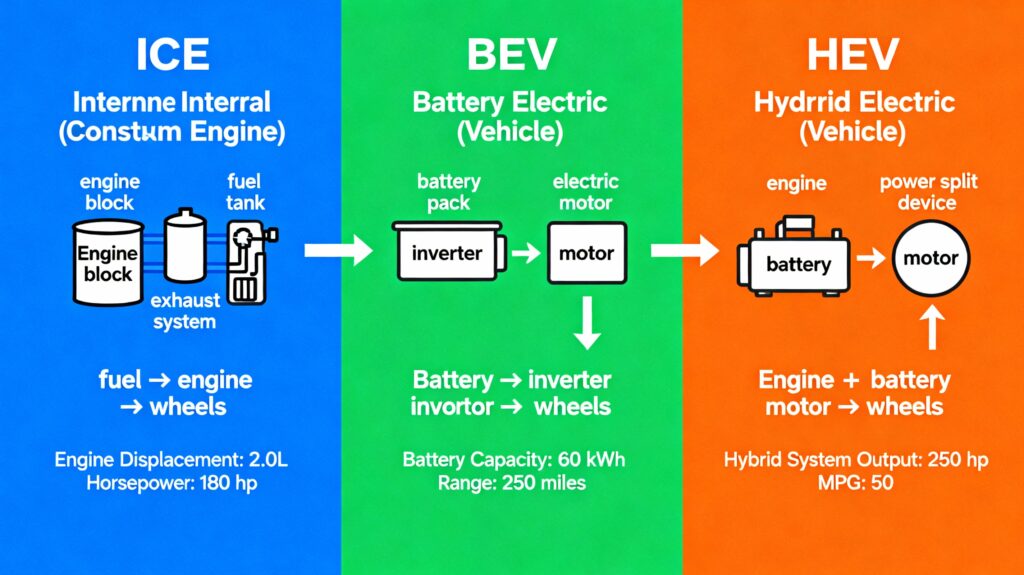
Traditional ICE Powertrain—The Baseline for Change
Before exploring electric alternatives, we must understand what is being replaced. The internal combustion engine (ICE) powertrain has dominated transportation for over a century, consisting of interconnected mechanical systems.
Core Components:
The engine converts chemical energy from fuel into mechanical power through controlled combustion. A typical petrol engine has efficiency of 20-35%, meaning 65-80% of energy is lost as heat. The transmission (gearbox) steps down engine output to appropriate wheel torque across multiple gear ratios. Driveshaft, axles, and differential distribute power to wheels, enabling steering and differential wheel speeds during turning.
Fundamental Limitations:
Thermal inefficiency (70-80% of fuel energy dissipates as heat), local air pollution (nitrogen oxides and particulate matter), complex mechanics (up to 2,000 moving parts increasing maintenance costs and failure points), and performance bottlenecks (gear shifts cause torque interruption) make ICE unsuitable for 21st-century sustainability standards. ijfmr
Battery-Electric Powertrains—Simplicity with Sophistication
Battery-electric vehicles (BEVs) represent a radical architectural departure, eliminating the transmission, gearbox, and internal combustion entirely. The result is stunning simplicity coupled with extraordinary technological sophistication. tandofline
Architecture & Core Components:
The traction battery pack is the energy source, typically lithium-ion (Li-ion) cells arranged in modules. Modern EV batteries operate at 400V (conventional) or 800V (next-generation), with energy densities reaching 250+ Wh/kg. Indian EV market growth is projected to reach USD 7.09 billion by 2025, with annual sales estimated at 10 million units by 2030.
Power Electronics—The “Brain”: The inverter converts DC battery power to three-phase AC current for the motor. High-performance inverters employ sophisticated control algorithms balancing multiple objectives in real-time: maximizing torque, minimizing losses, managing thermal stress, and coordinating with other vehicle systems.
Electric Motors: Two dominant designs compete: Radial flux motors (traditional, proven), delivering conventional torque profiles; Axial flux motors (emerging), offering 4x higher torque density, 50% weight reduction, and 1-2% better efficiency, with torque density reaching 100 Nm/kg—matching gasoline V8 engines from a compact, silent motor.
Battery Thermal Management—A Critical Techno-Economic Lever
Battery performance, lifespan, and safety are exquisitely sensitive to temperature. Lithium-ion cells operate optimally between 15°C and 35°C; outside this window, performance degrades, degradation accelerates, and thermal runaway risk emerges. During fast charging delivering 150+ kW, cells generate up to 2.5 kW of thermal energy, requiring sophisticated cooling.
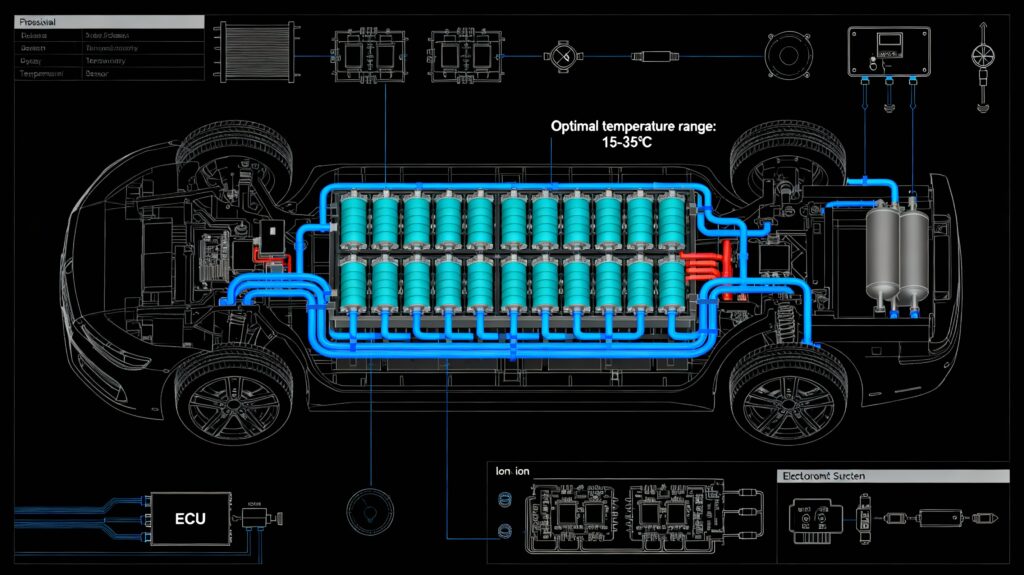
Thermal Management System Architecture:
Modern EV thermal management integrates four coupled circuits: battery cooling (primary), power electronics cooling (inverters, converters), electric motor cooling, and cabin climate. Liquid-based systems circulate water-ethylene glycol mixtures or refrigerants through serpentine channels embedded in battery modules, achieving uniform temperature distribution and precise control.
Fast-Charging Innovation:
Charging from 0-80% in 15-30 minutes requires extreme power delivery (up to 500 kW peak current at 600A). Current battery management systems employ dynamic current adjustment: starting at maximum to build initial charge rapidly, but reducing current if temperature rises excessively. Predictive models using deep learning (LSTM neural networks) estimate remaining useful life (RUL) in real-time, preventing over-stress. evengineeringonline
Advanced thermal switching protocols pre-condition batteries to optimal charging temperature (typically 25-35°C) even in cold climates, using high-voltage coolant heaters. This preheating phase ensures cells can accept maximum charge rate without lithium plating—a degradation mechanism reducing capacity and increasing fire risk.
Power Electronics Revolution—Wide-Bandgap Semiconductors
Traditional silicon-based power electronics face fundamental limits: switching losses increase dramatically at high frequencies and voltages. Silicon Carbide (SiC) and Gallium Nitride (GaN) wide-bandgap semiconductors overcome these constraints, enabling the next generation of efficient, compact, ultra-fast charging powertrains.
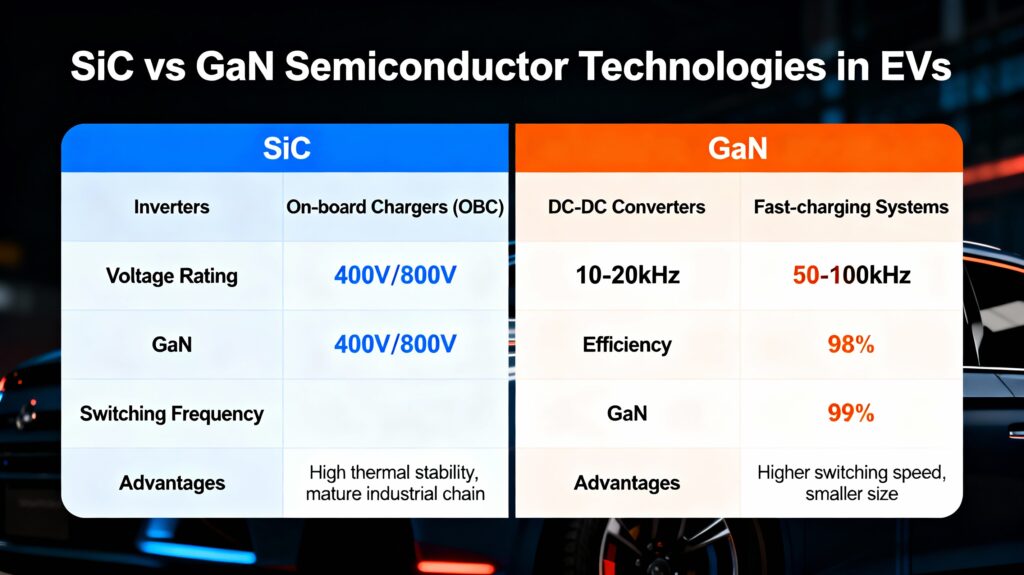
SiC vs GaN: Complementary Technologies
Silicon Carbide (SiC):
Superior performance above 1,000V, ideal for traction inverters and DC fast chargers. Switching frequencies reach 100+ kHz (vs 10 kHz silicon), with thermal conductivity 3x higher. Conduction losses are 50% lower than silicon at equivalent current ratings, enabling 800V EV architectures supporting 350+ kW fast charging. SiC-based inverters reduce power losses by 30% compared to silicon, translating to 5-8% range improvement for equivalent battery capacity.
Gallium Nitride (GaN):
Optimal for 400V systems, on-board chargers (OBC), and DC-DC converters. Faster switching speeds than SiC (MHz range) enable smaller inductors and capacitors. On-board charger efficiency improvements from 89% (silicon) to 95% (GaN/SiC) reduce charging time and grid stress. Lower cost trajectory due to simpler manufacturing processes positions GaN for emerging challenge to SiC for 800V systems.
Impact on EV Performance
Industry Data Reveals Transformative Gains:
Tesla’s shift to SiC in Model 3/Y inverters, followed by BMW (iX M60) and Mercedes (C-Class EQE), signals industry-wide adoption momentum. Combined efficiency improvements allow aggressive fast-charging protocols previously considered unsafe, cutting DC fast charging time from 45 minutes (0-80%) to 15-20 minutes.
For India, developing indigenous SiC/GaN manufacturing through the India Semiconductor Mission becomes strategically essential. The India Semiconductor Mission allocates ₹76,000 crore to build foundries, packaging facilities, and design centers, with current focus on establishing semiconductor fabrication plants expected to produce 80,000 wafers monthly.
Software-Defined Powertrains—The Intelligent Layer
Modern EVs are software-defined vehicles (SDVs) where functionality, efficiency, and safety increasingly reside in algorithms rather than fixed hardware. Over-the-air (OTA) updates are the enabling technology.
Over-the-Air Updates: Transforming Vehicle Evolution
Traditional vehicle updates required dealership visits, costing time and money. OTA enables wireless delivery of firmware, software patches, configuration changes, and even AI model updates directly to vehicles parked at home, in offices, or at charging stations.
The OTA process involves: (1) Content generation (firmware, software, configuration, AI models, command scripts); (2) Validation & testing through simulation and limited fleet trials; (3) Staged deployment to vehicle subsets, monitoring for anomalies; (4) Vehicle-side installation when safely parked with adequate battery; (5) Installation with rollback capability if failures occur.
Powertrain-Specific Benefits:
Battery Optimization: Algorithms adjust charging profiles based on ambient temperature, grid conditions, and driver usage patterns. Machine learning models predict optimal battery preconditioning for different climate zones, extending battery lifespan by 10-15%.
Efficiency Improvements: Real-time powertrain control algorithm updates optimize torque delivery, regenerative braking efficiency, and motor cooling, improving range without hardware changes.
Safety & Security Patches: Critical cybersecurity vulnerabilities in vehicle networks (CAN bus, Ethernet, wireless) can be patched remotely, addressing emerging threats faster than hardware recalls.
Feature Activation: OEMs deploy new features such as advanced driver assistance systems (ADAS) improvements, energy efficiency coaching, and predictive maintenance through software updates.
Cybersecurity Imperative for Connected Powertrains
As vehicles become software-defined and connected, cybersecurity becomes as critical as mechanical safety. India’s EV ecosystem faces unique vulnerabilities.
Regulatory Gaps: While IT security frameworks are robust, automotive cybersecurity standards remain nascent. The Bureau of Indian Standards (BIS) is developing automotive cybersecurity guidelines, but implementation mechanisms remain evolving.
Industry Preparedness: Many Indian EV startups lack dedicated cybersecurity teams, prioritizing rapid market entry over security hardening. Third-party components often represent “black box” imports introducing hidden backdoor vulnerabilities.
Infrastructure Vulnerabilities: Rapid expansion of EV charging networks has outpaced security standardization. Unsecured charging stations using legacy protocols (OCPP 1.6 without security extensions) become potential attack vectors for compromising vehicle systems.
Mitigation Strategies: Mandatory cybersecurity certification before vehicle type approval, secure-by-design architecture embedding encryption and secure boot, information-sharing platforms for threat intelligence, consumer education on software update discipline, and regular penetration testing are essential.
Hybridization & Fuel Cells—Transitional Pathways
Not all vehicles can transition directly to pure battery-electric powertrains. Hybrids and fuel cells bridge the gap, addressing range anxiety, charging infrastructure gaps, and segment-specific requirements.
Hybrid Electric Vehicles—Three Architectures
Mild Hybrid Electric Vehicles (MHEV): Battery (48V, ~0.5-1 kWh) with small motor assists during acceleration and captures regenerative braking energy. Improves efficiency by 10-15% without requiring plug-in charging. MHEV represents 95% of India’s hybrid market, primarily in light commercial vehicles where cost-sensitivity is high.
Full Hybrid Electric Vehicles (HEV): Larger battery (1.5-2.5 kWh) and motor enabling extended electric-only driving at low speeds (5-15 km range), reducing fuel consumption by 20-35%. Suitable for urban and suburban driving where frequent stop-start patterns maximize efficiency gains.
Plug-in Hybrid Electric Vehicles (PHEV): Battery (10-20 kWh) sufficient for 40-80 km electric range, with ICE as range extender for longer trips. Combines EV environmental benefits in daily commuting with ICE flexibility for occasional long-distance travel.
Why Hybrids Matter for India
Current EV market penetration faces barriers: high upfront cost, inadequate charging infrastructure (only ~26,000 chargers for 2+ million EVs), and range anxiety in tier-2 and tier-3 cities. Hybrids provide a practical bridge, enabling consumers to reduce emissions and fuel costs without requiring lifestyle changes or infrastructure transformation.
India Hybrid Vehicles Market reached ₹0.53 billion USD in 2025, projected to grow at 24.81% CAGR through 2029 as emission norms (CAFÉ III, BS VII) pressure OEMs to adopt mixed powertrains. However, current GST policy (18% on hybrids vs 5% on BEVs) discourages hybrid adoption despite their role in emission reduction. Policy harmonization—reducing hybrid GST to match BEV rates—would accelerate transitional adoption while OEM supply chains mature. jmsr-online
Fuel Cell Electric Vehicles—Heavy-Duty & Strategic
Hydrogen fuel cells excel where batteries face limitations: heavy-duty vehicles (trucks, buses), long-haul transport, and industrial applications where extended range and rapid refueling are essential. A hydrogen truck refuels in 5-10 minutes compared to 30+ minutes for EV fast charging, critical for fleet operators minimizing downtime.
India’s Hydrogen Ambitions:
The National Green Hydrogen Mission targets producing 5 million tonnes per annum of green hydrogen by 2030. Five pilot projects launched in March 2025 deploy 37 hydrogen-powered vehicles (15 fuel cell, 22 hydrogen ICE) across mining logistics and public transport, with ₹208 crore government support. Indian Railways announced plans to deploy hydrogen-powered Vande Bharat trains by 2026. Kochi and Visakhapatnam ports are being developed as hydrogen bunkering hubs to support maritime sector decarbonization.
Strategic Value: Leverages renewable energy (solar, wind) to produce green hydrogen, aligning with PM 2047 net-zero target. Enables decarbonization of heavy-duty transport currently reliant on diesel. Creates new industrial clusters and diverse powertrain portfolio, reducing battery supply chain bottleneck.
Industrial, Economic & Employment Implications
Powertrain transformation reshapes India’s automotive industrial ecosystem, with ripple effects across manufacturing, employment, and economic structure.
Supply Chain Revolution
Traditional ICE vehicle manufacturing concentrated on engine and gearbox production. Shifting to BEV requires fundamentally different supply chains: from engine manufacturers to battery cell and pack integrators, from gearbox suppliers to electric motor and controller designers, from fuel injection specialists to power electronics engineers.
This transition threatens incumbent suppliers lacking EV technology. Conversely, new entrants—battery startups (Ather Energy, Okinawa Autotech), charging infrastructure companies (Exicom, Statiq), and semiconductor designers—emerge as growth engines. Successful localization requires attracting global tier-1 suppliers and emerging specialists to establish manufacturing hubs in India.
Skilling Requirements & Employment
Powertrain transformation demands workforce reskilling on unprecedented scale: electronics & embedded systems, thermal management engineering, power semiconductors & wide-bandgap technology, automotive cybersecurity, and AI/ML for autonomous systems. The Ministry of Skill Development & Entrepreneurship has launched specialized training programs, but higher-skill roles in design require university curriculum transformation.
Make in India & Atmanirbhar Bharat Opportunities
India’s goal is manufacturing critical components. The PLI scheme offers incentives sevenfold since launch, targeting battery manufacturing (50 GWh annual capacity by 2030), semiconductor manufacturing (India Semiconductor Mission’s ₹76,000 crore), electric motor manufacturing, power electronics & inverters, and control software. indiascienceandtechnology
Environmental & Energy Policy Dimensions
Powertrain electrification only delivers emissions reduction if coupled with grid decarbonization and responsible battery lifecycle management.
Grid Decarbonization—The Silent Prerequisite
An EV charged on a coal-heavy grid merely displaces emissions from tailpipe to power plant. India’s power sector remains coal-dependent (coal generates ~70% of electricity). To achieve climate targets, India must reach ~90% renewable electricity by 2050. Fortunately, modeling studies demonstrate India’s renewable resource potential is sufficient.
Policy Alignment Required: Integrate EV charging infrastructure with renewable generation sites, implement time-of-use electricity pricing encouraging off-peak EV charging, enable vehicle-to-grid (V2G) integration for grid stabilization, and deploy smart charging algorithms.
Battery Lifecycle Management & Circular Economy
Lithium-ion battery production is energy-intensive and material-consuming. Creating a sustainable EV ecosystem requires end-of-life battery management (second-life applications in stationary energy storage extend economic value by 10-15 years), recycling & material recovery (recovering 90%+ of lithium, cobalt, and nickel), and policy mechanisms incentivizing recycling infrastructure development.
Regulatory & Safety Considerations
Transitioning from mechanical to electric powertrains requires reimagining vehicle safety, testing, and homologation standards.
High-Voltage System Safety
BEV powertrains operate at 400-800V—potentially lethal voltages. Comprehensive standards must address electrical safety (insulation resistance testing, ground fault detection), thermal safety (battery cell-level temperature monitoring, overcharge/overdischarge protection), and mechanical safety (crash testing specific to battery placement, pack integrity under collision).
Over-the-Air Update Governance
OTA introduces novel safety risks: faulty updates could compromise braking, steering, or stability control across fleets. Regulatory frameworks must address pre-update validation, atomic updates, rollback capability, and cybersecurity standards.
Data Privacy & Cybersecurity Regulation
Connected vehicles collect vast telematics daily. Misuse creates privacy risks; inadequate security enables remote vehicle hijacking. Proposed regulatory mechanisms include data minimization, encryption standards (AES-256, TLS 1.3), right to data deletion, and liability clarification.
Strategic Choices & Recommendations for India
India stands at an inflection point. Decisions made today determine whether the nation becomes a leader in next-generation mobility or a follower dependent on imports.
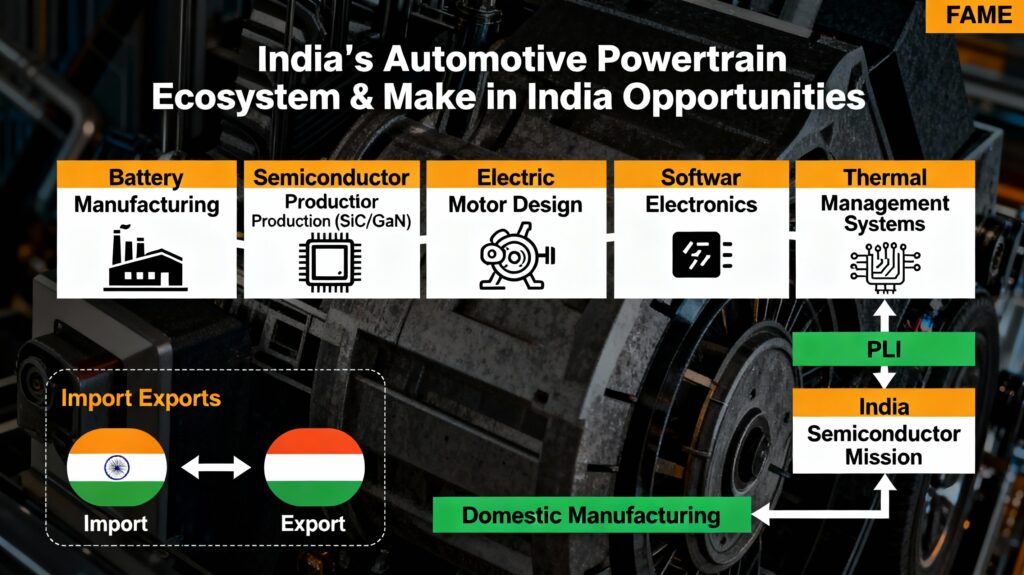
Priority 1: Domestic R&D in Frontier Technologies
Reduce technology import dependence by building indigenous capabilities in batteries, power semiconductors, and intelligent control software. Expand CSIR-CECRI’s lithium-ion research toward solid-state battery prototyping. Establish SiC/GaN research labs at IIT-Bombay, IIT-Madras, and BITS-Pilani. Fund AI/ML research for adaptive powertrain control.
Priority 2: Phased Powertrain Deployment Roadmap
Different vehicle segments have different readiness levels: two-wheeler sector (BEV primary, target 50% electrification by 2028), four-wheeler passenger vehicles (BEV for <300 km, hybrids for 300-600 km), commercial vehicles & heavy transport (FCEVs prioritized for trucks/buses by 2028-2040), two-wheeler last-mile delivery (aggressive BEV adoption with integrated charging-swapping hubs by 2026-2032).
Priority 3: Semiconductor Ecosystem Building
Accelerate foundry commissioning to advance 28 nm fab timelines. Create specialized SiC/GaN design centers at Bangalore, Pune, and Hyderabad. Establish “Semiconductor-Automotive Cluster” with co-located fabs, tier-1s, and test facilities. Train 10,000+ power electronics engineers over 5 years.
Priority 4: Skilling & Human Capital
Expand EV engineering curriculum at 100+ institutions. Establish mobile training units for 500,000 mechanics requiring reskilling. Create industry-academia partnerships with tax incentives. Fund Ph.D. programs with 5-year industry placements.
Priority 5: Charging Infrastructure & Grid Integration
Expand from current 26,000 to 100,000+ stations by 2030. Implement vehicle-to-grid (V2G) technology. Mandate rooftop solar on new parking structures. Adopt IEC 61851 charging connector standards uniformly.
Priority 6: Policy Harmonization for Hybrids
Reduce hybrid GST from 18% to 5%, matching BEV treatment. Include hybrids in FAME-II/III subsidy schemes. Apply same import duty rationalization to hybrid powertrains as BEVs.
Conclusion: India’s Powertrain Future
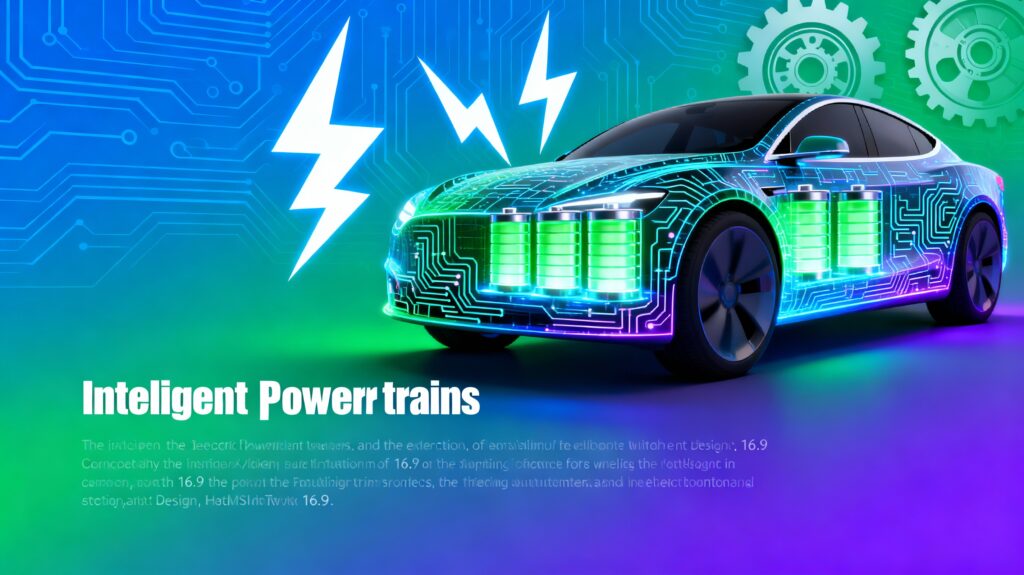
Modern automotive powertrains are evolving from mechanical devices to intelligent, software-centric systems continuously adapting to optimize efficiency, safety, and user experience. This evolution mirrors broader technological shifts toward AI-driven automation.
For India, this represents both opportunity and challenge. The emerging powertrain ecosystem—batteries, motors, power electronics, software, thermal systems—is neither locked into traditional ICE suppliers nor dominated by any single company. First-movers in semiconductors, battery manufacturing, and control software can establish market positions and supply-chain relationships that compound over decades.
Yet the window is narrow. The global EV transition accelerates daily: 25+ million electric vehicles sold annually worldwide, 45% of new car sales in Europe, and ambitious targets set across regions. India’s 30% EV target by 2030 is achievable but demands coordinated action across industry, government, academia, and civil society.
The imperative is clear: Strategic investments in semiconductors, battery manufacturing, thermal engineering, and intelligent control systems will position India as a leader in sustainable mobility. Delays risk consigning India to a follower role, losing opportunities to create millions of skilled jobs.
The intelligent heartbeat of vehicles tomorrow is being designed today. India can be the architect or merely the adopter. Policy choices made in 2025-2027 will determine India’s automotive future for the next 30 years.




+ There are no comments
Add yours