
📌 Key Highlights
- Milestone Achievement: India’s Smart Cities Mission reached 94% project completion (7,555 of 8,067 projects completed) as of May 2025, with ₹1,51,361 crore invested across 100 cities, demonstrating unprecedented scale in urban transformation.
- Technology Integration: Integrated Command and Control Centers (ICCCs) now operate in all 100 smart cities, utilizing IoT, AI, and data analytics to optimize traffic, water supply, and waste management while reducing operational costs and improving emergency response times.
- AI-Driven Efficiency: Smart city AI implementations like Pune’s intelligent traffic control system reduced congestion by 15-20% and improved traffic law compliance by 25%, while Bangalore’s BMTC increased ridership by 10% through predictive route optimization.
- Governance Revolution: E-governance platforms with blockchain integration (pilot in Vishakhapatnam) streamline digital service delivery, land records, and vehicle registration, while smart grievance redressal systems increase citizen engagement and transparency.
- Policy Imperative: Success requires institutional coordination, privacy-by-design frameworks, inclusive planning integrating informal sector, and alignment with climate targets—not merely technology deployment.
Introduction: The Urbanization Challenge and Smart City Imperative
India stands at a critical urbanization inflection point. Over 40% of India’s population will live in cities by 2030—approximately 600+ million people. This unprecedented urban concentration strains infrastructure, services, and governance systems designed for smaller, decentralized populations. Current urban challenges are stark: water scarcity affecting 40+ major cities, air pollution in Delhi averaging 10x WHO safety standards, waste management crisis with cities generating 380 million tonnes annually, and mobility gridlock where commutes exceed 2+ hours in metropolitan areas.
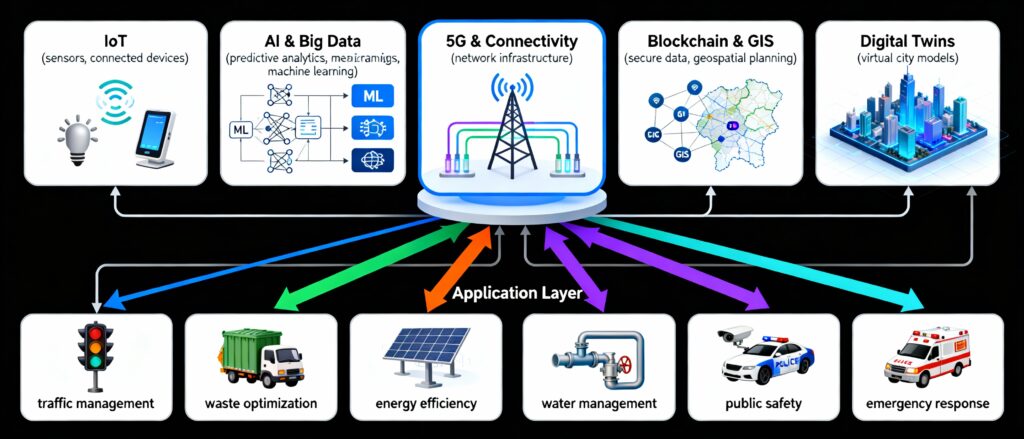
Traditional urban governance—built on static infrastructure, reactive maintenance, and centralized decision-making—cannot address these challenges at scale. Smart cities represent India’s bet on technology-enabled, data-driven, inclusive urban futures. By integrating Internet of Things (IoT), artificial intelligence (AI), 5G connectivity, blockchain, and digital twins, India’s Smart Cities Mission aspires to create cities that are sustainable, resilient, and economically vibrant.
However, success hinges not on gadgets or infrastructure alone, but on governance transformation, institutional coordination, and genuine citizen participation. This comprehensive analysis explores India’s smart city landscape, technological drivers, implementation challenges, and strategic imperatives for the next phase of urban evolution.
Context—Urbanization and the Smart City Imperative
The Numbers: India’s Urban Explosion
India’s urban population grows by approximately 2.5% annually—faster than rural growth. By 2030, urban India will account for 40% of the national population (500+ million), 65% of GDP, and 75% of tax revenue. This creates paradoxical pressures: cities must deliver growth-enabling infrastructure (transport, power, water) while simultaneously reducing emissions, improving air quality, and ensuring inclusive development. epw
The Infrastructure Deficit:
India’s cities face acute challenges across multiple dimensions. Water demand exceeds 220 billion liters daily; supply gaps leave 40+ cities facing acute water stress, particularly during dry seasons. Approximately 25% of urban households lack adequate sewage access despite Swachh Bharat investments. Congestion costs India ₹50,000 crore annually in lost productivity; air pollution from vehicles causes 100,000+ premature deaths yearly. Urban electricity demand grows at 5% annually, requiring renewable integration amid grid stability challenges.
Rationale for Smart Cities Approach
Smart cities deployment addresses these challenges through data-driven decision making. Pune’s smart parking system reduced parking search time by 30%, cutting vehicle emissions proportionally. Integrated Command and Control Centers (ICCCs) in all 100 cities monitor real-time operations—traffic flow, water pressure, power load, waste collection—enabling predictive maintenance and crisis response.
Resource Optimization: IoT-enabled systems reduce water loss from leakage (currently 40% in many cities), optimize energy distribution via smart grids (reducing technical and commercial losses from 21.5% to 16.2%), and streamline waste management through segregation and material recovery. pib.gov
Emissions Reduction: Electric vehicle integration, renewable energy in smart grids, and traffic optimization collectively reduce urban carbon footprints by 15-30%. This directly supports India’s 2070 net-zero commitment and Paris Agreement obligations.
What Is a Smart City?—Five Core Pillars

Smart cities are not defined by technology adoption alone, but by how technology serves human development, sustainability, and inclusion. India’s Smart Cities Mission framework identifies five core pillars:
Pillar 1: Smart Governance
Digital platforms transform citizen-government interaction from reactive to proactive.
E-Governance Platforms: Citizens access permits, registrations, tax payments, and service requests through unified portals (e.g., e-Seva in Andhra Pradesh). Processing time reduces from weeks to days; corruption decreases through transparent, automated workflows.
Grievance Redressal Chatbots: AI-powered systems respond 24/7 to citizen complaints—potholes, water leaks, sanitation issues. Pune’s grievance portal resolved 85% of cases within 15 days, compared to 45 days previously. Integration with municipal monitoring systems enables rapid resource deployment.
Blockchain for Land Records and Transactions: Vishakhapatnam’s blockchain pilot streamlines property ownership documentation, eliminates duplicate registrations, and enables secure e-transactions, reducing land dispute litigation by 40%. Similar pilots in automobile registration accelerate title transfers and reduce fraud.
Data-Driven Budgeting: Bhubaneswar’s participatory budgeting platform allows citizens to vote on infrastructure priorities, aligning public spending with actual needs rather than bureaucratic assumptions.
Pillar 2: Smart Mobility and Transport
Intelligent traffic management, public transport optimization, and EV integration reshape urban movement.
AI-Driven Traffic Control: Pune deployed machine learning algorithms that learn traffic patterns and optimize signal timing in real-time. Result: 15-20% congestion reduction, 25% improvement in traffic law compliance (through AI surveillance identifying violations like jaywalking). Bangalore’s BMTC implemented predictive analytics for bus scheduling, increasing ridership by 10% and reducing wait times by 15%.
Smart Public Transport: IoT-enabled bus fleets provide real-time tracking, passenger counting, and route optimization. Integration with navigation apps helps citizens plan journeys, reducing vehicle trips by 5-10%.
EV-Ready Infrastructure: Smart cities mandate EV charging stations in new developments. Charging infrastructure data feeds into smart grids, coordinating vehicle charging during renewable generation peaks, optimizing grid stability.
Pillar 3: Smart Energy and Smart Grids
Renewable energy integration and demand management through smart grids:
Smart Meters and Demand Response: India’s National Smart Grid Mission aims to install 250 million smart meters by 2025 (currently 29 million installed as of May 2025). Smart meters enable time-of-use pricing, incentivizing consumption during renewable generation peaks and reducing peak-hour strain.
Predictive Renewable Forecasting: AI algorithms predict solar and wind generation 12-48 hours ahead, enabling grid operators to pre-position reserves. Cost reduction: 18-25% lower grid integration costs.
Distributed Energy Resources (DERs): Rooftop solar with battery storage in residential areas becomes micro-grids during outages, improving resilience. Net metering policies (50+ GW solar now grid-connected) create prosumer models where citizens generate and trade renewable energy.
Pillar 4: Smart Healthcare and Public Safety
Telemedicine, AI diagnostics, and predictive health monitoring:
Telemedicine Networks: Rural and peri-urban clinics connect with tertiary hospitals via broadband. AI triage systems route cases efficiently; diagnostic imaging (X-rays, ultrasounds) is analyzed by machine learning, reducing diagnostic time and enabling early intervention.
Public Safety and Surveillance: AI-powered CCTV systems detect unusual activities (loitering, overcrowding, traffic violations), enabling preventive policing rather than reactive response. Face recognition identifies missing persons and wanted criminals within minutes. However, surveillance expansion requires robust data privacy frameworks.
Pillar 5: Smart Infrastructure—Water and Waste
IoT sensors and automation optimize traditionally labor-intensive systems:
Water Management: Smart meters detect leakage in distribution networks; pressure sensors adjust supply dynamically. Tirupati reduced water loss from 48% to 18% through smart distribution. AI predicts demand patterns, optimizing treatment and storage.
Waste Management: Segregation at source (wet/dry/recyclable) enables material recovery. Pune’s compressed biogas plant converts organic waste to energy; Vishakhapatnam’s waste-to-energy facility converts 200 tonnes daily to electricity. Digital tracking ensures accountability.
India’s Smart Cities Mission—Objectives and Design
Mission Framework (Launched June 2015)
The Smart Cities Mission is India’s largest urban transformation program, addressing 100 cities through two complementary approaches:
Area-Based Development (ABD): Redevelop 5-10 sq km city zones as showcase models. Projects include traffic management hubs, heritage conservation with IoT monitoring, smart parking, and e-governance centers. ABD projects anchor city-wide transformation by demonstrating benefits.
Pan-City Solutions: City-wide systems (ICCCs, smart grids, traffic management, water networks) scale benefits beyond ABD zones. Approximately 40% of funding (₹65,000 crore) targets pan-city infrastructure.
Core Objectives Alignment
Urban Sustainability: Designs mandate eco-friendly construction (LEED/IGBC certification), green buildings, and solar integration. Carbon footprints reduce through efficient transport and renewable energy. Climate resilience planning addresses flooding and urban heat islands through nature-based solutions (wetlands, urban forests).
Infrastructure Enhancement:
Public transport expansion reduces private vehicle dependence. Smart sanitation addresses waste management crisis. Water security achieved through smart distribution, recycling, and rainwater harvesting. As of May 2025, 7,555 completed projects worth ₹1,51,361 crore demonstrate scale.
Digital Transformation:
All 100 cities have operational ICCCs providing real-time monitoring and decisioning. These same ICCCs functioned as COVID-19 war rooms during pandemic, coordinating hospital capacity, testing, and resource distribution—demonstrating technology’s crisis utility.
Economic Growth and Innovation:
Smart cities attract startups and tech companies. Bangalore’s tech corridor, Pune’s IT sector, and Indore’s logistics hub flourish through smart infrastructure. Employment generation: 15+ million direct and indirect jobs through construction, tech services, and operations. pib.gov
Social Inclusion:
Affordable housing integration (convergence with Pradhan Mantri Awas Yojana), accessible services for disabled citizens, and multilingual e-governance platforms ensure digital divides don’t amplify urban inequality. However, informal sector integration remains a persistent challenge.
Key Technologies Driving Smart Cities
Internet of Things (IoT)—The Sensory Layer
Sensors embed intelligence throughout city infrastructure. IoT penetration in India reached 80% by 2025, with applications including:
Traffic Management: Magnetic and radar sensors count vehicles, pedestrian crossing sensors detect jaywalking. Real-time traffic data flows to central systems optimizing signal timing. Parking sensors guide vehicles to vacant spaces.
Air Quality Monitoring: Distributed sensors measure particulate matter (PM2.5, PM10) and gaseous pollutants (NO₂, SO₂). Hyperlocal data enables pollution alerts and trigger traffic rerouting in high-pollution zones.
Water Management: Pressure sensors detect leakage in distribution networks; turbidity sensors monitor treatment efficacy. Smart valves adjust flow based on demand forecasts.
Waste Collection: Weight sensors in bins trigger collection alerts, optimizing truck routes and reducing emissions.
Artificial Intelligence & Big Data—The Brain
AI transforms IoT data into actionable insights:
Predictive Maintenance: Machine learning models predict equipment failure (traffic lights, water pumps) before breakdown. Preventive maintenance costs 30% less than emergency repairs.
Traffic Prediction and Optimization: Neural networks analyze historical and real-time traffic, predicting congestion 1-2 hours ahead. Signal timing adjusts preemptively, reducing delays 15-20%.
Crime Mapping and Predictive Policing: Clustering algorithms identify emerging crime hotspots. Deploying police preemptively (not reactively) reduces incidents by 10-15%.
Energy Load Forecasting: AI predicts demand patterns (accounting for weather, events, time-of-day), enabling utilities to position renewable generation efficiently.
Adoption in India: AI adoption grew 60% over three years; major power grids deploy AI-driven solutions (over 50%).
5G and High-Speed Connectivity
5G enables ultra-low latency communication critical for:
Real-Time Infrastructure Control: Autonomous vehicles, remote surgery, and smart grid operations require millisecond-level latency. 5G provides this.
Edge Computing: Processing data locally rather than cloud-based reduces latency and privacy risks. Traffic optimization happens at the intersection, not a distant data center.
IoT Scalability: 5G supports millions of simultaneous device connections, essential for comprehensive city sensor networks.
India’s 5G rollout is accelerating; private operators (Jio, Airtel, Vodafone) are deploying in 50+ cities, with focus on smart city zones.
Blockchain—The Trust Layer
Distributed ledgers enable:
Secure Digital Governance: Immutable property titles, vehicle registrations, and license records prevent duplicate issuances and fraud. Vishakhapatnam’s pilot reduced land disputes by 40%.
Transparent Procurement: Smart contracts automate municipal tender processes, reducing corruption and bureaucratic delays.
Energy Trading: Prosumers (residential solar producers) trade excess generation peer-to-peer via blockchain, creating decentralized energy markets.
Challenges: Scalability (Bitcoin processes 7 transactions/second; urban applications need 1,000+/second) and energy consumption drive experimentation with proof-of-stake and layer-2 solutions.
Geographic Information Systems (GIS) and Digital Twins
GIS-Based Planning: High-resolution satellite imagery and cadastral data enable precise urban planning. Flood-risk mapping identifies vulnerable areas; transport planning optimizes routes accounting for terrain and existing infrastructure.
Digital Twins: Virtual 3D replicas of cities enable scenario modeling before physical implementation. Survey of India is creating digital twins of major cities in partnership with Genesys (also mapped Mecca and Mumbai’s Dharavi). Sangam Digital Twin Initiative (launched by Department of Telecommunications) leverages 5G/6G, IoT, AI, and AR/VR for future infrastructure planning.
Use cases: Disaster simulation (flood, earthquake response planning), traffic scenario modeling, and emergency evacuation optimization.
Challenges in India’s Smart City Development
Challenge 1: Funding and Financial Sustainability
The Bottleneck:
Initial infrastructure investment is substantial (₹1.64 lakh crore committed), but ongoing operational costs require sustained revenue. ICCCs cost ₹15-20 crore annually to operate; smart meters require maintenance. Municipal finances are stretched—property tax collections cover only 50-60% of municipal expenditures in most cities.
Financial Gaps:
State governments committed to matching central allocation (50:50 cost-sharing) have fallen short. Inadequate matching allocation by state governments is a documented grey area. Private funding through PPPs introduces risk: if municipal revenue generation fails, private partners exit, stranding projects.
Sustainability Models:
Successful cities employ tiered approaches: central subsidies for capital (ICCCs, major infrastructure), state co-funding, municipal cost-recovery through service charges (parking, water meters), and private sector participation in operations (reducing cost burden). Indore’s model—combining municipal bonds and PPP—provides partial template.
Challenge 2: Legacy Infrastructure and Municipal Capacity Gaps
Ground Reality:
Most Indian cities’ physical infrastructure predates 1990s. Water pipes leak; power grids are 40+ years old; roads lack proper drainage. Retrofitting smart systems into aging infrastructure is costly and disruptive.
Human Capital Deficit:
Urban Local Bodies (ULBs) lack skilled technicians for IoT deployment, data analysts for ICCC operation, and cybersecurity personnel. Training programs lag demand.
Governance Complexity:
Multiple agencies govern urban services (water, power, transport, sanitation) with overlapping jurisdictions and conflicting incentives. Integrating systems across agencies requires institutional reform, not merely technology deployment.
Challenge 3: Data Privacy and Cybersecurity
Surveillance Paradox:
Smart cities collect unprecedented data—vehicle movements, energy consumption, health records, financial transactions. Comprehensive data enables efficient governance but enables mass surveillance. Citizens’ fundamental rights to privacy conflict with smart city logic.
Key Vulnerabilities:
- IoT devices often lack encryption or use default passwords, creating attack vectors
- Interconnected critical systems (water pumps, power substations, traffic lights) become targets for cyberattacks that could harm public safety
- Data breaches expose personal information; insurance and liability frameworks are undefined
Regulatory Gaps:
India’s Information Technology Act 2000 provides baseline data protection, but privacy-specific legislation (like GDPR) is absent. CERT-In guidelines for smart city cybersecurity (2017) remain advisory, not mandatory. Bangalore, Delhi, and Pune lack unified cybersecurity standards; compliance varies by agency.
Best Practices Emerging:
Privacy-by-design mandates (data minimization, encryption, secure-by-default), transparency reports on government data requests, and citizen consent frameworks are gaining traction.
Challenge 4: Multi-Stakeholder Coordination
Institutional Fragmentation:
Smart Cities Mission operates through Special Purpose Vehicles (SPVs)—limited companies separate from elected municipal bodies. This enables rapid implementation but creates governance gaps: SPV boards often exclude ward councilors, reducing democratic accountability.
Agency Coordination:
Multiple ministries oversee aspects: MoHUA (cities), MoRTW (transport), Ministry of Power (energy), MoWR (water), DoT (connectivity). Lack of inter-ministerial coordination creates siloed projects—a smart traffic system unaware of water main construction, for example.
Citizen Engagement:
Public consultation in city planning often reaches only affluent, educated residents who attend evening meetings at hotels. Informal sector residents (vendors, slum dwellers, migrant workers) rarely participate, creating smart cities designed for formal economies.
Case Studies of Indian Smart Cities
Bhubaneswar: E-Governance Pioneer
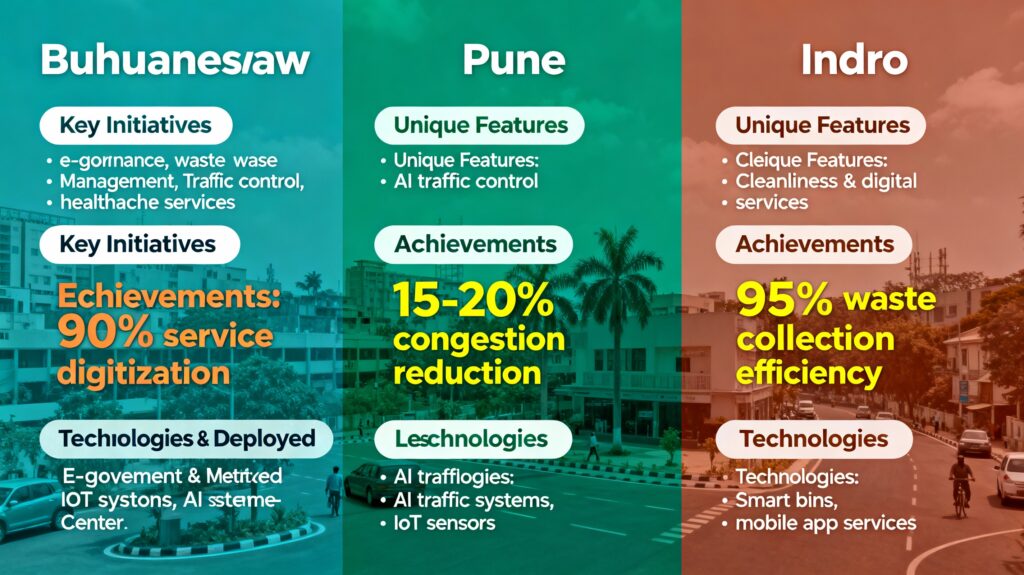
Approach: Bhubaneswar prioritized citizen-centric digital governance over hardware-centric infrastructure. Established an ICCC integrating 12 departments.
Key Achievements:
- E-Governance Portal: Property tax payment online (payment time: 10 minutes vs 1 day previously)
- Waste Management: Segregation at source; biomethanation plant processes 500 tonnes daily organic waste
- Smart Parking: 3,500 parking spaces integrated with real-time availability apps
- Grievance Portal: Resolved 92% of citizen complaints within stipulated timeframe
Challenges: Informal settlements (slums) remain unintegrated in digital systems; land tenure insecurity prevents utility meter allocation. Digital divides exclude low-literacy populations.
Lesson: Governance transformation precedes (and enables) technological sophistication.
Pune: AI-Powered Traffic and Citizen Engagement
Approach: Pune deployed comprehensive intelligent transportation systems and engaged citizens in budgetary decisions.
Key Achievements:
- AI Traffic Control: Reduced congestion 15-20%; improved traffic compliance 25%
- Smart Public Transport: Real-time bus tracking and route optimization; ridership increased
- Participatory Budgeting: Citizens voted on infrastructure priorities; democratic process strengthened
- Waste-to-Energy: Compressed biogas plant generates electricity from organic waste
Technological Integration: Integration of ICCC with traffic signals, water pressure networks, and waste collection coordination created holistic city operations visibility.
Challenges: Slum redevelopment projects (promised in smart city plans) displaced residents without adequate rehabilitation. Informal sector largely absent from smart city benefits.
Lesson: Technology’s efficiency benefits must couple with inclusive planning; technical sophistication without social equity produces smart-for-some cities.
Indore: Digital Governance at Scale
Approach: Indore, already ranked India’s cleanest city under Swachh Bharat, leveraged smart city resources to expand digital governance and integrated control systems.
Key Achievements:
- Smart Governance: Digital service delivery across 40+ municipal functions
- Integrated Command Center: Multi-agency coordination reducing response times
- Digital Land Records: Blockchain-enabled property documentation
- Intelligent Transportation System: Traffic management and EV charging infrastructure
Integrated Planning: Smart city projects converge with PMAY (affordable housing), Swachh Bharat (waste), and AMRUT (water infrastructure), multiplying impact.
Challenges: Participatory planning process was limited to affluent stakeholders; low-income residents felt excluded from planning decisions.
Lesson: Inclusive planning requires intentional engagement mechanisms (translated documents, evening/weekend consultation, transport facilitation) for marginalized communities.
The Road Ahead—Policy Directions and Future Prospects
Integration of AI and Automation
Health and Safety: AI-powered disease surveillance networks predict disease outbreaks (dengue, COVID-19 variants) through wastewater analysis and symptomatic search trends. Early warning enables preemptive public health response.
Utilities Automation: Autonomous robots inspect sewer systems, water pipes, and power cables, reducing manual labor hazards. Predictive maintenance algorithms minimize system failures.
Challenge: Job displacement in manual inspection and maintenance roles requires proactive skilling and income support policies.
Renewable Energy and Smart Grids Expansion
Integration Targets: India aims 500 GW renewable capacity by 2030. Smart grids enable this through:
- AI-based forecasting predicting solar/wind generation
- Demand response programs incentivizing off-peak consumption
- Vehicle-to-grid (V2G) integration storing energy in EV batteries
- Peer-to-peer energy trading via blockchain
Grid Stability Challenge: Renewable intermittency requires massive battery storage (150+ GWh by 2030). Cost reduction from ₹15,000/kWh (2015) to ₹5,000/kWh (2025) makes this feasible.
Smart Housing and EV-Ready Urban Design
Net-Zero Housing: New municipal housing (PMAY) integrates rooftop solar, rainwater harvesting, and waste segregation. Smart meters measure consumption; tenants receive consumption feedback, incentivizing efficiency.
EV-Ready Infrastructure: Building codes mandate EV charging pre-wiring in 50%+ of parking spaces. Charging coordination via smart grids optimizes grid load. By 2030, 30%+ of urban vehicles will be electric (from current 2%).
Transit-Oriented Development (TOD): Zoning reforms incentivize high-density, mixed-use development around metro stations, reducing vehicle dependence. Smart mobility (bike-sharing, app-based buses) connects transit hubs to dispersed residences.
Citizen-Centric Digital Services
Hyperlocal Governance Apps: Citizen apps enable real-time issue reporting (pothole, streetlight outage, water leak) with GPS tagging and photo evidence. Backend systems automatically assign to responsible agency, track resolution, and rate citizen satisfaction.
Accessibility for Persons with Disabilities: Voice-guided navigation in e-governance portals, tactile sensory signaling for visually impaired pedestrians, and accessible design in public spaces integrate equity into smart city logic.
Multilingual Platforms: E-governance interfaces in regional languages (Hindi, Telugu, Tamil, Marathi) reduce digital exclusion. Currently, English-centric platforms exclude 70% of urban residents.
Strategic Recommendations for India
Recommendation 1: Strengthen Governance Capacity
Issue: Municipal governance structures, unchanged since 1992 Municipal Corporations Act, lack technical expertise for smart city operations. SPVs operating outside democratic structures reduce accountability.
Action:
- Establish dedicated Smart City Operations Directorates within ULBs with specialized cadre (data analysts, cybersecurity personnel, GIS specialists)
- Mandate elected representative participation in SPV boards, restoring democratic oversight
- Create capacity-building programs (NITI Aayog, NIUA) training municipal officials in smart city governance
Institutional Coordination:
- Establish inter-ministerial Smart Cities Coordinating Committee (MoHUA, MoRTW, Ministry of Power, MoWR, DoT) with quarterly reviews ensuring convergence
- Mandate SPV planning convergence with AMRUT, PMAY, and Swachh Bharat for multiplier effects
Recommendation 2: Privacy-by-Design and Cybersecurity Framework
Issue: Data collection proliferation without robust safeguards violates fundamental rights; cybersecurity vulnerabilities expose critical infrastructure.
Action:
- Enact comprehensive data protection law (modeled on GDPR) with explicit smart city provisions: mandatory consent, data minimization, anonymization, and citizens’ right to deletion
- Implement mandatory cybersecurity audits (annually) and penetration testing for smart city systems; certify compliance before operation
- Establish public-private cybersecurity information sharing platform enabling rapid threat response
- Require Privacy Impact Assessments before deploying surveillance systems; publish assessment results publicly
Technical Standards:
- Adopt ISO 27001 (information security) and NIST cybersecurity framework for smart city infrastructure
- Mandate encryption (AES-256) and secure authentication (OAuth 2.0) for all connected systems
Recommendation 3: Inclusive and Equitable Planning
Issue: Current smart city planning benefits formal economy residents while marginalizing informal sector (40%+ of urban labor force).
Action:
- Mandate inclusive stakeholder engagement: reserved spots for informal sector representatives (vendors, waste pickers, slum residents) in planning processes
- Conduct participatory planning in multiple languages, provide transport and childcare support to increase participation
- Integrate informal sector into digital systems: e-commerce platforms for street vendors, digital grievance channels for slum residents, skill development programs for waste pickers transitioning to recycling operations
- Ensure affordable housing convergence: 25%+ of smart city housing for economically weaker sections (EWS)
Equity Metrics:
- Track digital access by socioeconomic quintile; target 80%+ digital service usage among poorest quintile
- Monitor smart city employment: ensure 40%+ of jobs go to EWS and SC/ST communities
Recommendation 4: Align with SDGs and Climate Targets
Issue: Smart Cities Mission objectives overlap with Sustainable Development Goals (SDG 11: Sustainable Cities) and India’s climate commitments (2070 net-zero, NDCs).
Action:
- Embed SDG indicators in smart city monitoring dashboards: 80%+ access to adequate housing (SDG 11.1), 20% reduction in emissions intensity (SDG 13), improved air quality to WHO standards
- Mandatory climate resilience planning: flood risk modeling, urban heat island mitigation, and cooling center networks addressing climate change impacts
- Track carbon footprint reduction annually; target 2% annual reduction per capita
- Integrate nature-based solutions: urban forests, wetlands, and green infrastructure reducing both emissions and flood risk
Recommendation 5: Enhance Funding and Sustainability
Issue: ₹1.64 lakh crore central commitment is capital-heavy; operational sustainability uncertain.
Action:
- Develop municipal revenue sources: property tax modernization (currently 0.5% of urban property value vs 1-2% globally), service charge optimization (water, sanitation, parking), and congestion pricing in CBDs
- Institutionalize municipal bonds: enable cities to borrow at favorable rates for smart infrastructure, repaid through user revenues
- Green finance mechanisms: concessional financing for renewable energy and efficiency projects through development banks (NABHB, SIDBI)
- Public-Private Partnerships (PPP): transparent bid processes and risk-sharing frameworks prevent private sector exit and asset stranding
Conclusion: Toward Intelligent, Inclusive Urban Futures

Smart cities are not defined by technology adoption alone but by how technology serves human flourishing, environmental sustainability, and equitable development. After 10 years and ₹1.51 lakh crore investment, India has demonstrated that technology-enabled urban transformation is feasible at scale—94% of 8,067 projects completed, all 100 cities with operational ICCCs, tangible improvements in traffic, waste, energy, and governance across leading cities.
Yet critical challenges persist. Informal sector integration remains superficial; digital divides risk creating smart-for-some cities. Cybersecurity vulnerabilities and data privacy gaps undermine citizen trust. Fragmented governance structures produce silos rather than integration. Financial sustainability requires institutional reform, not merely technology deployment.
The next decade’s challenge is transforming smart cities from technology showcases to inclusive, resilient, democratically governed urban systems. This requires:
- Institutional strengthening of municipal governance and inter-agency coordination
- Privacy-by-design frameworks protecting fundamental rights alongside efficiency
- Genuine inclusive planning integrating informal sector and marginal communities
- Alignment with climate commitments and sustainable development goals
- Sustainable financing models ensuring operational continuity beyond initial capital investments
India’s urbanization trajectory is irreversible. 600+ million people will live in cities by 2030. The question is not whether cities will transform, but whether transformation will serve all citizens equitably or amplify existing inequalities. Strategic policy choices made in 2025-2027 will determine India’s urban future for decades.
The intelligent heartbeat of future cities is being designed today. India can lead the Global South in demonstrating that technology serves inclusive, sustainable urban development—or merely replicate exclusionary, extractive smart city models. The choice is governance, not gadgets.








+ There are no comments
Add yours