Key Highlights
- Augment Code (Claude on Vertex AI) completed a 4–8 month enterprise project in 2 weeks—demonstrating agentic AI productivity gains that reduce timelines by 75–80% for complex codebases.
- Developer onboarding dropped from weeks to 1–2 days when using agentic tools; new developers become productive faster without relying on senior engineers’ time.
- Agentic refactoring achieves 60–80% reduction in technical debt accumulation and 40% improvement in code maintainability, with 20–30% increases in overall development velocity.
- 26.1% of agent-generated commits explicitly target refactoring, dominated by low-level consistency edits (variable renaming, type changes), indicating agents excel at standardization and code quality tasks.
- For India: Policy urgently needed on reskilling, regulatory sandboxes for AI-assisted government software, and standards for autonomous debugging in critical infrastructure.
The Coding Revolution That Snuck Up on Everyone
Three years ago, AI coding assistants like GitHub Copilot were celebrated as “productivity helpers”—they’d auto-complete functions, suggest variable names, explain complex code. Useful, but ultimately complementary to human developers.
Today, the landscape has fundamentally shifted. Autonomous agentic AI agents don’t suggest code—they execute it.
When Augment Code deployed Claude 3.5 Sonnet on Google Cloud’s Vertex AI, something remarkable happened: an enterprise customer finished a software project in two weeks that their CTO had estimated would take 4–8 months. The agent didn’t just write code; it understood the entire codebase architecture, identified dependencies, refactored legacy patterns, generated tests, and validated performance—all autonomously. cloud.google
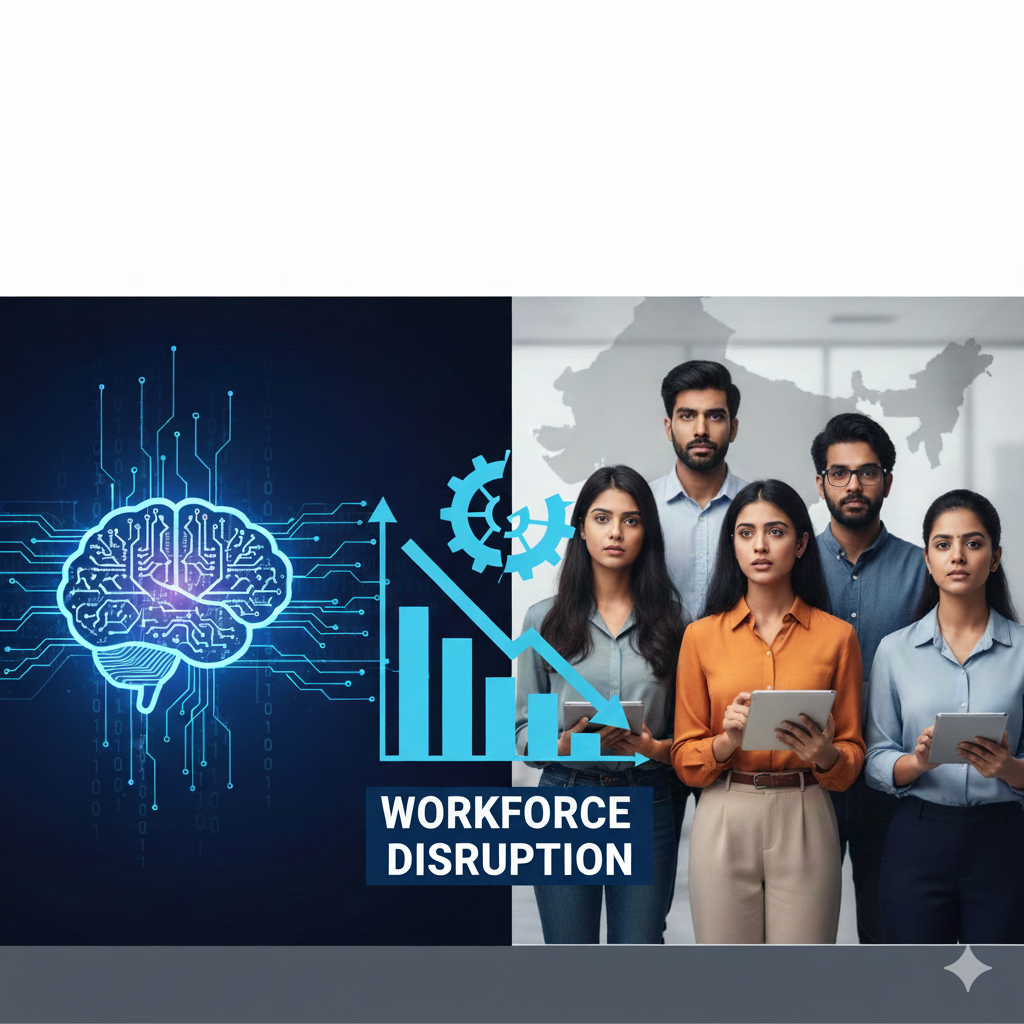
For India, this represents both a transformational opportunity and an existential crisis. India’s IT services industry (TCS, Infosys, Wipro, HCL) generates $245 billion in annual exports—largely by employing millions of developers in routine coding, testing, and maintenance tasks. Agentic AI threatens to automate the very foundation of that business model.
Yet simultaneously, it offers India’s government (Digital India, e-governance, BharatNet) the ability to accelerate critical infrastructure projects at unprecedented speed—if policy catches up.
This blog unpacks the agentic AI revolution and what India must do to navigate it.
From Autocomplete to Autonomous Agents
The Evolution
Traditional AI Coding Tools (2022–2023):
- Autocomplete suggestions (e.g., “type
forand suggestfor (int i = 0; i < n; i++)“) - Chat-based explanations (“Explain this function”)
- Documentation lookup
- Syntax error detection
Agentic AI Systems (2024–2025):
- Understand requirements in natural language (“Add pagination to this API endpoint”)
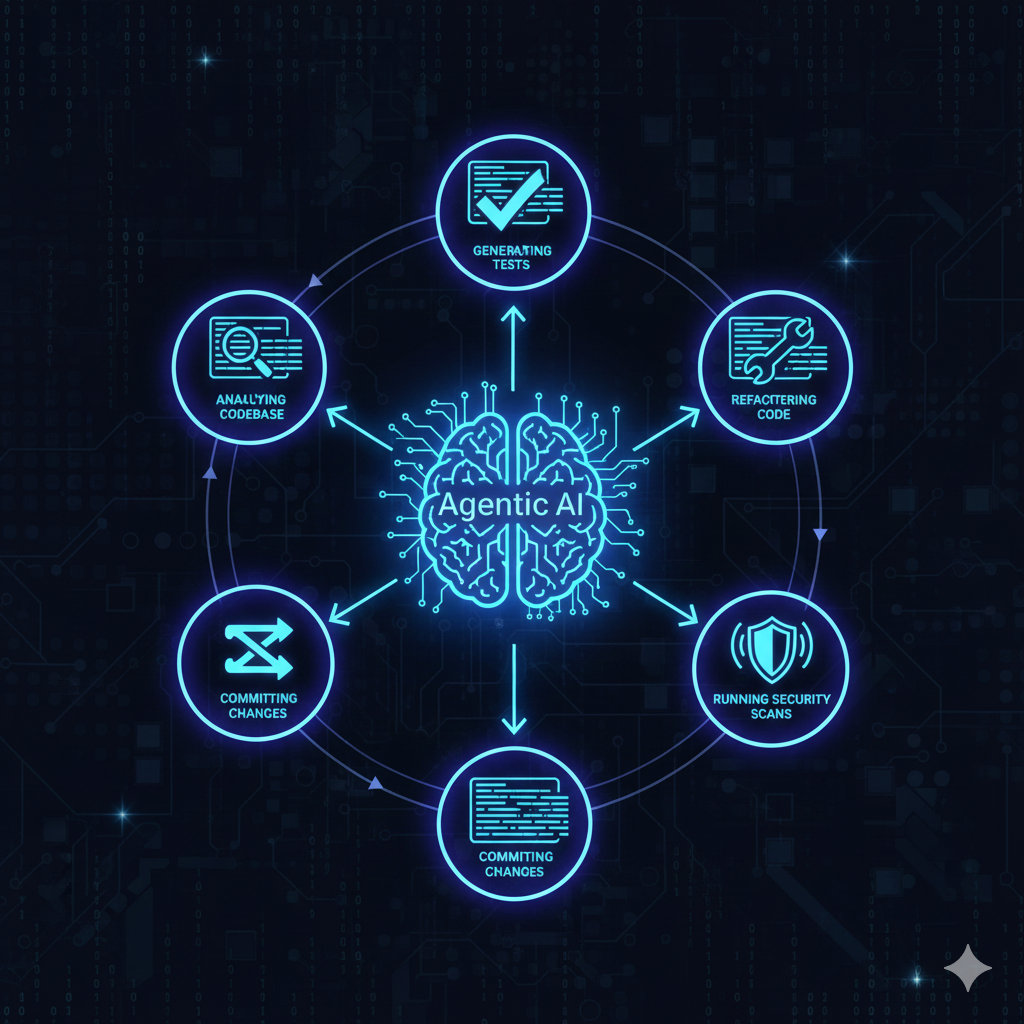
- Analyze entire codebase (millions of lines, hundreds of files)
- Locate relevant endpoints, understand patterns
- Modify logic while respecting project conventions
- Generate/update tests automatically
- Execute changes, validate performance, commit to version control
- All without human prompts after the initial requirement
A Real-World Example
Request: “Add pagination to the user API endpoint using cursor-based pagination with 50 items per page, consistent with our existing patterns, and include tests.”
Traditional approach:
- Developer reads documentation (2 hours)
- Developer reviews existing pagination implementations (2 hours)
- Developer codes the endpoint (4 hours)
- Developer writes tests (2 hours)
- Code review, fixes, back-and-forth (8 hours)
Total: 18 hours over 2–3 days
Agentic approach:
- Agent analyzes codebase, finds similar implementations
- Agent generates endpoint with pagination logic
- Agent auto-generates comprehensive tests
- Agent runs performance benchmarks
- Agent commits code
- Agent awaits human review (5 minutes)
Total: 30 minutes, human review time only
Productivity Revolution and Economic Impact
The Augment Code Case Study
Augment Code’s deployment of Claude on Vertex AI produced quantifiable results: claudeai
| Metric | Before Agentic AI | After (With Claude) | Improvement |
|---|---|---|---|
| Project timeline | 4–8 months | 2 weeks | 88–95% faster |
| Developer onboarding | 3–4 weeks | 1–2 days | 93–97% faster |
| Critical incident resolution | 2–4 hours | 15–20 minutes | 80–90% faster |
| Development velocity | Baseline | +20–30% | 20–30% increase |
| Technical debt | Accumulating | −60–80% | Declining |
Why does this matter for India?
India’s IT services rely on timeline-based contracts (“Project X will take 6 months, cost ₹3 crore”). If AI agents compress 6 months to 2 months:
- Revenue per developer drops (same project, 1/3 the billable hours)
- Profit margins compress unless headcount is proportionally reduced
- Competitive pressure increases (clients expect 6-month projects to cost ₹50 lakh, not ₹3 crore)
Autonomous Debugging, Refactoring, and Quality Control
What Agents Can Now Do Independently
Error Analysis and Root-Cause Detection
- Agent receives error log: “NullPointerException in UserService line 523”
- Agent searches codebase, traces call stack, identifies that a database query returned null under specific conditions
- Agent searches for similar patterns elsewhere in code
- Result: 5-minute analysis vs. 1–2 hour human debugging
Automated Refactoring at Scale
Research on 15,451 refactoring instances across 12,256 pull requests found: arxiv
- 26.1% of agent-generated commits explicitly targeted refactoring
- Top refactorings: Change Variable Type (11.8%), Rename Parameter (10.4%), Rename Variable (8.5%)
- Impact: Consistency across millions of lines of code, eliminating technical debt systematically
Quality Control and Security Scanning
- Agents detect race conditions, memory leaks, SQL injection vulnerabilities
- Agents propose or auto-apply fixes
- Agents generate tests validating the fix
- Result: Security audits that once took weeks are now continuous
Accelerated Onboarding and Skill Reconfiguration
The Onboarding Crisis Solved
Traditional onboarding narrative:
- New hire spends Week 1–2 reading documentation, setting up environment
- Senior engineer spends 10+ hours explaining architecture, patterns, dependencies
- New hire struggles with mental models for 4–6 weeks
- Productivity ramp: 50% at week 4, 80% at week 8
With agentic AI:
- Onboarding takes 1–2 days (environment setup + AI system orientation)
- Agentic AI acts as a “thinking partner” with perfect recall of system architecture
- New hire asks: “How do we handle authentication in this service?”
- Agent instantly provides code examples, patterns, and test cases
- Productivity ramp: 70% at day 3, 95% at week 2
Hiring Implications
If onboarding accelerates, hiring profiles shift:
Old model: Prioritize 5+ years of experience in specific tech stacks (Java, Spring, PostgreSQL) because learning curves are expensive.
New model: Prioritize strong fundamentals (algorithms, system design, debugging mindset) and rely on agents to fill specialized knowledge gaps. A brilliant 1-year developer + good agent > mediocre 5-year developer in specific stack.
Full-Stack Empowerment and Democratization
Breaking Down Specialist Silos
Example: Grafana’s Intelligent Assistant
Developers query observability data in natural language and get optimized PromQL/LogQL queries:
- Frontend developer: “Why is the checkout page slow?” → Agent queries database, identifies slow query, suggests index optimization
- Backend developer: “Why is user login timing out?” → Agent suggests frontend caching, CDN configuration
- DevOps engineer: “Which services consume the most memory?” → Agent identifies memory leaks, suggests fixes
Impact: Barrier to contributing across the stack falls. A 10-person team + agentic AI can deliver work equivalent to a 20–30 person team.
New Workflows and IDE Integration
How Teams Actually Use Agentic AI
Recommended adoption pattern:
- Phase 1: Small, low-risk tasks (write tests, add error handling, rename variables)
- Phase 2: Moderate tasks (add API endpoints, refactor legacy code)
- Phase 3: Large, architectural changes (redesign database schema, integrate new services)
Installation is trivial: Most agentic tools (Cursor, Aider, etc.) integrate directly into IDEs; setup takes 10 minutes.
Human oversight remains essential: Agents propose changes; humans review in pull requests before merging. This maintains accountability while capturing 80–90% of productivity gains.
Governance, Ethics, and Risk
Critical Concerns
1. Code Security and Supply-Chain Risk
- Problem: If AI agents auto-generate thousands of lines of code, who validates correctness?
- Risk: Subtle bugs introduced by agents could compromise critical systems
- Required safeguard: Mandatory security audits, AI-generated code flagged in version control, human code review for production
2. Accountability for AI-Generated Bugs
- Problem: If an agent introduces a vulnerability that causes a data breach, who’s liable—the developer, the company, or Anthropic/OpenAI?
- Required framework: Clear liability assignment, insurance products for AI-assisted code, regulatory clarity
3. Over-Reliance on Foreign AI Platforms
- Problem: India’s government and critical infrastructure depend on Claude (Anthropic/Google), GPT-4 (OpenAI/Microsoft)
- Risk: Export controls, geopolitical tensions, data sovereignty concerns
- Required action: Invest in indigenous agentic AI tools, ensure open standards
4. Data Protection for AI Training
- Problem: Enterprise codebases (trade secrets, security architecture) uploaded to Claude for analysis
- Required safeguard: Clarify what data is stored, used for training, or exposed to other companies
Implications for India’s Public Policy and Skilling
The Employment Crisis
India’s IT services employ 5+ million developers. If agentic AI reduces coding demand by 40–60% (conservative estimate), 2–3 million jobs are at risk within 5 years.
Yet simultaneously, demand for AI governance, security, and architecture roles will explode.
What India must do:
1. Curriculum Transformation (Urgent)
- Remove: 50% of rote coding exercises, syntax drills
- Add: AI-driven development workflows, agentic AI governance, security audits, system design
- Timeline: AICTE must update engineering curricula by 2026
2. Reskilling Programs
- NASSCOM and NSDC must launch “Agentic AI Governance” and “AI-Assisted Architecture” certifications
- Target: 2 million developers trained on new skill sets within 3 years
- Budget: ₹10,000+ crore for training infrastructure
3. Social Protection Policy
- Unemployment insurance for displaced routine coders
- Tax incentives for companies retaining and upskilling workers
- Future of Work Commission to define labor market transitions
4. Government IT Transformation
Opportunity: Digital India and e-governance projects can leverage agentic AI to ship faster.
But requirement: Strict validation, testing, and security frameworks for critical infrastructure.
Recommendation: Create regulatory sandbox—allow agentic AI for non-critical government software under strict audit trails; mandate human review for payment systems, health records, identity services.
Strategic Choices for Policymakers
Decision 1: Adopt or Restrict?
Question: Should India mandate agentic AI in government projects to accelerate delivery, or restrict it due to security/accountability concerns?
Answer: Selective adoption. Use for non-critical systems; mandate human-in-the-loop for critical infrastructure. Build regulatory framework as you go.
Decision 2: Domestic vs. Foreign Tools
Question: Should India rely on Claude/GPT-4 for agentic development, or invest in indigenous tools?
Answer: Both. Leverage foreign tools in near term for speed; invest ₹1,000+ crore in indigenous agentic AI platforms over 5–7 years.
Decision 3: Labor Market Transition
Question: How fast should India adapt hiring/training to agentic AI reality?
Answer: Aggressively. Every month of delay locks more developers into obsolete skill sets. Reskilling must start NOW.
Conclusion
Agentic AI is not coming to India’s software industry—it’s already here. Augment Code, Claude, OpenAI Agents, and others are transforming how software is built, maintained, and scaled.
For India, this presents a paradox:
- Opportunity: Accelerate Digital India, reduce government IT costs, enable startups to compete globally at 1/10th the team size
- Crisis: Displacement of 2–3 million routine coding jobs, erosion of India’s IT export model, dependency on foreign AI platforms
The path forward requires urgent action on three fronts:
- Policy: Regulatory sandboxes for agentic AI in government, liability frameworks, data sovereignty mandates
- Education: Reskill 5+ million developers into AI governance, security, architecture roles
- Innovation: Invest in indigenous agentic AI tools to reduce dependence on foreign platforms
The window is narrow. Decisions made in 2025–2026 will determine whether India leads the agentic AI revolution or becomes collateral damage.







+ There are no comments
Add yours