
Why Organic Farming Needs a Tech Upgrade
Organic farming is often viewed as traditional and low-tech—synonymous with manual labor, cow dung compost, and crop rotation. But in 2025, this perception is rapidly changing.
With rising demand for chemical-free food, farmers and startups are turning to AI and digital tools to scale organic farming while preserving its ecological soul.
From predictive analytics to drone spraying, and from soil sensors to blockchain traceability, technology is becoming a trusted ally in the future of farming.
🌐 Global organic food market is expected to reach $437 billion by 2026 (Statista)
🇮🇳 India has the largest number of organic farmers globally—over 4.5 million (FSSAI, 2024)
🤖 The Case for AI in Organic Farming
Unlike conventional farming, organic agriculture forbids synthetic inputs. That means:
- Higher pest/disease risk
- Lower productivity if poorly managed
- Dependency on natural cycles
AI can mitigate these challenges by:
- Predicting outbreaks before they spread
- Suggesting natural pest remedies based on real-time data
- Optimizing sowing and harvesting windows for climate-sensitive crops
🔍 How AI & Tech Work in Organic Fields: Key Use Cases
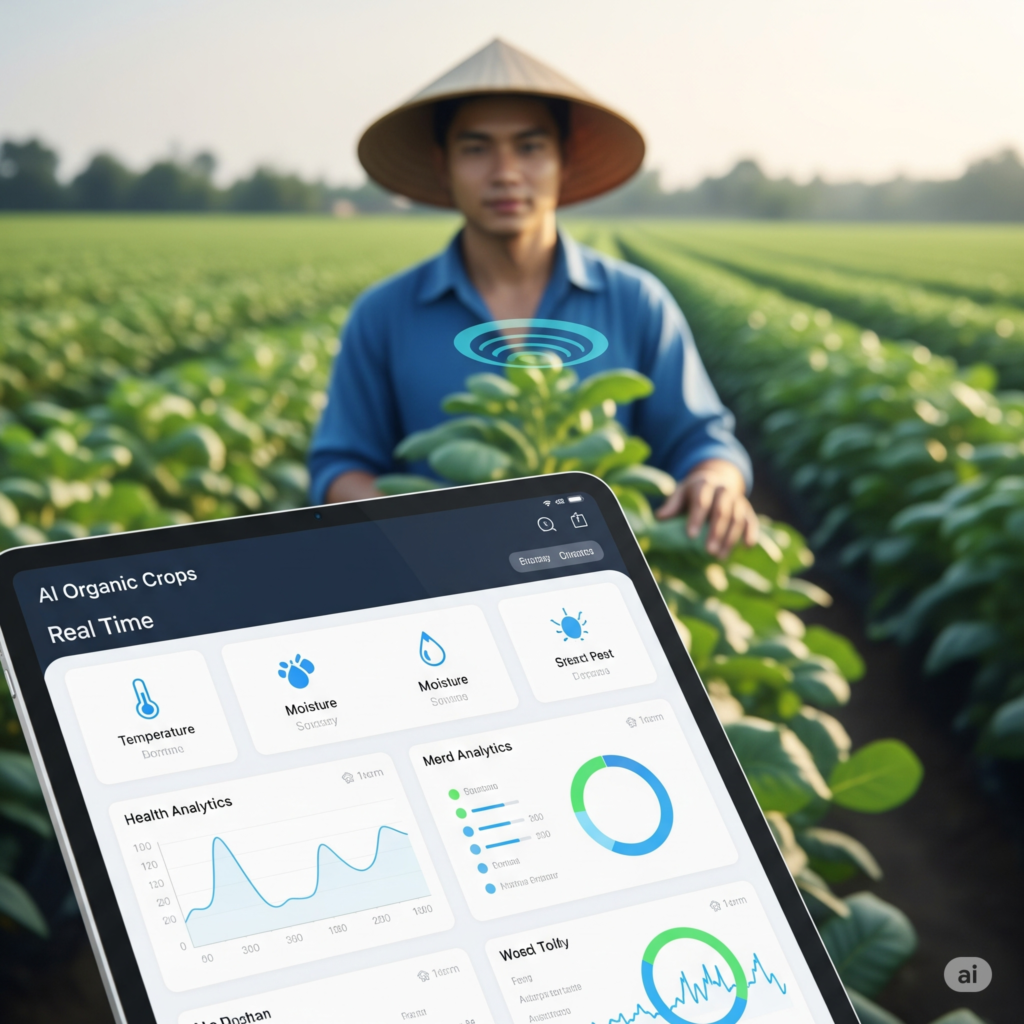
1. Precision Soil Monitoring
Problem: Organic yields drop with imbalanced nutrients or undetected fungal issues.
Solution:
- IoT soil sensors measure pH, nitrogen, phosphorus, moisture
- AI platforms adjust fertilization and watering recommendations using organic inputs (e.g., vermicompost, neem sprays)
📱 Example: Fasal and CropIn provide real-time soil-health dashboards.
2. Pest Prediction & Natural Remedy Suggestions
Problem: Without pesticides, controlling pests is a constant struggle.
Solution:
- AI analyzes satellite data, local weather, and crop imagery to flag threats
- Suggests organic-safe treatments: neem oil, pheromone traps, marigold borders
🧠 Example: TartanSense’s robot “BrijBot” uses computer vision to identify weeds for mechanical removal—chemical-free.
3. Automated Irrigation & Climate Control
Problem: Organic crops are sensitive to climate changes, especially drought or overwatering.
Solution:
- Smart irrigation systems like KritiKal’s Agripix monitor weather forecasts and soil moisture
- Micro-irrigation is auto-triggered using AI thresholds
This ensures water efficiency—a major win in drought-prone areas.
4. Supply Chain Transparency via Blockchain
Problem: Organic produce often gets mixed with non-organic in transit.
Solution:
- Blockchain records every step: from farm to table
- QR codes show buyers who grew it, where, and how
📦 Example: SourceTrace offers such traceability for organic cooperatives in Uttarakhand.
5. AI-Powered Crop Selection and Yield Forecasting
Problem: Many organic farmers experiment without data—leading to low ROI.
Solution:
- Machine learning analyzes previous yields, weather trends, soil history
- Recommends which organic crops to plant for maximum return
📊 Result: Up to 20–30% better yields and reduced crop failure risk (AgNext study, 2024)
🌍 India’s Potential: Where We Stand Today
| Metric | Stat (2025) |
|---|---|
| Organic farmers | 4.5 million+ |
| Certified organic area | 2.8 million hectares |
| Export value (organic food) | $1.1 billion (APEDA, 2024) |
| AI usage in agri sector | 12% and growing (NASSCOM) |
While most AI tools are still used in high-tech farms, pilot projects in organic clusters like Sikkim, Karnataka, and Maharashtra are showing massive promise.
💡 Real-World Example: A Cooperative in Tamil Nadu Goes Smart
The Sangamam Organic Farmer Collective in Erode district installed:
- Soil IoT kits
- An AI pest alert system via WhatsApp
- A solar-powered irrigation system synced with weather forecasts
Results in 18 months:
- Reduced pest damage by 45%
- Yield increased by 22%
- Labor time dropped by 30%
🌿 Benefits of AI in Organic Farming
| Benefit | Impact |
|---|---|
| 🌧️ Water use optimization | Up to 40% savings through smart irrigation |
| 🐛 Pest/disease control | Predictive alerts = less crop loss |
| 🌾 Better yields | Precision timing and soil health |
| 🔗 Consumer trust | Blockchain traceability |
| 📉 Reduced manual labor | Saves cost and increases scalability |
⚙️ Challenges to Tech Adoption
- Low digital literacy among rural organic farmers
- Upfront cost of tech (though falling with open-source kits)
- Connectivity gaps in hilly/northeast regions
- Lack of tailored AI models for indigenous crops
🧩 The Road Ahead: Scaling AI in Organic Farming
✅ What’s Needed:
- Govt incentives under PM-PRANAM and Digital Agriculture Mission
- Open-source agri-AI tools in regional languages
- Agri hackathons & youth bootcamps focused on sustainable tech
- Micro-financing for sensors and IoT for farmer SHGs
🏁 Conclusion: Organic Doesn’t Mean Offline Anymore
The future of farming is not about choosing between tradition and tech—it’s about merging them.
By combining the wisdom of organic practices with the precision of AI and digital tools, India can build a farming model that is:
- Productive
- Sustainable
- Resilient
- Profitable
And most importantly, one that puts farmers and the planet first.
🌾 As Mahatma Gandhi once said, “To forget how to dig the earth and tend the soil is to forget ourselves.” AI just helps us remember better.






+ There are no comments
Add yours