Key Highlights
- IIT Madras breakthrough demonstrates mycelium biocomposites grown on agricultural waste achieving 10x higher compressive strength than EPS foam while remaining completely biodegradable
- NatureWrks Technologies startup commercializes innovation moving from laboratory research to market application with government funding and industry partnership strategies
- India’s 350 million tonnes agricultural waste annually combined with 4+ million tonnes plastic waste creates massive opportunity for circular economy solutions
- Government targets $100 billion biomanufacturing hub by 2024 with BioE3 vision supporting domestic biotechnology innovation through policy framework and funding
- Biodegradable packaging aligns with SDGs 9, 12, 13 addressing industry innovation, responsible consumption, and climate action simultaneously
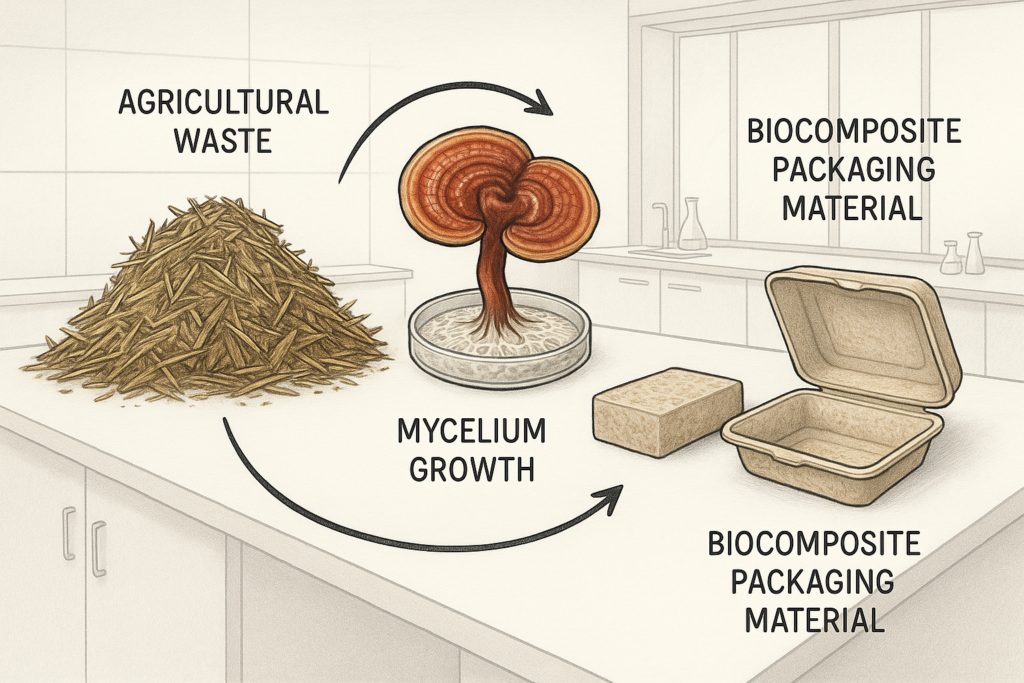
India stands at the forefront of a biotechnological revolution that could transform the nation from a major plastic polluter into a global leader in sustainable materials. Researchers at IIT Madras have achieved a breakthrough by developing biodegradable packaging materials using fungi like Ganoderma lucidum and Pleurotus ostreatus grown on agricultural waste, offering a dual solution to two of India’s most pressing environmental challenges. With India generating over 350 million tonnes of agricultural waste annually and producing 4+ million tonnes of plastic waste, this innovation represents more than just scientific advancement—it embodies a circular economy approach that transforms waste into valuable resources while addressing climate change, rural livelihoods, and sustainable development simultaneously. The establishment of NatureWrks Technologies startup to commercialize these innovations signals the transition from laboratory research to real-world applications, potentially positioning India as a $100 billion biomanufacturing hub by 2024 as envisioned by government policy. worldbiomarketinsights towardspackaging
The Science Behind Mycelium-Based Biocomposites
Fungal Innovation: Nature’s Sustainable Engineering
The IIT Madras research team, led by Dr. Lakshminath Kundanati from the Department of Applied Mechanics and Biomedical Engineering, has demonstrated that mycelium-based biocomposites can achieve mechanical properties superior to conventional plastic foams while remaining completely biodegradable. dtnext
Research Methodology and Findings:
- Fungi species tested: Ganoderma lucidum (medicinal mushroom) and Pleurotus ostreatus (edible oyster mushroom)
- Substrate materials: Sawdust, cardboard, paper, hay, and cocopith
- Optimal combination: Ganoderma grown on cardboard achieved compressive strength 10 times higher than EPS (Expanded Polystyrene)
- Performance metrics: Superior strength, water resistance, and complete biodegradability demonstrated at laboratory scale
Published Research Impact:
The findings, published in Bioresource Technology Reports (June 2025), provide the first systematic comparison of multiple fungus-substrate combinations for packaging applications, with co-authors Sandra Rose Biby and Vivek Surendran conducting comprehensive testing of mechanical properties, water absorption, and decomposition rates.
Technological Advantages Over Conventional Materials
The mycelium biocomposites demonstrate remarkable performance characteristics that position them as viable replacements for petroleum-based packaging foams:
Mechanical Properties:
- Compressive strength: Order of magnitude higher than EPS foam
- Lightweight structure: Comparable density to traditional packaging materials
- Flexibility: Adaptable for various packaging applications and custom molding
- Durability: Adequate shelf life with natural coating optimization under development
Environmental Benefits:
- Complete biodegradability: Decomposes naturally without microplastic formation
- Compostable: Safe for home composting systems and agricultural soil
- Carbon negative: Fungi sequester carbon during growth process
- Non-toxic: No harmful chemicals released during production or decomposition
India’s Waste Challenge: From Burden to Resource
Agricultural Waste: The Untapped Goldmine
India’s agricultural sector generates approximately 350-500 million tonnes of crop residue annually, creating both environmental hazards and economic opportunities for innovative utilization.
Current Waste Management Crisis:
- 92 million metric tons of crop waste burned annually contributing to air pollution
- 51% of air pollution in India comes from industrial sources, 27% from vehicles, and 17% from crop burning
- Delhi’s winter smog significantly attributed to agricultural burning in Punjab and Haryana
- Economic loss: Valuable biomass resources wasted through open burning
Waste Composition and Potential:
Major agricultural residues include rice straw, wheat straw, sugarcane bagasse, cotton stalks, and corn stover, each offering different properties for biocomposite development. The IIT Madras team’s approach of testing multiple substrate combinations maximizes utilization potential across diverse agricultural regions.
Plastic Pollution: The Growing Environmental Crisis
India’s plastic consumption of 14 million tonnes annually generates 3.5 million tonnes of plastic waste, with inadequate recycling infrastructure and limited biodegradable alternatives exacerbating the environmental crisis.
Single-Use Plastic Challenge:
- Per capita consumption: 3-11 kg annually (lowest globally)
- Total impact: Large population creates massive absolute waste volumes
- 2021 legislation: Ban on select SUP items covers only 2-3% of total plastic waste
- Infrastructure gaps: Limited recycling facilities and collection systems
Commercialization Journey: NatureWrks Technologies
From Laboratory to Market: Startup Innovation
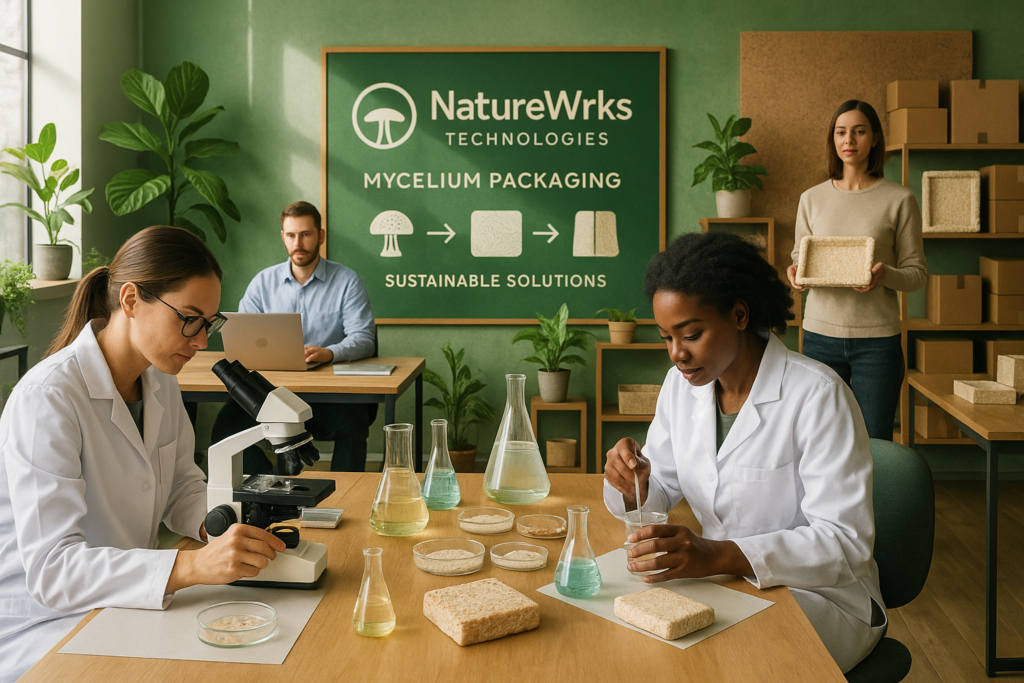
The establishment of NatureWrks Technologies by IIT Madras researchers represents a critical transition from academic research to commercial application, embodying India’s startup ecosystem success in deep-tech biotechnology. naturewrks
Startup Vision and Mission:
NatureWrks Technologies draws inspiration from nature’s millions of years of evolution to create sustainable packaging materials through mycelium-based composites. Their deep-tech approach focuses on biotechnology and sustainability with circular economy principles at the core.
Commercialization Strategy:
- Technology transfer: Industry partnerships and licensing agreements for wider adoption
- Government funding: Seeking policy support through biomanufacturing initiatives and startup schemes
- Scalability focus: Optimizing substrate compositions for mass production
- Market applications: B2B and B2C packaging solutions across multiple sectors
Industry Applications and Market Potential
Target Applications:
- Packaging industry: Replacement for EPS and EPE foams in product packaging
- Construction sector: Thermal and acoustic insulation materials
- Automotive applications: Lightweight components and interior materials
- Electronics packaging: Protective packaging for sensitive equipment
Market Expansion Opportunities:
The global bioplastics market, valued at $13.3 billion in 2020 and projected to reach $84.3 billion by 2028, provides significant growth opportunities for Indian innovations in biodegradable materials.
Policy Framework and Government Support
National Biomanufacturing Initiative
The Government of India’s commitment to developing a $100 billion biomanufacturing hub by 2024 provides strategic support for biodegradable materials innovation through multiple policy instruments.
BioE3 Vision:
The Department of Biotechnology’s BioE3 (Biotechnology for Economy, Environment, and Employment) vision emphasizes green economic growth through biotechnology applications, with biomanufacturing as a key focus area.
Policy Support Mechanisms:
- National Consultation Meeting (February 2023): Policy framework development for biomanufacturing sector
- Domestic manufacturing focus: Priority for homegrown companies and technology development
- Research funding: Ministry of Education and IIT grants supporting fundamental research
- Startup ecosystem: Incubation support and technology commercialization assistance
Regulatory Environment and Standards
Current Regulatory Landscape:
- 2021 SUP ban: Limited scope creates market opportunity for comprehensive alternatives
- Bureau of Indian Standards: Developing certification frameworks for biodegradable materials
- Central Pollution Control Board: Environmental clearance and monitoring standards
- Ministry of Environment: Incentive schemes for eco-friendly alternatives
Standards Development Needs:
- Biodegradability certification: Standardized testing protocols for compostability claims
- Performance standards: Mechanical property requirements for various applications
- Safety regulations: Food contact and chemical safety standards
- Life cycle assessment: Environmental impact measurement frameworks
Economic Viability and Scalability Analysis
Cost-Benefit Comparison with Conventional Plastics
Production Cost Factors:
- Raw material advantage: Agricultural waste available at ₹6 per kg (as demonstrated by Craste startup)
- Processing costs: Fungal cultivation and composite formation require specialized infrastructure
- Energy requirements: Lower than petroleum-based plastic production
- Labor intensity: Higher initial employment but potential for automation
Economic Benefits:
- Rural income generation: Value addition to agricultural waste creating new revenue streams
- Import substitution: Reduced dependence on petroleum-based materials
- Export potential: Global market for sustainable packaging solutions
- Carbon credits: Potential revenue from carbon sequestration and emission reduction
Value Chain Development
Supply Chain Components:
- Raw material sourcing: Direct procurement from farmers and agricultural processors
- Substrate preparation: Processing facilities for waste treatment and standardization
- Fungal cultivation: Controlled environment facilities for mycelium growth
- Composite formation: Manufacturing units for final product development
- Distribution networks: Market channels for B2B and B2C sales
Environmental Impact Assessment
Life Cycle Analysis: Cradle to Cradle
Carbon Footprint Comparison:
Mycelium-based materials demonstrate significantly lower carbon footprint compared to conventional plastics across entire life cycle:
Production Phase:
- Carbon sequestration: Fungi absorb CO2 during growth
- Energy efficiency: Lower processing temperatures and energy requirements
- Renewable feedstock: Agricultural waste rather than fossil fuel extraction
Transportation and Use:
- Lightweight properties: Reduced transportation emissions
- Comparable performance: Similar functionality with environmental benefits
- Extended applications: Thermal insulation properties reduce energy consumption
End-of-Life Benefits:
- Complete biodegradation: No microplastic formation or persistent pollution
- Soil enrichment: Composting adds organic matter to soil
- Circular economy: Waste becomes resource for agricultural applications
Social Impact and Rural Development
Empowering Agricultural Communities
The mycelium packaging industry has significant potential to transform rural economies by creating value-added opportunities for agricultural waste.
Rural Income Generation:
- Waste monetization: Farmers receive payments for previously discarded residues
- Processing employment: Local facilities creating manufacturing jobs
- Skill development: Training programs for biotechnology applications
- Cooperative models: Farmer producer organizations for collective value addition
Social Benefits:
- Air quality improvement: Reduced crop burning improving rural health
- Environmental stewardship: Community engagement in sustainable practices
- Technology adoption: Rural exposure to biotechnology innovations
- Gender inclusion: Opportunities for women in processing and quality control
Global Perspectives and Best Practices
International Bioplastics Leadership
European Union Model:
- €1.38 billion investment in bioeconomy research and sustainable materials
- Circular Economy Action Plan promoting biodegradable alternatives
- Strict regulations on single-use plastics driving innovation demand
- Life cycle assessment requirements for environmental claims
China’s Biomanufacturing Strategy:
- Massive government investment in biotechnology infrastructure
- Industrial-scale production of bio-based materials
- Export-oriented manufacturing for global markets
- Technology integration with traditional industries
United States Innovation Ecosystem:
- Biden administration’s biomanufacturing package supporting domestic innovation
- Public-private partnerships in research and commercialization
- Venture capital investment in biotech startups
- Regulatory frameworks supporting market entry
Learning from Global Success Stories
Netherlands Approach:
- Cradle-to-cradle design principles in policy frameworks
- Collaborative research between universities and industry
- Consumer awareness campaigns for sustainable products
- Tax incentives for environmentally friendly alternatives
Challenges and Risk Mitigation
Technical and Production Challenges
Technology Maturation:
- Scalability issues: Laboratory success requires industrial-scale optimization
- Quality consistency: Standardization across different substrates and growing conditions
- Shelf life optimization: Natural coating development for extended durability
- Climate adaptability: Performance testing under varied humidity and temperature conditions
Infrastructure Requirements:
- Controlled environment facilities: Investment in specialized production infrastructure
- Supply chain logistics: Efficient collection and processing of agricultural waste
- Quality control systems: Testing equipment and certification processes
- Skilled workforce: Training programs for biotechnology applications
Market and Economic Risks
Competition and Market Dynamics:
- Established plastic industry: Cost competition with existing materials
- Consumer acceptance: Market education about performance and benefits
- Regulatory compliance: Meeting safety and environmental standards
- Investment requirements: Capital intensity for scaling operations
Mitigation Strategies:
- Government policy support: Incentives for sustainable alternatives
- Industry partnerships: Collaborative development and market entry
- Phased rollout: Gradual market penetration with continuous improvement
- Performance demonstration: Pilot projects showcasing commercial viability
Sustainable Development Goals Alignment
SDG Integration: Triple Bottom Line Impact
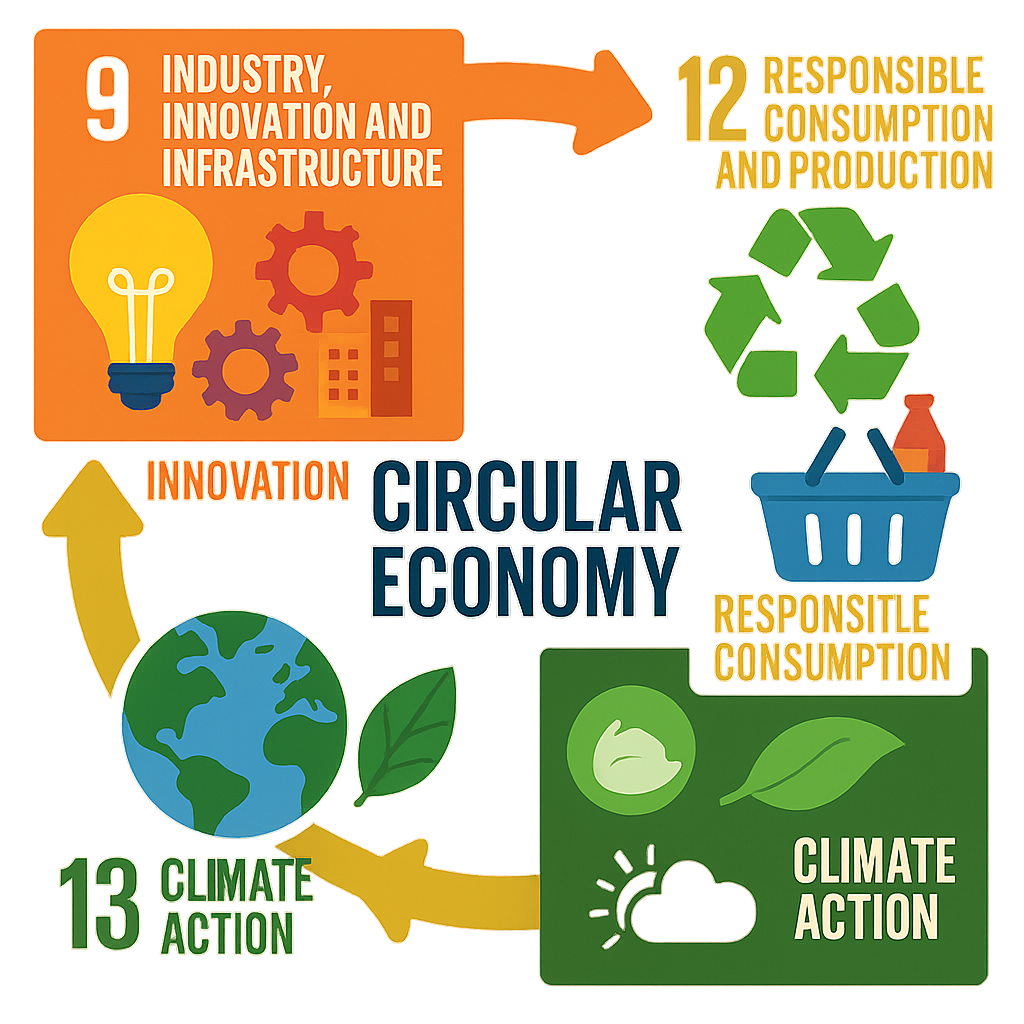
The mycelium packaging innovation directly contributes to multiple Sustainable Development Goals, demonstrating comprehensive sustainability impact:
SDG 9 (Industry, Innovation, and Infrastructure):
- Technology innovation in sustainable materials
- Research infrastructure development at IIT Madras
- Industrial applications across multiple sectors
- Knowledge transfer from academia to industry
SDG 12 (Responsible Consumption and Production):
- Circular economy principles transforming waste into resources
- Sustainable packaging alternatives reducing environmental impact
- Resource efficiency through agricultural waste utilization
- Consumer behavior change toward sustainable choices
SDG 13 (Climate Action):
- Carbon sequestration through fungal growth processes
- Emission reduction from decreased plastic production and waste burning
- Climate adaptation through sustainable material systems
- Green technology development and deployment
Future Roadmap: Building Sustainable Materials Ecosystem
Short-term Objectives (1-2 years)
Commercialization Acceleration:
- Pilot production facilities for market testing and customer validation
- Industry partnerships with packaging companies and consumer brands
- Regulatory approvals and certification for commercial applications
- Supply chain establishment for reliable raw material sourcing
Medium-term Goals (3-5 years)
Market Expansion:
- National distribution networks for widespread availability
- Product diversification into construction and automotive applications
- Export market development leveraging India’s cost advantages
- Technology licensing to international partners
Long-term Vision (5-10 years)
Industry Transformation:
- Complete replacement of conventional packaging foams in key applications
- Integrated biorefineries processing multiple waste streams
- Global leadership in sustainable materials innovation
- Economic ecosystem supporting rural development and environmental restoration
Conclusion: Pioneering India’s Bioeconomy Future
The bioengineering of biodegradable materials from agricultural waste represents more than just technological innovation—it embodies India’s potential to lead the global transition toward sustainable development. The IIT Madras breakthrough and NatureWrks Technologies commercialization demonstrate how scientific excellence, entrepreneurial vision, and policy support can converge to create transformative solutions.
With 350 million tonnes of agricultural waste and 4+ million tonnes of plastic waste annually, India has both the raw material abundance and environmental urgency to drive this biotechnology revolution. The government’s commitment to building a $100 billion biomanufacturing hub provides the policy framework, while advances in fungal biotechnology offer the technical foundation.
Success in this endeavor will require sustained collaboration between researchers, entrepreneurs, policymakers, and communities. The circular economy principles embedded in this innovation promise environmental restoration, rural prosperity, and industrial competitiveness simultaneously.
As India approaches its 2047 development goals, the mycelium packaging industry could serve as a model for sustainable industrialization—proving that economic growth and environmental stewardship are not just compatible but mutually reinforcing. The bioengineering revolution has begun, and India is uniquely positioned to lead the world toward a truly sustainable future.
Mains Questions
- “Bioengineering biodegradable materials is not just an environmental solution but also an economic opportunity.” Discuss with examples from India. (GS3)
- Examine the role of science, technology, and innovation in India’s efforts to reduce plastic pollution and promote sustainable alternatives. (GS3)
- How can agricultural residue management be integrated with India’s circular economy vision? (GS3/Essay)




+ There are no comments
Add yours