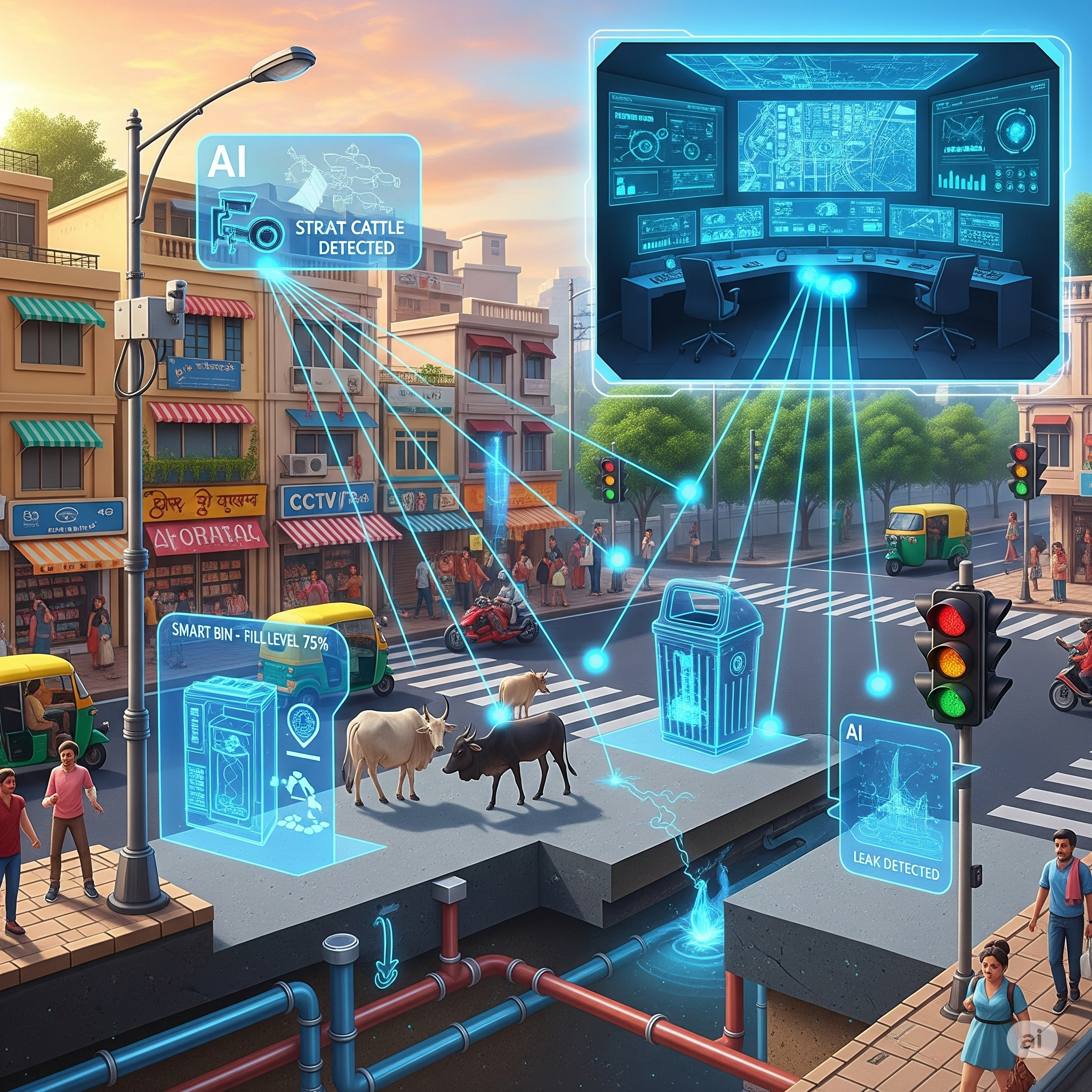
Urban India’s civic struggles are legendary. Stray cattle jam busy roads. Overflowing bins dot cityscapes. Traffic lights often seem set to “random.” Litter piles up, water leaks go undetected, and municipal complaints linger unresolved. But a technological revolution is sweeping through the country—and artificial intelligence (AI) is now at the heart of smarter, safer, more efficient Indian cities.
From Surat’s AI-powered stray cattle alerts to traffic management in Bengaluru and water-loss detection in Pune, municipalities are embracing AI to proactively monitor and manage challenges. Here’s how AI is quietly, but powerfully, changing daily life across urban India.
Stray Cattle: How AI Is Clearing City Streets
Anyone who’s driven through Surat, Ahmedabad, or Pune knows the stray cattle problem: traffic snarls, accidents, and rising tensions between residents, herders, and city officials. In Surat, a breakthrough came with an AI algorithm developed at NIT (National Institute of Technology):
- AI-powered video feeds from CCTV cameras at major junctions scan for unaccompanied cattle.
- When cattle are detected (minus a herder, using smart filtering), the system triggers an instant alert with timestamp and location.
- Municipal control rooms dispatch dedicated teams to safely impound animals—enforcing stricter laws and hefty fines (over ₹18 lakh recovered so far, with 1,500+ incidents flagged).
- RFID tagging ensures repeat violators can be identified, tracked, and penalized—building accountability in real cattle management.
Impact:
Reduced accidents, improved traffic flow, and a cleaner, safer urban environment—demonstrating AI’s real-world power to solve “unsolvable” old problems.
AI for Waste Surveillance: From Littering to Smarter Sanitation
Garbage management is another chronic headache, made worse by rapid urban growth. Cities like Prayagraj and Delhi have started using:
- AI-powered cameras and sensors to track bin fill levels, illegal dumping, and uncollected waste.
- Visual intelligence distinguishes between wet and dry waste and confirms real, not just GPS-logged, pickups—improving reporting accuracy and route efficiency.
- Optimized collection, predictive analytics, and real-time alerts reduce overflowing bins and enforce better waste segregation.
Control rooms now monitor cleanliness live, flag missed pick-ups, and minimize environmental impact by rerouting trucks dynamically. AI makes sure clean cities actually get cleaner—not just look good in reports.
Tackling Water Leaks Before They Drain the City
Pipe leaks waste precious water and tax-payer money. Pune and Coimbatore are leveraging AI-driven diagnostics:
- AI/ML algorithms digest flow meter, pressure, and acoustic sensor data to pinpoint leaks down to exact streets.
- Detection happens proactively—before visible damage, loss, or complaints.
- Rapid repair saves millions of liters, reduces costs, and shortens outage times for citizens.
Digital twins and data-driven models help prioritize repairs and combat water crises more effectively than ever before.
Smarter Traffic Management: From Chaos to Coordination
Bengaluru, Kolkata, and other metros are pioneers in AI-driven urban traffic:
- Adaptive AI traffic signals (like Bengaluru’s BATCS) use real-time sensor data to change light patterns based on flow and congestion.
- AI predicts jams, reroutes vehicles, and balances traffic across networks—enabling smoother commutes and reducing pollution.
- Integrated Traffic Management Systems (ITMS) can spot red light violations, helmetless riders, or wrong-way drivers; license plate recognition captures offenders automatically.
- AI-generated heatmaps and predictive analytics guide urban planners on where to build new flyovers or widen roads.
Results:
Faster travel, less idling (saving time and fuel), fewer accidents, and data-driven urban planning.
AI-Powered Civic Grievance Redressal
- Chatbots and AI backends (as in Aurangabad Smart City) log citizen complaints, issue SMS acknowledgments, and route issues automatically to the right departments.
- Stuck issues are flagged for review at the commissioner level.
- 3D city models compare official records with drone-imaging surveys—boosting revenue by catching unreported property expansions and plugging tax leaks (as in Jabalpur, MP).
Why AI is India’s Urban Game-Changer
- Real-time Response: No more slow or reactive governance. AI brings predictive power—solving problems before citizens feel their worst effects.
- Resource Optimization: Dynamic, data-driven allocation of teams and budgets boosts efficiency and reduces waste.
- Public Accountability: Digital trails, visual proof, and real-time dashboards ensure better service—not just reports.
- Scalable Impact: With over 100 smart cities leveraging AI, India’s innovations are models for developing economies worldwide.
Challenges and The Road Ahead
- Data Privacy: Real-time monitoring involves sensitive data—cities must ensure strong controls and ethical standards.
- Tech Adoption: Standardization, training, and local adaptation are crucial; one-size-fits-all solutions rarely succeed in diverse urban contexts.
- Sustainability: AI must be paired with community engagement, transparent policies, and green urban growth.
FAQs
Do citizens benefit directly?
Yes. Faster fixes, better sanitation, safer streets, and transparent governance make everyday urban life smoother.
Is AI replacing municipal workers?
No, it’s empowering teams—letting humans focus on tasks AI can’t automate, like on-ground inspections, outreach, and decision-making.
Are these solutions affordable for small/tier-2 cities?
Many AI tools are now cloud-based, modular, and scalable—making advanced urban management accessible beyond just big metros.
Conclusion: AI for Urban India Is Now

AI is no longer a distant buzzword. It’s in municipal control rooms, on garbage trucks, in traffic signals, and even watching out for stray livestock. As India’s cities embrace “smarter” management, technology is quickly making daily life safer, cleaner, and more efficient—and putting the tools of good governance closer to every citizen.








+ There are no comments
Add yours