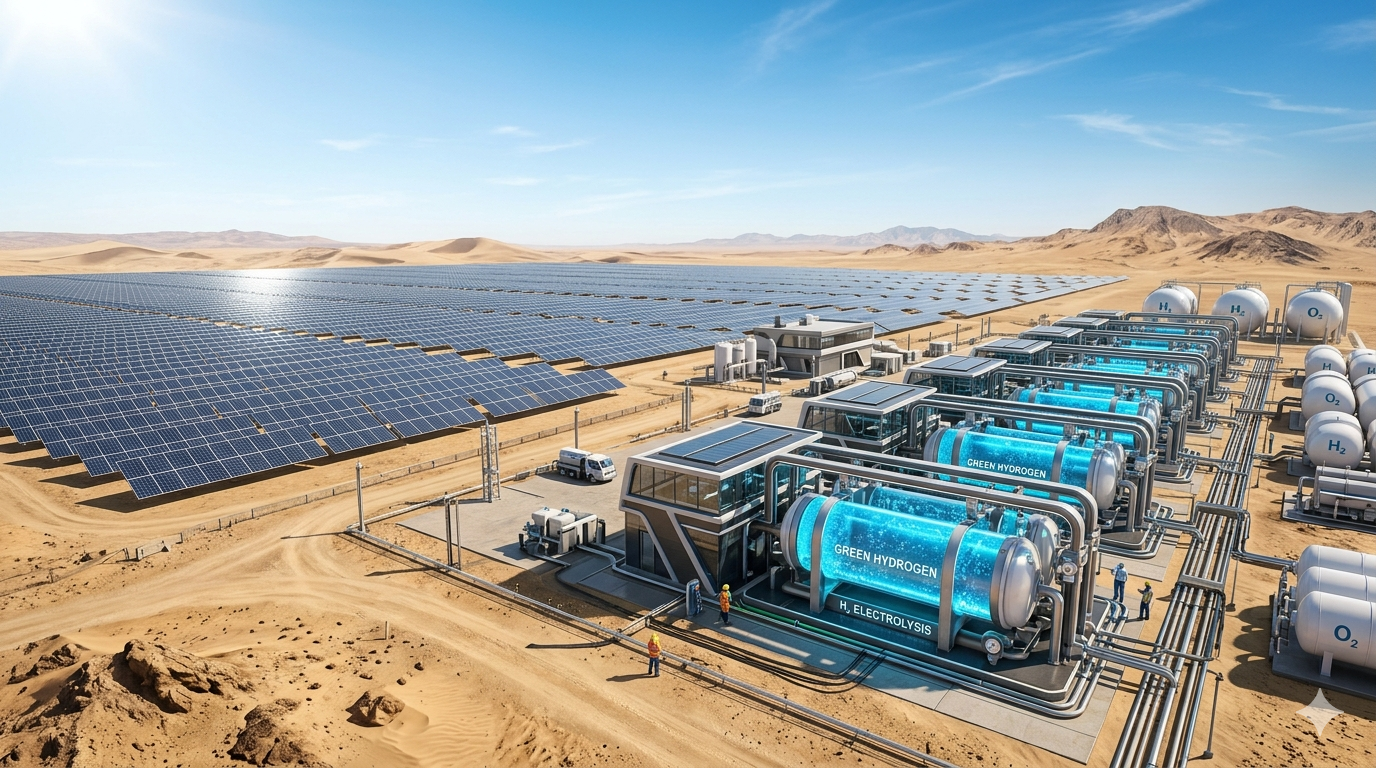
The global transition toward a low-carbon economy has officially moved beyond traditional solar panels and wind turbines. We have entered a highly complex, geopolitically charged phase dominated by a single, highly versatile molecule: green hydrogen.
As the world scrambles to decarbonize “hard-to-abate” sectors such as steelmaking, maritime shipping, and heavy-duty commercial transport, green hydrogen is no longer viewed merely as a futuristic environmental promise. It is now recognized as a critical strategic instrument for long-term economic dominance and national energy security.
At the absolute forefront of this transition are the world’s two most populous nations and largest energy consumers: China and India. Both nations recognize that dominating the clean energy supply chain is essential for their future economic resilience.
China has already seized an early, aggressive lead. The nation is utilizing massive state coordination, heavy domestic subsidies, and an unparalleled manufacturing scale to unilaterally shape the global hydrogen economy.
However, India has rapidly mobilized its own vast resources through the ambitious National Green Hydrogen Mission (NGHM). India aims to leapfrog legacy technologies and establish itself as a premier global export hub, capturing advanced markets across the globe.
The unfolding dynamic between these Asian giants offers profound lessons on industrial policy, technology deployment, and the shifting geopolitics of renewable energy. For serious readers, policymakers, and UPSC aspirants observing this space, understanding the nuances of this transition is absolutely vital.
Why This Topic Matters Today
The geopolitical landscape of global energy is undergoing a seismic, irreversible shift. As we navigate the complexities of 2026, the urgency to deploy green hydrogen has intensified dramatically.
This urgency is driven by looming national climate targets, highly volatile fossil fuel markets, and the strict implementation of cross-border carbon tariffs, such as the European Union’s Carbon Border Adjustment Mechanism (CBAM). Nations failing to decarbonize their heavy industries will soon face severe economic penalties in international trade.
For India, the stakes are exceptionally high. The nation is poised to become the world’s largest coal importer in the coming years, remaining heavily reliant on external, volatile energy sources to power its growth. Transitioning aggressively to green hydrogen offers India a rare dual dividend.
First, it provides a pathway to true energy independence by replacing expensive fossil fuel imports with domestically produced clean molecules. Second, it creates a highly lucrative export market. By leveraging strategic trade routes like the India-Middle East-Europe Economic Corridor (IMEC), India can fundamentally alter its position in the global economic hierarchy.
Understanding China’s precise successes and inevitable missteps in its hydrogen journey provides Indian policymakers, institutional investors, and industry leaders with a crucial, actionable blueprint. It highlights the absolute necessity of building robust supply chains, the inherent risks of fragmented infrastructure, and the paramount importance of reducing the “green premium” to make clean technology economically viable for the masses.
Key Highlights
- Diverging Policy Models: China relies heavily on a top-down, command-economy approach with aggressive regional subsidies to scale production. In contrast, India utilizes highly competitive bidding frameworks (like the SECI SIGHT scheme) to drive down costs naturally.
- Massive Scale vs. Export Focus: China’s mega-projects aim primarily for domestic decarbonization. India strategically targets lucrative global exports through international corridors.
- Technological Localization: China has localized over 70% of its hydrogen fuel cell core components, a critical benchmark India is actively pursuing through its targeted Production Linked Incentive (PLI) schemes.
- The Cost Challenge: India’s Levelized Cost of Hydrogen (LCOH) must drop to $1.8–$2.3/kg by 2030 to remain globally competitive, requiring massive scaling of local electrolyser manufacturing.
- Infrastructure Bottlenecks: Both nations face severe hurdles regarding water scarcity, high-pressure hydrogen storage, and transportation infrastructure, necessitating rapid innovations in seawater electrolysis.
Background
To grasp the magnitude of the current hydrogen transition, we must first look at the historical context of hydrogen use. For decades, hydrogen has been a vital industrial chemical, but its production has been deeply tied to fossil fuels.
Currently, the vast majority of the world’s hydrogen is categorized as “grey hydrogen.” This is produced via steam methane reforming (SMR) of natural gas or through coal gasification. These processes are highly carbon-intensive, emitting massive amounts of carbon dioxide into the atmosphere.
Both China and India have traditionally been major consumers of this polluting grey hydrogen, utilizing it primarily for petroleum refining and the production of ammonia-based agricultural fertilizers. The environmental cost of this reliance is staggering, prompting the urgent shift toward cleaner alternatives.
China formally integrated hydrogen development into its 14th Five-Year Plan (2021–2025). This early strategic document targeted the deployment of 50,000 hydrogen fuel cell vehicles (FCEVs) and the production of 100,000 to 200,000 tonnes of green hydrogen annually by 2025.
By early 2026, China’s focus had evolved sharply toward its 15th Five-Year Plan (2026-2030). This new blueprint elevated hydrogen from a mere policy-driven niche to a robust, market-driven industrial pillar, emphasizing the creation of mega-scale “wind-solar-hydrogen-ammonia-alcohol” bases across the country.
In direct response to this shifting landscape, India launched its National Green Hydrogen Mission (NGHM) with a massive initial outlay of ₹19,744 crore (approximately $2.4 billion).
The mission sets a monumental, legally binding target: producing at least 5 Million Metric Tonnes (MMT) of green hydrogen per annum by 2030. It also outlines the potential to scale up to 10 MMT as export markets mature and expand.
This aggressive policy aims not only to decarbonize domestic industries but also to establish India as a dominant, indispensable force in global clean energy trade. The mission aligns perfectly with India’s broader macroeconomic goals of self-reliance and sustainable development.
Core Explanation
What is Green Hydrogen?
Hydrogen is the most abundant element in the universe, but on Earth, it is a secondary energy carrier. This means it rarely exists in its pure form and must be extracted from other compounds, primarily water (H₂O) or hydrocarbons (like natural gas).
When hydrogen is separated from water using an electric current generated entirely by renewable energy sources—such as solar, wind, or hydroelectric power—the resulting product is officially termed “green hydrogen”.
Because the entire lifecycle of this process—from the generation of the power to the molecular separation of the water—emits absolutely zero greenhouse gases, it is widely considered the ultimate clean fuel. It holds the key to decarbonizing sectors where direct battery electrification is physically or economically impossible.
How it Works
The core scientific process underlying the entire green hydrogen economy is known as water electrolysis.
Inside a highly specialized piece of equipment called an electrolyser, a direct electric current is passed through purified water. This electrical energy breaks the strong chemical bonds holding the water molecules together.
This reaction yields pure oxygen (O₂) gas at the anode, which is safely released into the atmosphere, and pure hydrogen (H₂) gas at the cathode, which is captured.
Once captured, the resulting hydrogen gas presents a logistical challenge due to its low density. It can be heavily compressed into high-pressure tanks, cooled to extreme temperatures to become liquid hydrogen, or chemically converted into derivatives like green ammonia (NH₃) or green methanol (CH₃OH). These derivatives are much easier and cheaper to transport over long distances using existing maritime shipping infrastructure.
Key Components and Stakeholders
The green hydrogen ecosystem is not a single technology but a complex, interconnected value chain comprising several distinct layers:
- Renewable Energy Generation: Massive solar and wind farms that provide the clean, uninterrupted electricity required for the process.
- Electrolyser Manufacturing: The high-tech production of the core hardware used for the electrolysis process, involving complex supply chains for specialized metals and membranes.
- Production and Conversion: Heavy industrial facilities that synthesize the hydrogen gas and convert it into easily transportable carriers like ammonia or methanol.
- Storage and Transportation: High-pressure storage tanks, specialized pipelines, and global shipping infrastructure required to move the molecules.
- End-Users: Refineries, chemical fertilizer plants, steel manufacturers, and heavy-duty mobility sectors that ultimately consume the clean fuel.
The stakeholders driving this ecosystem differ vastly between China and India. In China, massive state-owned enterprises (SOEs) like Sinopec and the China Energy Engineering Group (CEEC) completely dominate the landscape, backed by virtually unlimited regional government support and cheap capital.
In stark contrast, India utilizes the Solar Energy Corporation of India (SECI) as a central nodal agency to orchestrate highly competitive market bidding under the SIGHT (Strategic Interventions for Green Hydrogen Transition) program. Major private conglomerates, including Reliance Industries, Adani Green Energy, L&T, and ACME Cleantech, are fiercely competing to drive the domestic build-out.
Conceptual Breakdown
To truly understand the strategic battlegrounds of the hydrogen economy, one must analyze the different types of electrolysers. The technology chosen dictates the cost, efficiency, and geopolitical vulnerability of the entire supply chain.
Currently, four primary technologies dominate the global market, each with distinct operational advantages and cost profiles.
| Technology Type | Electrolyte Medium | Key Advantages | Major Disadvantages | Commercial Status |
| Alkaline Water Electrolysis (AWE) | Liquid Potassium Hydroxide (KOH) | Very low capital cost; utilizes abundant, non-noble metals (like Nickel); highly durable over time. | Slower response to the natural fluctuations of solar/wind energy; requires a bulkier physical footprint. | Highly mature technology; currently dominates Chinese mega-projects. |
| Proton Exchange Membrane (PEM) | Solid Polymer Membrane (Nafion) | Highly responsive to intermittent renewable energy; produces extremely pure hydrogen; highly compact design. | Very expensive due to reliance on rare earth metals (Iridium, Platinum); acidic internal environment causes faster corrosion. | Commercial scale; highly preferred in Western markets and dynamic grid setups. |
| Anion Exchange Membrane (AEM) | Alkaline Solid Polymer | Beautifully combines the low cost of Alkaline (no noble metals required) with the fast response and compact size of PEM. | Still navigating early commercialization hurdles; long-term membrane durability requires further scientific improvement. | Emerging rapidly; expected to scale massively between 2026 and 2030. |
| Solid Oxide Electrolysis Cell (SOEC) | Solid Ceramic (Yttria-stabilized zirconia) | Extremely high electrical efficiency; can utilize waste industrial heat from steel or chemical plants to lower electricity needs. | Requires incredibly high operating temperatures (above 500°C); suffers from slow start-up and shut-down times. | Early commercial phase; considered ideal for deep integration with heavy industry. |
The Water Conundrum
Beyond the choice of electrolyser, a critical technical consideration that is often overlooked in policy documents is severe water consumption.
The basic stoichiometric chemical requirement is roughly 9 liters of highly purified, demineralized water to produce just 1 kilogram of hydrogen. However, the reality of industrial operation is far more demanding. When factoring in the necessary cooling processes and the extensive water purification required to prevent membrane degradation, the actual operational consumption footprint easily reaches 20 to 30 liters of water per kilogram of hydrogen produced.
This reality poses a significant, potentially crippling challenge for arid regions targeted for renewable expansion in both China and India. Consequently, massive scientific advancements in direct seawater electrolysis are moving to the forefront.
For example, China’s Sinopec successfully completed a 100 kW direct seawater electrolysis pilot project that operates without complex, energy-intensive desalination pretreatment, utilizing a novel chlorine-resistant electrode. Mastering this specific technology is a critical future pathway for India to protect its fragile freshwater resources.
Real-World Examples
To move beyond theory, we must examine how these differing national strategies are manifesting on the ground in real-world, multi-billion-dollar deployments.
China’s Mega-Scale Execution: The Songyuan Qingqing No. 1 Project
Located in the frigid Jilin province, the ambitious “Qingqing No. 1” project, constructed by the state-owned China Energy Engineering Corporation (CEEC), is globally heralded as the world’s largest integrated green hydrogen-ammonia-methanol facility.
Backed by an astonishing total planned investment of nearly 30 billion yuan (approximately $4.3 billion), this flagship initiative is designed to deploy a staggering 3 GW of wind and photovoltaic solar capacity. Its ultimate goal is to produce a combined 800,000 tons of green ammonia and green methanol annually.
The true technical marvel of this project lies not just in its size, but in its deep system integration. The project utilizes advanced Big Data analytics and artificial intelligence to create a “multi-stable flexible control strategy.” This allows complex chemical production to continue seamlessly and safely despite the natural, unpredictable fluctuations in wind and solar power generation.
This project perfectly exemplifies China’s overarching strategy: establishing massive, highly centralized, localized hubs to brutally drive down the Levelized Cost of Hydrogen (LCOH) through sheer, overwhelming economies of scale.
India’s Competitive Edge: The SECI SIGHT Auctions
India’s approach contrasts sharply and intentionally with China’s state-directed mega-projects. The Indian government utilizes the Solar Energy Corporation of India (SECI) SIGHT scheme to foster fierce, transparent market competition among private players. The resulting price discoveries have been globally groundbreaking.
In the highly anticipated e-reverse auctions for green ammonia production (designated as Mode 2A), ACME Cleantech Solutions secured a landmark 10-year contract to supply green ammonia. They achieved a record-low price of ₹51.89/kg to ₹55.75/kg (roughly $0.62 to $0.66 per kg).
To put this in perspective, this price point drastically undercuts international market benchmarks, which recently hovered around $1,153/tonne in global H2Global auctions. This aggressive pricing signals to the world that India possesses the inherent capability to produce green ammonia at costs rapidly approaching parity with highly polluting fossil-derived grey ammonia.
Furthermore, in early 2025, SECI announced the winners of Tranche II of its vital electrolyser manufacturing auction. Domestic companies stepped up aggressively. Waaree Energies secured 300 MW of capacity, Matrix Gas secured 237 MW, and Advait Infratech secured 200 MW.
These massive capacity allocations ensure that India is actively building a robust, indigenous hardware supply chain, rather than relying purely on cheap Chinese imports. By early 2026, India had successfully commissioned 8,000 tonnes per annum of actual green hydrogen capacity, demonstrating that its ambitious policies are translating into rapid on-ground execution.
Advantages
The aggressive, well-funded pursuit of a green hydrogen economy yields profound, multi-dimensional benefits for both nations, stretching far beyond simple environmental metrics.
- Deep Industrial Decarbonization: Green hydrogen directly and cleanly replaces heavily polluting coking coal in steel production (creating green steel) and natural gas in fertilizer production. This directly tackles the so-called “hard-to-abate” sectors that are responsible for a massive, stubborn share of global industrial emissions.
- Unprecedented Energy Security: By utilizing their own abundant domestic solar and wind resources, both India and China can drastically reduce their dangerous exposure to volatile, geopolitically sensitive global fossil fuel markets. India’s mission explicitly aims to cut fossil fuel imports by over ₹1 lakh crore cumulatively by 2030, keeping capital within its own borders.
- Macro-Economic Growth and Massive Job Creation: The rapid deployment of new renewable energy infrastructure, the construction of electrolyser gigafactories, and the operation of vast hydrogen hubs is projected to create over 600,000 high-quality clean energy jobs in India alone by 2030, fostering a new generation of skilled technical workers.
- Export Dominance via Strategic Corridors: Unlike China, India is strategically positioning itself to be a primary, trusted supplier for the European Union and other allied nations. Through the proposed India-Middle East-Europe Economic Corridor (IMEC), India could export vast quantities of low-cost green hydrogen via Gulf transshipment hubs. This visionary infrastructure project could dramatically alter the global energy trade map, enriching the Indian economy.
Criticism
Despite the overwhelming optimism and heavy investments, the transition is fraught with severe technical, financial, and geopolitical hurdles that cannot be ignored.
The Stubborn “Green Premium” and Financing Constraints
Currently, the cost of producing green hydrogen in India sits stubbornly around $3.20–$3.60/kg. This cost is heavily front-loaded by massive capital expenditures required for both the electrolysers and the dedicated renewable power plants.
This so-called “green premium” means that green hydrogen remains significantly more expensive than traditional grey hydrogen. While competitive bidding is undoubtedly lowering costs, the stark lack of long-term offtake agreements (committed, legally bound buyers) drastically increases the cost of capital. This makes these massive, multi-decade projects financially risky for private developers.
Infrastructure and Storage Deficits
Hydrogen is the lightest element in the universe, resulting in exceptionally low volumetric energy density. Transporting it requires either extreme high-pressure compression (up to 700 bar), energy-intensive liquefaction at cryogenic temperatures (-253°C), or complex chemical conversion into ammonia or methanol.
The current global lack of dedicated hydrogen pipelines and specialized, safe refueling infrastructure severely hinders rapid scale-up. In China, despite targeting the construction of 1,200 refueling stations by 2025, persistent issues like severe underutilization and high operational costs plague the sector, serving as a cautionary tale for Indian planners.
Severe Resource Constraints: Water and Land
The critical intersection of energy security and water security is frequently downplayed. As established, electrolysis requires massive volumes of highly purified water. Scaling green hydrogen mega-projects in arid, sun-rich regions—such as Rajasthan or Gujarat in India, and Inner Mongolia in China—risks dangerously exacerbating local water stress and provoking community backlash.
Furthermore, massive, contiguous land parcels are required for the associated renewable energy generation. This inevitably leads to potential socio-political friction over land acquisition, agricultural displacement, and environmental degradation.
Dangerous Supply Chain Vulnerabilities
Currently, China controls an estimated 60% to 65% of the global electrolyser manufacturing capacity. For India, an over-reliance on imported Chinese critical minerals or heavily subsidized alkaline electrolysers poses a severe, unacceptable geopolitical risk.
Strategic lessons learned the hard way from the solar PV industry—where Chinese dominance effectively hollowed out domestic manufacturing globally—underscore the absolute necessity of India’s PLI schemes to build indigenous capabilities at any cost.
Global Implications
The divergent national strategies of China and India have profound, long-lasting implications for the future of global energy geopolitics.
China’s approach is deeply characterized by defensive regionalism and aggressive techno-nationalism. By tightly integrating hydrogen into its long-term strategic blueprints (the 14th and 15th Five-Year Plans), China is treating green hydrogen not merely as a benign environmental tool, but as a critical “new quality productive force” essential for great power competition. The central government in Beijing provides sweeping, unyielding policy directives, while highly motivated regional municipalities execute aggressive demonstration projects to win central favor.
Conversely, India’s strategy is inherently collaborative, democratic, and export-oriented. By actively leveraging international frameworks like the International Solar Alliance (ISA) and the IMEC corridor, India is positioning itself as the trusted, reliable alternative to China in the global clean energy supply chain.
The IMEC corridor is particularly notable. Envisioning a 3,730 km electricity and hydrogen superhighway linking India, the UAE, Saudi Arabia, and Europe, it represents a geopolitical masterstroke. It physically bypasses traditional maritime chokepoints and aligns India perfectly with stringent European decarbonization mandates, potentially generating tens of billions in recurring export revenues.
Future Trends
Looking forward toward 2030 and beyond, several highly transformative technological and market trends will dictate the ultimate pace of the hydrogen economy:
- Deep AI Integration in Operations: Advanced artificial intelligence and machine learning algorithms will be deployed to optimize the dynamic, highly complex coupling of intermittent renewable energy with steady-state chemical processes. AI will predict weather load variations in real-time to prevent costly electrolyser degradation and maximize output.
- Commercialization of Seawater Electrolysis: To permanently bypass looming freshwater constraints, direct seawater electrolysis will move rapidly from small pilot scale to massive commercial deployment. Breakthrough innovations in corrosion-resistant membranes and chlorine-suppression catalysts will unlock virtually unlimited offshore hydrogen production capabilities.
- Solid-State Storage Breakthroughs: Critical advancements in solid-state hydrogen storage (utilizing advanced metal hydrides) will provide much safer, denser storage alternatives to highly pressurized, volatile tanks. This is absolutely crucial for scaling mobility solutions and urban energy applications.
- Rigorous Standardization of “Green”: Global consensus on the exact definition of green hydrogen will become intensely stringent, heavily influencing international trade. Regulations will focus heavily on “additionality” (using entirely new renewable energy capacity), “deliverability” (strict grid proximity), and “temporal matching” (ensuring hourly matching of renewable generation with hydrogen production).
To learn more about how technological breakthroughs are shaping adjacent sectors, consider exploring related discussions on renewable energy integration and advanced battery solutions.
Comparison Table
India vs. China: Green Hydrogen Strategy at a Glance
| Strategic Parameter | India (NGHM & SIGHT Scheme) | China (14th/15th Five-Year Plans) |
| Primary National Goal | 5 MMTPA by 2030; Establish as a global export hub via IMEC. | 100k-200k tonnes by 2025; Focus on domestic heavy industry decarbonization. |
| Core Policy Approach | Highly competitive bidding (SECI); PLI subsidies for local manufacturing. | State-directed command economy; massive, direct regional government subsidies. |
| Current LCOH (Est.) | ~$3.20 – $3.60/kg (Aggressively targeting $1.8 by 2030). | ~$4.0 – $5.0/kg (Driven higher by a deeply coal-reliant grid, despite cheap hardware). |
| Electrolyser Technology Focus | Encouraging diverse tech stacks (Alkaline, PEM, indigenous advanced stacks). | Heavy, overwhelming dominance in mature Alkaline systems (60% global capacity). |
| Infrastructure Push | Developing integrated hydrogen valleys; relying heavily on ammonia conversion for export. | Massive, localized build-out of refueling stations (aiming for 1,200 by 2025). |
| Key Vulnerability / Challenge | High cost of capital; stark lack of domestic consumption mandates. | Complex inter-provincial coordination; high curtailment rates of renewable energy. |
Conclusion
The high-stakes race between India and China in the green hydrogen sector is not a simple zero-sum game, but rather a crucial, dual-engine driver of global decarbonization.
While China’s early head start in electrolyser manufacturing and infrastructure deployment offers incredibly valuable lessons in scale and raw execution, India’s agile policy frameworks and strategic international partnerships provide a far more sustainable, democratic blueprint for the broader Global South.
For India to emerge truly victorious in this generational energy transition, it must transition rapidly from elegant policy formulation to relentless, uncompromising execution on the ground. By intelligently learning from China’s holistic supply-chain integration while carefully avoiding the severe pitfalls of overcapacity and technological lock-in, India can definitively secure its energy independence. In doing so, it will transform its heavy industries and power the world’s clean energy future.
FAQ SECTION
Q1: What is the main difference between green, blue, and grey hydrogen?
Grey hydrogen is traditionally extracted from fossil fuels (like natural gas or coal), releasing massive amounts of carbon dioxide into the atmosphere. Blue hydrogen utilizes the exact same fossil fuel process but actively captures and stores the resulting carbon emissions underground. Green hydrogen, the ultimate clean fuel, is produced by splitting pure water via electrolysis powered entirely by renewable energy (solar, wind), resulting in absolutely zero greenhouse gas emissions.
Q2: What exactly is India’s National Green Hydrogen Mission (NGHM)?
Launched in 2023 with a massive initial budget of ₹19,744 crore, the NGHM is a strategic initiative designed to make India a dominant global hub for green hydrogen. It sets a legally binding target to produce 5 million metric tonnes per annum by 2030, drastically reducing expensive fossil fuel imports and curbing national greenhouse gas emissions to meet international climate pledges.
Q3: How does China’s hydrogen strategy fundamentally differ from India’s?
China utilizes a top-down, state-directed command approach, heavily subsidizing vast state-owned enterprises to construct massive domestic mega-projects and hydrogen refueling infrastructure. India, conversely, relies on a highly competitive, market-driven approach. It uses transparent bidding via SECI and Production Linked Incentive (PLI) schemes to attract private investment and organically drive down technology costs.
Q4: What is the SECI SIGHT scheme and why is it important?
The Strategic Interventions for Green Hydrogen Transition (SIGHT) is a vital financial incentive program under India’s NGHM. It utilizes fierce competitive bidding to award lucrative subsidies to private companies for manufacturing domestic electrolysers and producing green hydrogen and green ammonia at the lowest possible cost, undercutting global benchmarks.
Q5: Why is water consumption considered a major concern for green hydrogen?
Producing 1 kg of hydrogen chemically requires approximately 9 liters of highly purified water. However, necessary cooling and purification processes push the actual industrial consumption to 20-30 liters per kg. This poses severe sustainability challenges in arid, sun-rich regions, making advanced research into direct seawater electrolysis absolutely crucial for future scale-up.
Q6: What are the different types of electrolysers used today?
The main technologies are Alkaline Water Electrolysis (AWE), which is mature and cost-effective; Proton Exchange Membrane (PEM), which is highly responsive but requires expensive noble metals; Anion Exchange Membrane (AEM), an emerging low-cost hybrid combining the best of both; and Solid Oxide Electrolysis Cells (SOEC), which operate at extreme temperatures for unparalleled high efficiency.
Q7: How will the IMEC corridor help India’s green hydrogen sector?
The India-Middle East-Europe Economic Corridor (IMEC) proposes a massive energy superhighway linking India to Europe via the Gulf. This unprecedented infrastructure allows India to efficiently export its low-cost green hydrogen and ammonia directly to the EU, meeting massive European decarbonization demands while bypassing traditional, vulnerable maritime chokepoints.
Q8: Can India realistically produce green hydrogen cheaper than China?
Currently, China benefits from cheap manufacturing hardware, but its electrical grid relies heavily on polluting coal. India has access to incredibly cheap, abundant solar and wind power. Recent Indian auctions achieved record-low ammonia prices (~$0.62/kg), strongly suggesting India’s Levelized Cost of Hydrogen (LCOH) could drop below China’s by 2030 as domestic manufacturing scales.
Q9: What is the biggest hurdle for green hydrogen adoption in India today?
The severe lack of guaranteed, mandated domestic demand. While production costs are steadily falling, green hydrogen remains noticeably more expensive than polluting grey hydrogen. Heavy industries require strict government mandates or long-term purchase agreements to offset this “green premium” before they can financially justify switching fully to clean fuels.
Q10: What role do Chinese supply chains play in the global market?
China currently manufactures roughly 60% of the world’s electrolysers. A key strategic goal for India and allied Western nations is to aggressively build indigenous manufacturing capabilities (exemplified by India’s Tranche I & II SECI awards). This is vital to prevent a dangerous geopolitical dependence on China for critical clean energy hardware, avoiding the mistakes made in the solar industry.




+ There are no comments
Add yours