Key Highlights
- Doctrinal Shift: India has evolved from the reactive “Cold Start” to the proactive, AI-enabled “Cold Strike” strategy using Integrated Battle Groups (IBGs).
- Indigenous Hardware: The deployment of the AI-integrated 25-tonne Zorawar light tank and the Mach 5.5+ capable Project Kusha air defense shield.
- Operation Sindoor (2025): The successful combat use of sensor fusion and Integrated Counter UAS grids to neutralize over 600 enemy drones.
- The Dependency Trap: The strategic vulnerability of having 90% of India’s military AI workloads running on foreign cloud servers.
- ETAI Framework: DRDO’s pioneering 2024 guidelines to ensure military AI is reliable, safe, transparent, fair, and private.
The next war India fights may not start with boots on the ground or tanks rolling across a contested border. It will likely begin in milliseconds, entirely in the silence of algorithms.
Picture a swarm of autonomous drones making real-time tactical decisions without human pilots. Imagine an Artificial Intelligence (AI) commander predicting enemy maneuvers and supply line shifts before the first bullet is even fired.
This is the unsettling, high-stakes new frontier of modern conflict: warfare at machine speed. In this domain, the difference between a decisive victory and a catastrophic disaster comes down to lines of code and the speed of data processing.
India is currently undergoing one of the most radical military transformations in its history. Moving away from legacy, hardware-heavy defense postures, the Indian Armed Forces are aggressively integrating AI, autonomous systems, and predictive analytics into their core warfighting doctrine.
This transition marks the birth of India’s next-gen war blueprint, fundamentally rewriting how the nation defends its sovereignty.
Why This Topic Matters Today
The geopolitical landscape surrounding India is highly volatile, characterized by a persistent two-front threat from China and Pakistan.
China’s People’s Liberation Army (PLA) has heavily invested in the “intelligentization” of its military. Current estimates suggest China is spending between $1.6 billion and $2.7 billion annually on AI research. Pakistan, meanwhile, relies heavily on asymmetric warfare, utilizing cross-border drone incursions and proxy tactics to destabilize the region.
To maintain credible deterrence, India can no longer rely solely on sheer troop numbers or traditional kinetic firepower. The battlefield has shifted. Modern warfare now permeates domains such as cyber, cognitive operations, electronic warfare, and space. Real-time situational awareness and rapid decision-making are the ultimate arbiters of national security.
Recent events have validated this urgency. The May 2025 conflict, known as Operation Sindoor, proved that technology-driven, multi-domain operations are no longer theoretical. They are the current reality of South Asian geopolitics.
For defense professionals, geopolitical analysts, and citizens, understanding this blueprint is essential. We must comprehend how India will protect its borders in the 21st century and beyond.
Background / Context
To understand India’s AI push, one must look at how its military doctrine has evolved over the decades.
Post-independence, India maintained a posture of “defensive defense,” deeply rooted in liberal internationalism. This shifted towards “deterrence by punishment” after the decisive 1971 Indo-Pak war, which resulted in the liberation of Bangladesh.
Following the 2001 Parliament attacks, India attempted to launch Operation Parakram. However, the slow, time-consuming mobilization of massive strike corps took weeks. This delay allowed international pressure to mount, and the critical element of surprise vanished.
To fix this, the Army theorized the “Cold Start” doctrine. This strategy was meant to launch swift, shallow offensives into enemy territory within hours, staying safely below the nuclear threshold.
Yet, for nearly two decades, Cold Start remained mostly a paper deterrent. It suffered from severe mobilization lags and lacked the real-time intelligence and civil-military coordination required to execute it effectively.
Enter the modern era. To actualize rapid mobilization, the Indian Army began restructuring its forces into Integrated Battle Groups (IBGs). These are agile, self-contained mini-armies comprising infantry, armor, artillery, and AI-enabled logistics.
Did You Know: The first Integrated Battle Group was structured in August 2019, fundamentally shifting the Indian Army away from legacy infantry-centric formations.
This restructuring birthed the modern “Cold Strike” doctrine. Cold Strike is not about brute invasion; it is a preemptive, multi-domain deterrence philosophy. Powered by real-time intelligence, information dominance, and strategic orchestration, Cold Strike relies heavily on AI to compress the decision-making cycle.
Core Explanation
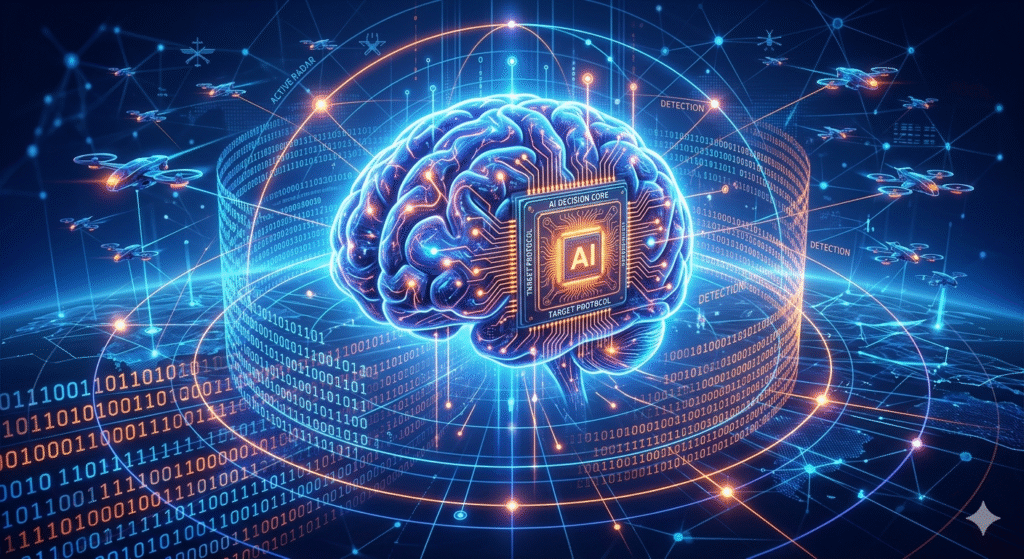
India’s integration of AI into its military is not a single project. It is a vast ecosystem of organizations, startups, and advanced tech frameworks working in tandem.
What It Is
The Indian military AI strategy is a concerted effort to weave machine learning, computer vision, natural language processing, and autonomous robotics into the fabric of daily operations.
This covers everything from command, control, communications, computers, intelligence, surveillance, and reconnaissance (C4ISR) to mundane logistics and supply chain management.
How It Works: The Super-OODA Loop
Military strategy has long relied on the OODA loop: Observe, Orient, Decide, Act. Historically, this was a human-driven, sequential process limited by cognitive speed.
AI compresses this into a “Super-OODA loop.” Sensors across land, air, and space ingest massive amounts of data instantly. AI algorithms instantly filter this data, identify high-value targets, predict enemy movements, and suggest tactical responses to commanders in milliseconds.
This effectively shrinks the “kill chain”—the time between target detection and neutralization. To understand the broader implications of data acting as the new currency of war, you can explore the comprehensive breakdown on(https://blog.aquartia.in/index.php/2026/03/24/data-driven-warfare-and-ai-are-rewriting-rules-of-global-conflict/).
Key Components
India has built specific institutional architecture to drive this transition:
- DAIC & DAIPA: The Defence AI Council (DAIC) provides the strategic vision, while the Defence AI Project Agency (DAIPA) acts as the executive arm. They translate policy into field-deployed technology.
- CAIR (Centre for Artificial Intelligence and Robotics): A critical Defence Research and Development Organisation (DRDO) facility in Bangalore leading R&D in network-centric warfare.
- STEAG: Established in 2024, the Signals Technology Evaluation and Adaptation Group is an elite Army unit. They focus on 5G/6G networks, quantum tech, and AI communication integration.
- iDEX (Innovations for Defence Excellence): Launched in 2018, this initiative bridges the gap between the military and agile private startups.
Conceptual Breakdown
India’s tactical transition is anchored by several flagship indigenous projects that replace outdated imported hardware.
Project Zorawar: The AI-Powered Light Tank
Designed specifically for the treacherous, high-altitude terrains of the Line of Actual Control (LAC), Project Zorawar is India’s answer to China’s ZTQ-15 light tanks.
Weighing a maximum of 25 tonnes and powered by a 760 hp Cummins engine, the Zorawar can be rapidly airlifted by C-17 Globemasters. This allows armored support to reach flashpoints in hours, not days.
Its technological edge lies in its C4ISR capabilities. It features an AI-powered fire control system that automatically recognizes and locks onto targets, reducing the required crew size from four to three. Crucially, it houses an integrated anti-drone shield—a C-UAS system that autonomously detects, tracks, and neutralizes incoming aerial threats without human intervention.
Project Kusha: The AI-Integrated Sky Shield
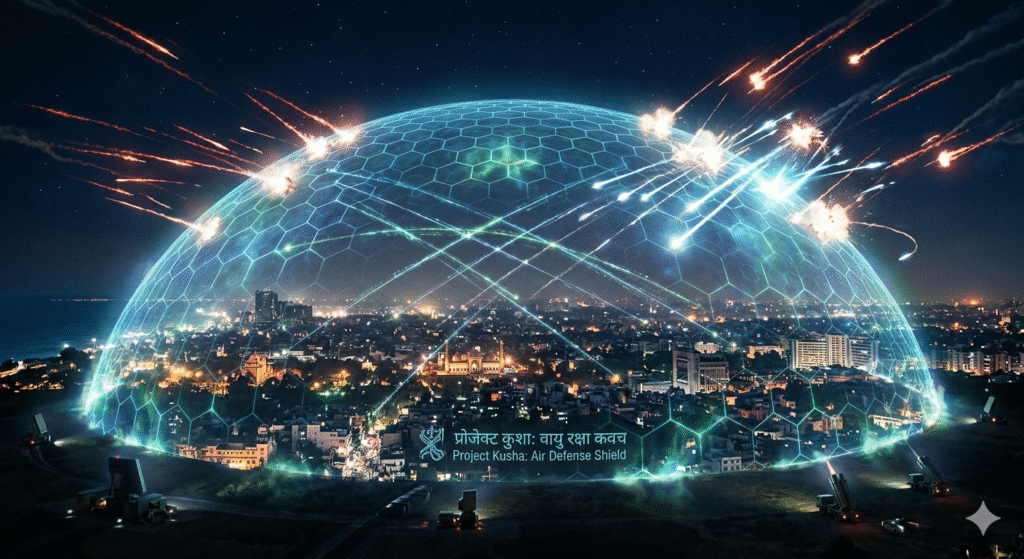
Often compared to Israel’s Iron Dome or Russia’s S-400, Project Kusha (Mission Sudarshan Chakra) is India’s indigenous, multi-layered air defense umbrella.
Kusha utilizes a network-centric AI architecture for automated threat prioritization and simultaneous target tracking. Powered by advanced Gallium Nitride (GaN) radars that offer 30% more range and superior heat dissipation, Kusha ensures a 350km protective bubble over critical infrastructure.
The system features three distinct interceptor tiers:
| Interceptor Tier | Operational Range | Target Profile | Test/Deployment Status |
| M1 | 120-150 km | Standard fighter jets, cruise missiles, low-flying drones. | Critical User Trials (2026) |
| M2 | 250 km | Anti-ship ballistic missiles (e.g., DF-21D), hypersonic gliders. | Scheduled 2027 |
| M3 | 350-400 km | High-value targets: AWACS, mid-air refuelers, transport aircraft. | Scheduled 2028 |
Table 1: Project Kusha Interceptor Capabilities
Swarm Drones & HAL CATS
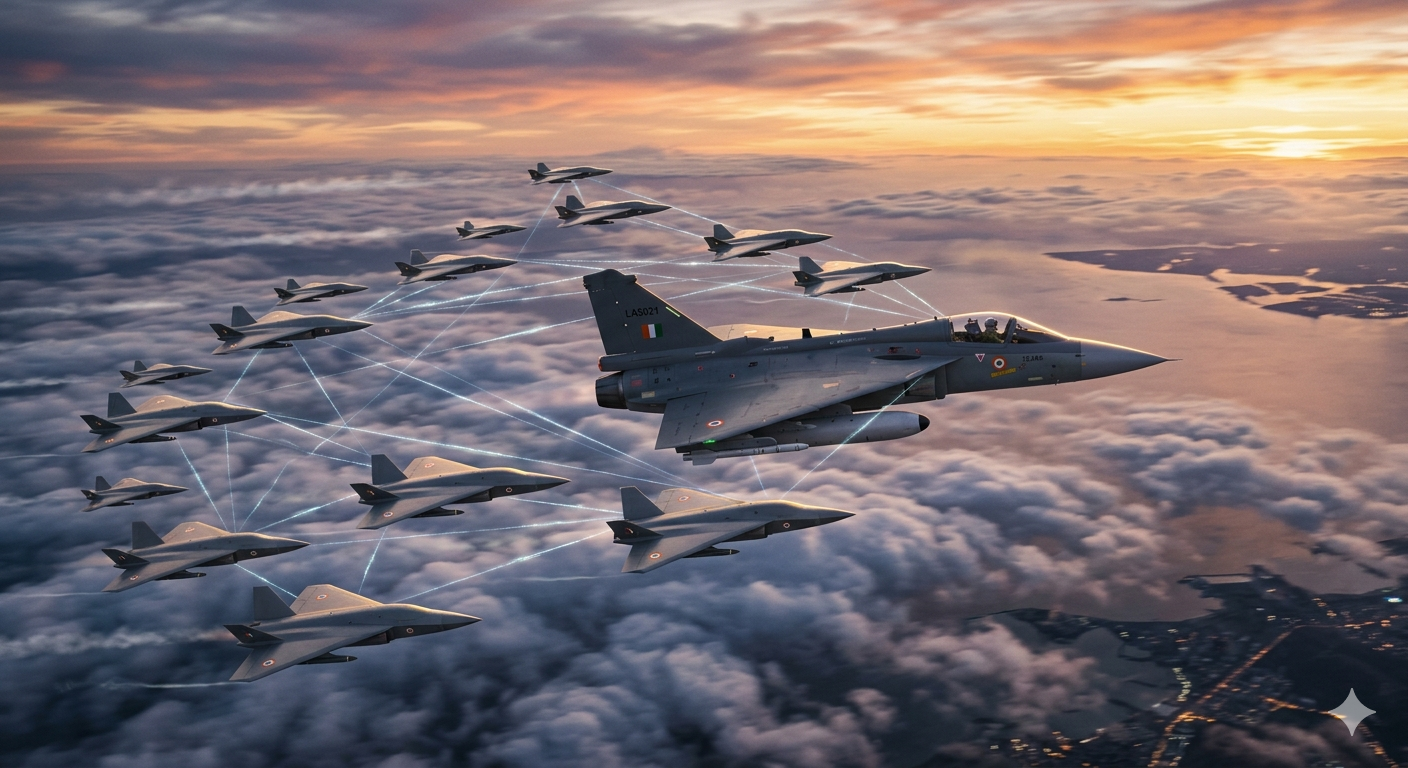
The military is heavily investing in unmanned teaming. The HAL Combat Air Teaming System (CATS) pairs a manned fighter (like the Tejas) with swarms of UAVs (CATS Warrior and ALFA).
These AI-driven swarms can penetrate deep into contested airspace, executing precision strikes while keeping the human pilot safely at a standoff distance.
To counter enemy swarms, DRDO’s Microwave Tube Research and Development Centre (MTRDC) has developed ground-based High-Power Microwave (HPM) directed energy weapons. These systems are capable of frying the electronics of multiple drones simultaneously up to a kilometer away, neutralizing threats without firing a single kinetic bullet.
Real-World Examples
The theoretical frameworks of Cold Strike and AI integration faced their ultimate test between May 6 and May 10, 2025, during Operation Sindoor.
Following a severe terrorist provocation in Pahalgam, India launched precise missile and air strikes against Jaish-e-Mohammed and Lashkar-e-Taiba infrastructure deep within Pakistan. The objective was strictly limited to eliminating terror nurseries without capturing territory, carefully managing escalation thresholds.
The AI Defense Reaction
On the night of May 7-8, Pakistan retaliated. They attempted to saturate Indian airspace with drone and missile strikes across northern and western bases, including Pathankot, Srinagar, and Adampur. Pakistan reportedly deployed over 600 drones to map and overwhelm Indian air defenses.
India’s response was a masterclass in networked, data-driven warfare. The Indian Army’s Akashteer system seamlessly plugged into the IAF’s Integrated Air Command and Control System (IACCS).
This AI-driven sensor fusion integrated data from legacy defense guns—which had been upgraded with optical sights—all the way up to the advanced S-400 systems. The Integrated Counter UAS grid autonomously neutralized the incursions, marking India’s first combat use of such deeply integrated, multi-domain defense networks.
Operation Sindoor validated the “Cold Strike” premise. India proved it could execute punitive, multi-domain strikes and manage massive retaliatory drone swarms using networked intelligence.
The Startup Revolution: iDEX
Another real-world success is the Innovations for Defence Excellence (iDEX) program. Launched to bypass sluggish state-run R&D, iDEX invites private startups to solve military problems.
For example, Sagar Defence, an iDEX winner, developed the “Genesis” system. This is an AI-powered, “boat-in-a-box” module that can be retrofitted onto existing vessels, making them fully autonomous. Another startup produced a 1000-drone swarm show for Republic Day at a fraction of the cost of foreign vendors.
By funding over 200 startups, India is rapidly indigenizing counter-UAV systems, autonomous high-altitude drones, and secure communications.
Benefits / Advantages
The integration of AI provides distinct, tangible asymmetric advantages for the Indian Armed Forces:
- Force Multiplication: AI tools like Trinetra provide a unified operational picture. They merge satellite data, ship movements, and open-source intelligence to give commanders unprecedented battlefield clarity.
- Predictive Defense: Machine learning vision systems on drones patrolling the LAC detect unauthorized incursions before they escalate. In December 2022, AI predictive tools successfully helped Indian forces counter PLA maneuvers in the Yangtse sector.
- Logistical Efficiency: AI algorithms drastically improve supply chain management, predictive maintenance of legacy platforms, and load distribution for high-altitude deployments.
- Cost Asymmetry: iDEX startups are delivering military-grade tech at highly competitive price points. Instead of relying on expensive foreign imports, local innovators are building bespoke solutions tailored for Indian terrains.
Challenges
Despite the rapid advancements, India’s AI blueprint harbors severe vulnerabilities that require immediate strategic remediation.
The Foreign Dependency Trap
Perhaps the most glaring risk is India’s severe hardware and cloud reliance. Current estimates suggest that up to 90% of India’s military AI workloads run on overseas cloud servers. These are primarily managed by American hyperscalers like Amazon Web Services (AWS), Microsoft Azure, and Google Cloud.
Furthermore, the silicon chips powering these advanced systems are predominantly manufactured in Taiwan and China, based on American designs from companies like Nvidia.
If undersea cables are sabotaged during a conflict—similar to incidents in the Baltic Sea—or if geopolitical sanctions cut off access to these cloud infrastructures, India’s multi-layered defense system could be severely paralyzed.
To dive deeper into how the nation can mitigate this systemic risk, read(https://blog.aquartia.in/index.php/2026/03/20/how-india-can-secure-its-electronic-hardware-ecosystem/).
Budgetary and Computational Gaps
While India allocates roughly $50 million annually specifically to military AI projects, this is merely a fraction of China’s estimated $1.6 to $2.7 billion investment. csdronline
Additionally, India faces a severe Graphics Processing Unit (GPU) deficit. GPUs are the engines of AI training. While China commands hundreds of thousands of high-end GPUs, India currently possesses roughly 38,000. Competing with China across all AI domains is unrealistic; India must prioritize asymmetric capabilities.
Fragmented Data Architectures
AI models are only as good as their training data. Currently, massive data silos exist between the Indian Army, Navy, and Air Force. Without full inter-service data integration, AI systems cannot cross-reference intelligence to create a flawless Common Operating Picture, limiting their operational effectiveness.
Global Implications
To govern the rapid deployment of these lethal technologies, India cannot afford a regulatory vacuum. The Ministry of Defence, via DRDO, officially launched the Evaluating Trustworthy Artificial Intelligence (ETAI) Framework in October 2024.
The ETAI Framework
The ETAI framework is designed to ensure that AI systems deployed in high-stakes combat are resilient to adversarial hacking and behave predictably. The framework provides a structured approach for developers and evaluators to build trust in military technology.
It is built upon five non-negotiable pillars:
| ETAI Pillar | Core Objective | Tactical Application |
| Reliability & Robustness | Sustaining performance in unexpected circumstances. | Ensuring AI doesn’t crash during electronic jamming. |
| Safety & Security | Protecting systems from cyber attacks. | Shielding drone swarm networks from data poisoning. |
| Transparency | Improving explainability of AI decisions. | Allowing human commanders to understand targeting logic. |
| Fairness | Mitigating algorithmic bias. | Preventing unfair profiling in facial recognition tools. |
| Privacy | Protecting personal and classified data. | Securing troop movement data from open-source scraping. |
Table 2: The Five Pillars of the DRDO ETAI Framework
Global South Leadership
As superpowers like the US and China race to build unconstrained AI capabilities, India is positioning itself as a normative leader for the Global South.
By championing the ETAI framework and meaningful human-control principles at international forums like the UN GGE, G20, and BRICS, India aims to prevent a global race to the bottom where safety is sacrificed for operational speed.
Future Trends
The horizon of India’s military tech landscape is accelerating rapidly toward 2027 and beyond.
- Quantum Warfare: India is actively simulating Shor’s algorithm on the PRAGYA quantum simulator. This is preparation for a near future where traditional encryption protocols (like AES-256) are easily cracked by adversary quantum computers.
- Offensive Cyber AI: The military is exploring elite cyber-attack forces capable of wielding AI-generated zero-day exploits. Frameworks like DIVYASTRA are being developed to cripple enemy networks preemptively before physical hostilities begin.
- AI-Native Startups: The iDEX pipeline is expanding drastically. Startups are proving India is transitioning from a net importer to a global defense exporter. Over 2,000 defense startups are currently driving deep-tech innovation across the country.
Quick Summary Table
Legacy Warfare vs. AI-Enabled Warfare (Cold Strike)
| Feature | Legacy Warfare (Pre-2020) | AI-Enabled Warfare (Current/Future) |
| Primary Doctrine | Cold Start / Defensive Defense | Cold Strike / Proactive Deterrence |
| Mobilization Time | Weeks (Massive Strike Corps) | Hours (Integrated Battle Groups) |
| Decision Cycle | Human OODA Loop (Sequential) | Super-OODA Loop (Machine Speed) |
| Air Defense | Standalone Radars & Manual Guns | Sensor Fusion (Kusha, IACCS) |
| Border Surveillance | Human Patrols, Scheduled Flights | Persistent AI Drones, Predictive Analytics |
| Weaponry Focus | Dumb Munitions, Heavy Armor Tanks | Swarm Drones, AI Light Tanks (Zorawar) |
Table 3: The Evolution of Indian Military Strategy
Conclusion
The battlefield of tomorrow is already here, and it operates at the speed of light. India’s strategic pivot toward algorithmic warfare is not just about keeping pace with global superpowers; it is about establishing credible, localized deterrence in an increasingly unstable geopolitical neighborhood.
From startups innovating in Bangalore tech hubs to the icy heights of the LAC where AI drones maintain an eternal vigil, the Indian military is rewriting its destiny. The shift from a reactive, troop-heavy force to a proactive, data-driven entity is well underway.
As we look toward a future dominated by autonomous systems, drone swarms, and quantum cyber-attacks, one critical question remains: Will the speed of India’s indigenous innovation outpace the complexities of its geopolitical threats?
FAQ SECTION
1. What is India’s Cold Strike military doctrine?
Cold Strike is a proactive military strategy that evolved from the older, slower “Cold Start” doctrine. Instead of relying on massive, time-consuming troop mobilizations, Cold Strike utilizes agile Integrated Battle Groups (IBGs), real-time AI intelligence, and multi-domain operations. This allows the Indian Armed Forces to execute swift, precise strikes while tightly controlling escalation thresholds.
2. How did Artificial Intelligence play a role in Operation Sindoor (2025)?
During the May 2025 conflict, Pakistan launched over 600 drones at Indian bases. India utilized advanced AI sensor fusion, integrating the Army’s Akashteer system with the IAF’s Integrated Air Command and Control System (IACCS). This AI-driven network allowed automated air defense grids to track, prioritize, and neutralize the drone swarms simultaneously without overwhelming human operators.
3. What is Project Zorawar and why is it important?
Project Zorawar is India’s indigenous, AI-enabled light tank designed specifically for high-altitude combat along the Line of Actual Control (LAC). Weighing just 25 tonnes, it features an AI-powered fire control system for automated target locking. Most importantly, it houses an integrated anti-drone shield that autonomously detects and destroys aerial threats.
4. How does India’s Project Kusha compare to the Russian S-400?
Project Kusha is India’s highly advanced, multi-layered air defense shield. While functionally similar to the S-400, Kusha is customized with Gallium Nitride (GaN) radars for superior heat dissipation and longer range. Its M3 interceptor is designed to hit high-value targets up to 400 km away, utilizing a network-centric AI architecture for automated threat prioritization.
5. What is the DRDO ETAI Framework?
Launched by DRDO in October 2024, the Evaluating Trustworthy Artificial Intelligence (ETAI) Framework provides strict ethical and technical guidelines for military AI. It is built on five core pillars: Reliability & Robustness, Safety & Security, Transparency, Fairness, and Privacy. The goal is to ensure autonomous systems act predictably and safely in chaotic combat scenarios.
6. What is the ‘Foreign Dependency Trap’ in Indian defense technology?
Despite massive local software innovations, approximately 90% of India’s military AI computing power currently runs on foreign cloud servers (like AWS and Azure). Additionally, the systems rely heavily on hardware microchips manufactured in Taiwan and China. This creates a critical strategic vulnerability in the event of global sanctions or severed supply chains.
7. How is the iDEX initiative helping the Indian Armed Forces?
Innovations for Defence Excellence (iDEX) is a government initiative that connects the defense establishment with agile, deep-tech startups. By providing direct funding, iDEX bypasses sluggish traditional R&D, resulting in cost-effective indigenous innovations like autonomous boat swarms, AI cyber-security tools, and advanced drone payloads.
8. What are HAL CATS and drone swarming technologies?
The Combat Air Teaming System (CATS), developed by Hindustan Aeronautics Limited, pairs a manned fighter jet (the “mothership”) with swarms of AI-driven unmanned aerial vehicles (UAVs). These loyal wingman drones can autonomously penetrate enemy airspace to conduct surveillance or precision strikes while keeping the human pilot safely out of range.
9. What are Integrated Battle Groups (IBGs)?
Integrated Battle Groups are agile, self-contained, brigade-sized military formations. Unlike traditional army structures that take weeks to mobilize, IBGs integrate infantry, armor, artillery, and logistics into a single cohesive unit. Backed by AI, they are designed to deploy to flashpoints within hours, forming the backbone of the Cold Strike doctrine.
10. How is India addressing the threat of enemy drone swarms?
Aside from the kinetic defenses on the Zorawar tank, India’s DRDO is developing High-Power Microwave (HPM) directed energy weapons. These ground-based systems can emit concentrated microwave pulses that instantly fry the electronic circuitry of multiple drones simultaneously up to a kilometer away, neutralizing swarms without firing conventional ammunition.
KEY TAKEAWAYS BOX
- Algorithmic Combat is Real: Wars are now decided by data processing speeds and AI predictive models, compressing the traditional OODA loop into milliseconds.
- The Cold Strike Reality: India has definitively moved from slow mobilization to rapid, AI-backed Integrated Battle Groups (IBGs) capable of instant multi-domain deterrence.
- Atmanirbhar Innovations are Working: Projects like the Zorawar light tank, Kusha air defense shield, and iDEX startup solutions are significantly cutting reliance on foreign defense imports.
- Ethical Guardrails are Essential: The DRDO’s ETAI framework sets a vital global standard for Trustworthy AI, prioritizing human control, safety, and transparency in lethal systems.






+ There are no comments
Add yours