Key Highlights
- Financial Resurgence: The defense modernization drive is fueled by a ₹2.19 lakh crore capital outlay in 2026, representing a 21.8% year-on-year increase, with a heavy emphasis on indigenous defense production.
- Next-Generation Fighters: The Cabinet Committee on Security has approved the Advanced Medium Combat Aircraft (AMCA) project at ₹15,000 crore, while domestic production of the Tejas Mk1A accelerates with a newly inaugurated third assembly line.
- Air Defense Revolution: Project Kusha aims to establish a 400 km indigenous missile shield by 2030, supplementing the active S-400 Sudarshan squadrons to secure the skies.
- Autonomous Warfare: The Ghatak Unmanned Combat Aerial Vehicle (UCAV) and the ALFA-S swarm drone projects are moving toward operational reality, signaling a permanent shift toward manned-unmanned teaming.
- Structural Theaterisation: The Indian military is racing to operationalize Integrated Theatre Commands by May 2026 to ensure seamless joint operations across all branches of the armed forces.
The theatre of modern warfare is no longer defined merely by the thunder of jet engines; it is dictated by the silent, invisible realms of cyberspace, artificial intelligence, and hypersonic interception.
In an era where geopolitical fault lines are increasingly volatile, the ability to control the skies is synonymous with national survival. The Indian Air Force (IAF), operating within one of the world’s most complex security environments, is undergoing an unprecedented metamorphosis.
Caught in a strategic crucible between two nuclear-armed neighbors—China to the north and east, and Pakistan to the west—the IAF is rapidly transitioning. It is evolving from a legacy force reliant on imported platforms into an indigenous, network-centric aerospace power capable of multi-domain dominance.
This exhaustive strategic analysis explores the architecture of the IAF’s modern war machine as of 2026. From the tactical brilliance displayed during the recent Operation Sindoor to the multibillion-dollar investments in stealth fighters, drone swarms, and impenetrable air defense shields, the modernization of Indian air power represents a critical shift in global military dynamics.
Why This Topic Matters Today
The urgency of aerospace modernization cannot be overstated in today’s fragile geopolitical climate.
Following the brief but intense India-Pakistan conflict of May 2025, and the ongoing militarization of the Line of Actual Control (LAC) by the People’s Liberation Army Air Force (PLAAF), the strategic equilibrium in South Asia has fundamentally shifted.
The traditional “two-front war” scenario is no longer a theoretical military exercise but an active, daily operational calculus.
Furthermore, the economic commitment to this transformation is staggering. The Union Budget for 2026–27 signals a decisive pivot toward capability-based preparedness, allocating a record ₹7.85 lakh crore to the Ministry of Defence.
This budget includes a massive 15.19% hike over previous estimates, with nearly ₹1.39 lakh crore earmarked strictly for domestic capital procurement to stimulate local manufacturing.
Understanding the trajectory of the IAF is essential for defense professionals, strategic analysts, and competitive exam aspirants. Those preparing for the UPSC must deeply grasp the nuances of India’s national security apparatus, the Defence Acquisition Procedure (DAP) 2020, and the broader implications of self-reliance, or Aatmanirbhar Bharat.
Background / Context
The historical trajectory of the Indian Air Force provides the necessary context to truly appreciate its current modernization efforts.
Established officially on October 8, 1932, as an auxiliary air force of British India, the IAF has evolved into the fourth largest air force globally. Today, it operates over 1,700 aircraft with approximately 140,000 active personnel, securing an incredibly vast and diverse airspace.
Did You Know? The IAF created a world record by performing the highest landing of a C-130J Super Hercules at the Daulat Beg Oldi airstrip in Ladakh, at a breathtaking altitude of 16,614 feet (5,065 meters).
The IAF’s operational history is marked by significant and defining engagements. From providing critical logistical support during the 1947 conflict to its decisive role in the 1971 Indo-Pak war, the IAF has consistently proved its mettle. In fact, the IAF is the only air force globally to have engaged in a full-scale war after World War II, a conflict that ultimately led to the creation of Bangladesh.
Historically, the IAF’s procurement strategy was heavily dependent on foreign technology. It relied largely on Soviet and later Russian platforms like the ubiquitous MiG series and the heavy-lift Sukhoi Su-30MKI. This was supplemented by Western acquisitions, including French Mirage 2000s and British SEPECAT Jaguars.
However, the shifting character of global conflict—demonstrated by the limitations of legacy aircraft in modern contested airspaces—necessitated a strategic pivot. The lessons learned from the 1999 Kargil War (Operation Safed Sagar), the 2019 Balakot airstrikes, and the recent May 2025 engagements have collectively underscored a vital truth.
The modern battlefield demands absolute precision strike capabilities, electronic warfare superiority, and, crucially, secure indigenous supply chains that are immune to global sanctions.
Core Explanation
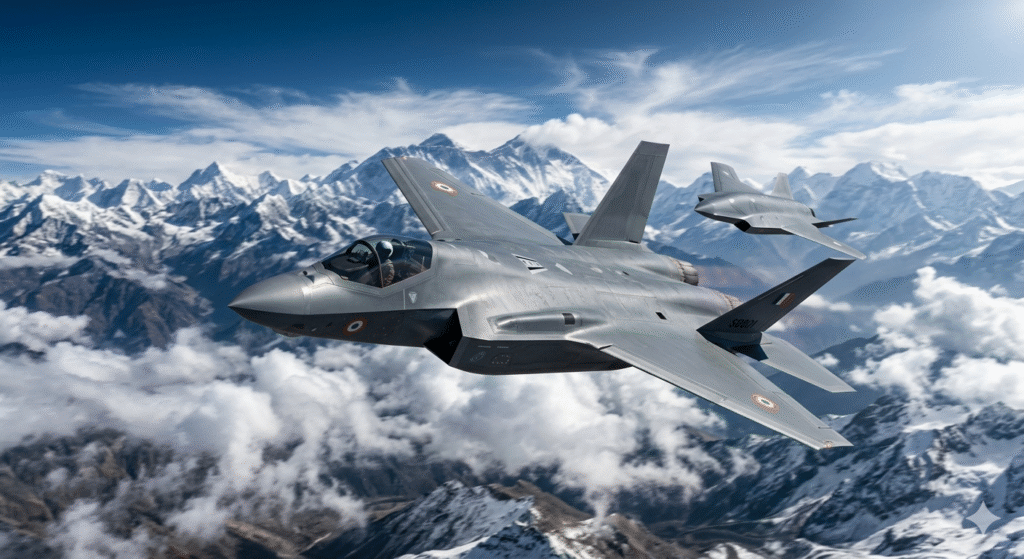
The backbone of any modern air force is its fighter fleet, and the IAF is currently navigating a highly complex transition phase.
The strategy balances the urgent need to arrest its depleting squadron strength—currently hovering around 31 squadrons against a sanctioned minimum requirement of 42—with the long-term goal of acquiring fifth-generation stealth technology.
The Heavyweight Backbone: Su-30MKI Upgrades
The Su-30MKI remains the undisputed heavy-lift workhorse of the IAF. Comprising the largest component of the combat fleet, this twin-engine, long-range fighter is optimized for air superiority and deep penetration strikes.
Recognizing its continued relevance in a two-front scenario, the Ministry of Defence contracted Hindustan Aeronautics Limited (HAL) to manufacture an additional 12 Su-30MKI aircraft at a cost of ₹13,500 crore.
Simultaneously, the IAF has initiated a comprehensive “Super Sukhoi” upgrade program for 84 existing jets. This modernization integrates fifth-generation subsystems, new AESA radars, and modern indigenous weapons to keep the platform lethal against newer threats.
The Spearhead: Dassault Rafale and MRFA
Operating alongside the heavy Sukhois is the Dassault Rafale, a 4.5-generation multirole fighter that currently serves as India’s most sophisticated combat platform.
Armed with the Meteor beyond-visual-range (BVR) air-to-air missile and the SCALP cruise missile, the Rafale provides a decisive qualitative edge over regional adversaries. Its advanced electronic warfare suite makes it a highly credible counter to both Pakistani JF-17s and Chinese J-10/J-16 platforms.
To further bolster this medium-weight capability, the IAF is actively expediting the acquisition of 114 Multi-Role Fighter Aircraft (MRFA). This massive $40 billion procurement is expected to be executed under the “Make in India” rubric, emphasizing high-level technology transfers and domestic assembly. By integrating future F4 and F5 Rafale standards, the IAF aims to maintain dominance while indigenous programs mature.
The Indigenous Vanguard: Tejas Mk1A and Mk2
To replace the rapidly aging MiG-21 fleet, which is finally slated for complete retirement, the IAF is leaning heavily on the indigenous Light Combat Aircraft (LCA) program.
The Tejas Mk1A, a single-engine, 4.5-generation supersonic fighter, features an advanced Active Electronically Scanned Array (AESA) radar, updated electronic warfare suites, and crucial mid-air refueling capabilities.
To meet delivery timelines, HAL has established a third production line in Nashik. This expansion aims to scale output to 24 aircraft per year, actively fulfilling the government’s mandate for domestic capital outlay.
Concurrently, the much-anticipated Tejas Mk2 (Medium Weight Fighter) is under active development. Designed with an elongated airframe, close-coupled canards, and powered by the robust US-origin GE F414 engine, the Mk2 is expected to roll out its first prototype in 2026.
This platform is strategically critical. It is designated to eventually replace the legacy Mirage 2000, MiG-29, and Jaguar fleets, offering significantly higher payload capacities and superior network-centric avionics.
Expert Tip: For defense analysts mapping the IAF’s future, tracking the integration timeline of the GE F414 engine into the Tejas Mk2 is paramount. This powertrain deal not only secures India’s immediate propulsion needs but also lays the groundwork for future co-development of higher-thrust engines for fifth-generation fighters.
Conceptual Breakdown: The Air Defense Matrix
Modern air superiority is not solely about offensive fighters; it requires an impenetrable, multi-layered defensive shield.
The IAF is aggressively constructing a network-centric air defense grid, conceptually termed Mission Sudarshan Chakra. This architecture is designed to autonomously prioritize and neutralize threats ranging from low-flying micro-drones to hypersonic glide vehicles.
Project Kusha: The Indigenous Shield
At the apex of this defensive umbrella is Project Kusha, also known as the Extended Range Air Defence System (ERADS).
Approved by the Defence Acquisition Council for five squadrons at ₹21,700 crore, this indigenous system is engineered by DRDO and Bharat Electronics Limited (BEL). It is explicitly designed to rival the capabilities of the US Patriot and the Russian S-400.
The architecture of Project Kusha is defined by three distinct, highly capable interceptors:
- M1 Interceptor: Designed for terminal engagement with a range of 120–150 km.
- M2 Interceptor: Engineered for mid-course engagement at ranges up to 250 km.
- M3 Interceptor: Built for long-range exo-atmospheric and endo-atmospheric interception up to 400 km.
Reaching speeds of approximately Mach 5.5, these interceptors utilize advanced seekers and kill-vehicle technologies for pinpoint terminal accuracy.
Integrating the Kill-Web: IACCS and Akashteer
Project Kusha will operate in tandem with the Russian-supplied S-400 systems. As of 2026, India operates three operational S-400 squadrons (renamed Sudarshan units), with the final two expected to arrive shortly to complete the strategic shield.
The critical technological leap that ties these weapons together is the Integrated Air Command and Control System (IACCS).
Developed by BEL, the IACCS fuses raw data from civilian radars, military ground stations, Airborne Early Warning and Control (AEW&C) aircraft, and space-based assets. It creates a unified, real-time “kill web” that provides commanders with a 360-degree, live digital map of the airspace.
This integration eliminates single points of failure. It allows for central control with decentralized execution, drastically reducing reaction times against incoming threats. Concurrently, the Army’s Akashteer system is being actively linked into the IACCS, effectively bridging the gap between low-level tactical air defense and high-altitude strategic interception.
Visual Explanation Suggestion: Imagine a digital dome over India. The outermost layer is the S-400 and Project Kusha (400km range). Inside that are Medium-Range SAMs (Barak-8). The inner layer consists of Quick Reaction SAMs. The core features point-defense guns and counter-drone systems. All layers are digitally tethered to the IACCS command center.
Real-World Case Study: Operation Sindoor (May 2025)
The theoretical capabilities of the IAF’s modern war machine were violently and comprehensively tested during Operation Sindoor in May 2025.
Sparked by a brutal, religiously motivated terrorist attack in Pahalgam on April 22, 2025, the Indian military response represented a massive paradigm shift in the application of sub-conventional military force under a nuclear overhang.
Unlike the isolated, limited airstrikes of Balakot in 2019, Operation Sindoor was a heavy-hammer, multi-domain suppression of enemy air defenses (SEAD).
The conflict, lasting roughly 88 hours between May 6 and May 10, showcased the IAF’s maturation into a highly disciplined precision warfare force. Between 2:00 AM and 5:00 AM on May 10, the IAF executed a kinetic decapitation strike against ten PAF airbases—including the heavily defended Murid facility—and critical command-and-control nodes.
Tactical analysis from defense experts, including defense scholar Vishnu Som, reveals that the IAF utilized a perfectly synchronized package of munitions.
They deployed BrahMos-NG supersonic cruise missiles, SCALP stealth munitions fired from Rafales, and Harop loitering munitions. This overwhelming kinetic saturation induced immediate paralysis within the PAF’s defensive grid, rendering them unable to mount a cohesive counter-attack.
The operation demonstrated that India’s doctrine of “strategic restraint” is not an inability to act, but a calculated, ethical application of force. By successfully executing deep strikes with absolute precision and minimal collateral damage, the IAF validated its billion-dollar investments in modern weaponry, ultimately forcing Pakistan to the ceasefire table.
Advantages: The Autonomous and AI Revolution
The future advantage of the IAF relies heavily on reducing human casualties, extending operational endurance, and accelerating decision loops through autonomous systems and Artificial Intelligence (AI).
The Ghatak UCAV and Swarm Warfare
India is aggressively pursuing sovereign stealth technology. The Defence Procurement Board recently cleared the development of the 13-ton Ghatak Unmanned Combat Aerial Vehicle (UCAV).
Powered by a dry variant of the indigenous Kaveri engine, the Ghatak features a highly advanced flying-wing stealth design. It is engineered to act as a “first wave” asset. Its primary role is to penetrate highly contested airspace, execute SEAD missions, and destroy radar installations before manned fighters enter the theater.
Simultaneously, the IAF is investing heavily in the ALFA-S (Air-Launched Flexible Asset – Swarm) project. The military plans to acquire 800 Medium Range Swarm Unmanned Munition Systems.
These systems are capable of deploying 20-drone swarms over 350 kilometers. These AI-driven swarms can overwhelm enemy radars through sheer volume, jamming communications, and executing pinpoint kamikaze strikes. Impressively, they are designed to operate reliably in extreme temperatures ranging from -20°C to 50°C, making them ideal for high-altitude Himalayan deployments.
AI and Machine Learning Integration
Through the Defence Artificial Intelligence Council (DAIC) and the overarching M.A.N.A.V. framework, the IAF is embedding machine learning deeply into its core logistics and operational algorithms.
Predictive maintenance AI is currently utilized for the Su-30MKI fleet. By forecasting component failures before they occur, the IAF drastically reduces grounding time and increases sortie generation rates.
Furthermore, AI is being deployed in live threat detection. It parses millions of data points across the IACCS to identify anomalous flight patterns instantly, filtering out civilian traffic from potential hostile incursions.
Challenges, Risks, and Criticism
Despite the aggressive pace of modernization, the IAF faces severe structural, logistical, and financial headwinds that cannot be ignored.
The most glaring vulnerability remains the persistent squadron depletion. A parliamentary panel report in late 2024 starkly highlighted that the combat fleet stands at only 31 squadrons against the absolute minimal requirement of 42. Bridging this gap is a race against time.
Furthermore, the IAF’s historical reliance on Hindustan Aeronautics Limited (HAL) for the bulk of fighter production has frequently resulted in chronic schedule slippages. While the Tejas Mk1A delivery has finally commenced, the overarching LCA program took nearly four decades to mature, a luxury of time the IAF no longer possesses.
Additionally, the budgetary constraints are stark. Despite the massive ₹7.85 lakh crore allocation, legacy manpower costs—specifically burgeoning pension and salary liabilities—consume a vast portion of the revenue budget. This structural imbalance restricts the capital available for deep-tech research and next-generation acquisitions.
Finally, the indigenous drone sector struggles with critical supply chain dependencies. Systems like the TAPAS UAV have faced developmental hurdles and a controversial reliance on imported components (often from China), prompting the MoD to push for much stricter indigenous sourcing to avoid security compromises.
Strategic / Policy / Global Implications
The modernization of the IAF is occurring concurrently with massive administrative and doctrinal reforms, which are reshaping India’s geopolitical posture.
Defence Acquisition Procedure (DAP) 2020
The implementation of the Defence Acquisition Procedure (DAP) 2020 represents a monumental structural pivot from being a global “buyer” to a domestic “builder”.
By instituting stringent Positive Indigenisation Lists, the MoD has banned the import of hundreds of foreign subsystems, deliberately creating a captive, lucrative market for domestic aerospace firms.
This policy framework not only insulates the Indian military from global supply chain shocks and geopolitical sanctions but also positions India as an emerging defense exporter. India’s defense exports grew by 78 percent between 2023 and 2024, aided by strategic agreements like the Security of Supply Agreement (SOSA) signed with the United States. Authoritative data and policy details regarding these shifts can be explored further on official Government of India portals.
The Push for Integrated Theatre Commands
By May 2026, under the direct mandate of Chief of Defence Staff General Anil Chauhan, the Indian military aims to finalize the rollout of Integrated Theatre Commands.
This historic restructuring will dissolve the legacy single-service commands in favor of joint operational entities. The plan outlines a Northern Theatre Command (facing China) headquartered in Lucknow, a Western Theatre Command (facing Pakistan) in Jaipur, and a Maritime Theatre Command in Thiruvananthapuram.
While the IAF previously expressed valid reservations regarding the potential dilution of its limited air assets across multiple commands, current strategic consensus points toward compromise. Air Chief Marshal A.P. Singh has proposed a unified planning hub that ensures rapid, decentralized execution without adding cumbersome bureaucratic layers at the lower levels.
Future Trends
The trajectory of the Indian Air Force firmly points toward space and the electromagnetic spectrum as the ultimate high grounds of future conflict.
With the establishment of the Defence Space Agency and the impending launch of military-specific communications satellites like GSAT-7A, the IAF is officially transitioning from an air force into an aerospace force.
The integration of Directed Energy Weapons (lasers and high-powered microwaves) for localized counter-drone defense is progressing rapidly. Furthermore, the fielding of hypersonic glide vehicles, and the maturation of manned-unmanned teaming (MUM-T)—where a single Tejas Mk2 pilot securely controls a swarm of Ghatak drones—represent the immediate technological horizon for the late 2020s.
Expert Insights
Strategic evaluation of the IAF’s current posture indicates a military force in the midst of a profound, sometimes painful, but ultimately necessary transition.
Air Chief Marshal A.P. Singh recently emphasized that military power remains the “ultimate arbiter of national security,” warning against complacency and the inherent dangers of relying solely on economic or diplomatic strength in a hostile neighborhood.
Former IAF Chief V.R. Chaudhari echoed this sentiment, drawing lessons from recent conflicts in West Asia to highlight the absolute necessity of robust, multi-layered air defense systems and the growing lethality of drone warfare.
The synthesis of available data suggests that the IAF is consciously shifting its doctrine. It is moving away from pure platform-centric warfare—where strength is measured merely by the number of fighter jets—to agile, network-centric warfare.
A single Rafale, integrated with space-based sensors, communicating with drone swarms via secure Software Defined Radios (SDRs), and backed by the Kusha air defense shield, offers an exponentially higher combat value than multiple disconnected legacy fighters. The strategic gamble lies entirely in the execution timelines.
Comparison Tables
To truly understand the tactical environment, one must evaluate how Indian platforms stack up against regional adversaries, specifically the Pakistan Air Force (PAF) and the PLAAF.
Table 1: Multi-Layered Air Defense Umbrella (Mission Sudarshan Chakra)
| Defense Layer | System Deployed | Threat Focus | Estimated Range |
| Layer 4 (Outer) | S-400 Triumf, Project Kusha (M3) | Strategic bombers, AWACS, ballistic missiles | 350 – 400 km |
| Layer 3 (Mid) | Project Kusha (M1/M2), MR-SAM | Fighter jets, cruise missiles | 120 – 250 km |
| Layer 2 (Inner) | Akash, QRSAM | Low-flying aircraft, heavy tactical drones | 25 – 80 km |
| Layer 1 (Point) | VSHORADS, Counter-Drone Jammers | Micro-drones, loitering munitions, helicopters | < 10 km |
Source data synthesized from IACCS deployment capabilities and Project Kusha specifications.
Table 2: IAF Rafale vs. PLAAF J-20
| Specification / Capability | Dassault Rafale (India) | Chengdu J-20 (China) |
| Generation Status | 4.5 Generation (Combat Proven) | 5th Generation (Claimed, Unproven) |
| Radar Technology | RBE2 AESA | Type 1475 AESA (Classified specs) |
| Stealth Profile | Low observable features, heavy ECM | Full stealth airframe, internal bays |
| Primary A2A Missile | Meteor (Ramjet, ~150 km) | PL-15 (Dual-pulse, ~200+ km) |
| Strategic Advantage | Superior dogfighting agility, mature EW suite, SCALP deep strike integration. | Sensor fusion, BVR stealth engagement capability, extreme range. |
Data synthesis indicates that while the J-20 possesses superior stealth and first-look capability at extreme ranges, the Rafale excels in dynamic kinematic engagements and possesses a highly mature electronic warfare suite that can jam incoming missile seekers.
Table 3: IAF Tejas Mk1A vs. PAF JF-17 Block III
| Specification | Tejas Mk1A (India) | JF-17 Block III (Pakistan/China) |
| Engine Thrust | 84 kN (GE F404) | 84.4 kN (RD-93 / WS-13) |
| Radar Type | Uttam AESA / EL/M-2052 | KLJ-7A AESA |
| Maximum Payload | 5,300 kg | 3,700 kg |
| Ferry Range | ~3,000 km | 3,482 km |
| Construction Base | High composite material usage | Conventional aerospace alloys |
The Tejas Mk1A holds a distinct operational advantage in payload capacity and structural composite technology, allowing for a superior thrust-to-weight ratio in heavy combat configurations. The JF-17 Block III, however, benefits from a slightly longer ferry range and well-established export production lines.
Conclusion
The Indian Air Force’s journey from a tactical support arm flying biplanes in 1932 to a strategic, multi-domain war machine in 2026 is a profound testament to national resilience and technological ambition.
As the global security architecture continues to fragment and regional instability rises, India’s relentless pursuit of sovereign defense capabilities—driven by private sector innovation and bold policy reforms like DAP 2020—ensures that the skies above the subcontinent remain secure. The impending operationalization of Theatre Commands, coupled with the integration of AI and autonomous systems, will fundamentally redefine the calculus of deterrence in South Asia for decades to come.
What are your thoughts on India’s massive shift toward indigenous stealth fighters and autonomous drone swarms? Do you believe the Theatre Commands will optimize or complicate air operations? Join the conversation in the comments below and share this exhaustive analysis with your professional network.
FAQ SECTION
Q1: What is the current fighter squadron strength of the Indian Air Force in 2026? As of early 2026, the Indian Air Force operates approximately 31 active fighter squadrons. This number is significantly below the officially sanctioned requirement of 42 squadrons, which is deemed necessary to effectively handle a simultaneous two-front conflict scenario against China and Pakistan. The IAF is working aggressively to arrest this depletion by inducting indigenous Tejas Mk1A fighters, upgrading the massive Su-30MKI fleet, and accelerating the procurement of 114 Multi-Role Fighter Aircraft (MRFA).
Q2: How does the indigenous Tejas Mk1A compare to Pakistan’s JF-17 Block III? The Tejas Mk1A and the JF-17 Block III are both highly capable light multirole fighters. The Tejas Mk1A holds a distinct edge in maximum payload capacity (5,300 kg vs. 3,700 kg) and utilizes advanced composite materials for a superior thrust-to-weight ratio. It is powered by the highly reliable GE F404 engine. While the JF-17 boasts a slightly longer ferry range, the Tejas features superior indigenous avionics, including the Uttam AESA radar and a robust electronic warfare suite.
Q3: What is Project Kusha and why is it strategically important? Project Kusha, developed domestically by DRDO and BEL, is an indigenous long-range surface-to-air missile (ER-SAM) system designed to intercept aerial threats at ranges up to 400 km. Utilizing three different interceptors (M1, M2, M3), it serves as a critical, top-tier pillar of India’s Mission Sudarshan Chakra air defense shield. It is vital because it significantly reduces reliance on foreign systems like the Russian S-400, ensuring absolute strategic autonomy against advanced aircraft, drones, and cruise missiles.
Q4: What was the objective and outcome of Operation Sindoor in May 2025? Operation Sindoor was a heavy-hammer, multi-domain military response by the IAF following a severe terror attack in Pahalgam. Over an intense 88 hours in May 2025, the IAF utilized BrahMos supersonic missiles, SCALP stealth munitions, and drone swarms to execute deep strikes. They effectively suppressed Pakistan’s air defenses and struck ten key airbases, including Murid. The operation successfully paralyzed adversary command networks, proving India’s precision strike capabilities and enforcing strategic restraint.
Q5: What is the AMCA project and who is building it? The Advanced Medium Combat Aircraft (AMCA) is India’s highly ambitious indigenous fifth-generation stealth fighter program. Approved by the government with a ₹15,000 crore development budget, it features a twin-engine design, internal weapon bays for stealth, and supercruise capability. In a major policy shift under DAP 2020, the government is utilizing a Special Purpose Vehicle (SPV) model, partnering with private sector giants like Larsen & Toubro, Tata, and Adani to co-develop the aircraft alongside HAL and DRDO.
Q6: What role does Artificial Intelligence play in the IAF’s modernization? Artificial Intelligence is fundamentally transforming IAF operations through the M.A.N.A.V. framework and the Defence Artificial Intelligence Council (DAIC). AI is actively used for predictive maintenance—forecasting engine and part failures in the Su-30MKI fleet to reduce downtime. Furthermore, AI algorithms are vital for cyber threat detection and real-time data fusion within the Integrated Air Command and Control System (IACCS). AI also forms the computational brain guiding autonomous swarm drones like the ALFA-S.
Q7: What are Integrated Theatre Commands in the Indian military? Integrated Theatre Commands are unified military organizational structures that bring together the operational assets of the Army, Navy, and Air Force under a single commander for specific geographical regions. Driven by the Chief of Defence Staff, this restructuring aims to optimize resource allocation, enhance joint combat readiness, and streamline decision-making in modern warfare. Target operationalization is set for May 2026, featuring a Northern, Western, and Maritime Theatre Command.
Q8: How does the IAF plan to utilize autonomous drones in future combat? The IAF is rapidly integrating unmanned systems for both persistent surveillance and kinetic strikes to minimize human casualties. It has cleared the 13-ton Ghatak stealth UCAV for deep-penetration suppression of enemy air defenses (SEAD). Additionally, the IAF is acquiring MQ-9B SeaGuardians for high-altitude ISR, and developing ALFA-S swarm drones—clusters of AI-linked munitions designed to overwhelm enemy radar and execute precision kamikaze strikes across contested borders.
Key Takeaways
- Modernization Budget: A record ₹7.85 lakh crore budget in 2026 is driving India’s shift from imported arms to an indigenous defense manufacturing ecosystem under the Aatmanirbhar Bharat initiative.
- Fighter Fleet Evolution: The IAF is bridging its squadron gap by upgrading Su-30MKIs, inducting 4.5-gen Tejas Mk1A and Rafale jets, and aggressively pursuing the 5th-gen AMCA stealth fighter through public-private partnerships.
- Impenetrable Air Defense: The integration of the S-400 and the indigenous 400km-range Project Kusha, all tied together by the AI-driven IACCS network, provides a robust shield against modern aerial threats.
- Autonomous Warfare: Investments in the Ghatak stealth UCAV and ALFA-S swarm drones indicate a strategic shift toward manned-unmanned teaming and AI-driven combat operations.
- Structural Reforms: The transition to Integrated Theatre Commands by May 2026 will fundamentally reorganize how the Indian military plans and executes joint operations against dual-front threats.







+ There are no comments
Add yours