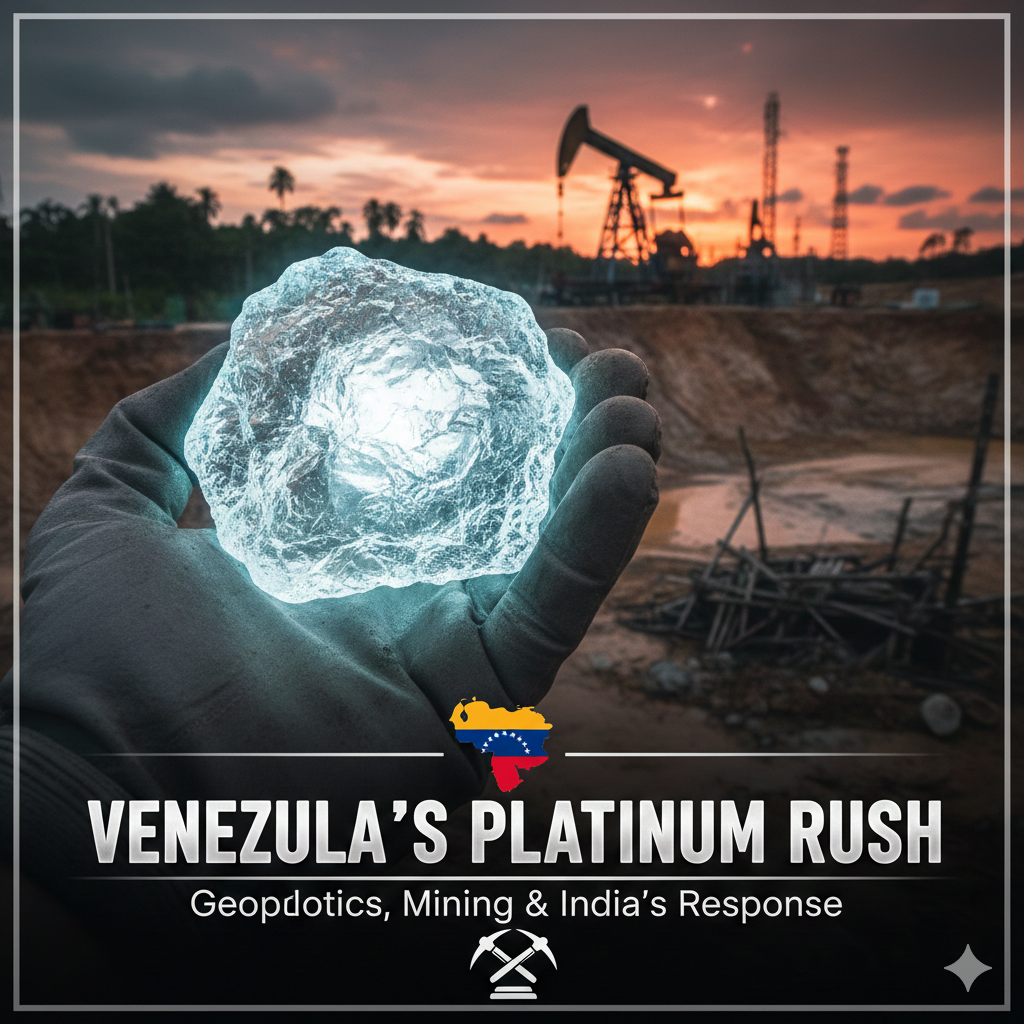
KEY HIGHLIGHTS:
✦ Platinum Explosion: Platinum prices surged 120% in one year, reaching ₹63,400/10g (₹6,340/g) in India following US military intervention in Venezuela and President Nicolás Maduro’s capture in January 2026.
✦ Precious Metals Rally: Gold jumped 2.83% to $4,451/oz (₹1,37,400/10g), silver rose 10.5%, and all three metals reached near-record highs, driven by safe-haven demand amid unprecedented geopolitical uncertainty.
✦ Strategic Mineral Goldmine: Venezuela holds the world’s largest oil reserves, 8,000+ tons of gold reserves, plus massive nickel, coltan, rare earth elements, copper, and titanium deposits in the Orinoco Mining Arc—now at the center of US-China strategic competition.
✦ Energy Transition Catalyst: Uncertainty over Venezuelan oil accelerates focus on alternative energy; platinum is critical for hydrogen economy, fuel cells, and catalytic converters; India’s hydrogen mission faces platinum dependency risk.
✦ India’s Economic Test: Rising precious metal prices ahead of Union Budget 2026 (February 1) create inflationary pressures; India’s massive import dependency on gold, silver, and platinum raises critical policy questions for inflation control and mineral security.
THE FLASHPOINT—VENEZUELA’S GEOPOLITICAL EARTHQUAKE
A. US Military Intervention: Trigger for Market Shock
On January 4-5, 2026, United States forces captured Venezuelan President Nicolás Maduro in an operation that marked the most dramatic escalation in US-Venezuela relations in two decades. The Trump administration announced it would “run” Venezuela until a “safe, proper, and judicious transition,” signaling Washington’s direct takeover of the nation’s political and resource apparatus.
The reverberations were immediate and far-reaching. Within hours of the news, global precious metals markets erupted. Platinum—long the forgotten cousin of gold and silver—suddenly became the darling of risk-averse investors. The yellow metal itself climbed 2.83% to $4,451/oz, while silver surged 10.5% to $75.85. But platinum outpaced them all: rising 5.70% to $2,259/oz in a single trading session.
For Indian investors, the impact was equally visceral. Gold prices shot up to ₹1,37,400 per 10 grams—a staggering 111% increase over just two years (from ₹65,100 in January 2024). Platinum reached ₹63,400 per 10 grams, a 120% surge in 12 months, the steepest appreciation among all precious metals.
B. Why Platinum? The Dual Demand Story
Most observers expected gold to dominate during a geopolitical crisis. Gold is the traditional safe-haven asset, the metal central banks accumulate, the hedge against currency depreciation and political uncertainty.
But platinum’s outsized rally reveals a more complex story—one that blends traditional crisis hedging with emerging energy transition dynamics.
Platinum serves two distinct markets, each facing acute supply-demand pressures:
1. Traditional Demand—Jewellery, Automotive, Industrial
Platinum has long been a luxury metal for high-end jewellery, particularly in India and China. It’s also essential for catalytic converters in vehicles, mandated for emission control in advanced economies. Medical devices, electronics, petroleum refining catalysts—platinum’s fingerprints are everywhere in industrial civilization.
As Venezuelan uncertainty spikes, investors don’t just buy platinum as a store of value; industrial users also rush to lock in supplies, fearing further disruptions.
2. Emerging Demand—The Hydrogen Economy
But here’s the game-changer: Platinum is absolutely critical for hydrogen fuel cells and electrolyzers—the cornerstones of the global energy transition.
India’s National Green Hydrogen Mission targets 5 million metric tons of production by 2030. The EU, Japan, and South Korea are racing toward hydrogen economies. The technology requires platinum-based catalysts, particularly for polymer electrolyte membrane (PEM) fuel cells and electrolyzers.
As geopolitical risks rattle oil markets, sending crude prices volatile, major economies are doubling down on hydrogen as the “clean energy insurance policy.” This accelerates platinum demand precisely when supplies are tightening.
VENEZUELA’S RESOURCE PARADOX—CRISIS OF GOVERNANCE, NOT SCARCITY
A. From Oil Giant to Failed State: The 12-Year Collapse
Venezuela’s tragedy is not one of lacking resources—it’s one of catastrophic governance failure.
The nation sits atop the world’s largest proven oil reserves: 303 billion barrels. It holds the most significant gold reserves in Latin America. Its Guayana Shield region—an area larger than Portugal (112,000 sq km)—is estimated to contain:
- 8,000+ tons of gold (exceeding South Africa’s total reserves)
- 340 million tons of nickel (rivaling Indonesia’s resources)
- 35,000 tons of coltan (critical for smartphones, EVs, defense)
- Vast rare earth element deposits (thorium, monazite-bearing sands)
- Titanium, rhodium, copper, diamonds, iron ore, bauxite
Yet between 2014 and 2026, this resource-wealthy nation descended into humanitarian catastrophe:
Oil Sector Collapse: Production plummeted from 3 million barrels/day to under 600,000 barrels/day. The 2014 oil price crash triggered economic freefall, but poor governance ensured recovery never materialized.
Mining Sector Devastation: Iron ore production crashed from 20 million tons (1990s) to 2 million tons. Bauxite plummeted from 5 million to 0.3 million tons. Gold, diamond, and nickel mining became almost entirely illicit, controlled by guerrilla and criminal groups.
Humanitarian Meltdown: Hyperinflation obliterated savings. Wages collapsed to $4/month. Healthcare system disintegrated. Nutrition crisis engulfed millions. An estimated 7+ million Venezuelans fled since 2015—the largest migration crisis in Latin American history.
B. The Mining Arc’s Paradox: Vast Wealth on Paper, Nothing on Ground
In 2016, President Maduro created the Orinoco Mining Arc (Arco Minero del Orinoco), designating 112,000 sq km of pristine rainforest for strategic mineral extraction. On paper, it promised transformation.
In reality, infrastructure collapsed, investment dried up, and governance evaporated. The consequence? Criminal organizations and guerrilla groups (primarily Colombian ELN, paramilitaries) seized control of gold mining operations.
By 2025, Venezuela’s gold production was entirely artisanal, small-scale, and linked to money laundering, cocaine trafficking, and weapons smuggling. Estimated gold extraction: a few hundred tons annually, mined under conditions of violence, environmental devastation, and human exploitation.
For other critical minerals—coltan, nickel, rare earths—the extraction infrastructure never materialized at all.
THE GEOPOLITICAL CHESSBOARD—US, CHINA, RUSSIA, AND CRITICAL MINERALS
A. Beyond Humanitarian Intervention: Strategic Mineral Competition
The official narrative frames US intervention as a humanitarian response to Venezuelan political repression and state collapse. But beneath the surface lies a stark geopolitical calculation: control over Venezuela’s strategic mineral reserves.
The competition for critical minerals represents a new fault line in global power politics, potentially more consequential than traditional oil geopolitics.
US Strategy: Containment and Control
- Reduce China’s Monopoly: China controls 70% of global rare earth mining and 90% of rare earth processing. This dominance is weaponizable—Beijing can restrict supplies to rival nations, particularly in defense and advanced technology sectors.
- Western Hemisphere Dominance: The Monroe Doctrine, dormant for decades, resurfaces. The US views Latin America as its strategic backyard and opposes external (Chinese/Russian) influence.
- Secure EV/Defense Supply Chains: The US auto industry and defense establishment face chronic nickel, cobalt, and rare earth shortages. Venezuela’s resources could ease supply crunches, accelerating the EV transition and strengthening military capabilities.
China’s Play: Strategic Partnerships
Before US intervention, China had aggressively positioned itself in Venezuela:
- Belt and Road Initiative (BRI) lending: Billions in Chinese loans, often repaid via Venezuelan oil at discounted rates
- Mining partnerships: Chinese companies explored mineral extraction projects; Beijing pre-positioned itself as Venezuela’s energy and investment partner
- Rare earth supply agreements: Chinese negotiations sought long-term exclusive access to Venezuelan mineral resources
US intervention disrupts this Chinese position, reigniting the great-power competition over 21st-century commodities.
B. Platinum’s Supply Concentration: South Africa, Russia, Zimbabwe
Platinum’s supply chain is brutally concentrated:
| Producer | Market Share | Geopolitical Risk |
|---|---|---|
| South Africa | 70-75% | Energy crisis; labor strikes; governance challenges; BEE (Black Economic Empowerment) policies |
| Russia | 10-12% | Sanctions due to Ukraine war; supply uncertainty |
| Zimbabwe | 5-7% | Emerging producer; governance risk; infrastructure limitations |
| North America | 2-3% | Limited primary production; recycling important |
South Africa’s Crisis: The world’s platinum powerhouse faces an energy crisis (rolling blackouts), labor militancy, and political instability. Mining operations have curtailed production. Any further deterioration could constrain global platinum supplies.
Russia’s Isolation: Ukraine war sanctions limit Russian platinum exports. Moscow seeks alternative markets, but Western import restrictions bite.
Venezuela’s Potential: With US control, Venezuela could theoretically emerge as a significant platinum producer within 5-10 years. Even unexploited resources provide strategic leverage in negotiations.
INDIA’S VULNERABILITY—IMPORT DEPENDENCY AND POLICY DILEMMAS
A. The Numbers: Massive Import Dependency
India is the world’s second-largest gold consumer and a major silver consumer. For platinum, India’s consumption, while smaller in volume (8-10 tons/year), is strategically important:
| Precious Metal | India’s Annual Consumption | Import Dependency | Inflation Channel |
|---|---|---|---|
| Gold | 750-850 tons/year | 90%+ (import-based) | Direct: jewellery costs; Indirect: industrial inputs |
| Silver | 5,000-7,000 tons/year | 80%+ (import-based) | Direct: solar panels, electronics; Indirect: manufacturing inputs |
| Platinum | 8-10 tons/year | 100% (entirely imported) | Direct: catalytic converters; Indirect: hydrogen economy vulnerability |
Current Account Deficit Pressure: Rising precious metal prices directly widen India’s Current Account Deficit (CAD). Each percentage-point increase in gold/silver prices translates to roughly $300-500 million additional annual import costs.
Rupee Depreciation Risk: Higher import costs for precious metals, combined with other commodity pressures, weaken the rupee, making all imports more expensive. This creates a cascading inflationary effect.
B. Union Budget 2026 (February 1): The Policy Trilemma
India’s Finance Ministry faces a genuine trilemma in Budget 2026:
Trilemma 1: Inflation vs. Mineral Security
Rising precious metal prices push inflation upward. To contain inflation, the government can increase import duties on gold/silver, making them more expensive and restraining demand.
But higher duties also undermine India’s hydrogen economy transition—platinum becomes scarcer and costlier, slowing fuel cell R&D and deployment.
Trilemma 2: Consumer Impact vs. Industrial Competitiveness
Jewellery industry (8-10% of manufacturing employment) faces demand slowdown as gold prices rise. Automotive and electronics sectors face input cost pressures.
The budget can provide relief through subsidies or tax breaks, but this costs fiscal resources.
Trilemma 3: Short-Term Inflation Control vs. Long-Term Energy Security
RBI’s December 2025 projection: CPI inflation at 2.0% for FY26—the lowest in years. This provides room for growth-supportive policies, not austerity.
But precious metal prices threaten to reignite inflation. If RBI holds rates or tightens further, growth slows. If RBI ignores inflation creep, credibility erodes.
C. Strategic Minerals: India’s National Security Imperative
Beyond inflation, the Venezuela crisis exposes India’s critical mineral vulnerability—a strategic challenge as important as energy security.
The National Critical Minerals Mission (January 2025) set ambitious targets:
- Identify 1,200 critical mineral deposits by 2030
- Auction 100+ critical mineral blocks by 2031
- Build recycling infrastructure for lithium, cobalt, nickel, platinum, rare earths
- Allocate ₹1,500 crore (2025-31) for recycling capacity
KABIL (Khanij Bidesh India Limited), the government’s overseas mineral acquisition arm, has already secured lithium exploration rights in Argentina. But platinum remains a gap.
The Hydrogen Economy Vulnerability: India’s National Hydrogen Mission targets 5 million metric tons of green hydrogen by 2030. Platinum-based fuel cells and electrolyzers are essential.
The problem: Platinum dependency on South Africa (70% global production), Russia (sanctions-hit), and Zimbabwe (governance risks). Any supply disruption cripples India’s hydrogen transition.
MACROECONOMIC CONSEQUENCES FOR INDIA
A. Inflation Transmission Channels
Direct Channel:
- Jewellery prices climb → consumer spending on gold jewellery drops → jewellery industry slowdown
- Electronic components using silver become expensive → IT hardware costs rise
- Catalytic converter costs jump → auto industry margins compress
Indirect Channel:
- Higher precious metal costs inflate manufacturing input costs across jewellery, automotive, electronics sectors
- These sectors pass costs downstream → consumer prices rise
- WPI (Wholesale Price Index) increases faster than CPI
Financial Channel:
- Higher gold prices incentivize smuggling (duty evasion)
- Black market gold transactions reduce tax revenues
- Import payments rise → CAD widens → rupee pressure
Monetary Policy Channel:
- RBI must decide: tighten rates to combat inflation (sacrificing growth), or keep rates accommodative (risking inflation anchors).
B. Current Account Deficit Widening
India’s CAD, already a vulnerability, worsens with precious metal prices:
| Scenario | CAD Impact (Estimated) |
|---|---|
| Gold: +10% price | +$300-500M annual CAD |
| Silver: +10% price | +$150-300M annual CAD |
| Both metals: +10% | +$500-800M annual CAD |
With platinum jumping 120% YoY and gold 111%, the cumulative CAD pressure in 2026 could push deficits 150-200 basis points higher.
ENERGY TRANSITION AND PLATINUM’S CRITICAL ROLE
A. Hydrogen Economy: India’s Green Energy Bet
India’s hydrogen strategy is transformative but platinum-dependent:
National Green Hydrogen Mission (2021):
- Target: 5 million metric tons green hydrogen by 2030
- Investment: ₹19,744 crore budgeted; estimated ₹34 billion total investment by 2030
- Industries: Steel (1.5 MMT), fertilizer (1 MMT), refineries, heavy transport
Technology:
- Alkaline Electrolyzers: Use nickel, copper, steel; Pt-free catalysts emerging
- PEM Electrolyzers: Require platinum, iridium, titanium; state-of-the-art for efficiency
- Fuel Cells: Platinum absolutely essential for performance; no proven substitutes at scale
The Problem: India’s entire PEM-based hydrogen stack manufacturing depends on platinum imports. Any supply shock threatens deployment timelines.
B. Hydrogen Sector Platinum Demand: 2025-2035
With global hydrogen capacity expected to surge from 20 GW (2024) to 1,000+ GW (2030s), platinum demand for electrolyzers and fuel cells could triple to quintuple by 2030.
Meanwhile, South African mining faces perpetual crisis, Russia’s supplies are sanctioned, and new sources (Zimbabwe, potentially Venezuela post-transition) take years to develop.
Result: Platinum supply bottleneck threatens the hydrogen transition itself.
MULTIDIMENSIONAL ANALYSIS
A. International Relations Dimension
1. US Foreign Policy Pattern
The Venezuela intervention fits a historical pattern of US military/political interventions in Latin America:
- Guatemala 1954 (CIA coup)
- Chile 1973 (Pinochet support)
- Panama 1989 (Noriega invasion)
- Grenada 1983 (military intervention)
The stated justification differs—humanitarian crisis, anti-communism, counter-narcotics—but the underlying logic remains: assert US dominance in the Western Hemisphere, deny rival powers influence, secure strategic resources.
Venezuela 2026 adds a new element: critical minerals competition becomes explicit justification for military intervention.
2. Monroe Doctrine 2.0
The US has effectively revived the Monroe Doctrine—the 1823 principle asserting Western Hemisphere as a US sphere of influence where external powers (then European, now Chinese/Russian) have no legitimate role.
This confronts the post-Cold War international order based on non-intervention and state sovereignty.
3. International Law Questions
Did the US intervention violate international law?
- UN Charter Article 2(4): Prohibits use of force except in self-defense or with UNSC authorization
- No UNSC resolution: The intervention occurred without UN Security Council approval
- Responsibility to Protect (R2P): Doctrine allowing military intervention for humanitarian reasons, but requires UNSC approval and exhaustion of diplomatic means
Venezuela presents a legal gray zone: humanitarian crisis is real, but unilateral intervention without UNSC mandate sets a dangerous precedent.
4. Impact on Global Order
If powerful nations can intervene unilaterally whenever humanitarian crises exist, what remains of state sovereignty and multilateralism?
- BRICS Reaction: Brazil, Russia, China condemned the intervention; India’s position (balancing) matters
- Global South Implications: Developing nations fear such precedent could be weaponized against them
- UN Credibility: Unilateral action undermines multilateral institutions
B. Economic Dimensions
1. Commodity Market Volatility as Economic Indicator
The platinum surge exemplifies how geopolitical events instantly translate to commodity shocks.
- Supply-Side Shock: US intervention creates uncertainty over Venezuelan minerals, tightening supply expectations
- Demand-Side Shock: Investors flee to safe-haven assets, driving prices up
- Vertical Integration: Energy market shocks (oil uncertainty) cascade to metals markets (platinum, gold)
2. Developing Economy Vulnerability
India, unlike developed economies with diversified import sources, faces acute exposure to commodity shocks:
- Import-dependent: 90%+ of precious metal consumption via imports
- CAD-sensitive: Rising import costs directly widen external deficits
- Rupee-vulnerable: Commodity price spikes pressure currency
- Manufacturing exposure: Industry competitiveness suffers from input cost inflation
3. Inflation Dynamics and Monetary Policy
RBI faces the classic dilemma: commodity inflation requires tighter policy, but growth concerns push toward easing. The new CPI series (base year 2024) launching in February 2026 adds data uncertainty to policy decisions.
C. Strategic Minerals and Energy Transition
1. Critical Minerals as Strategic Asset
Control over critical minerals rivals control over energy in importance:
- Traditional Strategic Assets: Oil (energy security)
- New Strategic Assets: Rare earths, platinum, lithium, cobalt (energy transition, defense, technology)
2. Global Supply Concentration Risks
| Metal | Top Producer Share | Risk |
|---|---|---|
| Rare Earths | China 70% mining, 90% processing | Geopolitical weaponization |
| Platinum | South Africa 70% | Energy crisis, labor strikes |
| Nickel | Indonesia 35% | Single-country dependency |
| Lithium | Australia, Chile, China 80% | Geographic concentration |
This concentration creates vulnerabilities. A supply disruption affects the entire global clean energy transition.
3. The Resource Curse and Governance
Venezuela’s collapse demonstrates the resource curse—the paradox that resource-rich nations often underperform resource-poor nations economically.
Reasons: overdependence on commodity exports; weak institutional development; corruption and elite capture; governance failures; neglect of manufacturing and human capital.
Lessons for India: Managing mineral wealth responsibly requires strong institutions, transparency, equitable distribution, and diversified development.
D. Ethics and Governance
1. Military Intervention Ethics
Is unilateral military intervention justified by humanitarian crisis?
- Just War Doctrine: Intervention required last resort, right intention, proportionality, legitimate authority
- Venezuela Case: Real humanitarian crisis (✓), but exhausted peaceful means? (✗), Right authority from UNSC? (✗)
2. Neo-Colonialism Concerns
Does US control over Venezuela’s resources constitute neo-colonial resource extraction?
- Historical Pattern: Powerful nations claim to “help” weak nations, but primarily benefit economically
- Modern Manifestation: Critical minerals become new “oil curse”—weak nations’ resources controlled by distant powers
3. Justice in Energy Transition
As the world transitions from fossil fuels to renewables, who bears costs and who receives benefits?
If mineral-rich developing nations lose control of their resources to developed nations during the energy transition, equity suffers. The transition becomes a mechanism for perpetuating global inequality.
INDIA’S POLICY RESPONSE FRAMEWORK
A. Immediate Actions (Budget 2026)
1. Import Duty Calibration
Rather than raise tariffs uniformly, differentiate:
- Increase duties on precious metals for jewellery (non-essential, price-elastic demand)
- Reduce duties on platinum and other critical minerals for hydrogen, industrial catalysts, defense (essential, price-inelastic)
This protects inflation control while enabling energy transition.
2. Strategic Reserves Policy
India should consider building strategic reserves of platinum (similar to petroleum reserves), ensuring supply continuity for hydrogen economy through potential disruption periods.
3. Sector Support
- Jewellery industry: Working capital loans, GST relief for affected businesses
- Automotive sector: Support for catalytic converter cost pressures
- Energy transition: Tax incentives for fuel cell R&D, electrolysis technology
B. Medium-Term Strategy (2026-2030)
1. Domestic Exploration Acceleration
GSI should intensify exploration for platinum, rare earths, lithium in geologically promising zones (Odisha, Tamil Nadu, Jharkhand).
2. Recycling Infrastructure
Establish urban mining capability to extract platinum from:
- Catalytic converters (60-70% recovery rates achievable)
- Electronic waste (trace platinum in hard drives, thermocouples)
- Industrial waste
3. KABIL Expansion
Extend KABIL’s mandate to acquire platinum exploration/mining assets in:
- South Africa (partnerships with JSE-listed mining companies)
- Zimbabwe (emerging producer; partnership potential)
- Potentially post-transition Venezuela (if India maintains diplomatic relations)
4. Technology Partnerships
Collaborate with countries developing platinum-free fuel cell catalysts (iron-nitrogen-carbon catalysts; emerging research):
- Germany (Fraunhofer institutes)
- Japan (hydrogen leader)
- South Korea (fuel cell research)
C. Long-Term Vision (2030-2050)
1. Critical Minerals Diplomacy
Lead Global South nations in negotiating equitable terms for mineral extraction and trade:
- Support technology transfer to mineral-rich nations
- Advocate for fair pricing mechanisms (not exploitative arrangements)
- Build South-South partnerships (India-Africa, India-Latin America)
2. Circular Economy Transition
Make recycling and substitution central to mineral strategy:
- 50% platinum recovery from e-waste by 2030
- 75% by 2040
- Develop platinum-alternative catalysts
3. Supply Chain Diversification
Never depend on single sources (the “South Africa risk”):
- Develop multiple suppliers (Zimbabwe, potentially Venezuela, Australia)
- Invest in related technologies (recycling reduces virgin mining dependency)
- Build regional partnerships (BRICS, African partners)
CONCLUSION: THE BIGGER PICTURE
The Venezuela crisis and platinum surge encapsulate a fundamental shift in 21st-century geopolitics: the transition from oil as the primary strategic commodity to critical minerals.
For India, this shift presents both acute challenges and long-term opportunities:
Immediate Challenge: Rising precious metal prices threaten inflation control, widen the CAD, and create sectoral pain. Union Budget 2026 must navigate carefully.
Strategic Challenge: India’s import dependency on platinum and rare earths for energy transition creates vulnerability. A supply shock could derail hydrogen economy ambitions.
Long-Term Opportunity: If India acts decisively—through domestic exploration, overseas partnerships (KABIL), recycling innovation, and technology development—it can secure mineral supplies while leading the Global South in just mineral governance.
The Venezuela intervention signals that critical minerals are now explicitly geopolitical; nations will compete fiercely. India’s response will define not just its energy transition trajectory, but its broader strategic autonomy in the coming decades.
KEY TERMS:
Platinum Group Metals (PGMs): Six elements (Pt, Pd, Rh, Ru, Ir, Os) with catalytic properties; essential for automotive catalytic converters, fuel cells, industrial catalysis.
Orinoco Mining Arc: 112,000 sq km region in southern Venezuela; claimed to hold 8,000+ tons gold, 340 million tons nickel, 35,000 tons coltan, rare earths.
Coltan (Columbite-Tantalite): Ore containing niobium and tantalum; critical for smartphones, EVs, aerospace, defense electronics. China processes 50% of global coltan.
Resource Curse: Paradox where resource-rich nations experience slower economic growth, corruption, authoritarianism due to commodity dependence and governance failure.
Safe-Haven Assets: Investments retaining/gaining value during market turmoil (gold, silver, platinum, US Treasuries, Swiss Franc, Swiss Gold).
Hydrogen Economy: Energy system based on H₂ production via electrolysis, storage, distribution, and consumption in fuel cells; platinum essential for electrolyzer/fuel cell catalysts.
Monroe Doctrine: US policy (1823) asserting Western Hemisphere as US sphere of influence; revival in 21st century context with resource geopolitics dimension.
Critical Minerals: Elements essential for economic/national security; vulnerable to supply disruptions (rare earths, lithium, cobalt, nickel, platinum, copper, titanium).
KABIL (Khanij Bidesh India Limited): Joint venture of PSUs (NALCO, HCL, MECL); government overseas mineral acquisition entity targeting lithium, cobalt, platinum, rare earths.
National Hydrogen Mission: India’s initiative (2021) targeting 5 MMT green hydrogen by 2030; depends on electrolyzer/fuel cell technology; platinum-intensive.
National Critical Minerals Mission (NCMM): Union Cabinet approval (January 2025) to secure India’s critical mineral supplies through domestic exploration, overseas acquisitions, recycling, by 2030-31.




+ There are no comments
Add yours