
Key Highlights:
- 70% of climate finance must reach local communities in Least Developed Countries through innovative delivery mechanisms like Uganda’s Decentralized Climate Finance model
- Enhanced Direct Access programs allocate $200 million from Green Climate Fund specifically for community-driven adaptation projects across developing nations
- 34 Indian states have developed State Action Plans on Climate Change, integrating local vulnerabilities with national climate strategies through decentralized governance frameworks
- Blended finance mechanisms mobilize private capital alongside public funding, with successful models demonstrating 4:1 leverage ratios for adaptation investments
- South-South cooperation networks enable knowledge transfer between Africa, Asia, and Latin America, creating regional climate adaptation hubs and technology sharing platforms
The Climate Finance Paradigm Shift
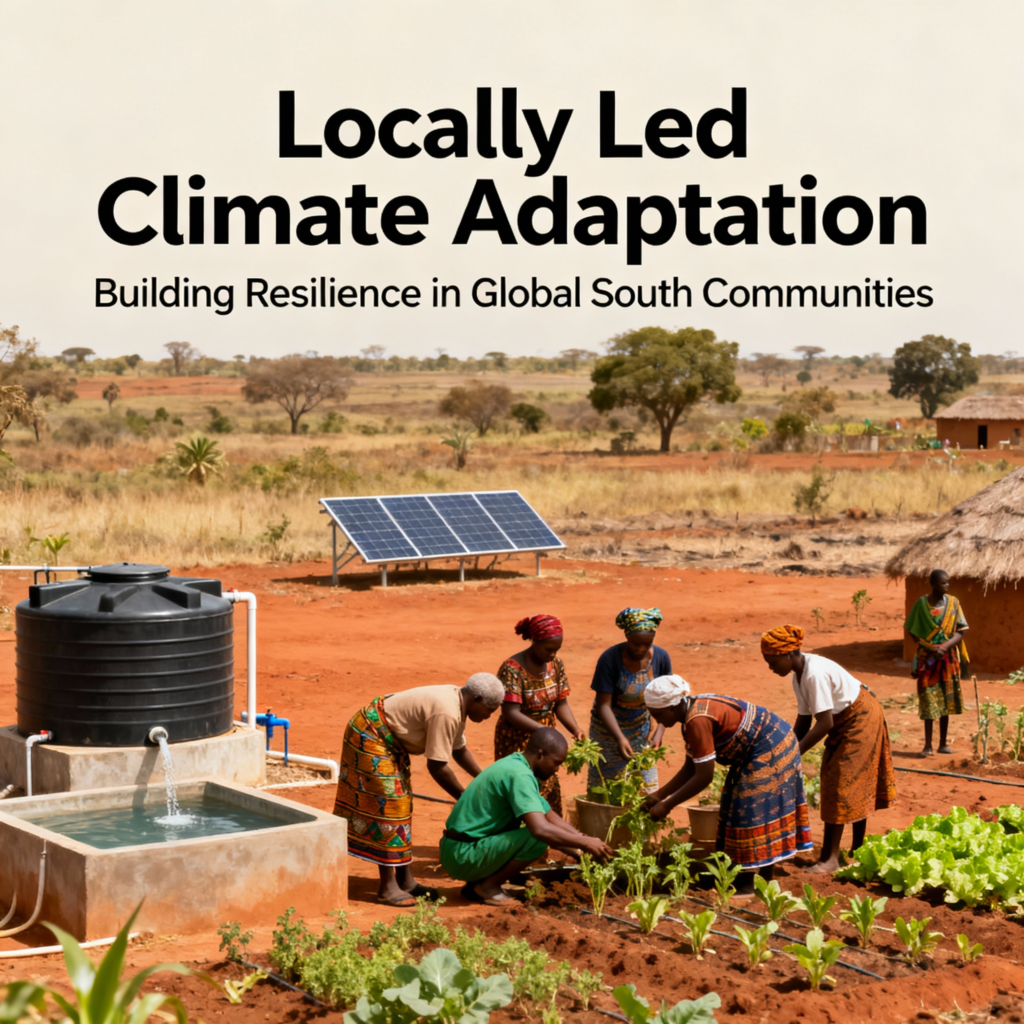
The global climate finance landscape stands at a critical juncture where locally-led adaptation (LLA) emerges as the most effective approach to building resilience in vulnerable communities. While the Global North contributed 92% of historical carbon emissions, the Global South bears 75% of climate change impacts, creating an urgent need for equitable and accessible climate finance mechanisms. iied
Locally-led adaptation represents a fundamental shift from traditional top-down climate interventions to community-driven solutions that devolve decision-making authority to subnational and local actors. This paradigm recognizes that households and communities are the biggest spenders on adaptation, investing their own resources at rates far exceeding international climate finance flows.
The urgency is undeniable: climate finance needs reach $2.8 trillion annually by 2030 for developing countries, yet current flows remain insufficient and poorly targeted toward local communities. The Least Developed Countries (LDCs) receive only 11% of total adaptation finance, despite facing the highest climate risks.
Understanding Locally-Led Adaptation: The Community-Driven Revolution
Core Principles and Framework
Locally-led adaptation operates on eight foundational principles that fundamentally reshape how climate finance flows and decisions are made:
Devolving Decision-Making: Local actors gain authority and control over adaptation decisions, moving beyond consultative participation to genuine ownership of climate responses.
Addressing Structural Inequalities: LLA explicitly tackles power imbalances and systemic barriers that prevent marginalized communities from accessing resources and participating in climate planning.
Providing Patient and Predictable Funding: Long-term, flexible financing replaces short-term project cycles, enabling communities to build sustained adaptive capacity.
Investing in Local Institutional Capacity: Strengthening local organizations and governance systems ensures communities can manage adaptation processes independently.
Building on Local Knowledge: Indigenous and traditional knowledge systems integrate with scientific approaches to create contextually appropriate solutions.
Top-Down vs. Community-Driven Approaches
Traditional Top-Down Model:
- Decisions made at national/international levels
- Standardized solutions across diverse contexts
- Short-term project implementation cycles
- Limited community participation in design
- External expertise prioritized over local knowledge
Community-Driven LLA Model:
- Local actors control priority setting and resource allocation
- Context-specific solutions developed through participatory processes
- Long-term capacity building and institutional strengthening
- Community ownership of adaptation planning and implementation
- Integration of local and scientific knowledge systems
Global South Success Stories
Nepal’s Local Adaptation Plans of Action (LAPAs)
Nepal demonstrates how decentralized climate planning can effectively channel finance to communities. The government mandates that 80% of climate finance reaches the local level through LAPAs, which are jointly developed by subnational governments, community groups, and civil society.
LAPAs integrate climate risk assessments conducted by communities with vulnerability analysis, creating adaptation plans that address both climatic and non-climatic stresses. Both national and local planning are supported through household-level data collection by the Central Bureau of Statistics.
Decentralized Climate Finance in East Africa
The Decentralized Climate Finance (DCF) approach implemented in Senegal, Mali, Kenya, and Tanzania establishes subnational climate funds managed by local governments and community institutions.
Key features include:
- 90% of funds finance locally prioritized adaptation investments
- 10% allocated for administration and community consultation
- Institutional strengthening processes engage communities in decision-making
- Public goods prioritized by local government-supported adaptation committees
Bangladesh’s Community-Based Adaptation Portfolio
Bangladesh’s comprehensive CBA portfolio includes five community-level projects spanning wetland management, women’s empowerment, climate-resilient development, and diversified agriculture. These initiatives demonstrate how country-driven interventions leverage national adaptation priorities while maintaining community ownership.
Challenges in Scaling Climate Finance: Systemic Barriers
Funding Gaps and Resource Misallocation
Global Climate Finance Flows
Current climate finance patterns reveal stark inequities:
- Only 1% of global mitigation finance reaches Least Developed Countries
- 61% of climate finance ($384 billion) raised as debt, with only 12% ($47 billion) as concessional funding
- Less than 10% of global climate fund finance reaches local-level action
- Average adaptation finance per LDC: $28 million annually against needs exceeding $200 million
Regional Disparities
Africa receives disproportionately low adaptation finance relative to vulnerability:
- Only 11% of tracked adaptation finance goes to Africa’s 10 most climate-vulnerable countries
- Bangladesh, India, and Mongolia represent top three GCF investment destinations in Asia
- Small Island Developing States face unique access challenges due to scale and capacity constraints
Access Barriers and Capacity Constraints
Institutional Capacity Limitations
Green Climate Fund accreditation requirements pose significant barriers for local organizations:
- Complex fiduciary standards exceed many national institutions’ capabilities
- Limited transparency and accountability in fund allocation to local levels
- Accredited Entities lack experience in designing locally-focused adaptation projects
Financial Mechanism Design Flaws
Current climate funds exhibit structural shortcomings:
- Lack of unified framework for defining local levels, actors, and processes
- Limited evidence of actual finance delivery to claimed local beneficiaries
- Intermediation challenges between international funds and community organizations
Governance and Policy Barriers
Bureaucratic Hurdles
National-level bottlenecks impede local access:
- Lengthy approval processes for adaptation projects
- Rigid reporting requirements unsuited for community-scale interventions
- Limited coordination between national and subnational authorities
Data and Monitoring Challenges
Absence of standardized methodologies for assessing community-focused adaptation creates evaluation difficulties:
- No common metrics for measuring local-level adaptation effectiveness
- Limited baseline data on community vulnerability and adaptive capacity
- Insufficient monitoring systems for tracking finance flows to local levels
Innovative Financing Solutions: Lessons from the Global South
Blended Finance Mechanisms
Public-Private Partnership Models
Blended finance combines concessional public resources with private capital to mobilize additional funding for climate adaptation. Successful models demonstrate leverage ratios of 4:1 or higher, where each dollar of public funding attracts four dollars of private investment.
Asian Innovation Examples:
- UNDP’s Adaptation Innovation Marketplace connects innovative technologies with financing in Asia
- Impact organizations report successful community-driven solutions through blended finance structures
- Regional climate adaptation hubs facilitate investment in community-based climate solutions
Risk Mitigation Instruments
Climate-focused financial instruments address adaptation project risks:
- Weather-indexed insurance protects smallholder farmers against climate variability
- Green bonds with adaptation components mobilize institutional investor capital
- Guarantee mechanisms reduce private sector risk perception for community-scale projects
Community-Based Funding Innovations
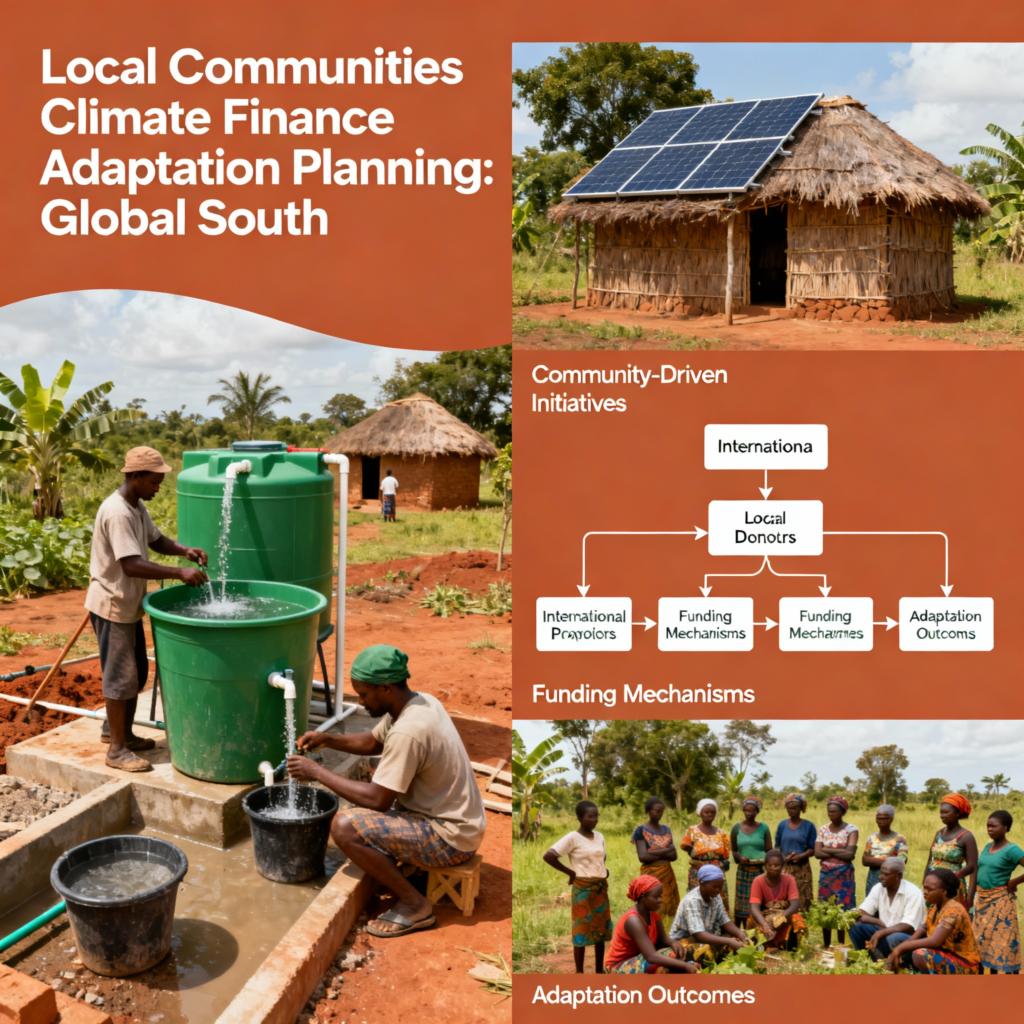
Microfinance Integration
Community-managed microfinance institutions adapt to climate risks:
- Climate-smart agricultural loans with flexible repayment schedules
- Disaster-resilient savings products that maintain liquidity during climate shocks
- Group-based lending models that strengthen community social capital
Indigenous Financial Systems
Traditional resource management integrates with modern finance:
- Community-based natural resource management generates revenue streams
- Payment for ecosystem services compensates communities for conservation
- Traditional savings and credit associations adapt to climate risk management
Technology and Knowledge Sharing
Digital Financial Inclusion
Mobile money platforms expand financial access in rural areas:
- Digital payment systems reduce transaction costs for small-scale adaptation investments
- Blockchain-based transparent fund tracking ensures accountability to communities
- Satellite-based crop insurance enables precise risk assessment and payout mechanisms
South-South Technology Transfer
Inter-regional knowledge networks facilitate innovation diffusion:
- Climate adaptation technology banks share patent-free innovations
- Regional research networks conduct collaborative vulnerability assessments
- Professional exchange programs build technical capacity across developing countries
Policy and Institutional Strategies: Enabling Local Action
Flexible Financial Mechanisms
Enhanced Direct Access Innovations
The Green Climate Fund’s Enhanced Direct Access (EDA) pilot allocates $200 million specifically for locally-focused programming. EDA enables national institutions to make funding decisions at the country level without requiring individual project approvals from GCF.
Key EDA advantages include:
- Enhanced country ownership of adaptation programming
- Stronger involvement of local organizations in decision-making processes
- Flexible, context-specific approaches to adaptation challenges
- Streamlined approval processes for community-scale interventions
Adaptation Fund’s LLA Initiatives
The Adaptation Fund adopted locally-led adaptation principles in 2021, establishing three modalities for enhanced local access:
- Enhanced Direct Access window expansion for national implementing entities
- Global MIE Aggregator program channeling grants to non-accredited local organizations
- EDA-type national programs for multilateral and regional implementing entities
Multi-Level Governance Coordination
National-Subnational Integration
Effective LLA requires coordination across governance levels:
National Government Role:
- Policy frameworks enabling local decision-making authority
- Capacity building support for subnational institutions
- Resource allocation mechanisms ensuring local access to climate finance
- Regulatory environments that support community-based adaptation
Subnational Authority Functions:
- Local adaptation planning integrating community priorities
- Implementation oversight of community-selected interventions
- Coordination between government agencies and civil society organizations
- Monitoring and evaluation of local adaptation outcomes
International Climate Fund Engagement
Strategic Fund Access
Optimizing multilateral climate fund access requires coordinated approaches:
Green Climate Fund Engagement:
- Country programming frameworks that prioritize locally-led approaches
- Direct access entity development for national and subnational institutions
- Readiness support focusing on local capacity building
Adaptation Fund Strategies:
- Enhanced Direct Access utilization for community-driven programming
- Direct access modality bypassing multilateral intermediaries
- Regional collaboration through regionally implementing entities
India’s Climate Adaptation Framework: Decentralized Governance in Action
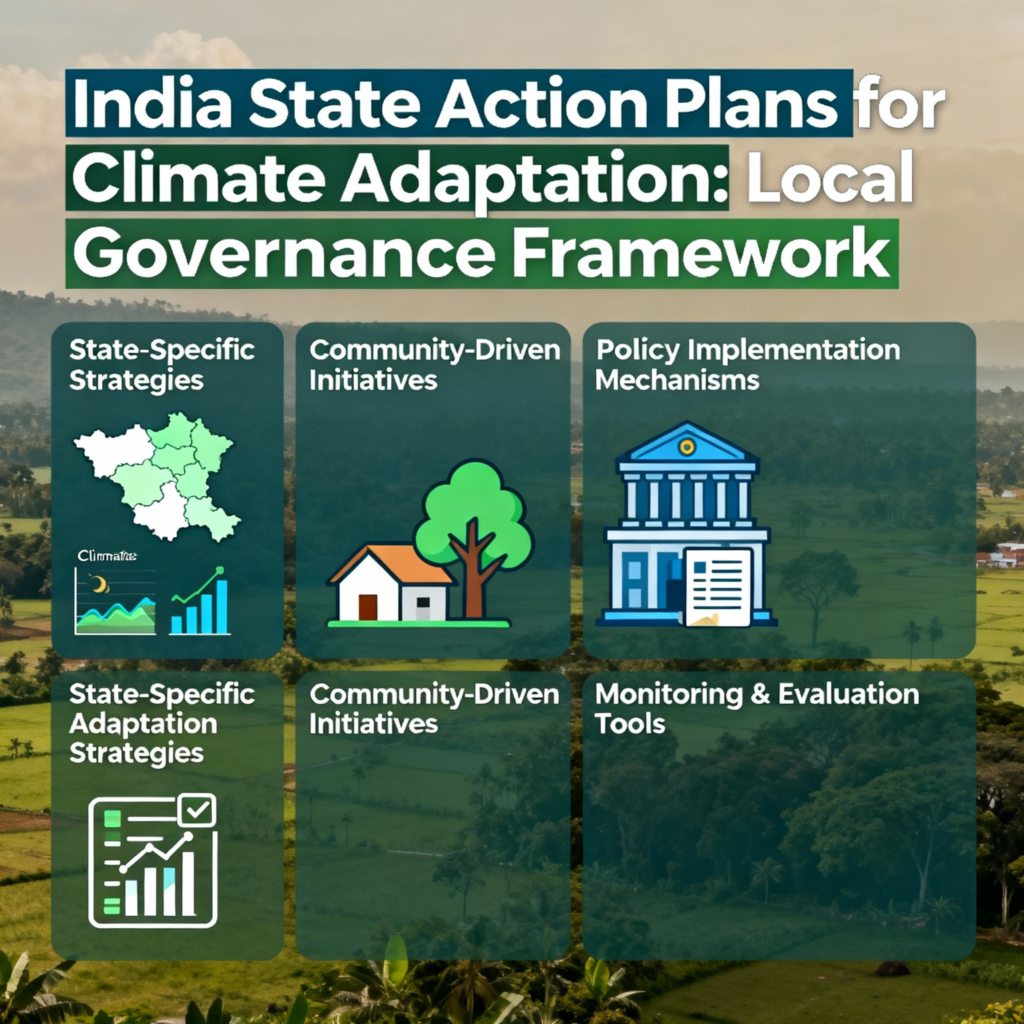
National Architecture for Local Action
National Action Plan on Climate Change (NAPCC)
India’s comprehensive climate framework integrates adaptation across eight national missions:
- National Mission for Sustainable Agriculture: Climate-resilient crops and weather insurance mechanisms
- National Water Mission: 20% improvement in water use efficiency through regulatory mechanisms
- National Mission for Sustainable Habitat: Energy-efficient urban planning and waste management
- Himalayan Ecosystem Mission: Biodiversity conservation and ecological value preservation
State Action Plans on Climate Change (SAPCC)
34 states and union territories have formulated SAPCCs aligned with NAPCC while addressing state-specific climate vulnerabilities. These plans represent proactive decentralization of climate action from national to local levels.
SAPCC Key Features:
- Detailed climate impact and vulnerability assessments for each state
- Sector-specific adaptation and mitigation options including agriculture, water, health, and disaster management
- Financing and capacity building needs for identified interventions
- Evolutionary nature allowing incorporation of new developments in climate science
Leading State Innovations
Gujarat’s Solar Leadership
Gujarat demonstrates renewable energy integration with local development:
- Solar park development creating rural employment opportunities
- Decentralized solar installations for agricultural water pumping
- Community ownership models for renewable energy projects
Kerala’s Community-Powered Resilience
Kerala’s approach emphasizes community participation in climate adaptation:
- Local Self-Government Institution (LSGI) integration with climate planning
- Participatory vulnerability assessments conducted by village councils
- Traditional knowledge integration with modern climate science
Maharashtra’s Urban Climate Action
Maharashtra leads urban climate resilience initiatives:
- Municipal climate action plans for major cities
- Integration of climate considerations in urban infrastructure development
- Community-based disaster risk reduction programs
Existing Community Programs
Coastal Community Resilience
The “Enhancing Climate Resilience of India’s Coastal Communities” project (2019-2027) demonstrates large-scale locally-led adaptation implementation:
Key Achievements:
- 97,984 beneficiaries across Odisha, Andhra Pradesh, and Maharashtra received training in climate-adaptive livelihoods
- 3,825.91 hectares of coastal ecosystems restored, including 2,985.91 hectares of mangroves
- Community-led co-management structures established across all project landscapes
- Network of 13 coastal states fostering dialogue on sustainable coastal management
Traditional Knowledge Integration
Indigenous and local knowledge systems contribute significantly to India’s adaptation planning:
- Seasonal prediction methods using traditional indicators for agricultural planning
- Water conservation techniques developed over generations for drought resilience
- Ecosystem-based approaches integrating traditional forest and watershed management
- Community-based early warning systems for natural disaster preparedness
South-South Cooperation: Scaling Through Regional Networks
Knowledge Sharing Platforms
Regional Climate Adaptation Hubs
Collaborative networks facilitate experience sharing across the Global South:
Africa-Asia Partnerships:
- Collaborative Adaptation Research Initiative in Africa and Asia (CARIAA) builds resilience across regional climate hotspots
- Multi-consortium programs provide connections between diverse expertise sources
- Geographically dispersed teams coordinate adaptation research and implementation
South Asian Regional Cooperation:
- South Asian Association for Regional Cooperation (SAARC) Disaster Management Centre coordinates climate adaptation responses
- Bay of Bengal Initiative for Multi-Sectoral Technical and Economic Cooperation (BIMSTEC) focuses on climate-resilient agriculture
Technology and Financial Partnerships
Innovation Transfer Mechanisms
South-South technology sharing accelerates adaptation deployment:
Indonesia’s Regional Leadership:
- ASEAN Outlook on Indo-Pacific (AOIP) commitments enhance South-South cooperation
- Climate adaptation technology exchange with countries sharing similar geo-climatic conditions
- National Development Contribution (NDC) alignment with regional cooperation frameworks
Nordic Development Fund Model
NDF provides climate finance to Asia, Africa, and Latin America for mitigation and adaptation activities, demonstrating cross-regional cooperation principles applicable to South-South frameworks.
Regional Financial Mechanisms
Development Finance Institution Coordination
Regional development banks adapt models for climate finance:
- Blended finance facility development combining public and private resources
- Risk-sharing mechanisms across multiple countries and sectors
- Technical assistance programs building institutional capacity regionally
Currency and Payment Systems
Regional financial integration supports climate finance flows:
- Local currency climate bonds reducing foreign exchange risks
- Regional payment systems facilitating cross-border climate investments
- Harmonized regulatory frameworks enabling regional climate finance markets
Policy Recommendations: Transforming Global Climate Finance Architecture
Immediate Reform Priorities
Direct Access Mechanism Enhancement
Streamlining accreditation processes for national and subnational institutions:
- Simplified fiduciary standards appropriate for local organization capacities
- Differentiated requirements based on project size and institutional maturity
- Fast-track approval procedures for community-scale adaptation interventions
- Capacity building support integrated with accreditation processes
Mandatory Local Allocation Targets
Establishing binding requirements for local-level finance delivery:
- 70% minimum allocation to local communities in Least Developed Countries
- Transparent tracking mechanisms for fund flow monitoring to local levels
- Community participation requirements in project design and implementation
- Accountability mechanisms ensuring genuine local ownership
Innovative Finance Architecture
Blended Finance Optimization
Coordinated public-private partnership strategies:
- Risk-sharing instruments that attract private capital to adaptation investments
- Patient capital provision through extended loan terms and grace periods
- Technical assistance facilities supporting project development and implementation
- Performance-based incentives linking payments to adaptation outcomes
Regional Climate Finance Facilities
Establishing multi-country financing mechanisms:
- Regional climate adaptation funds pooling resources across neighboring countries
- Currency hedging facilities reducing foreign exchange risks for local borrowers
- Technology transfer mechanisms facilitating innovation diffusion regionally
- Capacity building networks sharing expertise across borders
Institutional Strengthening Framework
Multi-Level Governance Integration
Coherent policy frameworks spanning national to local levels:
- National enabling legislation supporting local decision-making authority
- Decentralized budget allocation mechanisms ensuring local resource access
- Inter-governmental coordination protocols facilitating vertical integration
- Civil society engagement frameworks ensuring inclusive participation
Knowledge Management Systems
Comprehensive information platforms supporting evidence-based decision-making:
- Climate vulnerability databases with local-level resolution
- Adaptation option catalogs featuring successful community practices
- Cost-effectiveness analysis tools for local adaptation planning
- Monitoring and evaluation frameworks tracking local-level outcomes
India’s Strategic Opportunities: Leveraging Global Lessons
Policy Integration Enhancements
SAPCC Strengthening Framework
Building on existing state-level climate planning:
- Enhanced local government integration with district and panchayat-level planning
- Community participation mechanisms in SAPCC development and implementation
- Traditional knowledge integration protocols for state adaptation strategies
- Resource allocation reforms ensuring local access to state climate budgets
Urban Local Body Empowerment
Addressing specific challenges for India’s Urban Local Bodies (ULBs):
- Technical capacity building for climate vulnerability assessment
- Financial mechanism access training for ULB officials
- Public-private partnership frameworks for urban adaptation projects
- Inter-city knowledge sharing networks for climate solution exchange
International Engagement Strategy
Global Climate Fund Optimization
Strategic approaches for enhanced international climate finance access:
- Direct access entity development for multiple state-level institutions
- Enhanced Direct Access programming focusing on community-driven approaches
- Regional collaboration with neighboring countries for shared adaptation challenges
- South-South partnership development with Africa and Latin America
Technology and Innovation Leadership
Positioning India as regional climate technology hub:
- Indigenous innovation promotion for locally appropriate adaptation technologies
- Technology transfer facilitation to other Global South countries
- Climate entrepreneurship support for community-based solution development
- Traditional knowledge documentation and integration with modern approaches
Conclusion: The Imperative for Transformative Climate Action
The evidence is unequivocal: locally-led adaptation represents the most effective pathway for building climate resilience in the world’s most vulnerable communities. With 34 Indian states implementing climate action plans and global initiatives directing 70% of climate finance to local levels, the foundation for transformative change exists.
Success stories from Uganda’s Decentralized Climate Finance mechanism to Nepal’s Local Adaptation Plans demonstrate that communities can effectively manage climate finance when empowered with appropriate resources and decision-making authority. The $200 million Enhanced Direct Access pilot from the Green Climate Fund proves that international climate institutions can adapt to support genuine local ownership.
For UPSC aspirants and governance professionals, understanding these dynamics is crucial. The intersection of climate finance, local governance, and community empowerment represents core challenges for India’s administrative leadership. Mastering these concepts provides essential knowledge for addressing 21st-century governance complexities.
The path forward requires coordinated action across multiple levels: international climate funds must streamline local access mechanisms, national governments must strengthen decentralized governance frameworks, and local communities must be empowered as genuine partners in climate adaptation planning.
India’s unique position – with robust democratic institutions, diverse climate vulnerabilities, and strong community organizations – creates exceptional opportunities for locally-led adaptation leadership. The lessons from 34 state climate action plans and successful coastal community programs provide a foundation for scaling effective approaches nationwide.
The climate finance revolution is already underway. The question is whether governance systems can adapt quickly enough to harness its transformative potential for building resilient, equitable, and sustainable communities across the Global South.








+ There are no comments
Add yours